It’s one of those English words that creates confusion because both versions actually exist. So, which one should you use?
The answer depends on more than just spelling. It can vary based on regional English, editorial style, and even the audience you’re writing for.
Once you understand why these two forms exist, choosing the right one becomes much easier.
In this guide, you’ll learn the difference between cancellation and cancelation, why both spellings are valid, when each one is appropriate, and which version is the safest choice in everyday writing.
By the end, you’ll know exactly which spelling to use without stopping to think twice.
Cancellation or Cancelation – Quick Answer
Let’s clear this up right away.
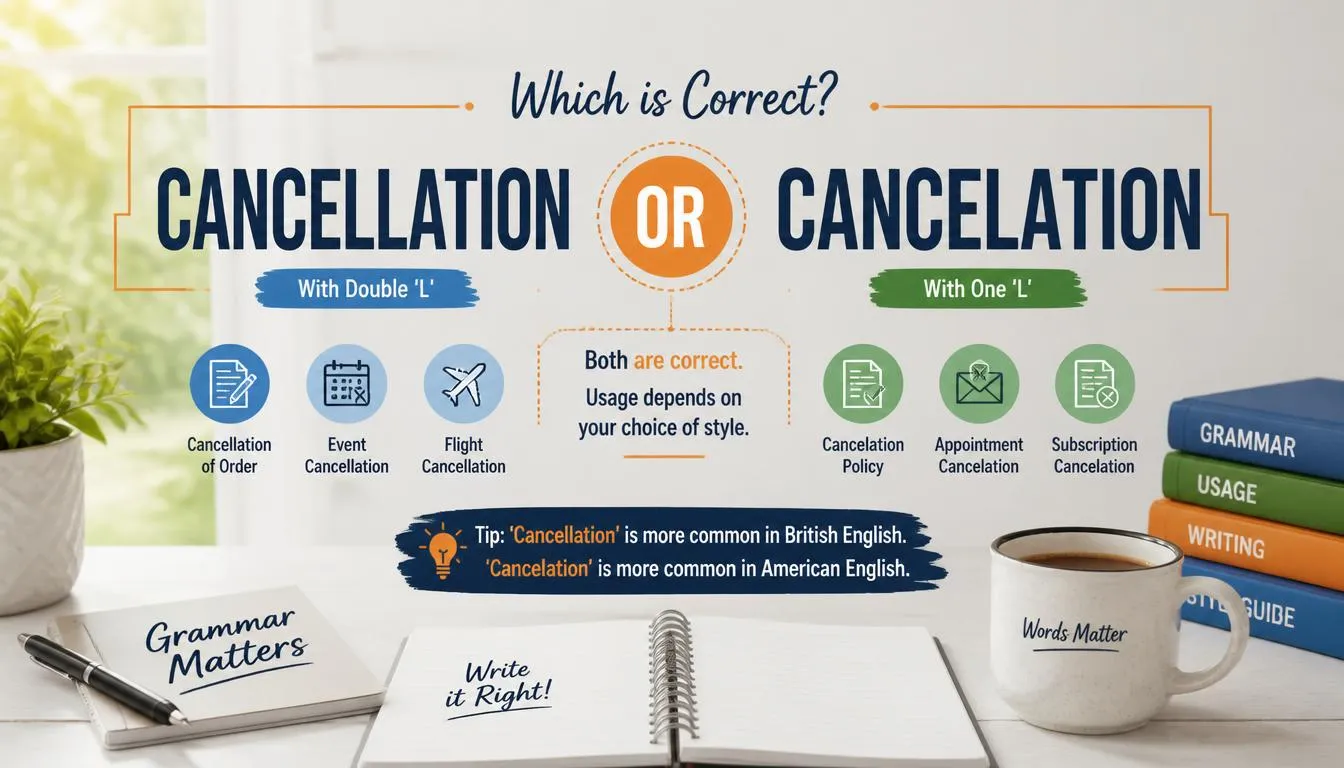
- Cancellation = the standard, widely accepted spelling
- Cancelation = a rare American variant, technically valid but far less used
Examples:
- The airline announced the cancellation of flight 204.
- Please review our cancellation policy before booking.
- Some older American texts use cancelation instead.
“Cancellation” (with two L’s) is the standard spelling in both American and British English. “Cancelation” (with one L) is a less common variant sometimes seen in American English, though most style guides, including AP and Merriam-Webster, still prefer “cancellation.” When in doubt, use “cancellation.”
Quick tip: If you’re not sure which to use, go with “cancellation.” It’s correct everywhere and never looks out of place.
The Origin of Cancellation and Cancelation
The word traces back to the Latin verb cancellare, meaning “to make like a lattice” or “to cross out.” Think of someone drawing crisscross lines through a document to void it. That image stuck.
From Latin, the word moved into French as “canceller,” then into English. Over time, English settled on doubling the L in most derived forms, which is where “cancellation” comes from.
So why does “cancelation” exist at all? It comes down to a spelling pattern debate. In American English, there was a push in the 19th and early 20th centuries to simplify spelling by dropping doubled consonants, similar to how “traveling” sometimes replaces “travelling.”
That simplification took hold for some words, like “canceled” instead of “cancelled.” But it never fully caught on for “cancellation.” Most dictionaries and style guides kept the double L here, even in American usage.
It’s one of those quirks where the simplified spelling rule applies inconsistently, and that inconsistency is exactly why people still search for the right answer today.
British English vs American English Spelling
This is one of the rare cases where American and British English mostly agree.
| American English | British English | Meaning | Example Sentence | Used In |
| Cancellation | Cancellation | The act of calling something off | The cancellation of the event upset many fans. | Both regions |
| Cancelation | Not used | Rare variant of cancellation | The cancelation notice arrived late. | Uncommon in American English only |
Notice that British English doesn’t recognize “cancelation” at all. If you’re writing for a UK audience, always use “cancellation,” no exceptions.
Which Spelling Should You Use?
Here’s how to decide, based on your audience and context.
- American audience: “Cancellation” is safest and most widely recognized. “Cancelation” appears occasionally but isn’t standard.
- British audience: Always use “cancellation.” “Cancelation” will look like an error.
- Canada: Follows British conventions here. Use “cancellation.”
- Australia: Use “cancellation” as well.
- International audience: “Cancellation” is universally understood and accepted.
- Business writing: Stick with “cancellation” for professionalism and consistency.
- Academic writing: Use “cancellation,” since most style guides and journals expect it.
- Websites and blogs: “Cancellation” keeps your content consistent with reader expectations and search behavior.
In short, unless you have a specific style guide telling you otherwise, “cancellation” is the safer, more professional choice every time.
Common Mistakes with Cancelation or Cancellation
These slip-ups happen more often than you’d think.
- Mistake: “The cancelation of the meeting surprised everyone.” Correction: “The cancellation of the meeting surprised everyone.” (standard spelling preferred)
- Mistake: Mixing both spellings within the same document. Correction: Pick one spelling and use it consistently throughout.
- Mistake: Assuming “cancelation” is a typo and auto-correcting it to something else entirely. Correction: Recognize it as a valid, though rare, spelling variant.
- Mistake: Using “cancelation” in formal or international communication. Correction: Switch to “cancellation” for wider recognition and professionalism.
These errors usually happen because writers assume one spelling is simply wrong. In reality, one is just far less common.
Cancelation and Cancellation in Everyday Examples
Here’s how the word shows up across different types of writing.
Emails:
- “This email confirms the cancellation of your subscription.”
- “We regret to inform you of the cancellation of tomorrow’s appointment.”
News articles:
- “The cancellation of the concert left thousands of fans disappointed.”
- “Officials confirmed the cancellation of the annual parade.”
Social media:
- “Can’t believe the cancellation of the show happened without warning!”
- “Just got a cancellation notice for my flight. Ugh.”
Business writing:
- “Please refer to section 4 for our cancellation policy.”
- “A cancellation fee applies within 24 hours of booking.”
Academic writing:
- “The cancellation of the program affected enrollment numbers significantly.”
- “Researchers studied the cancellation rate among online subscriptions.”
Casual conversations:
- “Did you hear about the cancellation? Wild, right?”
- “I need to request a cancellation for next week.”
Google Trends & Usage
Searches for cancellation or cancelation stay fairly consistent throughout the year, often spiking around travel seasons, subscription renewal periods, and major event announcements.
The United States shows some search volume for “cancelation,” though “cancellation” still dominates by a wide margin. The United Kingdom, Canada, and Australia show almost no search interest in the single-L variant at all.
Modern usage trends point toward “cancellation” becoming even more dominant, largely because global businesses, streaming platforms, and airlines standardize their policy language using the double-L spelling. This consistency across major brands reinforces “cancellation” as the expected form, even in everyday American writing.
Comparison Table: Cancellation vs Cancelation
| Feature | Cancellation | Cancelation |
| Spelling | Cancellation | Cancelation |
| Pronunciation | /ˌkænsəˈleɪʃən/ | /ˌkænsəˈleɪʃən/ |
| Meaning | The act of calling something off | Same meaning, rare variant |
| Region | American and British English | American English only, uncommon |
| Formal Usage | Fully accepted everywhere | Not recommended |
| Informal Usage | Standard and expected | Occasionally seen |
| Example | Flight cancellation notice | Rarely used in modern writing |
| Recommendation | Use this spelling | Avoid unless following a specific style guide |
Key Takeaways
- Cancellation is the standard, correct spelling in both American and British English.
- Cancelation is a rare American variant that most style guides don’t recommend.
- British English, Canadian English, and Australian English don’t recognize “cancelation” at all.
- When unsure, always default to “cancellation.”
- Consistency matters more than personal preference in business and academic writing.
- The double-L spelling traces back to Latin roots and standard English spelling conventions.
FAQs
- Is “cancelation” a real word?
- Yes, technically. “Cancelation” appears in some American dictionaries as a variant spelling. However, it’s rarely used in professional or everyday writing, and “cancellation” remains the far more accepted and recognized form.
- Why does “cancellation” have two L’s?
- The double-L comes from its Latin root, cancellare, combined with standard English spelling patterns for words ending in “-ation.” Most related word forms, like “cancelled” in British English, follow this same doubling pattern.
- Which spelling do airlines use?
- Airlines almost universally use “cancellation,” regardless of whether they’re based in the United States, the United Kingdom, or elsewhere. This keeps their policies consistent and easily understood by international customers.
- Is “cancelation” considered a spelling mistake?
- Not exactly a mistake, but it’s considered nonstandard by most major style guides, including AP and Merriam-Webster. Using “cancellation” instead is the safer, more widely accepted choice in almost every context.
- Does British English ever use “cancelation”?
- No. British English exclusively uses “cancellation” with two L’s. The single-L variant doesn’t appear in British dictionaries or style guides at all, making “cancellation” the only correct option there.
- Why do some words drop the double L in American English?
- American English simplified certain double consonants in the 19th century, following suggestions from figures like Noah Webster. This affected words like “traveling,” though it didn’t fully apply to “cancellation.”
- Should I use “cancelation” in a resume or cover letter?
- No. Stick with “cancellation” in professional documents like resumes and cover letters. It’s the universally recognized spelling and avoids any risk of looking like an error to hiring managers.
- Is there a difference in meaning between the two spellings?
- No difference in meaning exists between “cancellation” and “cancelation.” They both describe the act of calling something off. The only difference lies in spelling convention and regional acceptance.
Conclusion
So, cancellation or cancelation? The answer is clear. “Cancellation” is the correct, widely accepted spelling across American English, British English, and every other major English variant.
“Cancelation” exists, but it’s rare, nonstandard, and best avoided in professional, academic, or international writing. Unless a specific style guide explicitly asks for it, there’s no real reason to use the single-L version.
For business writing, customer emails, academic papers, or even casual social media posts, “cancellation” keeps your writing consistent and recognizable to every reader, everywhere.
Next time you type that word and hesitate for a second, remember this: two L’s, every time, no exceptions worth worrying about.

I’m Sophia Mitchell, an English grammar and writing enthusiast. I create simple, easy-to-understand content to help learners improve their English. My goal is to make grammar clear, practical, and enjoyable for everyone.