The word cancelled and the word canceled both mean the same thing. They mean to stop something before it happens.
So why are there two spellings? It’s simple. American people write it with one L. British people write it with two L’s.
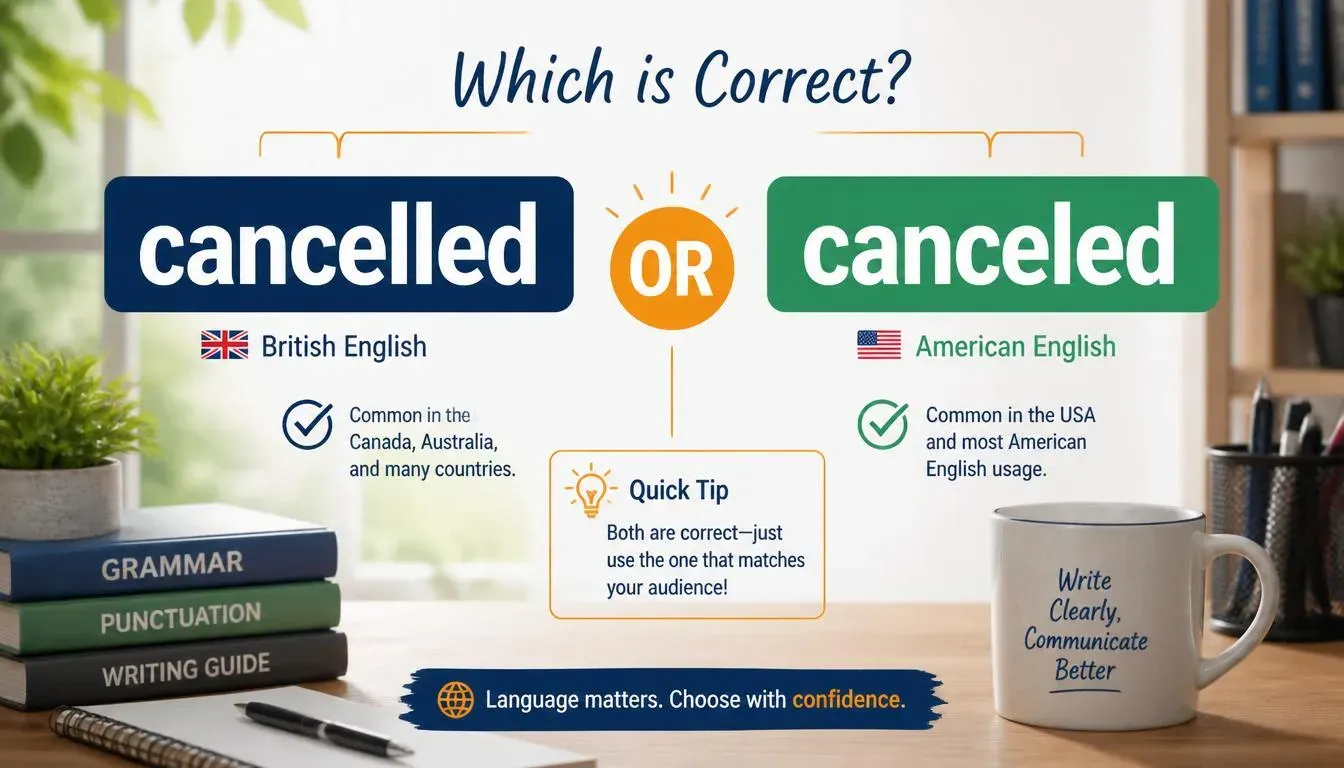
“Canceled” is the standard American English spelling, while “cancelled” is the standard British English spelling.
Neither one is wrong. They are just different ways to spell the same word.
In this article, you will learn:
- Which spelling to use
- Why there are two spellings
- How to remember the difference easily
Cancelled or Canceled – Quick Answer
Definition: To cancel means to call off an event, order, or plan before it happens.
Meaning: Both “cancelled” and “canceled” carry the exact same meaning. The only difference is the number of L’s.
Short examples:
- American English: “The airline canceled the flight due to weather.”
- British English: “The airline cancelled the flight due to weather.”
Quick tip: If you’re writing for a U.S. audience, drop the extra L. One L for American English. Two L’s for British English. That’s the whole rule.
Find More About:
The Origin of Canceled or Cancelled
This spelling split traces back further than most people expect.
The word “cancel” comes from the Latin word cancellare, meaning to cross out or make into a lattice. It entered English through French in the 14th century. Back then, spelling wasn’t standardized at all. Writers spelled words however they liked.
Things changed in the 1800s. American lexicographer Noah Webster wanted to simplify English spelling for American readers. He believed British spelling conventions were unnecessarily complex. So he trimmed extra letters from many words.
Webster’s dictionary reduced double consonants in verbs like “travel” and “cancel” when adding suffixes such as “-ed” or “-ing.” That’s why Americans write “traveled” and “canceled,” while the British write “travelled” and “cancelled.”
Interestingly, this rule isn’t applied to every word the same way. American English still doubles the L in certain cases, like “controlled” and “compelled.” The difference often depends on where the stress falls in the word. Since “cancel” is stressed on the first syllable, American English treats it differently than words stressed on the last syllable.
British English vs American English Spelling
The spelling difference goes beyond just this one word. Many verbs ending in a single L follow the same pattern.
| American English | British English | Meaning | Example Sentence | Used In |
| canceled | cancelled | called off | She canceled her appointment. | Everyday writing |
| canceling | cancelling | in the process of calling off | He is canceling the meeting. | Business emails |
| traveled | travelled | went on a trip | They traveled to Chicago. | Travel writing |
| modeled | modelled | shaped or represented | The house was modeled after a castle. | Design articles |
| labeled | labelled | marked with a tag | The box was labeled fragile. | Shipping documents |
Notice the pattern? American English typically keeps a single L before adding “-ed” or “-ing.” British English doubles it.
Which Spelling Should You Use?
Your audience determines your spelling choice. Here’s a simple breakdown.
American audience: Use “canceled” and “canceling.” This matches U.S. newspapers, textbooks, and style guides.
British audience: Use “cancelled” and “cancelling.” This is standard across the UK.
Canada: Canadian English often leans toward British spelling, so “cancelled” is more common, though usage varies.
Australia: Australian English follows British conventions, making “cancelled” the preferred choice.
International audience: If you’re writing for a global audience with no specific regional focus, British spelling tends to be recognized more widely. However, American spelling dominates in tech and business content.
Business writing: Match your company’s location or your client’s preference. Multinational companies often pick one spelling and apply it consistently across all documents.
Academic writing: Follow your institution’s style guide. U.S. universities expect “canceled.” UK universities expect “cancelled.”
Websites and blogs: Check your target audience’s location using analytics. If most readers are American, use “canceled” throughout your site.
Common Mistakes with Cancelled and Canceled
Even experienced writers slip up here. Let’s look at the most frequent errors.
- Mixing both spellings in one document. Writers sometimes switch between “cancelled” and “canceled” without noticing. This looks inconsistent and unprofessional.
- Incorrect: “The event was cancelled, so we canceled our hotel too.”
- Correct: “The event was canceled, so we canceled our hotel too.”
- Trusting autocorrect blindly. Spell checkers set to different regional dictionaries can silently change your spelling. Always double-check your language settings.
- Assuming one spelling is universally wrong. Some writers think “cancelled” is a typo. It isn’t. It’s simply the British standard.
- Forgetting related word forms. Writers often fix “canceled” but forget to adjust “cancellation,” which keeps two L’s in both American and British English.
- Incorrect: “cancelation”
- Correct: “cancellation”
Canceled and Cancelled in Everyday Examples
Seeing the word in real contexts makes the rule easier to remember.
Emails: “I regret to inform you that tomorrow’s meeting has been canceled.”
News articles: “The concert was canceled after the venue reported safety concerns.”
Social media: “Ugh, my flight got canceled again. Third time this month!”
Business writing: “Due to low enrollment, the workshop has been canceled until further notice.”
Academic writing: “The professor canceled Thursday’s lecture to attend a conference.”
Casual conversations: “We canceled our dinner plans because Sam got sick.”
Across all these contexts, American writers stick with one L. British writers would double it in every example above.
Google Trends & Usage
Search behavior reflects the regional divide clearly. American users searching online tend to type “canceled,” while users in the UK, Australia, and much of the Commonwealth search for “cancelled.”
Search popularity generally favors “cancelled” worldwide, largely because more English-speaking countries follow British spelling conventions than American ones. However, “canceled” dominates within the United States specifically, given its massive population and content output.
The spelling difference persists because each country’s education system teaches its own standard. American schools teach Webster’s simplified spelling. British, Canadian, and Australian schools teach traditional English spelling.
Modern usage trends show a slight blending, especially online. Global platforms and international brands sometimes default to British spelling since it reads as more universally recognized. Still, major American publications, from The New York Times to the Associated Press, consistently use “canceled.”
Comparison Table: Cancelled vs Canceled
| Feature | Canceled (American) | Cancelled (British) |
| Spelling | One L | Two L’s |
| Pronunciation | Same | Same |
| Meaning | Called off | Called off |
| Region | United States | UK, Australia, parts of Canada |
| Formal Usage | U.S. business and academic writing | UK business and academic writing |
| Informal Usage | Common in U.S. texts and social media | Common in UK texts and social media |
| Example | “The trip was canceled.” | “The trip was cancelled.” |
| Recommendation | Use for American audiences | Use for British or international audiences |
Key Takeaways
- “Canceled” is correct in American English.
- “Cancelled” is correct in British, Australian, and most Canadian English.
- Both spellings mean the same thing and are pronounced identically.
- Stay consistent within a single document.
- “Cancellation” always keeps two L’s, regardless of region.
- Match your spelling to your audience’s location.
FAQs
- Is “canceled” or “cancelled” correct in the U.S.?
- “Canceled” is correct in American English. It follows Noah Webster’s simplified spelling reforms from the 1800s, which reduced double consonants in many verbs. American style guides, including AP Style, confirm this as the standard spelling for U.S. writing.
- Why does British English use two L’s?
- British English kept the traditional spelling rules that existed before American reforms. Doubling the consonant before adding a suffix follows older English spelling patterns, which Webster later simplified specifically for American usage.
- Is “cancelation” a word?
- No, “cancelation” is not a recognized spelling. The correct noun form is “cancellation,” spelled with two L’s in both American and British English, even though the verb forms differ regionally.
- Which spelling does Microsoft Word prefer?
- It depends on your language setting. If your document is set to English (United States), Word will flag “cancelled” as incorrect. If set to English (United Kingdom), it will flag “canceled” instead.
- Do Canadians use “cancelled” or “canceled”?
- Canadian English often blends American and British spelling. Many Canadians write “cancelled,” following British tradition, though American spelling appears frequently due to U.S. media influence.
- Does AP Style use “canceled” or “cancelled”?
- AP Style, used by most American newspapers, uses “canceled” and “canceling.” This is one of the clearest indicators of standard American usage in professional journalism.
- Is one spelling more formal than the other?
- Neither spelling is more formal. The choice depends entirely on regional standards, not formality. Both are equally acceptable within their respective English variants.
- Can I use both spellings on my website?
- It’s best to pick one spelling and use it consistently across your entire website. Mixing spellings can look like an error, even though both are technically correct in different regions.
Conclusion
The debate between cancelled or canceled comes down to geography, not correctness. American English uses “canceled” with a single L, thanks to Noah Webster’s 19th century spelling reforms. British, Australian, and much of Canadian English use “cancelled” with two L’s.
If you’re writing for American readers, stick with “canceled” and “canceling.” If your audience is British, Australian, or international, “cancelled” and “cancelling” will feel more familiar.
The most important rule isn’t which spelling you pick. It’s staying consistent. Choose one version based on your audience, then use it throughout your entire piece of writing. And remember, no matter which spelling you choose, “cancellation” always keeps its two L’s.
Once you know this simple regional rule, you’ll never second guess this word again.

I am an English language writer passionate about grammar and clear communication. I create simple, easy-to-understand content that helps readers improve their English skills. My goal is to make learning English both practical and enjoyable.