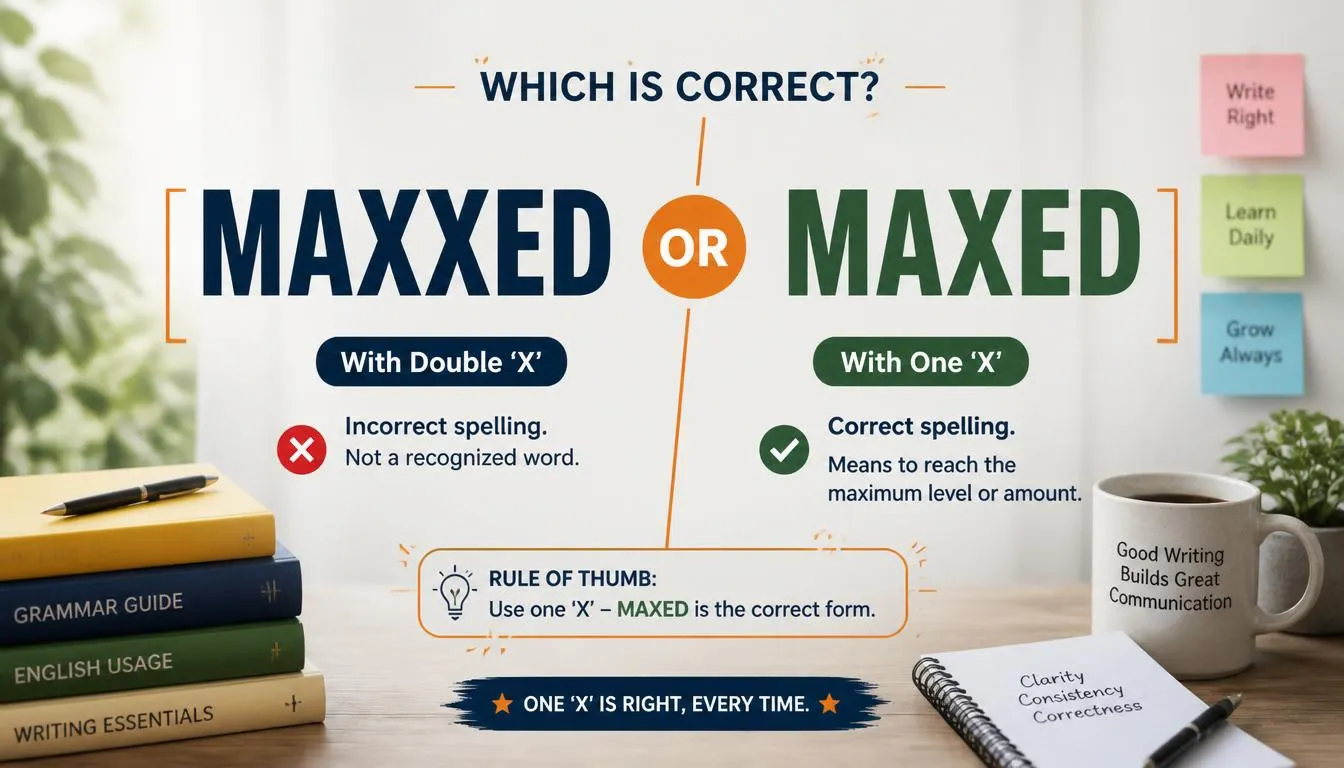
Maxxed or maxed look nearly identical but feel like they belong in completely different worlds. One feels like standard English.
The other feels like slang built for the internet. That gap creates real confusion, especially for students, writers, and anyone trying to sound polished in an email or article.
This confusion isn’t really about grammar rules. It’s about two forms of English colliding: the dictionary approved version and the version shaped by memes, gaming culture, and social media trends. Both exist. Only one belongs in formal writing.
In this guide, you’ll learn which spelling is correct, where “maxxed” came from, how to use each form naturally, and which one to reach for depending on your audience.
Quick Answer
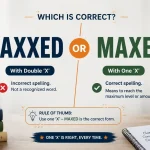
“Maxed” is the correct, standard English spelling. It’s the past tense of the verb “max,” meaning to reach the highest possible level or limit.
“Maxxed” is an informal, internet driven spelling that shows up mainly in slang, gaming communities, and trends like “looks maxxing.”
Stick with “maxed” for anything formal, and save “maxxed” for casual, online writing where the slang tone fits.
Maxed – Meaning and Definition with Example
Here’s the short version before we go deeper.
- Definition: “Maxed” means to reach the maximum limit, level, or capacity of something.
- Meaning in context: You max out a credit card, max out a workout, or max a character’s stats in a video game.
- Short examples: “She maxed her credit limit.” “He maxed every skill in the game.”
- Quick tip: If you wouldn’t double the final consonant in “maxing,” don’t double it in “maxed” either. One “x” is all you need.
That last point matters more than it seems. English speakers sometimes assume doubling a consonant makes a word look more “finished” or emphatic. With “max,” that instinct leads people astray.
Find Mor About:
Cancelled or Canceled – Correct Spelling
The Origin of Maxed
The word “max” is short for “maximum,” which traces back to the Latin word maximum, meaning “greatest” or “largest.” English speakers shortened it into a casual noun and, eventually, a verb.
Once “max” became a verb, it followed a normal English pattern. Verbs ending in a single consonant after a single vowel usually just add “-ed” to form the past tense, unless the final syllable is stressed and needs a doubled consonant to protect the vowel sound (like “stopped” or “planned”). “Max” doesn’t need that protection, so “maxed” is the natural result.
So why does “maxxed” exist at all? The extra “x” isn’t a grammar rule. It’s a style choice. Doubling a letter, especially a sharp-sounding one like “x,” makes a word feel more intense or dramatic. That’s exactly why online communities picked it up. A “maxxed” character sounds more impressive than a “maxed” one, even though they mean the same thing.
This kind of playful respelling isn’t new. Slang has always stretched spelling for effect think “sooo” instead of “so,” or “hawt” instead of “hot.” “Maxxed” fits that same tradition, just applied to gaming and self-improvement culture.
Standard English vs. Internet Slang
This isn’t a British versus American English situation. Both American and British writers use the same standard spelling here. The real divide is between standard English and internet slang.
| Form | Category | Meaning | Example Sentence | Used In |
| Maxed | Standard English | Reached the highest limit, level, or capacity | “I maxed out my gym membership benefits.” | Emails, articles, academic writing, dictionaries |
| Maxxed | Internet slang | Same core meaning, with added emphasis or trend association | “He’s totally maxxed after that looksmaxxing routine.” | Social media, gaming chats, memes, casual texts |
Notice that the meanings overlap almost completely. The difference is tone and setting, not definition. “Maxed” reads as neutral and professional. “Maxxed” reads as informal, trendy, and sometimes ironic.
Which Spelling Should You Use?
Your audience decides which version fits best.
- General audience: Use “maxed.” It reads clearly and doesn’t distract from your message.
- International readers: “Maxed” works everywhere, since it’s the recognized standard form worldwide.
- Business writing: Always use “maxed.” Slang spellings undercut credibility in reports, proposals, or client emails.
- Academic writing: Use “maxed” without exception. Professors and editors expect standard spelling.
- Websites and blogs: Use “maxed” for SEO and professional tone, unless you’re specifically writing about internet slang or gaming culture, where “maxxed” may fit the topic.
- Social media and casual chats: “Maxxed” is fine here. It signals familiarity with online trends and fits the relaxed tone of the platform.
- Gaming communities: Either spelling appears, but “maxxed” often carries a specific cultural flavor tied to leveling up or fully upgrading a character.
A simple rule: if you’re writing something a stranger, employer, or teacher might read, choose “maxed.”
Common Mistakes with Maxed or Maxxed
Even careful writers slip up here. Here are the mistakes that show up most often, along with corrected examples.
- Mistake: Doubling the consonant automatically, assuming it matches words like “planned” or “stopped.” Why it happens: English does double consonants in some past-tense verbs, so writers overapply the rule. Correction: “I maxxed my score” → “I maxed my score.”
- Mistake: Using “maxxed” in a resume, cover letter, or formal report. Why it happens: The word feels familiar from everyday speech, so writers forget it’s slang. Correction: “I maxxed my sales targets this quarter” → “I maxed my sales targets this quarter.”
- Mistake: Assuming “maxxed” is a regional (British vs. American) spelling difference. Why it happens: Many English spelling debates really are regional, so writers assume this one is too. Correction: Recognize that both American and British English agree on “maxed.” The other version is slang, not a dialect.
- Mistake: Mixing “maxed” and “maxxed” in the same piece of writing. Why it happens: Writers copy and paste from different sources without noticing the inconsistency. Correction: Pick one spelling for the entire piece and stay consistent.
Maxed in Everyday Examples
Seeing the word in real contexts makes the correct usage stick.
Emails “I’ve maxed out this month’s marketing budget, so let’s revisit the plan next quarter.”
News articles “Analysts say consumer credit card balances have maxed out at record levels this year.”
Social media “Just maxxed my character’s build after grinding all weekend 😤”
Business writing “Our storage capacity is maxed, and we’ll need to upgrade before the next data migration.”
Academic writing “The experiment measured how quickly test subjects’ heart rates maxed under physical stress.”
Casual conversation “I’m completely maxed after that workout, I need a nap.”
Notice how “maxed” fits every context smoothly, while “maxxed” only feels natural in the casual, online example.
Google Trends & Usage
Search interest in “maxed” has stayed fairly steady over time, largely because it’s a common, everyday word tied to credit cards, fitness, and gaming. “Maxxed,” on the other hand, tends to spike alongside internet trends, especially “-maxxing” culture, which took off through self-improvement and appearance-focused content on platforms like TikTok and Reddit.
In general, English-speaking countries including the United States, the United Kingdom, Canada, and Australia all favor “maxed” as the standard spelling in formal contexts. The slang spelling “maxxed” isn’t tied to a specific country. It’s tied to specific online communities, particularly gaming forums and social platforms popular with younger users.
As “-maxxing” trends continue to circulate online (think “looksmaxxing,” “moneymaxxing,” or “sleepmaxxing”), expect “maxxed” to keep showing up in casual writing. That doesn’t change its status in formal English, though. Dictionaries still list “maxed” as the correct form, and that isn’t likely to shift soon.
Comparison Table: Maxxed vs Maxed
| Feature | Maxed | Maxxed |
| Spelling | Standard | Informal/slang |
| Pronunciation | Identical | Identical |
| Meaning | Reached the highest limit or capacity | Same meaning, with added slang emphasis |
| Region | Used in American, British, and all English dialects | Used mainly in global online communities |
| Formal Usage | Correct and expected | Incorrect, avoid |
| Informal Usage | Acceptable | Common and expected |
| Example | “I maxed my credit limit.” | “I totally maxxed my build.” |
| Recommendation | Use for all professional and academic writing | Use only in casual, online, or slang-heavy contexts |
Key Takeaways
- “Maxed” is the correct, dictionary-recognized spelling in standard English.
- “Maxxed” is internet slang, popularized by gaming culture and “-maxxing” trends.
- Both spellings share the same core meaning: reaching a limit or maximum capacity.
- This isn’t a British versus American English issue; both dialects agree on “maxed.”
- Choose “maxed” for anything formal, academic, or professional.
- “Maxxed” works fine in casual conversation, texting, or social media posts.
- Never mix both spellings within the same piece of writing.
FAQs
1.Is “maxxed” a real word?
“Maxxed” isn’t found in standard dictionaries as an official word. It functions as internet slang, mostly used in gaming, fitness, and self-improvement communities. While it’s widely understood, it isn’t accepted in formal or academic writing, where “maxed” remains the correct choice.
2.Why do people spell it with two X’s?
The double “x” adds visual emphasis and makes the word feel more dramatic or intense. This kind of stylized spelling is common in internet slang, where users stretch or alter words for effect rather than following standard grammar rules.
3.Is “maxed out” the same as “maxxed out”?
Yes, they mean the same thing. “Maxed out” is the correct, standard phrase describing something that has reached its full capacity or limit. “Maxxed out” is simply the slang version of the same expression.
4.Does British English spell it differently than American English?
No. Both British and American English use “maxed” as the standard spelling. This isn’t a regional spelling difference like “colour” versus “color.” It’s a distinction between standard English and internet slang.
5.What does “-maxxing” mean online?
“Maxxing” is a slang suffix meaning to fully optimize or maximize a specific area, such as appearance (“looksmaxxing”), fitness (“gymmaxxing”), or sleep (“sleepmaxxing”). It’s popular in online self-improvement and gaming communities.
6.Can I use “maxxed” in a work email?
It’s best to avoid it. “Maxxed” reads as casual internet slang, which can undercut professionalism in workplace communication. Use “maxed” instead to keep your writing clear and appropriate for a business setting.
7.Where did the word “max” originally come from?
“Max” is a shortened form of “maximum,” which comes from the Latin word maximum, meaning “greatest” or “largest.” Over time, English speakers turned it into an informal noun and later a fully accepted verb.
8.Is “maxxed” more common now because of TikTok?
Yes, largely. Trends like “looksmaxxing” have pushed “-maxxing” language into mainstream online conversation, especially among younger users. This has increased how often people see and use “maxxed,” even though it remains informal.
Conclusion:
The difference between maxxed or maxed comes down to formality, not regional spelling. “Maxed” is the standard, dictionary approved spelling used correctly in American and British English alike.
“Maxxed” is a stylized slang variation shaped by gaming culture, social media, and trends like “looksmaxxing.”
For everyday professional writing, emails, academic work, or anything meant for a general audience, “maxed” is always the safer and more polished choice. Save “maxxed” for casual conversations, texts, or social posts where the informal tone actually fits.
Understanding this distinction helps you write with more confidence, whether you’re drafting a business report or just texting a friend about your latest gaming session. When in doubt, one “x” gets the job done.

I am an English language writer passionate about grammar and clear communication. I create simple, easy-to-understand content that helps readers improve their English skills. My goal is to make learning English both practical and enjoyable.