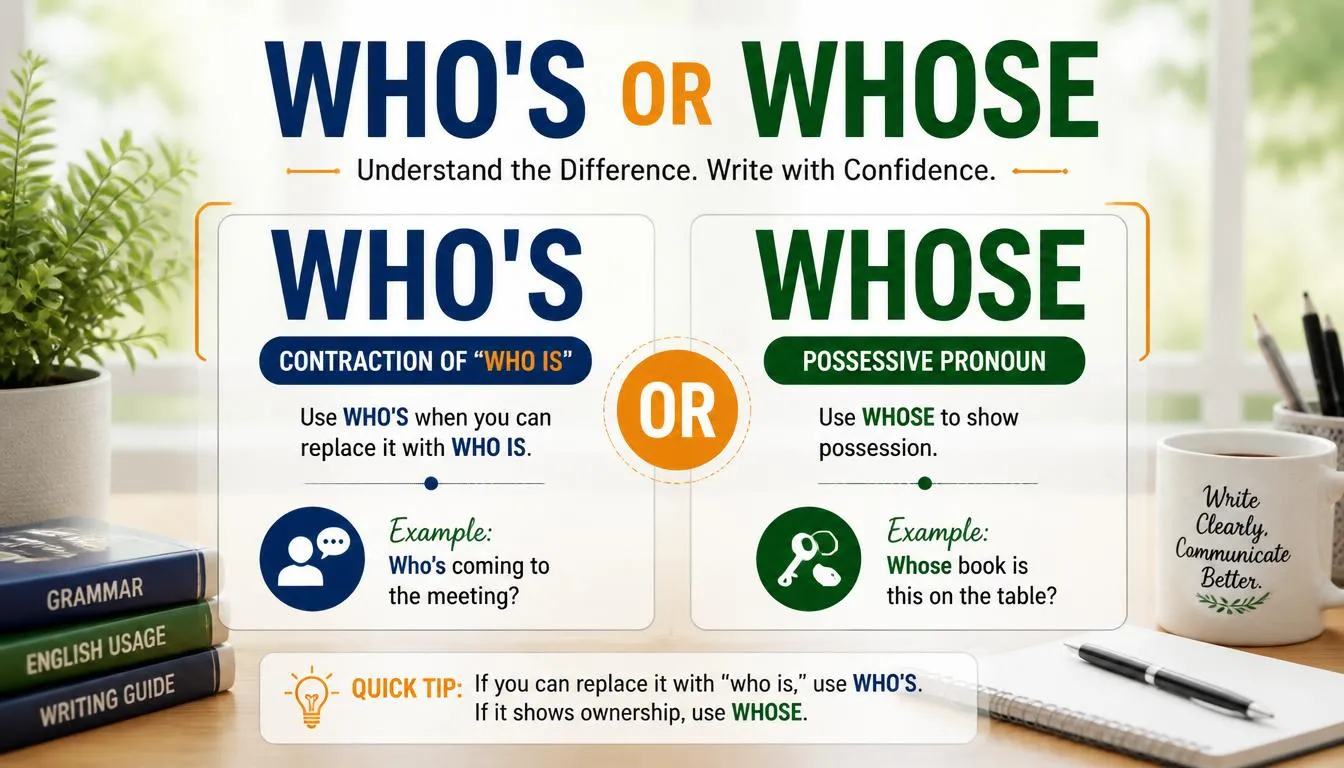
It’s one of those tiny grammar questions that can make writers hesitate. Since both words sound exactly the same, your ears won’t help you. The only way to choose the right one is to understand what each word actually means.
People search for who’s or whose because spell check often misses this error. It’s not a typo. It’s a real word either way. So the mistake slides right through.
In this guide, you’ll learn the exact difference between these two words. You’ll see simple examples. You’ll also get a quick trick to remember which one to use, every time. By the end, you won’t need to guess again.
Who’s or Whose – Quick Answer
Here’s the short version.
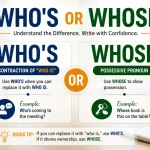
- Who’s = who is / who has (a contraction)
- Whose = belonging to someone (shows possession)
Examples:
- Who’s going to the meeting? (who is)
- Who’s eaten my lunch? (who has)
- Whose phone keeps ringing?
- I don’t know whose car this is.
Quick tip: Say the sentence out loud and replace the word with “who is.” If it still makes sense, use “who’s.” If it sounds wrong, use “whose.”
Learn More About:
The Origin of Who’s and Whose
Both words trace back to Old English. “Who” comes from “hwa,” an old pronoun used to ask about a person.
“Whose” developed as the possessive form of “who.” It followed the same pattern as other possessive pronouns in English, similar to “his” or “hers.”
“Who’s,” on the other hand, isn’t a separate word at all. It’s a contraction. English speakers started joining “who is” and “who has” with an apostrophe centuries ago, the same way we created “it’s,” “he’s,” and “she’s.”
The confusion exists because English apostrophes serve two different jobs. They show contractions, and they show possession. Most of the time, an apostrophe means possession. But with pronouns like “who,” “it,” and “you,” the apostrophe almost always signals a contraction instead.
That inconsistency is exactly why so many writers second-guess themselves.
British English vs American English Spelling
Good news here. This is one grammar rule that doesn’t change across regions.
“Who’s” and “whose” are used the same way in American English and British English. There’s no regional spelling variation like there is with “color” and “colour.”
| American English | British English | Meaning | Example Sentence | Used In |
| Who’s | Who’s | Who is / who has | Who’s calling, please? | Both regions |
| Whose | Whose | Belonging to whom | Whose idea was this? | Both regions |
The rule stays consistent everywhere English is spoken. The only thing that changes is how often people make the mistake.
Which Spelling Should You Use?
Since spelling doesn’t shift by region, the real question is about correct usage, not regional preference.
- American audience: Use standard contraction and possessive rules as shown above.
- British audience: Same rules apply exactly.
- Canada: No difference in usage.
- Australia: No difference in usage.
- International audience: These rules hold across all English-speaking regions.
- Business writing: Avoid contractions like “who’s” in very formal documents. Use “who is” instead.
- Academic writing: Spell out “who is” or “who has” fully. Reserve “whose” for possession only.
- Websites and blogs: Contractions like “who’s” feel natural and conversational. They work well here.
Common Mistakes with Whose and Who‘s
These mix ups happen because the words sound identical when spoken.
- Mistake: “Whose coming to dinner?” Correction: “Who’s coming to dinner?” (who is)
- Mistake: “I don’t know who’s book this is.” Correction: “I don’t know whose book this is.” (possession)
- Mistake: “Who’s dog ran into the street?” Correction: “Whose dog ran into the street?”
- Mistake: “Whose been calling me all day?” Correction: “Who’s been calling me all day?” (who has)
Writers make these errors because they’re rushing, or because they trust their ear over the meaning. Since both words sound the same, the ear offers zero help.
Whose or Who’s in Everyday Examples
Here’s how both words show up in real, daily writing.
Emails:
- “Who’s available for a call tomorrow?”
- “Please confirm whose signature is required.”
News articles:
- “Who’s leading the investigation remains unclear.”
- “Officials are questioning whose responsibility this falls under.”
Social media:
- “Who’s watching the game tonight?”
- “Whose idea was this trend, honestly?”
Business writing:
- “Who’s authorized to approve this budget?”
- “Whose department handles vendor contracts?”
Academic writing:
- “Who’s presenting the findings this semester?”
- “The study didn’t specify whose data was used.”
Casual conversations:
- “Who’s up for pizza?”
- “Whose turn is it to drive?”
Google Trends & Usage
Searches for who’s or whose stay steady year-round. Students, writers, and professionals all search this term when proofreading their work.
English speakers across the United States, the United Kingdom, Canada, and Australia search this pair equally often. That makes sense, since the rule doesn’t change by country.
Modern usage trends show something interesting. Casual writing, texting, and social media use “who’s” far more often, since contractions feel natural in informal settings. Formal writing and academic papers lean toward spelling out “who is” and “who has,” reserving contractions for a more relaxed tone.
“Whose” shows up less frequently overall, simply because possession questions come up less often than identity or action questions.
Quick Comparison Table: Who’s or Whose
| Feature | Who’s | Whose |
| Spelling | Who’s | Whose |
| Pronunciation | /huːz/ | /huːz/ |
| Meaning | Who is / who has | Belonging to whom |
| Region | Universal (all English regions) | Universal (all English regions) |
| Formal Usage | Avoid; write “who is/has” | Fully acceptable |
| Informal Usage | Common and natural | Common and natural |
| Example | Who’s driving tonight? | Whose keys are these? |
| Recommendation | Use for contractions only | Use for possession only |
Key Takeaways
- Who’s always means “who is” or “who has.”
- Whose always shows possession.
- Try replacing the word with “who is.” If it fits, use “who’s.”
- Both spellings work the same way in American and British English.
- Avoid contractions like “who’s” in formal or academic writing.
- The words sound identical, so you can’t rely on pronunciation to choose correctly.
FAQs
- Is it “who’s” or “whose” car is this?
- It’s “whose car is this?” You’re asking who owns the car, not stating “who is car.” Since possession is the meaning here, “whose” is the correct choice, every single time.
- Can “who’s” ever show possession?
- No. “Who’s” only works as a contraction for “who is” or “who has.” It never shows ownership. If you mean possession, “whose” is always the correct word to use.
- Is “whose” used only for people?
- Mostly, yes, but not always. “Whose” can also refer to objects or animals in some sentences, like “the company whose stock rose” or “the dog whose leash broke.”
- Why do “who’s” and “whose” sound the same?
- Both words share the same pronunciation, “hooz,” even though they’re spelled differently. This happens because English contractions and possessives don’t always follow predictable sound patterns.
- Is “who’s” grammatically correct in formal writing?
- Contractions like “who’s” are grammatically correct, but many style guides discourage them in formal or academic writing. Spelling out “who is” or “who has” sounds more professional in that context.
- What’s an easy trick to remember the difference?
- Replace the word with “who is” in your sentence. If the sentence still makes sense, use “who’s.” If it sounds wrong or awkward, use “whose” instead.
- Does British English use “whose” differently than American English?
- No. Both American and British English use “whose” and “who’s” the exact same way. There’s no regional spelling or usage difference between the two versions of English.
- Can “whose” start a question?
- Yes. “Whose” often starts questions about ownership, like “Whose turn is it?” or “Whose idea was this?” It works the same as other question words in English.
- Is “who’s” only used in speech, not writing?
- No, “who’s” appears in both speech and writing. It’s especially common in casual writing, emails, and social media, though formal writing often avoids it.
- What happens if I use the wrong one by mistake?
- Spell check usually won’t catch this error since both words are spelled correctly. Readers may notice the mistake, though, since it changes the meaning of your sentence entirely.
Conclusion
The difference between who’s and whose comes down to one simple test. “Who’s” always replaces “who is” or “who has.” “Whose” always shows possession or ownership.
“Who’s” is a contraction of “who is” or “who has.” “Whose” shows possession and means “belonging to whom.
This rule stays exactly the same in American English, British English, Canadian English, and Australian English. There’s no regional variation to worry about here.
Next time you pause mid sentence, run the quick test. Try swapping in “who is.” If it works, you’ve got your answer. If it doesn’t, “whose” is the word you need.

As an American English writer, I specialize in creating clear and engaging content that makes grammar and language learning accessible to everyone. I enjoy breaking down complex English concepts into simple, practical lessons that readers can apply with confidence. My mission is to help learners strengthen their communication skills through easy and reliable content.