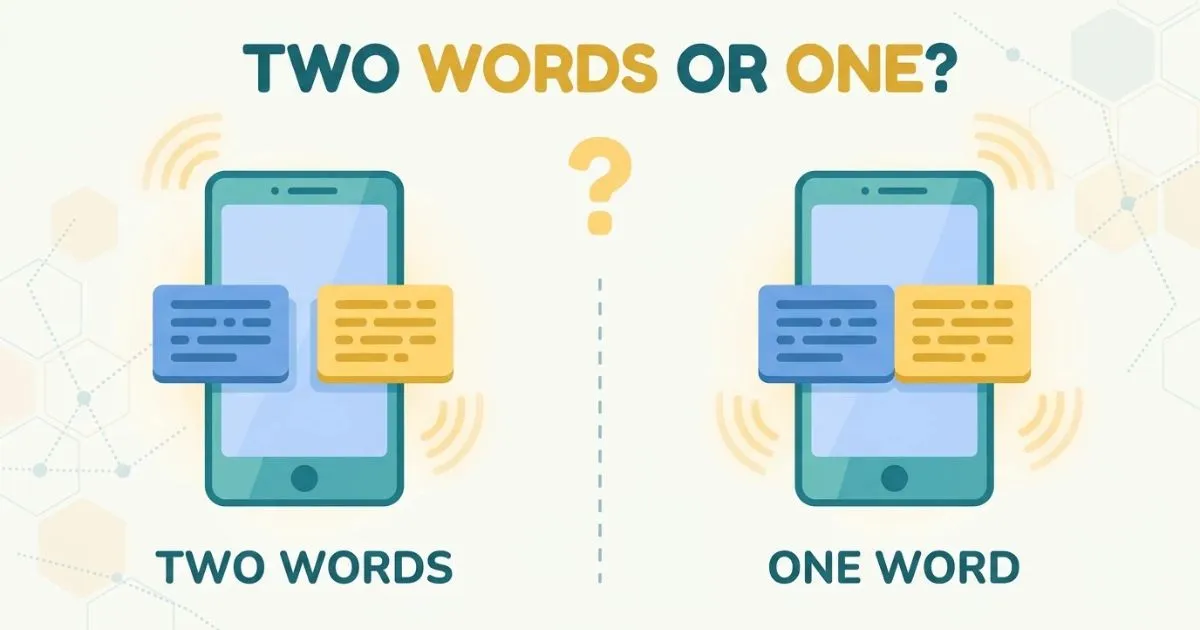
You are typing an email, a blog post, or a school essay, and you stop on one word. Is it cell phone or cellphone? Spell-check stays quiet either way, which makes the choice feel even more confusing.
Here is the good news: you are not making a mistake with either one. Both spellings name the same device, and dictionaries record both.
The real question is which one suits your reader, your style guide, and your own habits.
In this guide, you will get a quick answer, see how major dictionaries treat each form, learn how American and British English differ, and pick up plural rules, examples, and a simple method for choosing one spelling and sticking with it.
Cell Phone or Cellphone: The Quick Answer
Both are correct. Cell phone (two words) and cellphone (one word) mean the same thing: a portable phone that connects through a cellular network. Neither one is a typo.
If you want a single rule, use this one: follow the spelling your teacher, editor, or style guide requires. If nobody tells you what to use, write “cell phone” in American English and keep it the same from the first paragraph to the last.
Why the two-word form as a default? It is the main entry in the Oxford Learner’s Dictionaries. But Collins lists “cellphone” first and shows “cell phone” beside it. So dictionaries do not fully agree, and that is exactly why consistency matters more than the choice itself.
Read More: This Is She or This Is Her? What to Say on the Phone
What the Dictionaries Actually Say
It helps to look at the sources instead of guessing. Here is what the entries show:
- Oxford Learner’s Dictionaries: the headword is “cell phone,” marked as especially North American. It also lists “cellular phone” and the informal short form “cell,” and notes that British English usually says “mobile phone” or “mobile.”
- Collins Concise English Dictionary: the entry reads “cellphone, cell phone,” and defines it as a portable telephone operated by cellular radio.
- Dictionary.com: it gives “cellphone” as the entry, with the same cellular-radio definition.
The pattern is clear. The meaning never changes. Only the spacing changes, depending on the publisher.
Where the Word Comes From
The “cell” part has nothing to do with a prison cell or a biology cell. It points to the small areas that a cellular network is divided into, each served by its own transmitter. A cell phone is simply a phone that works by moving between those areas. Once you know this, the term makes sense, and so does the existence of the longer form, “cellular phone.”
Cell Phone vs Cellphone: Is There Any Real Difference?
No difference in meaning, no difference in the device, and no difference in grammar. You can see the whole comparison here:
| Cell phone | Cellphone | |
| Written as | Two words | One word |
| Meaning | Portable phone on a cellular network | Same |
| Plural | cell phones | cellphones |
| Where you see it | Oxford (main entry), common in US writing | Collins and Dictionary.com entries |
| Risk of being marked wrong | Very low | Low, but check your style guide |
Language tends to move this way. Many compound words begin as two separate words, and some later join into one. English has not settled this particular case, so both forms live side by side.
American vs. British English
This is where many people get confused, so let us clear it up.
The choice between “cell phone” and “cellphone” is not a US-versus-UK spelling rule. It is a spacing choice that exists in both varieties. The bigger regional difference is the word itself.
- American English: “cell phone,” or the informal “cell”
- British English: “mobile phone,” or just “mobile”
Compare:
- American: I left my cell phone in the car.
- British: I left my mobile in the car.
British readers will understand “cell phone” without any trouble. Still, if your audience is mostly in the UK, “mobile phone” will sound more natural.
You may also meet “handphone” in some Southeast Asian varieties of English. It is less familiar to American and British readers, so avoid it in general writing.
How to Choose One Spelling (Step by Step)
If you write often, do not decide each time. Decide once, then apply it.
Step 1: Check for a Required Style
Schools, publishers, and companies often have a style guide. If yours says “cell phone” or “cellphone,” that settles it. Follow it even if you personally prefer the other form.
Step 2: Think About Your Reader
Writing for Americans? Use “cell phone.” Writing for a British or international audience? Consider “mobile phone,” or use “cell phone” and expect it to be understood. The best word is the one your reader would use naturally.
Step 3: Pick One and Write It Down
Open a note and write: “We use cell phone (two words).” Keep it near your drafts. This tiny style sheet saves you from second-guessing the same word every week.
Step 4: Search Your Draft Before Publishing
Before you finish, use find-and-replace to look for the other spelling. If you chose “cell phone,” search for “cellphone” and fix any stray ones. It takes ten seconds and removes the most common inconsistency.
Cell Phone or Cellphone in Formal Writing
In essays, reports, and official letters, both forms can be understood. The safer habit is to follow the required style, and when no style is given, use “cell phone” with consistent spacing.
A few small tips for formal contexts:
- Use the same form in headings, body text, and captions.
- Do not switch just because a line looks too long.
- If you must mention both spellings, as in a language guide, explain it once and then stay with one.
- For very formal documents, “mobile phone” or “cellular phone” can sound a bit more neutral, but only use them if they suit your audience.
Example sentences for formal use:
- Please add your cell phone number to the application form.
- Staff must silence their cell phones during training sessions.
- The company provides each field worker with a cell phone.
Plural Forms: Cell Phones or Cellphones?
The plural simply follows the spelling you chose.
- Two words: cell phone → cell phones
- One word: cellphone → cellphones
In the two-word form, the “s” goes on “phone,” which is the main noun. In the one-word form, the “s” goes at the end of the whole word.
Possessives follow the same logic:
- singular: the cell phone’s battery
- plural: the cell phones’ batteries
Do not mix the two systems. If your style is “cell phone,” do not slip into “cellphones” in the next sentence.
Example Sentences You Can Use
With “Cell Phone”
- My cell phone is charging in the kitchen.
- Please keep your cell phone on silent during the exam.
- She saved the number in her cell phone.
- The teacher asked everyone to put away their cell phones.
- You can reach me by email or on my cell phone.
With “Cellphone”
- I left my cellphone on the desk.
- His cellphone rang during dinner.
- The shop sells accessories for cellphones.
- She takes most of her photos with her cellphone.
- Several cellphones were left in the classroom.
Cell Phone as a Describing Word
Often the term works like an adjective in front of another noun. Keep the spacing the same:
- cell phone number
- cell phone charger
- cell phone policy
- cell phone signal
Notice that the spacing rule you chose applies here too. If you wrote “cellphone,” then write “cellphone number” and “cellphone charger.”
Cell Phone vs Related Terms
People often use these words as if they were identical. They overlap, but they are not always the same.
| Term | What it means | Notes |
| Cell phone / cellphone | Portable phone on a cellular network | Common in American English |
| Cell | Informal short form | Mainly American, casual |
| Cellular phone | Longer, fuller form | Sounds more formal |
| Mobile phone / mobile | Same device | The usual British term |
| Handphone | Same device | Used in some Southeast Asian English |
| Smartphone | A cell phone with apps and web browsing | A type of cell phone |
| Landline | A phone on a fixed wire | The opposite idea |
A smartphone is a cell phone, but a basic cell phone is not always a smartphone. If you are writing about features such as apps or touch screens, “smartphone” is the more precise word.
Common Mistakes to Avoid
1. Treating “cellphone” as a spelling error.
It is a recognized form in major dictionaries. Do not “correct” it in someone else’s work unless a style guide asks for the other spelling.
2. Switching spellings in the same piece.
This is the most common problem. A reader may wonder whether you are making a point, when you just forgot.
3. Using a hyphen.
You may see “cell-phone” in some places, but it is uncommon in mainstream dictionaries. For ordinary writing, choose the two-word or one-word form.
4. Using “cell phone” for a UK audience without thinking.
It will be understood, but “mobile phone” usually reads more naturally.
5. Mixing up cell phone and smartphone.
Use “smartphone” when the device’s smart features matter.
6. Forgetting the headings and captions.
Writers often fix the body text and leave the old spelling in a subheading or an image caption. Check those places too.
A Simple Memory Trick
Keep it to three lines:
- Cell phone = two words
- Cellphone = one word
- Mobile phone = the usual British term
And one rule to rule them all: whichever you choose, choose it once.
FAQs
Is “cell phone” one word or two?
Both are accepted. “Cell phone” is written as two words and is the main entry in Oxford Learner’s Dictionaries. “Cellphone” is the one-word form and appears in Collins and Dictionary.com. The meaning is identical, so follow your style guide and stay consistent.
Is “cellphone” a misspelling?
No. Cellphone is recorded in major dictionaries as a valid form. It becomes a problem only when it breaks the style your school, employer, or publisher requires, or when you mix it with “cell phone” in the same text.
Which spelling should I use in an essay or article?
Use whatever your instructor or editor requires. If there is no rule, “cell phone” is a sensible choice for American English. Whichever you choose, apply it everywhere, including headings and captions, and check the draft once before you submit.
What is the plural of cell phone?
The plural of “cell phone” is “cell phones,” and the plural of “cellphone” is “cellphones.” The plural always follows the spelling you picked. Avoid mixing the two within one piece of writing, because the change can look careless to readers.
Do Americans and British people use different words?
Yes. American English usually says “cell phone” or the casual “cell.” British English usually says “mobile phone” or “mobile.” Both groups understand the other term, but picking your audience’s word makes your writing feel more natural.
Is a cell phone the same as a smartphone?
Not exactly. A smartphone is a type of cell phone that runs apps and browses the web. A basic cell phone may only make calls and send texts. Use “smartphone” when those extra features matter to your sentence.
Should I write “cell-phone” with a hyphen?
It is better not to. The hyphenated form is uncommon in mainstream dictionaries, and most style guides expect the two-word or one-word version. Pick “cell phone” or “cellphone” and use it consistently instead of adding a hyphen.
Conclusion:
So, cell phone or cellphone? Both are right. They describe the same device and carry the same meaning.
What separates a polished piece of writing from a careless one is not the spelling you pick but whether you keep it consistent.
Your next step is simple. Check whether you have a required style guide. If you do not, choose “cell phone” for American readers or “mobile phone” for British readers, write it in your notes, and run one find-and-replace before you publish.
After that, you will never have to stop on this word again.

As an American English writer, I specialize in creating clear and engaging content that makes grammar and language learning accessible to everyone. I enjoy breaking down complex English concepts into simple, practical lessons that readers can apply with confidence. My mission is to help learners strengthen their communication skills through easy and reliable content.










1 thought on “Cell Phone or Cellphone: Which One Should You Use?”