
A friend asks, “Can you send me those notes?” You want to say yes, so you type “Of coarse!” Then you freeze. Something looks off.
You are right to pause. This is one of the most common spelling slips in English, mostly because the two words sound exactly the same.
The short answer: “of course” is the correct phrase when you mean “certainly” or “obviously.” “Coarse” is a real word too, but it means something else entirely.
In this guide, you will learn what each word means, why they get mixed up, when “of coarse” can actually be correct, and three simple tests you can use every time you write.
Of Coarse or Of Course: The Quick Answer
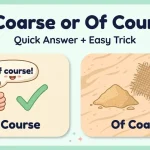
If you want to say “yes,” “certainly,” or “naturally,” write of course. It is always two words.
If you want to describe something rough, crude, or not smooth, write coarse.
Here is the whole rule in one line:
Meaning “certainly”? Use “of course.” Meaning “rough”? Use “coarse.”
Compare these two sentences:
- Of course, I will help you. (I agree to help.)
- The sand was coarse. (The sand felt rough.)
That is the core of it. The rest of this article helps you apply it without thinking.
What Does “Of Course” Mean?
“Of course” is an everyday expression. It works in texts, emails, speeches, and essays. It does three main jobs.
1. Saying “Yes” or “Certainly”
This is its most common use. Someone asks for something, and you agree warmly.
- “Can I borrow your charger?” “Of course.”
- “Could you check this report?” “Of course, send it over.”
2. Saying “Obviously” or “As You’d Expect”
Here, “of course” points out something that should not surprise anyone.
- The airport was crowded the night before the holiday, of course.
- Of course the shop is closed on a public holiday.
3. Replying to “Thank You”
Many speakers use “of course” instead of “you’re welcome” after being thanked. It sounds friendly and a bit more personal than a stock reply.
- “Thanks so much for the lift.” “Of course!”
Is It “Ofcourse” or “Of Course”?
It is always two words. “Ofcourse” is a spelling mistake, even though the phrase sounds like one word when people speak quickly.
- Correct: Of course, I understand.
- Incorrect: Ofcourse, I understand.
What About “Of Course Not”?
You can add “not” to give a firm no.
- “Did you forget our meeting?” “Of course not.”
The spelling is the same. Only the meaning flips, because “not” makes the answer negative.
Read More: Party’s or Parties? The Easy Rule to Pick Every Time
What Does “Coarse” Mean?
Coarse is an adjective. It describes something that is rough, thick, or not fine. It can also describe behavior or language that is crude or vulgar.
Coarse as a Texture
- The towel felt coarse against my skin.
- We walked across coarse sand to reach the water.
- This wool is too coarse for a baby blanket.
Coarse as a Quality of Behavior
- He was fined for coarse language on the show.
- Her coarse jokes made the room go quiet.
The Grammar Clue
Coarse works only as an adjective. It sits before a noun (“coarse sand”) or after verbs like is and feels (“the cloth is coarse”).
That gives you a handy rule: if the word is not describing something, it is not “coarse.”
Course vs. Coarse: What’s the Difference?
The two words are homophones. They sound the same but have different spellings and meanings.
“Course” has several meanings, and it can be a noun or a verb. “Coarse” has one job: describing roughness or crudeness.
| Word | Meaning | Example |
| of course | certainly, obviously | Of course, I agree. |
| course (noun) | a class or series of lessons | I am taking a writing course. |
| course (noun) | a route or direction | The river changed its course. |
| course (noun) | one part of a meal | The main course arrived late. |
| course (verb) | to flow or run quickly | Adrenaline coursed through him. |
| in the course of | during | In the course of one week, we finished the project. |
| coarse (adjective) | rough in texture | The cloth feels coarse. |
| coarse (adjective) | rude or crude | His coarse remarks upset her. |
A Common Meal Mistake
Writers sometimes slip with food, too. Meals are made of courses, not “coarses.”
- Correct: a three-course dinner
- Incorrect: a three-coarse dinner
If “of coarse” surprises you in a sentence, the same logic applies. Ask whether the word is describing something rough. If not, it should be “course.”
Why Do People Confuse These Words?
Three things make this mistake easy.
1. They sound identical. When you speak fast, “of course” and “of coarse” are the same noise. Your brain stores the sound, not the spelling.
2. The wrong word is still a real word. A spell checker sees “coarse” and moves on, because it is spelled correctly. It cannot always tell that you meant something else.
3. “Of course” is often typed from memory. You have said it thousands of times, but you may have seen it written far less. Typing it is a guess based on sound.
The fix is not to memorize harder. The fix is to check the meaning before you pick the spelling.
When Is “Of Coarse” Actually Correct?
This surprises many readers: “of coarse” is not always wrong.
The word “of” can sit right before “coarse” when you are describing what something is made from. In that case, the words are doing their literal jobs.
- The path was made of coarse gravel.
- The rug is woven of coarse wool.
- The wall is built of coarse stone.
Each time, “coarse” describes a material, and “of” shows what the object is made from.
The mistake happens only when someone writes “of coarse” to mean “certainly.”
- Wrong: Of coarse, I will come.
- Right: Of course, I will come.
So the real question is not whether the two words can sit side by side. The question is what you mean. In everyday writing, “of course” is by far the more common phrase.
How to Use “Of Course” Correctly
Spelling is half the job. Using the phrase well matters too.
Where It Can Go in a Sentence
You can place it at the start, middle, or end. A comma usually separates it from the rest of the sentence.
- Start: Of course, we can meet on Monday.
- Middle: We can, of course, meet on Monday.
- End: We can meet on Monday, of course.
When it is a one-word reply, you can use a full stop or an exclamation mark.
- “Can I sit here?” “Of course.”
- “Are you coming tonight?” “Of course!”
Watch Your Tone
“Of course” can sound warm, but it can also sound impatient. Used the wrong way, it suggests the other person should have known the answer.
- Friendly: “Of course, happy to help!”
- Possibly dismissive: “Of course I read the email.”
In professional writing, think about your reader. If a client asks a basic question, “Of course” may feel a little cold. A softer option works better.
Alternatives
If you want variety, you can swap in:
- certainly
- definitely
- naturally
- sure
- absolutely
- without a doubt
Each one has a slightly different feel. “Certainly” is polished, “sure” is casual, and “naturally” suggests something obvious.
Common Mistakes to Avoid
Here are the errors you will see most often, with fixes.
| Incorrect | Correct | Why |
| Of coarse, I agree. | Of course, I agree. | You mean “certainly.” |
| Ofcourse, I can help. | Of course, I can help. | It needs a space. |
| I will, of coarse. | I will, of course. | You are agreeing. |
| This fabric is of course. | This fabric is coarse. | You are describing texture. |
| A three-coarse meal | A three-course meal | Meals have courses. |
| She took a coarse in design. | She took a course in design. | A course is a class. |
Notice the pattern. Whenever you mean agreement, a class, a route, or a meal part, the answer is “course.” Only roughness or crudeness takes “coarse.”
Three Easy Ways to Remember the Difference
You do not need all three. Pick the one that clicks for you.
1. The Swap Test
Replace the phrase with “certainly.”
- Certainly, I will help you. ✔ Sounds natural, so write “of course.”
- The sand is certainly. ✘ Makes no sense, so the word you need is something else.
If “certainly” fits, choose “of course.”
2. The Adjective Test
Ask: Am I describing how something feels or behaves?
- If yes, you probably want coarse.
- If no, you probably want course.
Remember, coarse is the adjective. Course is not.
3. The Letter Trick
Think of the extra a in “coarse” as standing for abrasive or awful to touch. That “a” is a reminder of roughness.
“Course” has no “a,” so it stays plain and everyday, like the phrase “of course.”
A Quick Proofreading Method
Mistakes slip through because we read too fast. Use this simple routine before you send or publish anything.
- Search for “coarse” in your document (Ctrl+F or Cmd+F).
- Look at each result. Is it describing something rough or crude?
- If not, change it to “course.”
- Search for “ofcourse” and fix any one-word versions.
This takes under a minute and catches both mistakes at once. It is especially useful for emails, job applications, and school assignments, where a small slip is easy to avoid.
Quick Practice: Test Yourself
Fill in the blank with of course, course, or coarse. Answers are below.
- “Can you help me with this?” “______!”
- The beach was covered in ______ sand.
- I signed up for a photography ______.
- The main ______ was grilled fish.
- He apologized for his ______ language.
- The river followed a winding ______.
Answers: 1. Of course 2. coarse 3. course 4. course 5. coarse 6. course
If you got five or six right, you have the rule down. If you missed some, go back to the swap test and try again.
FAQs
Is it “of coarse” or “of course”?
Of course is correct when you mean “certainly” or “obviously.” “Coarse” is a different word meaning rough or crude. Writing “of coarse” to agree with someone is a common spelling mistake, mainly because the two words sound identical.
Is “of coarse” ever correct?
Yes, but only literally. In “a path made of coarse gravel,” the word “coarse” describes the material. It is wrong when you use it to mean “certainly,” which is how most people intend the phrase.
Is “ofcourse” one word?
No. The correct form is two words: of course. Writing “ofcourse” is a spelling error. The phrase can sound joined together when people speak quickly, but in writing, always leave the space between “of” and “course.”
What does “of course” mean?
It means “certainly,” “obviously,” or “as you would expect.” People also use it to agree, give permission, or answer “thank you.” Its exact feel depends on tone, so it can sound warm or, occasionally, a little impatient.
What is the difference between course and coarse?
“Course” is a noun or verb. It can mean a class, a route, or one part of a meal. “Coarse” is an adjective meaning rough or crude. They sound the same, but you cannot swap them without changing the meaning.
Can I say “of course” instead of “you’re welcome”?
Yes. Many people reply “of course” after being thanked, and it sounds friendly. It suggests the favor was no trouble at all. In very formal writing, “you’re welcome” or “my pleasure” may feel more polished.
What can I say instead of “of course”?
You can use “certainly,” “definitely,” “absolutely,” “sure,” “naturally,” or “without a doubt.” Choose based on tone. “Certainly” suits formal emails, while “sure” works better in casual chats with friends or coworkers.
Conclusion:
So, of coarse or of course? “Of course” is the correct phrase whenever you mean “certainly,” “obviously,” or “yes.” It is always two words.
“Coarse” is a perfectly good word, but it belongs to rough textures and crude language. It can appear after “of” only when you are describing what something is made from.
Your next step is simple: the next time you type this phrase, run the swap test. If “certainly” fits, you have the right spelling. Then, before you send an important message, use the Ctrl+F check.
Keep these two habits, and this mistake will stop slowing you down.

As an American English writer, I specialize in creating clear and engaging content that makes grammar and language learning accessible to everyone. I enjoy breaking down complex English concepts into simple, practical lessons that readers can apply with confidence. My mission is to help learners strengthen their communication skills through easy and reliable content.









1 thought on “Of Coarse or of course? Quick Answer and Easy Trick”