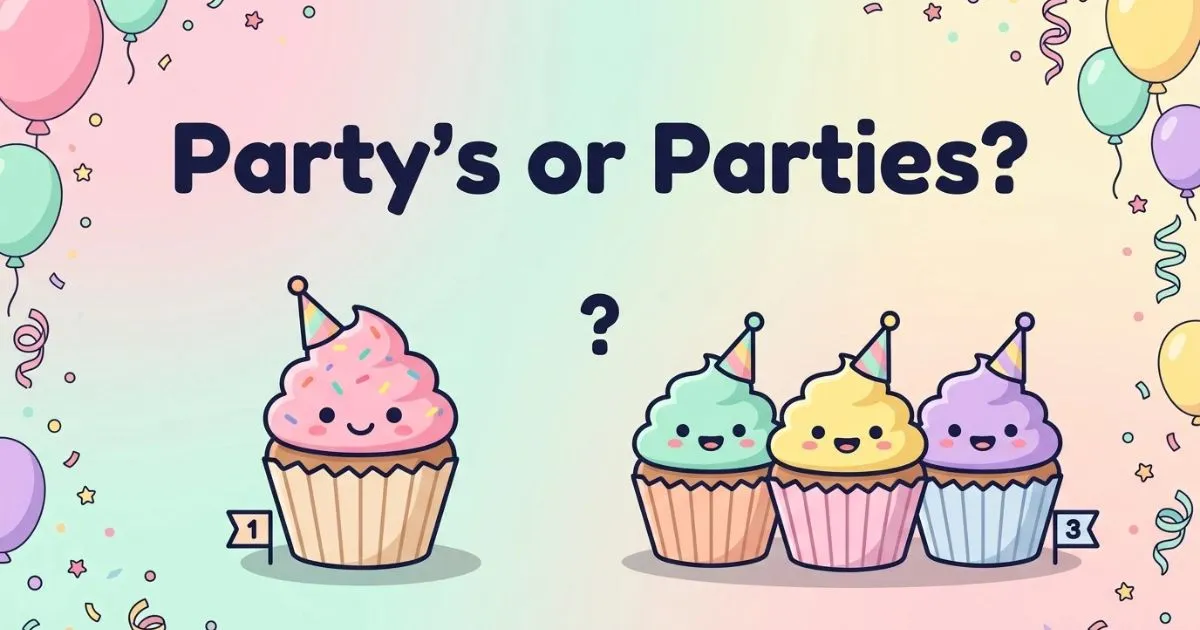
You’re typing an invitation, and you stop mid-sentence. Is it party’s or parties? One small apostrophe, and the meaning of your sentence changes.
Whether it’s an email, an essay, or a contract, the mistake is easy to make and just as easy to fix.
This mix-up is common because the spellings look almost identical but do very different jobs. One counts things, one shows ownership, and one can even stand in for “party is.”
In this guide, you’ll get a plain-English explanation of each form, a three-question check you can run in seconds, real examples from invitations, elections, and contracts, the most common mistakes, and a short quiz to test yourself.
The Quick Answer: Party’s or Parties?
Here is the whole rule in four lines:
- Parties means more than one party. No apostrophe.
- Party’s means something belongs to one party, or it is a short form of “party is” or “party has.”
- Parties’ means something belongs to several parties.
- Partys is never correct as a plural.
One example of each:
- We went to two parties on Saturday.
- The party’s theme was outer space.
- The parties’ lawyers met on Monday.
If you remember only one thing, remember this: an apostrophe never makes a word plural.
Why These Spellings Trip Everyone Up
Three things work against you.
First, we are trained to add an -s for plurals, so “partys” feels natural even though it isn’t.
Second, apostrophes do two jobs, ownership and contractions, so party’s can be read two ways.
Third, parties, party’s, and parties’ sound exactly the same when spoken. You can’t rely on your ear. The difference only shows up on the page, which is why it pays to learn the logic instead of guessing.
Read More: Lense vs Lens: The Only Correct Spelling Explained
The Four Forms at a Glance
| Form | Its job | Example |
| Party | One party (singular noun) | The party starts at six. |
| Parties | More than one party (plural noun) | Both parties signed. |
| Party’s | Belonging to one party, or “party is / party has” | The party’s music was loud. The party’s over. |
| Parties’ | Belonging to several parties | The parties’ signatures are required. |
| Partys | Not standard English | Write “parties” instead. |
Notice that party’s has two different jobs. We’ll untangle both below.
Parties: The Plural Form
Use parties whenever you mean two or more. No apostrophe is needed, because nothing is being owned. You are simply counting.
What “Parties” Can Refer To
The word covers three common meanings:
- Celebrations: We attended three birthday parties this summer.
- Political groups: Several political parties joined the debate.
- Sides in an agreement or dispute: Both parties accepted the terms.
You will also see it in phrases like “interested parties” and “third parties,” as in “All interested parties may submit comments.”
Why It’s Parties, Not Partys
English has a spelling rule for nouns that end in a consonant plus y: change the y to i and add -es. In “party,” the letter before the y is a t, which is a consonant. So party becomes parties.
| Singular | Plural |
| baby | babies |
| city | cities |
| family | families |
| country | countries |
There is an exception worth knowing. When a vowel comes before the y, you keep the y and just add s: day becomes days, key becomes keys, boy becomes boys.
Compare “play” (vowel + y, so “plays”) with “party” (consonant + y, so “parties”). That one comparison explains why “partys” looks wrong to a trained eye.
The Verb Surprise
Here is something most guides skip. “Parties” can also be a verb.
- Marcus parties every weekend.
In that sentence, “parties” does not mean several celebrations. It describes what Marcus does. The other verb forms are partied and partying. Notice the y changes to i in “partied” but stays in “partying.”
Party’s: Possession or Contraction
This is the form that causes the most confusion, because it does two jobs.
Party’s Showing Ownership
Use party’s when something belongs to, or is connected with, one party.
- The party’s location changed at the last minute.
- The party’s host welcomed everyone at the door.
- The party’s candidate gave a speech after the vote.
A quick check: you could rephrase each one with “of the party.” “The location of the party changed.” If that works, you have possession.
Party’s as a Shortcut for “Party Is” or “Party Has”
The same spelling can also be a contraction.
- The party’s ready. (The party is ready.)
- The party’s already started. (The party has already started.)
How do you know whether it means “is” or “has”? Look at the word that follows.
- Party’s + an -ing word, an adjective, or a place usually means “is”: The party’s getting loud. The party’s at my house.
- Party’s + a past participle (started, begun, been, ended) usually means “has”: The party’s been postponed.
Ownership or Contraction? The Swap Test
Try swapping in “party is” or “party has.” If either one fits the sentence, it’s a contraction. If neither fits, it’s ownership.
- “The party’s decorations were lovely.” Swap in “party is decorations” and it makes no sense, so this is ownership.
- “The party’s over.” Swap in “party is over” and it works, so this is a contraction.
One more tip: in contracts and other formal writing, spell the contraction out. “The party is” looks cleaner than “The party’s” in a legal document.
Parties’: When Several Parties Share Ownership
Parties’ is the plural possessive. It shows that something belongs to, or involves, more than one party.
Build it in two steps. First make the plural (parties). Then add the apostrophe after the final s.
- The parties’ agreement was signed yesterday.
- We compared the political parties’ proposals.
- The parties’ responsibilities are listed in the contract.
The Same Logic Works for Other Nouns
You don’t need to memorize this word by word. The pattern holds for most regular nouns.
| One owner | Many owners |
| the party’s rules | the parties’ rules |
| the company’s policy | the companies’ policies |
| the teacher’s lounge | the teachers’ lounge |
“Each Party’s” vs “The Parties’”
Words like “each” and “every” point to one at a time, so they take the singular possessive.
- Each party’s lawyer received a copy.
- The parties’ lawyers received copies.
Both are correct. The first looks at the sides one by one. The second looks at them as a group.
A Simple Three-Question Check
When you’re stuck, run through these questions in order.
- Does anything belong to the party? If no, and you just mean more than one, write parties.
- If something belongs to it, how many owners are there? One owner gets party’s. Several owners get parties’.
- Does the sentence mean “party is” or “party has”? If yes, write party’s.
Let’s try it on a real sentence: “The ___ lawyers met yesterday.”
Do the lawyers belong to someone? Yes. How many owners? Two sides, so several. The answer is parties’: “The parties’ lawyers met yesterday.”
Proofreading tip: after you finish writing, use your search tool to find every “party” and “parties” in the document. Run the three questions on each hit. It takes a minute and catches most slips.
Party’s vs Parties in Real Life
The right form often depends on where you’re writing. Here is how it plays out in four common settings.
Invitations and Event Planning
- The party’s dress code is formal. (ownership)
- We’re hosting two graduation parties this weekend. (plural)
- The party’s at 7 p.m. at my place. (party is)
Invitations use contractions a lot, so don’t assume every party’s is about ownership.
Elections and Politics
- The party’s leader announced new policies. (one party)
- Several parties formed a coalition. (plural)
- Voters compared the parties’ proposals. (several parties owning proposals)
School and Academic Writing
Students often lose marks on this one.
- Incorrect: The political parties leader gave a speech.
- Correct: The political party’s leader gave a speech.
The leader belongs to one party, so you need the singular possessive. By contrast, “Different political parties have different policies” is a plain plural, so no apostrophe appears.
Contracts and Business
This is where one apostrophe can change the meaning. Compare:
- The party’s obligations are listed below.
- The parties’ obligations are listed below.
The first sentence points to the obligations of one side. The second points to the obligations of all sides. A reader could take away a very different message from each.
That is why careful writers proofread this one closely. A few correct patterns to keep handy:
- Both parties agreed to the revised terms.
- Each party’s responsibilities are described in Section 4.
- The parties’ signatures are required on the final page.
Common Mistakes and Quick Fixes
1. Writing “partys”
- Incorrect: We planned two partys.
- Correct: We planned two parties.
2. Using an apostrophe to make a plural
- Incorrect: We attended two party’s this month.
- Correct: We attended two parties this month.
3. Using party’s when several parties are involved
- Incorrect: The party’s representatives met yesterday. (when two sides met)
- Correct: The parties’ representatives met yesterday.
4. Forgetting the apostrophe in a possessive
- Incorrect: The parties agreement was signed.
- Correct: The parties’ agreement was signed.
5. Mismatching the verb
- Incorrect: The parties was canceled.
- Correct: The parties were canceled.
6. Using “parties” for a single event
- Incorrect: Her birthday parties starts at noon.
- Correct: Her birthday party starts at noon.
Memory Tricks That Stick
- The count test: If you can put a number in front of it (two, several, many), it’s parties.
- The owner test: One owner means apostrophe before the s. Many owners means apostrophe after the s.
- The swap test: If “party is” or “party has” fits, it’s a contraction.
- The golden rule: Apostrophes show ownership or missing letters. They don’t make plurals.
Quick Practice
Fill in each blank, then check the answers below.
- The ___ decorations were gorgeous.
- We were invited to three ___ this month.
- Both ___ signed the contract.
- The ___ obligations are listed in Section 4. (Two sides share them.)
- The ___ over. Let’s go home.
- My cousin ___ every weekend.
Answers:
- party’s (ownership by one party)
- parties (plural)
- parties (plural)
- parties’ (ownership by several parties)
- party’s (party is)
- parties (verb: they attends parties)
FAQs
Is it party’s or parties?
Both are correct, but they mean different things. Parties means more than one party. Party’s shows that something belongs to one party, or stands for “party is” or “party has.” Check whether you mean a plural, ownership, or a contraction before you choose.
What is the plural of party?
The plural is parties. Since “party” ends in a consonant plus y, the y becomes i and you add -es. This works for birthday parties, political parties, and parties to a contract. No apostrophe is needed when you simply mean more than one.
Can party’s mean “party is”?
Yes. In casual writing, party’s can shorten “party is” or “party has.” “The party’s starting soon” means “The party is starting soon.” “The party’s already begun” means “The party has already begun.” In formal documents, it’s better to write the words out.
What does parties’ mean?
Parties’ is the plural possessive. It shows that something belongs to or involves more than one party, such as “the parties’ agreement” or “the parties’ responsibilities.” Form the plural first, then add the apostrophe after the s. You’ll see it often in legal and business writing.
Is “partys” ever correct?
No. “Partys” is not a standard spelling. It happens when someone adds s to “party” without changing the ending. Always write parties for the plural. The same rule gives you babies, cities, and families, so the pattern is easy to carry over.
Is it “third parties” or “third party’s”?
Use third parties when you mean more than one outside party: “Third parties may access the data.” Use third party’s when something belongs to a single outside party: “The third party’s server was offline.” The number of parties, and whether anything is owned, decides the form.
Can “parties” be a verb?
Yes. As a verb, “parties” means to attend or enjoy social gatherings: “She parties with coworkers after big projects.” In that sense, it is not a plural noun. The other forms are partied and partying, so the y changes to i only before -ed.
Conclusion:
The party’s or parties question comes down to three things: counting, owning, and contracting.
Use party’s when one party owns something, or when you mean “party is” or “party has.”
When you’re unsure, don’t guess. Run the three-question check and the swap test. They take a few seconds and work every time.
Your next step: open the last email or document you wrote and search it for “party.” Check each one against the three questions. Spotting your own mistakes is the fastest way to make the rule stick.

I am an English language writer passionate about grammar and clear communication. I create simple, easy-to-understand content that helps readers improve their English skills. My goal is to make learning English both practical and enjoyable.








2 thoughts on “Party’s or Parties? The Easy Rule to Pick Every Time”