You are about to send an important email. Everything looks fine, but the last line stops you: “Please advise” or “Please advice”?
One letter decides whether that sentence is right or wrong, and even confident writers hesitate. The words look alike, sound alike, and both involve guidance. Yet they do very different jobs in a sentence.
In this guide, you will learn the one-rule difference between advise and advice, how to say each word correctly, four memory tricks that stick, and how to use “please advise” in emails without sounding cold. You will also get real examples, common mistakes, and a short quiz.
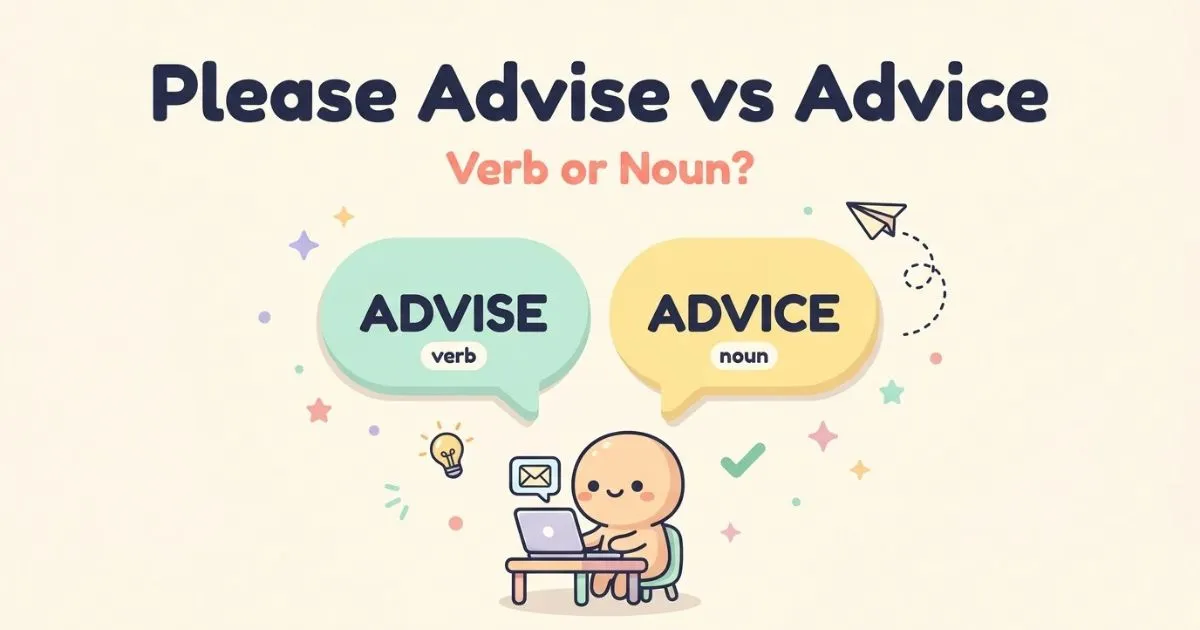
The Short Answer
“Please advise” is the correct phrase. “Please advice” is a spelling mistake.
Here is the whole difference in three lines:
- Advise (with an S) is a verb. It is the action of giving guidance.
- Advice (with a C) is a noun. It is the guidance itself.
- You advise someone, and then they receive advice.
| Advise | Advice | |
| Part of speech | Verb | Noun |
| Meaning | To recommend or counsel | A recommendation or suggestion |
| Ending sound | “z” | “s” |
| Example | I advise you to wait. | My advice is to wait. |
| Countable? | Not applicable | No, it is uncountable |
Keep this table in mind. Everything else in this article builds on it.
Advise vs Advice: What Really Separates Them
Both words appear in the same situations: someone offers an opinion about what another person should do. That is exactly why they get mixed up.
But the difference is not about meaning. It is about the job the word does in your sentence. So ask yourself one question: is this word an action or a thing?
- If it is an action, use advise.
- If it is a thing someone gives, takes, or receives, use advice.
Here is one sentence that contains both:
I advise you to get some advice from an expert before you sign.
“Advise” is what I am doing. “Advice” is what you should go and get. Swap them and the sentence falls apart.
Advise: The Verb
Advise is a regular verb, so it changes form like any other verb.
| Form | Example |
| advise | I advise you to double-check the date. |
| advises | She advises students on university applications. |
| advised | The doctor advised him to rest. |
| advising | They are advising the new team. |
Notice that “advised” is simply the past tense of the verb. It is not another way to spell advice.
Advice: The Noun
Advice names the recommendation. You can give it, ask for it, follow it, or ignore it.
- Thank you for your advice.
- I need some advice about choosing a course.
- He ignored his friend’s advice and regretted it.
Advice is also a mass noun, like “furniture”. That affects how you count it, which we will cover in the grammar rules below.
Read More: Wheelbarrow vs Wheelbarrel: The Barrow Trick to Remember
How to Pronounce Advise and Advice
Spelling is not the only clue. The two words end with different sounds.
- Advise ends with a “z” sound, like “size” or “realise”.
- Advice ends with an “s” sound, like “ice”.
In dictionary notation, advise is /ədˈvʌɪz/ and advice is /ədˈvʌɪs/. The S in advise sounds like a Z, while the C in advice sounds like an S.
If you are unsure which word you need, say the sentence out loud. “Thank you for your advize” sounds wrong the moment you hear it.
Please Advise or Please Advice?
“Please advise” is correct because the request needs a verb. You are asking someone to do the action of advising. “Please advice” puts a noun where a verb belongs.
Compare these:
- ✅ Please advise me on the next steps.
- ❌ Please advice me on the next steps.
- ✅ Please give me your advice on the next steps.
The third sentence shows that you can still use the noun with “please”, as long as you add a verb such as give or share.
Does “Please Advise” Need an Object?
Some grammar experts point out that advise is a transitive verb, which means it should be followed by an object, as in “Please advise me.” Others accept the shorter “Please advise” because it is so widely used, especially in email.
The safe habit is simple: add “me”, “us”, or the topic whenever you can. “Please advise me on the budget” is clear to everyone.
Four Memory Tricks That Actually Work
Trick 1: Check the Ending (-ice vs -ise)
Many verbs end in -ise: supervise, improvise, surprise, devise. Many nouns end in -ice: justice, novice, device.
So -ise points to a verb, and -ice points to a noun. You can also remind yourself that “ice” itself, the frozen water, is a noun.
This is a rule of thumb, not a law. “Dice” can be a noun (the dice in a board game) and also a verb (to dice onions), so always double-check with the other tricks.
Trick 2: The Swap Test
Replace the word with a simpler one.
- If recommend fits, you need the verb: advise.
- If suggestion or guidance fits, you need the noun: advice.
Try it: “I need your ___” becomes “I need your suggestion,” so the answer is advice. “I ___ you to wait” becomes “I recommend that you wait,” so the answer is advise.
Trick 3: The Sound Test
Read the sentence aloud and listen to the last sound. If it ends in “z,” write advise. If it ends in “s,” write advice. This works best when you already know how each word sounds, so practise the pronunciation section above once or twice.
Trick 4: The Word Neighbour Test
Look at the word just before the blank.
- After some, your, good, his, or the, you need a noun: advice.
- After a person or a subject such as I, she, the doctor, or they, you need a verb: advise (or advised, advises).
“She gave me good ___” has good before the blank, so it is advice. “The doctor ___ me to rest” has a subject before the blank, so it is advised.
Grammar Rules to Remember
Rule 1: Advise + Person + Recommendation
The verb usually comes with the person you are guiding.
- I advise you to read the terms first.
- The teacher advised us to revise every day.
You can also advise someone against something:
- My lawyer advised me against signing yet.
Rule 2: Advise Works in the Passive Too
Sometimes the focus is on the person who received the guidance.
- I was advised to bring my ID.
- The board will be advised on the outcome of the meeting.
Rule 3: Advice Is Uncountable
You cannot count advice the way you count books. Avoid “an advice” and “two advices.”
- ❌ She gave me an advice.
- ✅ She gave me some advice.
- ✅ She gave me a piece of advice.
- ✅ She gave me three pieces of advice.
You may spot “advices” in financial or legal documents, where it is a specialised term. It is not the plural of the advice you get from a friend or manager, so do not use it in everyday writing.
How to Use “Please Advise” in Emails
When It Works Well
“Please advise” is common in professional emails. It works when the context is clear, the relationship is formal, and you have already explained what you need.
When It Feels Cold
Used alone as the last line of an email, it can sound abrupt or demanding. Some readers even find it impolite. That does not mean you must avoid it. Use it sparingly and make sure the rest of your message is polite and specific.
Before and After: Four Quick Makeovers
| Before | After |
| Please advise. | Could you advise me on which option works best? Thank you for your help. |
| Please advise on next steps. | Could you let me know what I should do next? |
| Please advise whether we should proceed. | Could you let me know whether we should move forward with the proposal? |
| Please advise me on how to apply. | I would appreciate your guidance on completing the application. |
A Simple Email Formula
Use three parts:
- Context: one line on the situation.
- A specific question: exactly what you need.
- A polite close: thank the reader.
For example:
The client has asked to move the launch to Friday. Could you advise me on whether the team can manage that? Thank you for your help.
The reader knows what is happening, what you need, and that you value their time.
Friendly Alternatives
When “please advise” feels too stiff, try one of these:
- Could you let me know your thoughts?
- I would appreciate your advice.
- What would you recommend?
- Please let me know how I should proceed.
Choose the one that matches your relationship with the reader.
Advise and Advice in Real Situations
At work
- Advise: Our manager will advise us about the new policy.
- Advice: I received a useful piece of advice from my supervisor.
At school or university
- Advise: My teacher advised me to practise English every day.
- Advice: I need some advice before choosing a university.
In daily life
- Advise: Doctors often advise people to build healthy habits.
- Advice: He ignored his friend’s advice and missed the train.
In emails
- Advise: Please advise us if the meeting time changes.
- Advice: Thank you for your advice on the proposal.
Notice the pattern: when someone is doing something, it is advise. When someone is giving or getting something, it is advice.
Common Mistakes (and Quick Fixes)
1. Writing “Please advice”
❌ Please advice me on this issue.
✅ Please advise me on this issue.
A request for action needs the verb.
2. Writing “your advise”
❌ Thank you for your advise.
✅ Thank you for your advice.
Words like your are followed by a noun.
3. Writing “an advice” or “two advices”
❌ She gave me an advice.
✅ She gave me a piece of advice.
Advice is uncountable, so count it with “pieces of.”
4. Using advice as a verb
❌ My friend advice me to study harder.
✅ My friend advised me to study harder.
The sentence describes an action, so it needs the verb form.
5. Writing “good advise”
❌ That is good advise.
✅ That is good advice.
You are describing the recommendation itself.
6. Ending every email with “Please advise”
This is a tone mistake, not a spelling one. Repeating it in every email can make you sound demanding. Mix it with warmer alternatives.
Quick Self-Check Quiz
Fill in the blank with advise, advised, or advice.
- Could you ___ me about the deadline?
- Thank you for your ___.
- My manager gave me a useful piece of ___.
- The coach ___ the team to rest.
- I would ___ against sending that email tonight.
- Her ___ was to start early.
Answers: 1. advise 2. advice 3. advice 4. advised 5. advise 6. advice
If you got all six, you have the rule. If not, go back to the swap test and the word neighbour test.
FAQs
1. Is it “please advise” or “please advice”?
“Please advise” is correct. Advise is a verb, and a request for guidance needs a verb. “Please advice” is a spelling mistake because advice is a noun. If you prefer the noun, rephrase it: “Please give me your advice on this.”
2. Is “please advise” grammatically correct without an object?
Some grammar experts say advise is transitive and should take an object, such as “Please advise me.” Still, the short form is widely used, especially in emails, and is generally accepted. Adding “me,” “us,” or a topic makes your request clearer in formal writing.
3. Is “please advise” rude?
Not automatically, but some readers find it abrupt or demanding. The tone depends on context and your relationship with the reader. Explain what you need, add a thank-you, or use a softer alternative. Use the phrase sparingly rather than in every email.
4. Can I use “advices”?
In everyday English, advice is uncountable, so do not add -s. Say “some advice” or “two pieces of advice.” “Advices” does exist as a specific financial and legal term, but it is not the plural of the advice you give a friend or colleague.
5. How do I pronounce advice and advise?
Advise ends with a “z” sound, like “size.” Advice ends with an “s” sound, like “ice.” So the S in advise sounds like Z, and the C in advice sounds like S. Saying your sentence aloud can help you choose the right spelling.
6. What is the past tense of advise?
The past tense is “advised,” as in “The teacher advised us to review the lesson.” The same form works in the passive: “I was advised to wait.” Advice is a noun, so it has no past tense.
7. What can I write instead of “please advise”?
Try “Could you let me know your thoughts?”, “I would appreciate your advice,” “What would you recommend?”, or “Please let me know how I should proceed.” Each sounds friendlier than a bare “Please advise.” Pick the one that suits your relationship with the reader.
Conclusion:
The difference comes down to grammar. Advise is the verb, the action of giving guidance. Advice is the noun, the guidance itself. So when you ask for help in an email, “please advise” is the correct choice, and “please advice” is not.
Remember the key points: advice is uncountable (“some advice,” “a piece of advice”), -ise usually signals a verb, and a bare “please advise” is more polite when you add context and a thank-you.
Your next step: open your last five sent emails, search for “advice” and “advise,” and check each one with the swap test. It takes two minutes and you will never second-guess the word again.

As an American English writer, I specialize in creating clear and engaging content that makes grammar and language learning accessible to everyone. I enjoy breaking down complex English concepts into simple, practical lessons that readers can apply with confidence. My mission is to help learners strengthen their communication skills through easy and reliable content.










1 thought on “Please Advise vs Advice: Which One Is Correct?”