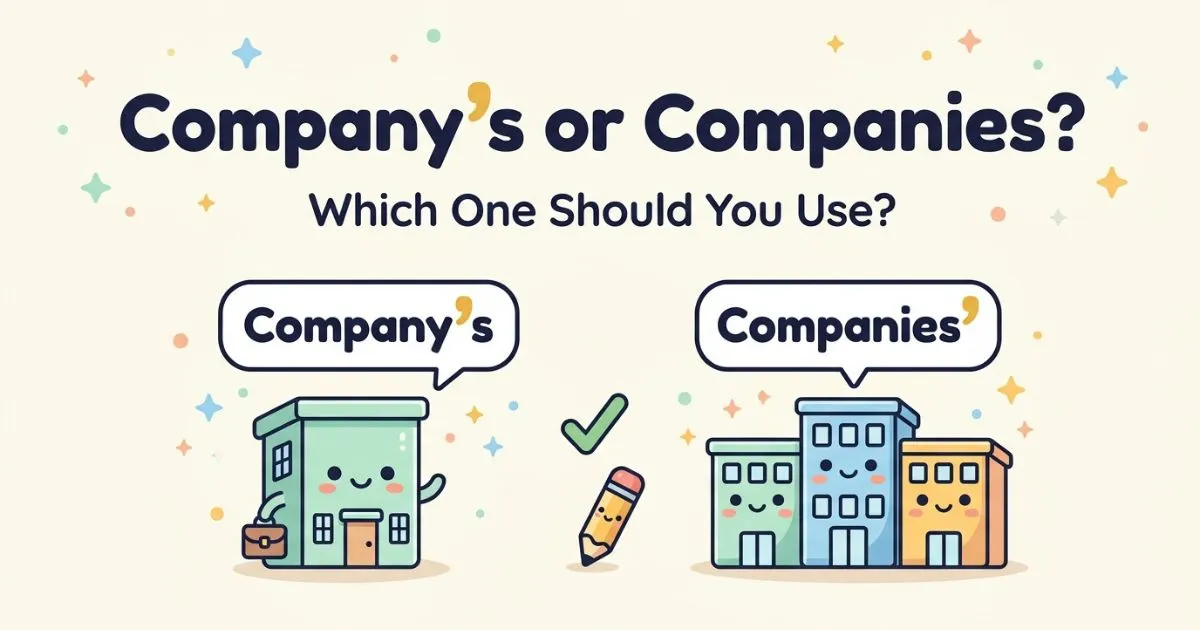
You are typing a quick email and suddenly you freeze. Is it “the company’s policy” or “the companies policy”? Or maybe “companies’”?
Three tiny spellings, one tiny apostrophe, and a surprising amount of second-guessing.
The confusion makes sense. All three forms sound exactly the same when you say them out loud, so your ear gives you no help. Only the page does.
This guide settles company’s or companies for good. You will learn what each form means, a simple swap test that picks the right one in seconds, a second meaning of company’s that most guides skip, and the mistakes that make professional writing look careless.
The Quick Answer
Here are all four forms side by side:
| Form | What it is | Example |
| Company | One business | The company is hiring. |
| Company’s | Belongs to one company (or short for “company is/has”) | The company’s office is new. |
| Companies | More than one business | The companies are hiring. |
| Companies’ | Belongs to more than one company | The companies’ offices are new. |
The one-line rule: no apostrophe means “more than one.” An apostrophe means “belongs to” (or, in one special case, “is” or “has”). The position of the apostrophe tells you how many owners there are.
Company vs. Companies: Singular and Plural
Company means a single business. Companies means two or more. That is all the plural does. It carries no sense of ownership.
English has a regular pattern for nouns that end in a consonant plus y. You drop the y and add ies. The same pattern turns city into cities and story into stories.
- One company, two companies
- Many companies, several companies
That is why companys is not a word. It is only a spelling slip, and spell checkers flag it for good reason. The only time “companys” appears in correct writing is with an apostrophe between the y and the s, which makes company’s.
The “Businesses” Test
Here is a quick check for the plain plural. Replace the word with “businesses” and read the sentence again. If it still makes sense, you need companies.
- “I have worked for three companies.” → “I have worked for three businesses.” Works, so no apostrophe.
- “The company’s budget was cut.” → “The businesses budget was cut.” Does not work, so something else is going on.
Notice that “businesses budget” feels wrong without an apostrophe too. That is your signal that the sentence is about ownership, which brings us to the next form.
How to Spell Companies (and Common Misspellings)
Companies is spelled C-O-M-P-A-N-I-E-S. It is a real word and the plural of company. Every other version, such as companys, companie or campany, is a typo.
The rule is simple: drop the y and add ies. Say it in parts to lock it in: com-pa-nies.
Here are the slips people make most often:
| Wrong | What went wrong | Correct |
|---|---|---|
| companys | Added s without changing the y | companies |
| companie | Dropped the final s | company (one) or companies (many) |
| campany | Swapped the second vowel | company |
| comapny | Letters flipped | company |
| compneys | Missing letters, wrong ending | companies |
| company ies | Split the ending with a space | companies |
The same typos sneak in with an apostrophe. “Comapny’s” should be company’s. “Companie’s” can never be right, because companie is not a word.
Companies in a Sentence
Use companies when you mean more than one business and nothing belongs to them. Here are a few quick examples:
- Several companies are offering remote roles this year.
- She has interned at two companies.
- Which companies are on your shortlist?
- Small companies often move faster than big ones.
- Do you know any companies that hire freshers?
Read More: How to Spell Whether or Not (and Never Mix It Up Again)
What Does Company’s Mean?
The apostrophe in company’s does one of two jobs. Most guides explain only the first.
Job 1: Showing Possession
Use company’s when something belongs to, or is connected with, one company. The apostrophe comes before the s because the owner is singular.
- The company’s website needs an update.
- Which company’s CEO gave that interview?
- Our company’s holiday policy changed last month.
- Please send me the company’s contact details.
You are doing the same thing you do with a person’s name. Monica’s dog and the company’s logo follow the exact same pattern.
Job 2: Standing In for “Is” or “Has”
Sometimes the apostrophe-s is not possession at all. It is a shortened verb.
- The company’s launching a new product. (company is launching)
- The company’s grown a lot this year. (company has grown)
- This company’s a great place to work. (company is a great place)
This second job explains many “wrong” sentences that are actually fine.
If it does not expand, it is possession. Quick comparison:
- “The company’s growing fast.” → company is growing (contraction)
- “The company’s growth is impressive.” → growth that belongs to the company (possession)
Company’s Before Plural Nouns
Here is a point that trips up many writers. The word after company’s can be plural, and the apostrophe still stays before the s.
One company with ten thousand staff still gets “the company’s employees.” The apostrophe follows the owner, not the thing owned. Since there is one company, there is one apostrophe position.
Legally, a company is treated as a single entity even though it is made up of many people. That is a handy way to remember why it counts as one owner.
What About Companies’?
Companies’ combines the two ideas. First you have a plural (more than one company). Then you show that something belongs to them. Because the plural already ends in s, you add only the apostrophe.
- Two tech companies announced a deal. The companies’ headquarters are in different countries.
- The companies’ annual reports are available online.
- We compared the companies’ pricing plans.
One Shared Thing or One Each?
Companies’ also raises a small meaning question. Read these two sentences:
- “The companies’ CEO signed the deal.” One CEO who leads all of the companies, such as a shared leader.
- “The companies’ CEOs signed the deal.” Each company has its own CEO.
The apostrophe stays the same in both. What changes is whether the owned noun is singular or plural. When you write about several companies, check that your second noun matches what you actually mean.
Each Company, Every Company, Both Companies
After each and every, use company (singular). After both, use companies (plural). The word before the noun decides the form.
Each and every look at one company at a time. Both needs two.
| Word | Use | Example |
|---|---|---|
| Each | company | Each company has its own rules. |
| Every | company | Every company needs a budget. |
| Both | companies | Both companies signed the deal. |
| One of the | companies | One of the companies is hiring. |
| Any | company or companies | Any company can apply. / Any companies that applied will hear back. |
So “each companies” and “both company” are wrong. Not sure whether you mean one or many? Rewrite it with any, as in “any company that applies.”
Company Has or Companies Have?
One company takes has. More than one takes have. The verb follows the number, just like the noun.
- Our company has a new office.
- Each company has its own app.
- Both companies have new offices.
- Many companies have moved online.
A quick check: if you can say “it,” use has. If you can say “they,” use have.
Why Do People Mix These Up?
Two reasons stand out.
First, these forms are homophones, meaning words that sound identical. In conversation your brain uses context to fill in the meaning. On the page you have to choose, and nothing in the sound helps.
Second, many writers learned that an apostrophe somehow “makes things plural.” It does not. A regular plural almost never needs one. Writing “many company’s offer discounts” is the classic result of that habit.
How to Choose the Right Form in 4 Steps
Use this process whenever you are unsure. It takes about ten seconds once you get used to it.
- Count the companies. Are you talking about one or more than one?
- Test for ownership. Can you rewrite it as “of the company” or “of the companies”? If yes, you need an apostrophe.
- Place the apostrophe. One owner means company’s. Several owners means companies’.
- Check for is/has. If company’s is followed by a verb and expands to “company is” or “company has,” it is a contraction, and you are done.
Worked Examples
Sentence: “Several ___ opened offices in Lahore.”
Many businesses, and nothing belongs to anyone. Answer: companies.
Sentence: “The ___ latest report looks strong.”
The report belongs to one company. Answer: company’s.
Sentence: “Both ___ policies were updated.”
Policies belong to two companies. Answer: companies’.
Sentence: “Our ___ opening a second branch.”
It expands to “company is.” Answer: company’s.
Tricky Spots Worth Knowing
Companies’s and Companys’ Are Wrong
Some writers add an extra s after the apostrophe on a plural, like “companies’s.” Many editors and grammar experts treat this as incorrect, so avoid it. Likewise, companys’ is never right, because companys is not a plural at all. The correct plural possessive is always companies’.
Company Policy vs. Company’s Policy
You will often see “company policy,” “company car,” or “company information” with no apostrophe. Both styles are normal in everyday English. “The company’s information” and “company information” are both acceptable.
What you cannot do is drop the apostrophe from a plural owner. “The companies policy” is wrong. Write “the companies’ policy” instead.
The Possessive Word for a Company Is “Its”
When a pronoun replaces company, use its, with no apostrophe. “The company announced its results.” Do not write it’s here, because it’s means “it is” or “it has.”
Company’s and Companies in the Same Sentence
You can use both forms in one sentence. Each word just follows its own rule. Check the number first, then check for ownership.
- Our company’s partner companies are listed below.
- Three companies share one parent company. The parent company’s name appears on all three companies’ websites.
If a sentence starts to feel crowded, switch to “of.” “The name of the parent company” is easier to read than stacked apostrophes.
Straight Apostrophe, Curly Apostrophe, or Backtick?
Company’s (straight) and company’s (curly) are both correct. They are the same word with a slightly different look. The backtick in company`s is not an apostrophe, so avoid it.
Word processors usually turn the apostrophe curly on their own. Code editors and some keyboards keep it straight. Pick one style and stay consistent.
You will also see “company s” in search boxes. That is just a typing shortcut. In writing, a space instead of the apostrophe is always an error.
Company’s or Companies in British English
There is no difference. British and American English use the same forms: company, company’s, companies and companies’.
The only small difference is with verbs. British writers sometimes use a plural verb when a company name stands for its people, as in “Sainsbury’s are hiring.” American writing rarely does this. In professional writing, “the company has” is the safe choice anywhere.
One more UK term you may see: Companies House is the official UK register of companies. It is a fixed name, so copy it exactly as written, with no apostrophe
Real Business Writing: Wrong vs. Right
Small apostrophe errors stand out most in professional writing, because readers expect polish. Here is how the fixes look in the places where you are most likely to need them.
In Emails
- ✗ Please review the companys proposal by Friday.
- ✓ Please review the company’s proposal by Friday.
In Reports
- ✗ Many company’s reported higher costs this quarter.
- ✓ Many companies reported higher costs this quarter.
- ✗ The three companies annual figures are attached.
- ✓ The three companies’ annual figures are attached.
On Websites and Social Posts
- ✗ Our companies mission is to help small businesses grow.
- ✓ Our company’s mission is to help small businesses grow.
Notice the pattern. Each mistake falls into one of three groups: a missing apostrophe, an unnecessary apostrophe, or the wrong plural spelling. Check for those three and you will catch almost every error.
Why This Small Detail Matters
It may feel like a minor issue, but readers notice. A misplaced apostrophe in a proposal, a job application, or a company website can make the whole business look less careful than it is.
The good news is that this is one of the easiest grammar problems to fix. The rules are short, they never change, and they work the same way for many other nouns that end in y.
Common Mistakes at a Glance
- Writing “companys.” Use companies for the plural.
- Adding an apostrophe to a simple plural. “Many company’s” should be “many companies.”
- Forgetting the apostrophe for ownership. “The companies website” should be “the company’s website” (one company) or “the companies’ websites” (several).
- Mixing up the apostrophe position. Before the s means one owner. After the s means more than one.
- Writing “companies’s.” Use companies’ instead.
Quick Self-Test
Try these before you move on. Answers are below.
- The ___ biggest clients attended the event. (one company)
- Three ___ applied for the contract.
- Both ___ contracts were cancelled.
- Our ___ moving to a new office next month.
Answers: 1. company’s, 2. companies, 3. companies’, 4. company’s (it means “company is”).
A Simple Memory Trick
Think of the apostrophe as a small sign that says “owner here.”
- Apostrophe before the s: one owner (company’s).
- Apostrophe after the s: several owners (companies’).
- No apostrophe: no ownership, just more than one (companies).
And if you see “-ies,” think plural. If you see an apostrophe, ask who owns what.
Same Rule for Business’s, Employee’s, and City’s
Yes, this rule works for most nouns. An apostrophe before the s means one owner, an apostrophe after the plural s means several owners, and no apostrophe means just more than one.
| One owner | Plural | Several owners |
|---|---|---|
| company’s | companies | companies’ |
| employee’s | employees | employees’ |
| city’s | cities | cities’ |
| party’s | parties | parties’ |
| business’s | businesses | businesses’ |
Nouns that end in a consonant plus y, like company, city and party, all switch to ies in the plural. Want to see the same pattern again? Read Party’s or Parties? The Easy Rule to Pick Every Time.
FAQs
1. Is it company’s or companies?
Both can be correct, depending on meaning. Company’s shows that something belongs to one company, such as “the company’s website.” Companies is simply the plural, meaning more than one business, such as “many companies hire remotely.” Decide first whether you mean ownership or simply a number of businesses, and the choice becomes clear.
2. What is the plural of company?
The plural is companies. Because company ends in a consonant followed by y, the y changes to ies. The spelling “companys” is not correct English. It only appears with an apostrophe (company’s) when showing possession, or as a short form of “company is.”
3. When do I use companies’ with an apostrophe after the s?
Use companies’ when something belongs to two or more companies. For example, “The companies’ offices are in different cities.” The apostrophe goes after the s because companies is already plural. If nothing is owned and you only mean several businesses, drop the apostrophe and write companies.
4. Can company’s mean “company is”?
Yes. Besides possession, company’s can be a contraction of “company is” or “company has.” In “The company’s hiring this month,” it means “company is.” Try expanding the sentence. If “company is” or “company has” fits, it is a contraction. If not, it shows possession.
5. Is “company’s information” or “company information” correct?
Both work. “The company’s information” shows possession directly, while “company information” uses company as a describing word. Either is fine for one company. For several companies, you need an apostrophe: write “the companies’ information,” not “the companies information,” since the owners are plural.
6. Is “companies’s” ever correct?
No. Many editors and grammar experts consider “companies’s” incorrect. Because companies already ends in s, the plural possessive takes only an apostrophe: companies’. You may still see “companies’s” online, but it is safer to avoid it in emails, reports, and other professional writing.
7. Is it “each company” or “each companies”?
Each company is correct. Each looks at one company at a time, so the noun stays singular. Use “both companies” when you mean two.
8. Is “companie” or “companie’s” ever correct?
No. Companie is not an English word. Use company for one, companies for more than one, and company’s to show ownership.
9. Is it “company has” or “company have”?
Use company has in most writing, because a company counts as one unit. Use companies have for more than one. Some British writers use a plural verb with a company name, but has is the safe choice everywhere.
10. Can I write company’s with a straight apostrophe?
Yes. Both the straight (company’s) and curly (company’s) versions are fine. Just stay consistent, and avoid the backtick (company`s).
Conclusion:
Choosing between company’s or companies comes down to two questions: how many companies are you writing about, and does something belong to them?
One company that owns something gets company’s. Several companies get companies. Several companies that own something get companies’.
And if company’s is followed by a verb, it may simply be short for “company is” or “company has.”
Your next step is easy. Open the last email or document you wrote and search for the word “compan.”
Check each apostrophe using the four steps above. You will likely spot at least one fix, and from then on the right form will come naturally.

I am an English language writer passionate about grammar and clear communication. I create simple, easy-to-understand content that helps readers improve their English skills. My goal is to make learning English both practical and enjoyable.










1 thought on “Company’s or Companies? Which One Should You Use?”