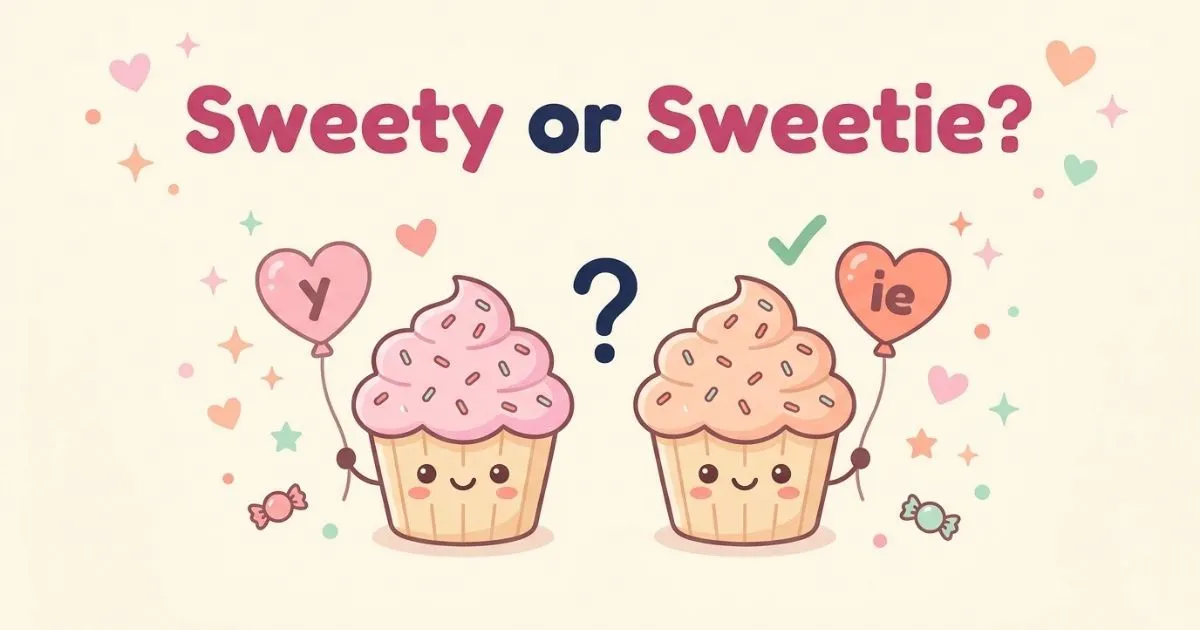
You are about to send “Good morning, sweety!” and your thumb freezes. Should it be sweetie?
Autocorrect stays quiet, and a quick search makes things worse: one site calls sweety flat-out wrong, another calls it a perfectly valid variant.
Here is the honest answer. Both camps are partly right, and the sweety or sweetie question has a clean, practical solution.
This guide shows what dictionaries actually record, then turns it into simple rules for texts, school, and work.
You will also get meanings, pronunciation, example sentences, a warning about the “sweaty” mix-up, and a few notes on when a pet name is better left unsaid.
Sweety or Sweetie: The Quick Answer
Use sweetie. It is the standard spelling, listed as the main entry in major dictionaries, and nobody will question it in an essay, an article, or a message to your manager.
Sweety is a less common variant. It has the same meaning and the same sound, and it turns up in published books and personal messages. It is not a different word. It is simply the spelling that dictionaries treat as secondary.
The one-line rule: use sweetie for anything public or edited. Use sweety only when the message is casual, and stay consistent.
Why Online Sources Disagree About Sweety
If you have read a few spelling guides, you have probably noticed that they contradict each other. That is not your imagination.
Some guides say sweety is simply incorrect. Others call it an acceptable alternative. The dictionary evidence looks like this:
- Dictionary.com and the Oxford Advanced Learner’s Dictionary list sweetie as the headword.
- Wiktionary lists sweety as an alternative spelling of sweetie and backs it with quotations from published books, including ones from 1976, 1998, and 2003.
- Green’s Dictionary of Slang files the two together under “sweetie, also sweety.”
- A historical dictionary entry for the Scottish sense of the word (a sweet or candy) also records the spelling sweety, with examples going back to 1790.
That last point matters. It means sweety is not purely a modern texting mistake, as some guides claim. It has appeared in print for a long time.
At the same time, “it exists” is not the same as “it is standard.” The fair summary is this: sweetie is the standard form, and sweety is a recorded variant that is rarer and more likely to look like a typo to a careful reader.
Read More: Photo Shoot or Photoshoot? Both Work, But Here’s When
What Does Sweetie Mean?
Sweetie is an informal noun, and it does several jobs depending on who says it and how.
A Term of Endearment
This is the most common use. Parents say it to children, partners say it to each other, and grandparents say it to just about everyone. Dictionaries describe it as a way of addressing someone you love.
“Don’t cry, sweetie. We’ll find your teddy bear.”
A Kind or Helpful Person
Sweetie can also describe someone instead of addressing them. Britannica’s learner dictionary lists “a kind or helpful person” as a separate sense.
“Our neighbour is such a sweetie. She watered my plants all week.”
You will also hear the phrase “be a sweetie,” which is a friendly way of asking for help.
An Ironic Insult
Tone can flip the meaning completely. Green’s Dictionary of Slang records an ironic use in which a sweetie is an unpleasant person, as in “Oh, he’s a real sweetie.”
Said with an eye-roll, it is no compliment. That is one more reason to be careful with the word around people you do not know well.
Candy in British English
In British English, a sweetie can be a child’s word for a sweet (candy), usually in the plural: sweeties. If someone offers you a sweetie in London, they probably mean a piece of candy, not a pet name.
A few references also list sweetie as the name of a citrus fruit, a grapefruit and pomelo cross. That is yet another use, but you will rarely need it in everyday writing.
The Plural Form
The plural is sweeties. Even Wiktionary’s entry for sweety gives sweeties as the plural, which quietly shows that the -ie spelling is the base form.
Where the Word Comes From
Sweetie is built from the adjective sweet plus the ending -ie. Dictionary.com dates the word to roughly 1695 to 1705. Sweet itself goes back to the Old English word swēte, and over time it stretched from describing taste to describing a gentle, lovable person.
English often adds -ie or -y to a word to make a smaller, more affectionate version. Think of doggie, birdie, and mommy. Wiktionary describes sweety as sweet plus the -y diminutive ending.
That is why sweety looks so natural. It follows the same pattern as other pet-name forms, just with a different ending. Neither spelling is a random guess. They are two ways of attaching the same affectionate suffix, and standard English settled on -ie for this word.
How to Pronounce Sweetie and Sweety
Both spellings are pronounced SWEE-tee (/ˈswiːti/). The word has two syllables, and the stress falls on the first one. The first part sounds like “sweet,” and the second part sounds like “tee.”
Because the sound is identical, you cannot hear which spelling someone meant. This is exactly why mistakes happen. You have to remember the written form, since your ears will not help.
One useful contrast: sweaty is pronounced SWET-ee, with the short “e” of “bed.” If you can say the two words differently, you are less likely to mix them up on the page.
Which Spelling Should You Use? A Situation Guide
| Situation | Best choice | Why |
| Text to a partner, child, or close friend | Sweetie (sweety is fine) | Personal and casual, so either is understood |
| Social media caption or username | Either, but stay consistent | Informal, and style is personal |
| School essay or assignment | Sweetie | The standard form |
| Blog post or edited article | Sweetie | Matches mainstream dictionaries |
| Email to a colleague or client | Neither | Pet names can feel unprofessional |
| Quoting someone else’s message | Their original spelling | Quotes are copied as written |
A Three-Question Check
When you are not sure, run through these questions in order:
- Should I use a pet name at all? If the reader is a colleague, client, stranger, or someone you manage or teach, the answer is usually no.
- Will anyone judge or edit the spelling? If yes, write sweetie.
- Is it a casual, personal message? Either spelling works. Pick one and stick with it, so it looks like a choice and not an accident.
Sweetie, Sweety, and Sweatie: Avoid the Mix-Up
The spelling that causes real trouble is not sweety. It is the one that changes the meaning.
Sweaty
Sweaty means covered in sweat. It is a perfectly good word, which is why autocorrect may happily swap it in.
- “Are you okay, sweetie?” (affection)
- “I feel sweaty after that run.” (sweat)
Sweatie
Sweatie is not a recognized pet name. If you take it literally, it would mean something like “little sweaty one.” It mostly shows up as a typo, a phonetic guess, or an autocorrect accident.
The practical lesson is simple: reread any message that contains a pet name before you send it. Swapping one letter can turn “You’re such a sweetie” into something you did not mean to say.
Sweetie in Sentences
These examples show the different ways the word works.
Speaking directly to someone
- “Take your time, sweetie. There is no rush.”
- “Sweetie, your jacket is still on the chair.”
- “Good night, sweetie. See you in the morning.”
Describing a kind person
- “The new intern is such a sweetie.”
- “Be a sweetie and hold the door for me.”
Plural and compound forms
- “The twins are real sweeties.”
- “Thanks for the soup, sweetie pie!”
British candy sense
- “Gran always kept a jar of sweeties for us.”
Ironic use
- “Oh, he’s a real sweetie,” she muttered after the meeting.
Sweety in Sentences
If you prefer the variant, it works the same way:
- “Sleep well, sweety.”
- “I saved you a seat, sweety.”
- “You’re such a sweety for remembering my birthday.”
For edited or formal writing, change each sweety to sweetie. The meaning stays exactly the same.
Sweetie vs Sweetheart, Honey, and Other Pet Names
Sometimes the better question is not how to spell sweetie but whether it is the right word at all.
- Sweetie is gentle and flexible. It suits children, partners, and close friends.
- Sweetheart leans more romantic or old-fashioned, though grandparents use it warmly too.
- Honey and darling feel familiar and are common between partners and family.
- Cutie and buddy are playful and lighter in tone.
If you are choosing a nickname for someone new in your life, sweetie is a low-risk starting point because it sounds kind without being intense. Even so, the same rule applies: let the other person’s comfort decide.
When to Skip Pet Names Altogether
Getting the spelling right is only half the job. Sometimes the best choice is to use no pet name at all.
Skip sweetie, sweety, and similar words in these situations:
- Work emails and meetings. They can sound unprofessional or overly personal.
- Customer service. A stranger being called sweetie can feel condescending.
- Unequal relationships. Manager to employee or teacher to student carries a power gap, and a pet name can feel uncomfortable.
- First conversations. Closeness needs to be earned before warmth like this lands well.
- Different cultural settings. Some cultures reserve terms of endearment for family.
If you are unsure, watch the other person’s reaction. If they seem uncomfortable, stop. Using their actual name is always safe.
Easy Ways to Remember the Spelling
- Sweet + ie = sweetie. The whole word “sweet” sits inside it.
- Think of other pet names that end in -ie: sweetie, cutie, doggie, birdie. They share the same friendly ending.
- Remember the plural. Even people who write sweety use sweeties for more than one, which hints that -ie is the base form.
- When in doubt, look it up. Dictionaries put sweetie first.
Frequently Asked Questions
Is it sweety or sweetie?
Sweetie is the standard spelling and the safe choice everywhere. Sweety is a recorded variant with the same meaning, but it is less common and may look like a typo in formal or edited writing.
Is sweety a real word?
Yes, as a variant. Wiktionary lists it as an alternative spelling of sweetie, and published books use it. Still, mainstream dictionaries put sweetie first, so choose sweetie when writing for school, work, or any publication.
Are sweetie and sweety pronounced differently?
No. Both are said SWEE-tee, with the stress on the first syllable. Because the sound is identical, you cannot tell the spelling by ear, so you simply have to remember the written form: sweetie.
What does sweetie mean in a text?
Usually it is a warm way to address someone you care about, such as a partner, child, or close friend. Tone matters, though. Said sarcastically, it can describe an unpleasant person, and it may land badly with colleagues.
Is sweetie the same as sweaty or sweatie?
No. Sweaty means covered in sweat and is pronounced SWET-ee. Sweatie is not a recognized pet name and usually appears as a typo or an autocorrect slip. Sweetie is the affectionate word, so check the spelling before sending.
Is sweetie British or American?
Both. Americans mainly use it as a term of endearment. In British English it can also be a child’s word for candy, usually sweeties, so “Would you like a sweetie?” can mean different things on each side of the Atlantic.
Can I call a colleague sweetie?
Better not. At work, pet names can feel unprofessional, overly personal, or condescending, especially with power gaps like manager and employee. Use the person’s name, and save sweetie for people who are clearly comfortable with it.
Conclusion:
The sweety or sweetie debate has a simple outcome. Sweetie is the standard spelling you can trust anywhere. Sweety is a recorded variant with the same meaning and pronunciation, best kept for casual, personal messages.
And the spelling that really changes things is sweaty, so give pet-name messages a quick reread.
Your next step: before you hit send, ask who will read it. If the answer is anyone other than someone close to you, write sweetie, or better still, use their name.

As an American English writer, I specialize in creating clear and engaging content that makes grammar and language learning accessible to everyone. I enjoy breaking down complex English concepts into simple, practical lessons that readers can apply with confidence. My mission is to help learners strengthen their communication skills through easy and reliable content.










1 thought on “Sweety or Sweetie? Which Spelling to Use (and When)”