Trek or treck? The wrong spelling looks believable. English has plenty of words that end in -ck after a short vowel, so an extra c can feel natural when you type this one.
Many writers, students, and travel bloggers stop and double-check it for that reason.
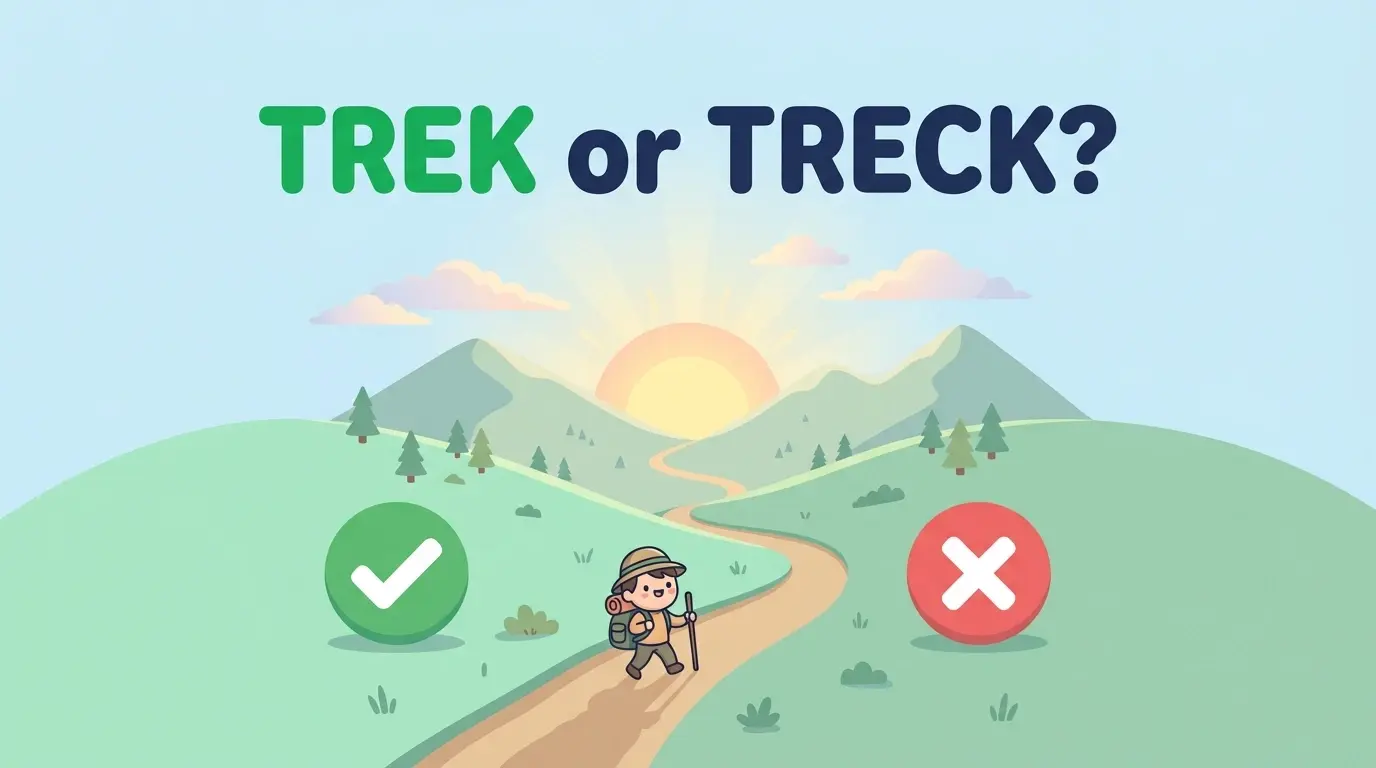
The answer is simple. Trek is the correct spelling for a long, difficult, or tiring journey. Treck is generally a misspelling in modern English.
The word also has a spelling detail worth learning: the base word has one k, but its past-tense and -ing forms have two. You write trekked and trekking, never trecked or trecking.
This guide covers the meaning of trek, how it works as a noun and a verb, why people misspell it, where it comes from, and easy ways to remember it.
Quick Answer: Trek or Treck?
- Correct✅: trek
- Incorrect❌: treck
- Correct forms: trek, treks, trekked, trekking, trekker
Use trek in school assignments, emails, travel writing, social media captions, and everyday messages.
Correct✅: We went on a long trek through the mountains.
Incorrect❌: We went on a long treck through the mountains.
You do not need to learn two meanings to choose between them. Treck is not a separate word with its own definition. It is a spelling error.
What Does Trek Mean?
Trek means a long walk or journey, often through hills, mountains, forests, deserts, or other challenging ground. Modern English also uses it for an ordinary trip that feels long, tiring, or inconvenient.
The word suggests effort, distance, and endurance. That is why writers often prefer it to a plain word like “walk.” It works as both a noun and a verb.
Trek as a Noun
As a noun, trek names the journey itself.
- We completed a three-day trek.
- The trek through the mountains was exhausting.
- Our trek ended near a quiet lake.
- They planned a trek through the forest.
Trek as a Verb
As a verb, trek describes the action of traveling a long distance, especially on foot or with some difficulty.
- We trek through the hills every summer.
- They trekked across the valley.
- She had to trek home in the rain.
- We trekked for hours to reach the campsite.
Trek for Everyday Journeys
A trek does not have to involve wilderness. People often use it informally for a trip that feels longer or harder than it should.
- The store is only two miles away, but walking there feels like a trek.
- Getting to the office was a trek because of the traffic.
- Getting through the airport felt like a trek.
This casual use adds humor and exaggeration. It is natural in conversation and informal writing.
Is Treck a Word?
In ordinary writing, treck is not the accepted spelling for a long journey. Standard modern usage has only one form: trek. You may still run into treck in a few places:
- a typo or quick-typing slip
- a proper name, brand name, or username
- a stylized or deliberate spelling
None of these makes treck the normal spelling of the English word. If you are writing about a long walk or journey, use trek. If you see treck in an official name, copy that name exactly and check its spelling separately.
Treck is also not a British or American variant. Trek is the standard spelling in both.
| Incorrect❌ | Correct✅ |
| We planned a treck. | We planned a trek. |
| The treck was difficult. | The trek was difficult. |
| They trecked through the forest. | They trekked through the forest. |
| We enjoy trecking. | We enjoy trekking. |
Why Do People Spell Trek as Treck?
Several things push writers toward the extra c.
1. Similar words end in -ck. Check, deck, neck, wreck, and speck all end in -ck. Trek rhymes with deck, so it seems natural to expect the same ending.
2. Spelling by sound. English spelling is not fully phonetic. The sound /trɛk/ can be written in more than one way, and learners who spell by ear often choose the wrong one.
3. Fast typing. On a phone, a slipped finger or a missed autocorrect can leave the extra letter in place.
4. Repetition online. When a misspelling appears often enough, other people copy it.
The lesson is that you cannot always predict a spelling from similar-sounding words. Learn the established form and recognize it.
Treck vs Trek: Quick Comparison
| Feature | Trek | Treck |
| Standard spelling | Yes | No |
| Meaning | A long or difficult journey | Usually a misspelling of trek |
| Noun use | A trek | Not standard |
| Verb use | To trek | Not standard |
| Past tense | Trekked | Trecked is incorrect |
| -ing form | Trekking | Trecking is incorrect |
| Example | We went on a trek. | We went on a treck. |
Trek, Treks, Trekked, Trekking: The Spelling Rules
The base word has four letters: T-R-E-K. When you add an ending that begins with a vowel, the final k doubles. This is a regular rule for short words that end in a single vowel plus a single consonant, and it is why you get trekked and trekking.
Trek is the base verb or the singular noun.
- I want to trek across the countryside.
- The trek was longer than expected.
Treks is the plural noun, or the present tense with he, she, or it.
- The guide organizes several treks each year.
- She treks through the hills every weekend.
Trekked is the past tense and past participle.
- We trekked through the forest yesterday.
- She has trekked across several mountain trails.
Trekking is the -ing form, and also a noun for the activity.
- We are trekking toward the campsite.
- Trekking is popular in this region.
Trekker is a person who treks.
- The trekkers rested near the river.
| Form | Correct spelling |
| Base form | trek |
| Plural noun / derogatory-it present | treks |
| Past tense and past participle | trekked |
| Present participle / activity | trekking |
| Person who treks | trekker |
Avoid treck, trecked, and trecking in every one of these roles.
Where Does the Word Trek Come From?
Knowing the origin makes the spelling easier to trust. Trek entered English from Afrikaans, which borrowed it from Dutch. The original sense was to pull, travel, or migrate slowly, and it was linked with journeys by ox wagon in Southern Africa. In the 1800s, long overland migrations across rough country were called treks.
English kept the word and widened it. Today it covers:
- hiking and mountain journeys
- long walks through forests, deserts, or remote areas
- difficult journeys such as evacuations or migrations
- figurative uses like a tiring commute
The spelling stayed short and simple. The extra c in “treck” came later from writers guessing at the spelling, not from the word’s history.
Trek vs Hike, Journey, Expedition, and Track
Trek has several near neighbors. They overlap, but each has its own feel.
| Word | Meaning | How it differs |
| Trek | A long, difficult journey | Stresses effort, distance, and endurance |
| Hike | A walk in nature | Usually shorter and recreational |
| Journey | Travel from one place to another | More general |
| Expedition | An organized exploration | More formal and planned |
| Walk | Moving on foot | Plain and neutral |
Trekking is generally longer and more demanding than a simple hike. A walk in a city park is not usually a trek, while a three-day mountain route can be.
Trek or Track
Trek and track are different words with different meanings, and people sometimes mix them up.
- Trek: a long or difficult journey.
- Track: a path, course, or route, or a verb meaning to follow or monitor something.
We went on a trek through the hills. Follow the track through the woods.
Trek vs. Star Trek
“Star Trek” is a proper noun naming a science fiction franchise. The word trek on its own is an ordinary English word for a journey. The franchise made the word widely recognized and reinforced the spelling, but the two are not the same thing.
Read More: Tying or Tieing? The Correct Spelling, Meaning, and Examples
How to Use Trek in a Sentence
Use trek when a journey is long, demanding, or tiring. The sentence itself tells you whether it is a noun or a verb.
As a noun
- Our trek through the mountains took three days.
- The trek to the lake was worth the effort.
- The hikers prepared carefully for their trek.
- The trek home felt longer than usual.
- Their trek across the valley was challenging.
As a verb
- We will trek through the hills tomorrow.
- They trekked across the desert last year.
- She had to trek home after missing the bus.
- We are trekking toward the campsite.
- I trekked to the station in heavy rain.
Figurative
- My commute is a daily trek.
- The walk from the parking lot to the stadium was a trek.
Where Trek Fits Best
- Travel writing: to describe routes, difficulty, and adventure.
- News reporting: for long, hard journeys, such as families traveling to safety after a disaster.
- Academic writing: in geography, anthropology, and migration studies.
- Social media: often playfully, as in “grocery trek” or “coffee trek.”
Trek works in both formal and informal writing. The tone depends on the sentence, not on the word.
Common Mistakes With Trek
Mistake 1: Writing treck instead of trek.
Incorrect❌: We went on a long treck.
Correct✅: We went on a long trek.
Mistake 2: Writing trecked instead of trekked.
Incorrect❌: They trecked through the mountains.
Correct✅: They trekked through the mountains.
Mistake 3: Writing trecking instead of trekking.
Incorrect❌: We enjoy trecking in the hills.
Correct✅: We enjoy trekking in the hills.
Mistake 4: Thinking a trek must involve climbing.
A trek can be a long walk across plains, forests, or even a city. Mountains are common but not required.
Mistake 5: Overusing trek for trivial trips.
The casual use is fine, but too much of it weakens the word. A walk to the house next door is just a walk. Save trek for effort or distance.
Mistake 6: Mixing up trek and track.
They are different words. See the comparison above.
Easy Ways to Remember the Correct Spelling
Trick 1: Count four letters. T-R-E-K. There is no c between the e and the k.
Trick 2: Learn the word family together. Write trek, trekked, trekking as a group. One k in the base, two in the longer forms.
Trick 3: Use a memory sentence. “We trekked through the mountains after planning our trek.” It holds the noun and the verb.
Trick 4: Picture the meaning. Think of boots, trails, forests, and long roads. When that image comes to mind, think of the short word.
Trick 5: Read it in context. Travel stories and outdoor guides use trek constantly, and seeing the right spelling often is the fastest way to lock it in.
Useful Synonyms and Common Phrases
Synonyms: journey, trip, hike, expedition, walk, march. Pick carefully. Trip is broad, hike is recreational, and the expedition sounds planned and serious.
Common phrases: mountain trek, long trek, difficult trek, weekend trek, trek through the woods, trek across town, go trekking, trekking trail, trekking boots, trekking guide.
Key Takeaways
- Trek is the standard spelling. Treck is generally incorrect.
- A trek can be a long walk or a tiring everyday journey.
- Trek works as both a noun and a verb.
- The past tense is trekked, and the -ing form is trekking.
- American and British English use the same spelling.
- Trek and track are different words.
FAQs
1. Is it treck or trek?
Trek is correct. Use it for a long or difficult journey. Treck is generally a misspelling.
2. What does trek mean?
A trek is a long walk or journey, often through hills, mountains, or forests. As a verb, it means to travel a long distance, usually on foot.
3. Is treck a real word?
Treck is not the standard modern spelling for the journey meaning. It can appear as a typo or in a name, but in ordinary writing use trek.
4. How do you spell trek?
T-R-E-K. Four letters, no c.
5. Is it trekking or trecking?
Trekking. The final k doubles before -ing.
6. Is it trekked or trecked?
Trekked. It is the past tense and past participle.
7. What is the plural of trek?
Treks. For example: “We completed two treks during our vacation.”
8. Can trek be used as a verb?
Yes. “We trek through the forest” and “They trekked across the valley” are both correct.
9. Does trek always mean hiking?
No. It often describes hiking or outdoor travel, but it can also refer informally to any tiring trip, such as “Getting to the airport was a trek.”
10. Is trekking the same as hiking?
They are similar. Trekking usually suggests a longer, more demanding journey, often over several days.
Conclusion:
Trek is the correct spelling when you mean a long or difficult journey, and treck is generally a mistake.
The confusion is understandable, since words like check, deck, and neck make an extra c feel natural.
Keep the word family in mind: trek, treks, trekked, trekking, trekker. The base word has no c, and the k doubles only before endings like -ed and -ing.
If you are describing a mountain adventure or a tiring trip across town, choose trek.

I am an English language writer passionate about grammar and clear communication. I create simple, easy-to-understand content that helps readers improve their English skills. My goal is to make learning English both practical and enjoyable.