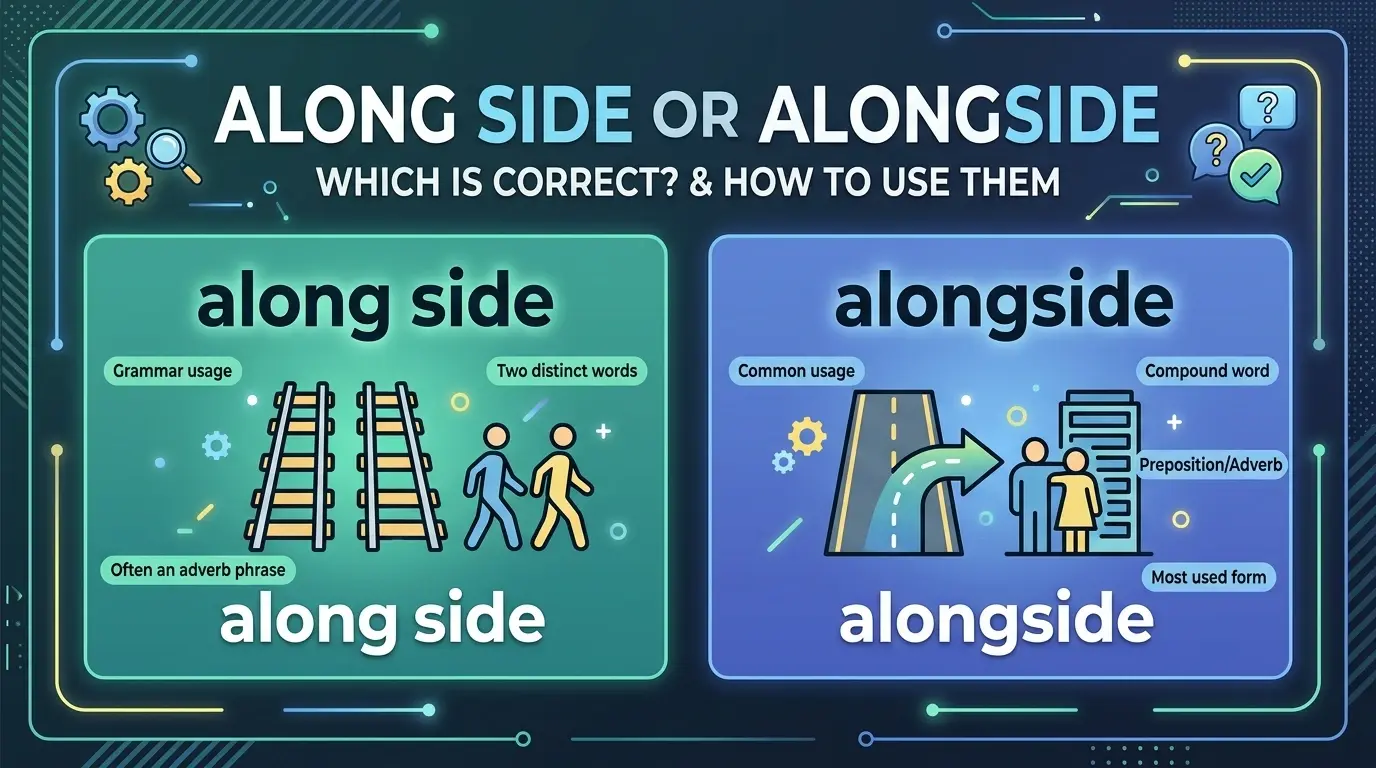
Alongside is the correct standard spelling when you mean “next to,” “beside,” or “together with.” Along side is usually incorrect when used with these meanings.
You are writing an email and want to say that someone worked next to you. You type, “She worked along side me,” then stop and wonder if the words should be joined.
This is a common English spelling mistake because along and side are both separate words on their own. However, alongside is an established word with its own meaning. It can work as a preposition or an adverb.
The good news is that the rule is simple. Use alongside as one word when you mean “next to,” “beside,” or “together with.”
In this guide, you will learn the difference, see clear examples, and discover when along side may appear in a different grammatical construction.
Quick Answer
Alongside is the correct one-word form in standard English when it means “next to,” “beside,” or “together with.”
For example:
- She sat alongside her brother.
- The new building stands alongside the old one.
- He worked alongside experienced engineers.
Along side is normally not the correct spelling for these meanings.
Quick Rule
Use “alongside” as one word when you mean next to, beside, or together with someone or something.
What Does “Alongside” Mean?
Alongside means next to, beside, or together with someone or something. It can describe physical position or people working and acting together.
The word has two common uses.
First, alongside can describe physical position. If one object is beside another, you can use alongside.
For example:
The car stopped alongside the building.
Here, the car stopped next to the building.
Second, alongside can describe working or existing together.
For example:
She works alongside her father.
This means she works together with her father.
Cambridge lists alongside as both a preposition and an adverb. Its meanings include “next to” and “together with.”
Read More: Goodluck or Good Luck? Correct Spelling, Meaning & ExamplesWhy Is “Alongside” One Word?
Alongside became an established compound word from along + side. Modern English normally writes it as one word.
The word has been used for centuries. Its early use was strongly connected with position beside something, especially in nautical contexts.
Today, alongside is a normal English word. You will find it in everyday writing, professional communication, news articles, and academic writing.
This is similar to many English words that began as separate elements but became established as single words.
For example:
- altogether
- already
- another
- alongside
So, seeing along + side as two familiar words does not mean they should always remain separate.
Alongside or Along Side
The main difference is simple: alongside is the established word, while along side is usually an incorrect spacing of that word.
| Form | Standard use? | Meaning |
| alongside | Yes | next to, beside, together with |
| along side | Usually no | usually an incorrect form of “alongside” |
| along-side | No in normal modern use | generally an incorrect hyphenated form |
Compare these examples:
Correct:
The nurse worked alongside the doctor.
Incorrect:
The nurse worked along side the doctor.
The meaning is clear in both sentences, but standard English uses alongside as one word.
Is “Along Side” Ever Correct?
In normal modern English, alongside should be written as one word when it has its standard meaning.
However, English sometimes allows separate words to appear next to each other for completely different grammatical reasons.
For example, along can be a preposition, and side can be a noun.
Consider:
We walked along the side of the river.
Here, along and side are not forming the word alongside.
The phrase means that you walked along a particular side of the river.
This is an important distinction.
Alongside
We walked alongside the river.
This means we walked beside the river.
Along the side
We walked along the side of the river.
This also describes movement beside a river, but the grammatical structure is different.
The second sentence contains the separate phrase along the side, not the word alongside.
Alongside vs “Along the Side”
These expressions can sometimes have similar meanings, but they are not grammatically identical.
Alongside is a single preposition or adverb.
The road runs alongside the river.
Along the side contains a preposition, an article, and a noun.
The children walked along the side of the road.
The first sentence uses alongside to mean “beside.”
The second describes movement along a particular side.
Both can be correct, depending on the sentence.
How to Use “Alongside” in a Sentence
Use alongside when you want to show that someone or something is beside another person or thing.
It can also show cooperation or simultaneous activity.
Here are several common patterns.
1. Alongside a person
She sat alongside her mother.
This means she sat beside her mother.
He walked alongside his friend.
This means he walked next to his friend.
2. Alongside an object
The bicycle was parked alongside the wall.
The bicycle was next to the wall.
A small path runs alongside the road.
The path runs beside the road.
3. Alongside a group
She worked alongside a team of designers.
This means she worked together with the designers.
4. Alongside another activity
He studies alongside his part-time job.
This means he studies while also having a part-time job.
5. Alongside another thing
The new system works alongside the existing system.
This means both systems work together.
15 Real Examples of “Alongside”
Here are examples showing how alongside works in everyday English.
- The children walked alongside their teacher.
- A narrow road runs alongside the river.
- She sat alongside her best friend.
- The car stopped alongside the sidewalk.
- He worked alongside his father for many years.
- The new building stands alongside the old library.
- Nurses worked alongside doctors during the project.
- The company developed the product alongside its customers.
- We placed the chairs alongside the wall.
- She studied alongside her full-time job.
- The boat moved alongside the dock.
- He trained alongside some experienced athletes.
- The new policy will operate alongside existing rules.
- A bike lane runs alongside the main road.
- The two teams worked alongside each other.
Notice that the word remains alongside in every example.
Alongside as a Preposition
Alongside often works as a preposition.
A preposition connects a noun or pronoun with another part of the sentence.
For example:
She worked alongside her sister.
Here, alongside connects the action “worked” with “her sister.”
Other examples include:
The dog ran alongside me.
The truck stopped alongside the building.
He stood alongside his friends.
In these sentences, alongside means “next to” or “together with.”
Alongside as an Adverb
Alongside can also work as an adverb.
In this use, it does not need to be followed immediately by a noun.
For example:
The car pulled alongside.
The sentence means that the car moved next to something else.
Another example is:
I parked beside the entrance, and she parked alongside.
Here, alongside describes where she parked.
This use is less common for beginners, but it is completely standard.
Alongside and Beside
Alongside and beside often have similar meanings.
Both can describe something being next to another person or object.
Compare:
She sat beside me.
She sat alongside me.
Both sentences mean that she sat next to me.
However, alongside can also suggest working or existing together.
For example:
She worked alongside her colleagues.
This naturally means she worked together with them.
You could also say:
She worked beside her colleagues.
But alongside often fits better when the idea of cooperation is important.
Alongside or Along
Do not confuse alongside with along.
Along often describes movement or position following the length of something.
We walked along the beach.
There are shops along the street.
Alongside means next to or beside something.
We walked alongside the beach.
There is a path alongside the street.
The meanings can overlap in some situations, but the words are not interchangeable in every sentence.
Cambridge specifically distinguishes along from alongside. It describes alongside as meaning “close beside,” “next to,” or “together with.”
Common Mistakes With “Alongside”
Mistake 1: Writing “along side”
Incorrect:
She worked along side me.
Correct:
She worked alongside me.
The word should normally be written as one word.
Mistake 2: Adding a hyphen
Incorrect:
He walked along-side the road.
Correct:
He walked alongside the road.
Modern standard English normally uses the unhyphenated form.
Mistake 3: Confusing “alongside” with “along”
Incorrect:
She walked alongside the street for three miles.
This may be possible depending on the intended meaning, but along may be more natural if the idea is movement following the street.
Compare:
She walked along the street.
She walked alongside the street.
The first focuses on movement along the street. The second emphasizes being beside the street.
Mistake 4: Assuming “alongside” only means physical position
Alongside can also mean together with.
He worked alongside experienced teachers.
This does not simply describe physical location. It also suggests cooperation.
When Should You Use “Alongside”?
Use alongside when you mean:
- next to
- beside
- by the side of
- together with
- working with
- existing with something else
Examples:
The hotel stands alongside the beach.
She works alongside her husband.
The new technology will operate alongside the current system.
He trained alongside professional players.
A simple test can help.
If you can replace alongside with next to or together with, it is probably the right word.
For example:
The dog walked alongside me.
Replace it:
The dog walked next to me.
The meaning still works.
When Should You Use “Along the Side”?
Use along the side when you are talking about a specific side as a noun.
For example:
We walked along the side of the building.
Here, side is a noun. It has the article the before it.
Another example:
There were flowers along the side of the road.
You are talking about a particular side of the road.
This is different from:
There were flowers alongside the road.
Both sentences can describe flowers beside a road, but their grammatical structures differ.
A Simple Memory Trick
Remember this:
Alongside = next to.
If you can replace the word with beside or next to, write alongside as one word.
For example:
He stood alongside his friend.
Try:
He stood beside his friend.
The meaning remains clear.
So remember:
Alongside = beside = next to.
Do not split it into along side just because the word contains two familiar parts.
Is “Alongside” American or British English?
Alongside is used in both American and British English.
It is not a US-versus-UK spelling difference.
American English uses alongside, and British English also uses alongside.
For example:
The new store opened alongside the existing market.
The spelling does not need to change based on the country.
This makes alongside different from words such as color/colour or canceled/cancelled, where regional spelling differences can occur.
For alongside, the standard spelling remains one word.
“Alongside of” vs “Alongside”
You may sometimes see alongside of, especially in American English.
For example:
The house stood alongside of the road.
However, alongside without of is the simpler standard choice in many contexts.
Compare:
The house stood alongside the road.
The house stood alongside of the road.
The first version is more direct.
If you are writing for school, work, or a professional audience, alongside is usually the safest choice.
FAQs
Is “along side” correct?
Usually, no. When you mean “next to,” “beside,” or “together with,” the standard spelling is alongside as one word.
Is alongside one word?
Yes. Alongside is normally written as one word.
Is “along side” a spelling mistake?
When it is intended to mean the word alongside, yes, it is generally treated as an incorrect spacing.
What does alongside mean?
Alongside means next to, beside, or together with someone or something.
Can alongside mean together with?
Yes. For example, “She worked alongside her colleagues” means she worked together with them.
Is alongside used in American English?
Yes. Alongside is standard in American English and British English.
Is “along-side” correct?
The standard modern form is alongside, without a hyphen.
What is the difference between alongside and beside?
Both can mean “next to.” Alongside can also emphasize working or existing together with someone or something.
What is the difference between alongside and along?
Along often describes movement following the length of something. Alongside means next to, beside, or together with something.
Can I use alongside in formal writing?
Yes. Alongside is suitable for formal, academic, professional, and everyday writing.
Conclusion:
Alongside is the correct standard form when you mean “next to,” “beside,” or “together with.” Write it as one word.
Use alongside in sentences such as “She worked alongside her team” or “The road runs alongside the river.” Avoid splitting it into along side when you mean the established word.
Remember the simple rule: alongside = beside or next to.
If you are talking about a specific side, however, you can use the separate phrase along the side of, as in “We walked along the side of the building.”

As an American English writer, I specialize in creating clear and engaging content that makes grammar and language learning accessible to everyone. I enjoy breaking down complex English concepts into simple, practical lessons that readers can apply with confidence. My mission is to help learners strengthen their communication skills through easy and reliable content.