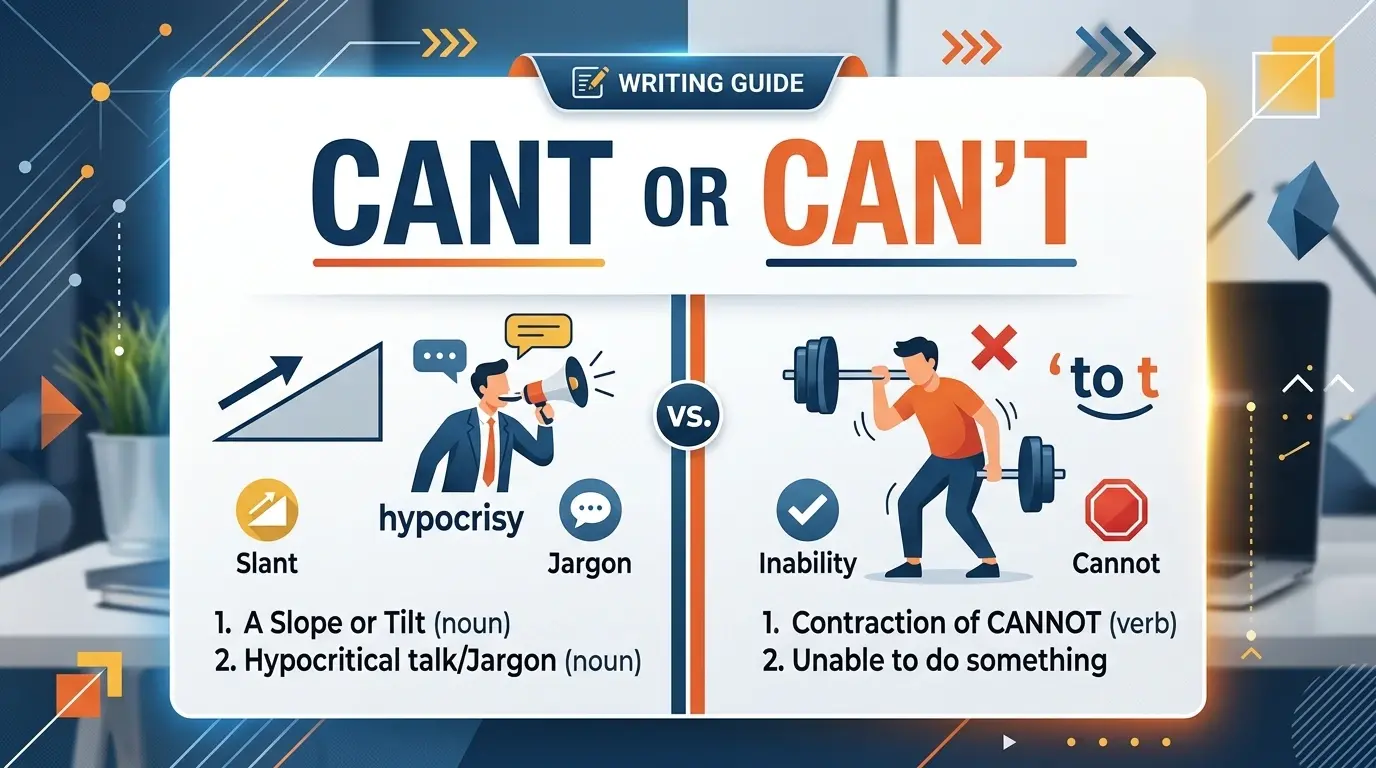
If you are writing an email, school assignment, or professional document, you may pause over one small question: cannot, can not, or can’t?
All three forms can appear in English, but they are not interchangeable in every sentence. The good news is that the main rule is simple. Cannot is the standard one-word form when can means “to be unable to.”
Can’t is the contraction of cannot and is common in everyday speech and informal writing.
Can not is possible, but it usually appears when not belongs to a separate part of the sentence, such as in structures like can not only…but also.
Understanding this small difference can help you avoid common grammar mistakes and choose the right form for emails, essays, conversations, and formal writing.
Cannot vs. Can Not vs. Can’t – Quick Answer
Cannot is the standard spelling when you mean that someone is unable to do something.
- I cannot attend the meeting.
- She cannot drive at night.
- We cannot wait any longer.
Can’t is simply the contracted form of cannot and is more common in speech and informal writing.
- I can’t attend the meeting.
- She can’t drive at night.
- We can’t wait any longer.
Can not is also grammatically possible, but it is used in different constructions. It is especially common when can is followed by not only or when not modifies a separate phrase.
- You can not only learn English but also improve your writing.
- We can not accept the offer and choose another option instead.
Simple rule
Cannot = standard negative form
Can’t = contraction of cannot
Can not = two separate words used in specific grammatical constructions
Read More: As Well or Aswell? Correct Spelling, Meaning & ExamplesWhat Does “Cannot” Mean?
Cannot means that someone or something is unable to do something. It is the negative form of can.
For example:
- I cannot swim.
- He cannot come today.
- They cannot solve the problem.
- This machine cannot operate without electricity.
In each sentence, cannot expresses inability or the lack of possibility.
Is “Cannot” One Word?
Yes. When cannot means “am not/is not/are not able to,” it is normally written as one word.
Correct:
I cannot understand this question.
Incorrect for this meaning:
I can not understand this question.
This is one of the most common mistakes involving cannot.
What Does “Can’t” Mean?
Can’t is a contraction of cannot.
A contraction combines two words into a shorter form. In this case:
cannot → can’t
For example:
- I cannot help you.
- I can’t help you.
Both sentences have essentially the same meaning.
When Should You Use “Can’t”?
Can’t is very common in:
- Everyday conversation
- Text messages
- Casual emails
- Social media
- Informal writing
- Dialogue in stories
For example:
Sorry, I can’t come to the party tonight.
I can’t find my keys.
We can’t finish the project today.
The contraction sounds natural in ordinary conversation.
Cannot vs Can’t in Formal Writing
Both cannot and can’t are grammatically correct, but cannot is generally the safer choice in formal writing.
For example, in a formal report:
The company cannot accept responsibility for the delay.
In a casual message:
Sorry, I can’t make it today.
Using cannot gives the writing a more formal tone, while can’t sounds more conversational.
This does not mean that can’t is grammatically wrong in formal writing. Contractions can appear in many modern forms of professional writing. The appropriate choice depends on the style and tone required.
What About “Can Not”?
This is where the confusion usually begins.
Can not can be grammatically correct, but it is not normally the spelling you use when simply saying that someone is unable to do something.
For example:
❌ I can not attend the meeting.
If your meaning is “I am unable to attend,” the standard form is:
✅ I cannot attend the meeting.
However, there are situations where can and not function separately.
Example: “Can Not Only…But Also”
One common example is the structure:
can not only…but also…
For example:
This course can not only improve your grammar but also strengthen your vocabulary.
Here, not is part of the larger structure not only…but also. It is not simply the negative form of can.
Another example:
The new system can not only save time but also reduce costs.
In these sentences, writing cannot only would change the grammatical structure and would not express the same construction.
Can Not or Cannot: Compare the Meaning
Look at these examples:
Cannot
I cannot eat another slice of cake.
Meaning: I am unable to eat another slice.
Can not
You can not eat dessert and choose fruit instead.
Here, the words are separated because not belongs with the choice or alternative being described.
A useful way to think about it is this:
Cannot usually expresses inability.
Can not can emphasize the separate ideas of can and not, depending on the sentence structure.
Cannot vs Can’t Examples
Here are some everyday examples:
| Cannot | Can’t |
| I cannot come today. | I can’t come today. |
| She cannot drive. | She can’t drive. |
| We cannot wait. | We can’t wait. |
| He cannot find his phone. | He can’t find his phone. |
| They cannot accept the offer. | They can’t accept the offer. |
The meaning is essentially the same. The main difference is style and formality.
Can or Can’t: Why They Sound Different
There is another important issue: pronunciation.
English learners sometimes have trouble hearing the difference between can and can’t, especially in fast conversation.
The final t in can’t may not always be strongly pronounced. Because of this, English speakers often use stress and vowel differences to make the meaning clear.
Compare:
I can meet you tomorrow.
I can’t meet you tomorrow.
In natural speech, can is often unstressed when it is used as an auxiliary verb, while can’t normally receives more emphasis because it carries the negative meaning.
For example:
I CAN’T come tomorrow.
The stronger stress helps the listener recognize the negative meaning.
Why This Matters
Misunderstanding can and can’t can completely change the meaning of a sentence.
If someone says:
I can help you.
they are saying they are able to help.
But:
I can’t help you.
means they are unable to help.
So listening for stress and context can be especially important in conversations.
Common Mistakes With Cannot, Can Not, and Can’t
Mistake 1: Writing “Can Not” for Every Negative Sentence
❌ She can not swim.
✅ She cannot swim.
When cannot means “is unable to,” use the one-word form.
Mistake 2: Thinking “Can’t” Is Incorrect
❌ “Can’t” is always grammatically wrong.
✅ Can’t is a standard contraction of cannot.
It is perfectly normal in informal communication.
Mistake 3: Using “Cannot” in a “Not Only” Structure
❌ The app cannot only save time but also reduce costs.
For the intended not only…but also construction:
✅ The app can not only save time but also reduce costs.
Mistake 4: Using Contractions in a Very Formal Context Without Checking the Style
Can’t is grammatically correct, but some formal documents, academic assignments, or professional style guides may prefer the full form.
When in doubt, cannot is the more formal choice.
Cannot vs Can’t in Everyday Writing
Your choice can depend on the situation.
Text Message
I can’t talk right now.
Casual Email
I can’t join the meeting today.
Formal Email
Unfortunately, I cannot attend the meeting.
Academic Writing
The results cannot be confirmed without further research.
Professional Report
The company cannot guarantee delivery by Friday.
The key is not simply whether a form is “right” or “wrong.” Tone, context, and sentence structure matter.
Quick Comparison Table
| Form | Meaning/Use | Typical Context |
| cannot | Standard negative form of can | Formal and general writing |
| can’t | Contraction of cannot | Speech and informal writing |
| can not | Separate can + not | Specific grammatical structures |
Which One Should You Use?
If you are unsure, use this simple guide:
Use “cannot” when you mean someone is unable to do something.
I cannot attend the meeting.
Use “can’t” when writing naturally in conversation or informal situations.
I can’t attend the meeting.
Use “can not” when the grammar of the sentence requires can and not to remain separate.
She can not only speak English but also write it fluently.
This rule will cover most situations you encounter.
FAQs
Is “cannot” one word or two?
Cannot is normally written as one word when it means “to be unable to.”
I cannot help you today.
Is “can’t” the same as “cannot”?
Yes. Can’t is the contraction of cannot, and both normally express inability or lack of possibility.
Is “can not” grammatically correct?
Yes, but only in certain constructions. When you simply mean “unable to,” cannot is the standard form. Can not often appears when not belongs to another grammatical structure, such as not only…but also.
Is “cannot” more formal than “can’t”?
Generally, yes. Cannot is usually preferred when a more formal tone is needed, while can’t is common in conversation and informal writing.
Should I use “cannot” in an essay?
If your essay requires a formal style, cannot is usually the safer choice. However, whether contractions are allowed depends on your instructor, publication, or style guide.
Why is “can’t” pronounced differently from “can”?
The negative form often receives stronger stress, and the final t in can’t may be less noticeable in some accents or connected speech. Context and stress help listeners distinguish the two.
Can “can not” ever be correct?
Yes. For example:
You can not only improve your grammar but also build your confidence.
Here, not is part of the not only…but also construction.
Conclusion:
The difference between cannot, can not, and can’t is easier than it first appears.
Use cannot as the standard one-word negative form of can when you mean “be unable to.”
Use can’t as its contraction in everyday speech and informal writing. Use can not only when can and not serve separate grammatical purposes, such as in can not only…but also constructions.
When you are simply saying that someone is unable to do something, remember the easiest rule: cannot is one word. In casual communication, can’t is the natural shortened form.

I’m Sophia Mitchell, an English grammar and writing enthusiast. I create simple, easy-to-understand content to help learners improve their English. My goal is to make grammar clear, practical, and enjoyable for everyone.










