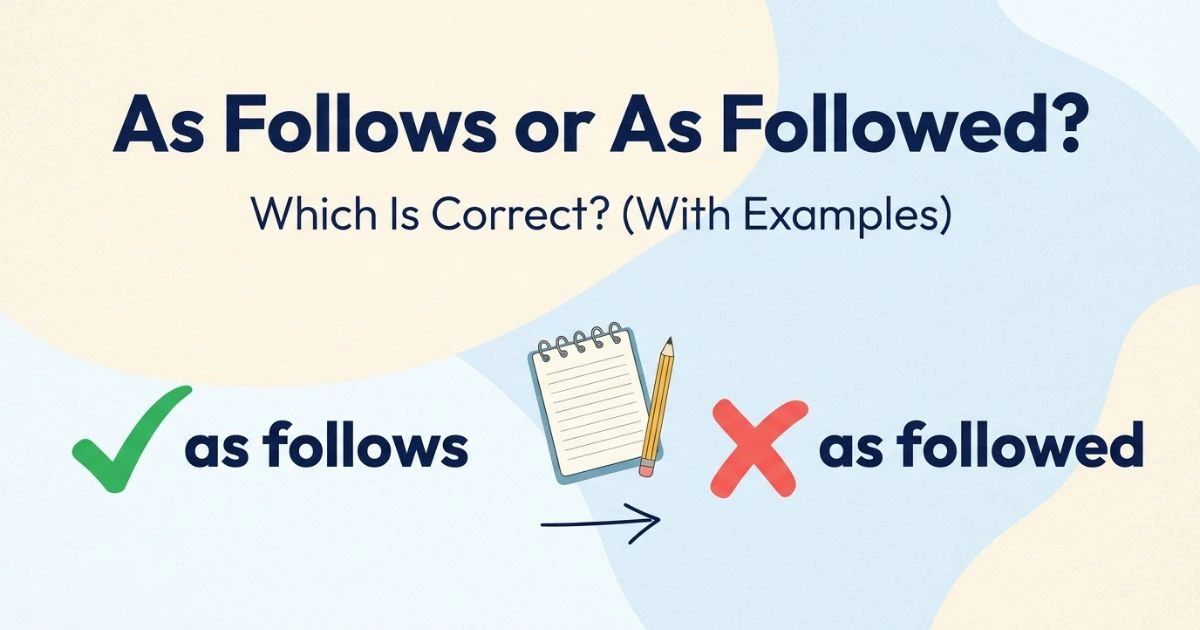
You type “The steps are as followed:” and your email app draws a red line under it. The correct phrase is “as follows,” and the verb never changes.
Use “as follows” to introduce a list, steps, or details that come next. “As followed” is a common slip.
It only works, in rare cases, when “followed” means “obeyed,” like “the plan as followed by the team.”
Many writers also write “as follow” when the list is long. That is wrong too, because the phrase is fixed and never changes form.
Below, you will learn the simple rule, the one real exception, an easy memory trick, and clear examples you can copy.
Table of Contents
- Quick Answer
- What Does “As Follows” Mean?
- Why Is It “Follows” and Never “Follow”?
- Is “As Followed” Ever Correct?
- Comparison Table: Four Look-Alike Phrases
- How to Punctuate “As Follows”
- Memory Trick
- 20 Example Sentences
- Common Mistakes
- When to Use Each Form
- FAQs
- Conclusion
- Key Takeaways
- Internal Linking Suggestions
- External References
- Schema Note
Quick Answer Box
Quick Answer: The correct phrase is “as follows.” Use it to introduce a list, steps, or details that come next. The verb stays “follows” even when the list has many items. “As followed” is almost always a mistake. It only works when “followed” is a past participle, as in “the steps as followed by the team.”
⚡ Quick Rule in 1 Line
Always write “as follows” with an S, even when a long list of items comes next.
What Does “As Follows” Mean?
“As follows” means “as comes next.” You use it to point forward to a list, a set of steps, or details you are about to give. Merriam-Webster lists it as a phrase and says it is used impersonally. It has been in use since the 14th century.
Think of it as a signpost. It tells the reader, “The details are coming right now.”
Here is how it looks in real writing:
- The rules are as follows: arrive early, bring your ID, and stay quiet.
- My position is as follows.
- The schedule for next week is as follows.
Notice that each sentence points forward. The information comes after the phrase, not before it. That forward pointing is what linguists call a cataphoric reference. You do not need that word. Just remember that “as follows” looks ahead.
Where you will see it
You will see “as follows” in places where clear order matters:
- Business emails and reports
- Legal and policy documents
- Instructions and school assignments
- News stories that list results or numbers
It sounds a little formal. That is fine in work and school writing. In a text to a friend, you would probably say “here’s the plan” instead.
Why Is It “Follows” and Never “Follow”?
The phrase is a fixed expression. It works as if it says “as it follows,” so the verb stays singular. This is true even when the list after it has many items. Writers do not change it to “as follow,” no matter how long the list is.
This is the part that trips people up. Your brain says, “I have five steps, so I need a plural verb.” That feels logical. But the verb does not agree with your list. It agrees with a hidden “it.”
The language blog Grammarphobia explains this well. It notes that the Oxford English Dictionary calls the verb impersonal and says the plural “follow” is incorrect. It also reports that Merriam-Webster’s Dictionary of English Usage says all experts agree on the singular form, even after a plural subject. Garner’s usage guide gives the same advice: the phrase is short for “as it follows,” not “as they follow.”
So the pattern looks like this:
- Singular list: The question is as follows.
- Plural list: The questions are as follows.
Both use “follows.” The words before the phrase can change. The phrase itself does not.
An old habit
The form is not new. The Oxford English Dictionary traces it back to the 1400s, and the early examples already use the singular. So “as follows” has been frozen for about 600 years. Your spell checker is not being picky. It is following a very old rule.
Is “As Followed” Ever Correct?
“As followed” is almost always wrong when you use it to introduce a list. It only works when “followed” is a past participle that describes something people obeyed or did, like “the diet as followed by athletes.” In that case it means “as it was followed.”
This is the exception that makes this keyword interesting. Most guides stop at “as followed is wrong.” That is true for 95 percent of cases. But the two words can sit side by side in a correct sentence.
The wrong way
Writers often use “as followed” when they mean “as follows.” Here are typical errors:
- ✗ The steps are as followed: first, open the file.
- ✗ Fees will be charged as followed.
- ✗ The dates are as followed.
Each sentence wants to introduce a list. That job belongs to “as follows.”
The right way
Here, “followed” is a real past participle. It describes a rule, plan, or habit that people obeyed:
- ✓ The report describes the safety plan as followed by the night crew.
- ✓ This is the recipe as followed in my grandmother’s kitchen.
- ✓ The study checked the diet as followed by the athletes.
To test it, replace “as followed” with “as it was followed.” If the sentence still makes sense, you may be fine. If you are trying to introduce a list, use “as follows.”
A word of care: even in correct uses, “as followed” is rare. If a sentence sounds clumsy, rewrite it. “The recipe my grandmother used” is easier to read.
Comparison Table: Four Look-Alike Phrases
Only one of these four phrases works as the standard way to introduce a list: “as follows.” The other three either break the grammar or fit only narrow cases. This table gives you the verdict at a glance, so you can check your sentence in seconds.
| Phrase | Correct? | Why | Example |
|---|---|---|---|
| as follows | ✓ Yes | Fixed phrase that points forward to a list | The steps are as follows: mix, bake, cool. |
| as follow | ✗ No | Plural verb is not accepted in this phrase | ✗ The steps are as follow. |
| as followed | ✗ Usually no | Past tense does not introduce a list | ✗ The steps are as followed. |
| as followed by | ✓ Only in a narrow case | “Followed” is a past participle meaning “obeyed” | The rules as followed by the team. |
| as following | ✗ Not standard | Not the set phrase; sounds off to most readers | ✗ The steps are as following. |
How to Punctuate “As Follows”
Use a colon after “as follows” when a list or full details come next. Use a period if the details are in the next sentence. Do not put a colon right after a plain verb like “are” without the phrase. The colon signals “more is coming.”
Here are the three common patterns.
Pattern 1: Colon plus a list
This is the most common pattern.
- The requirements are as follows:
- A valid passport
- Two photos
- A signed form
Pattern 2: Colon plus a sentence
You can also add a short statement after the colon.
- My answer is as follows: I cannot attend the meeting.
Pattern 3: Period, then details
Sometimes the details start on a new line. A period works fine here.
- The results are as follows.
- Team A scored 12 points.
- Team B scored 9 points.
One extra tip: if you have only two short items, you can skip the phrase. Write “You need a pen and paper.” Shorter is often better.
Memory Trick
The easiest trick is to picture a hidden “it.” Read “as follows” as “as it follows.” Because “it” is singular, the verb takes an S. Then remember: the S never leaves, even when your list is long.
Here are two more quick ways to lock it in:
- S for Stays. The S in “follows” stays, no matter how many items come next.
- Follows looks forward. Both words end in S, and both point to what is coming. “As followed” looks backward at something already done.
Try this mini-test. Fill in the blank: “The three reasons are as ____.” If you wrote “follows,” you are right. If you wrote “follow” because of the word “three,” now you know why that feels natural but is wrong.
20 Example Sentences
Seeing the phrase in real sentences makes the rule stick. Study the correct examples first. Then check the fixes and the rare “as followed” cases. Each group is labeled so you can scan it quickly.
Correct: “as follows” in work and school writing
- The meeting agenda is as follows.
- The rules of the contest are as follows: submit early, follow the guidelines, and include your contact details.
- My three main points are as follows.
- The steps to reset your password are as follows.
- Your fees are as follows: $20 for the form and $10 for the copy.
- The deadline for each task is as follows.
- The questions on the quiz are as follows.
- Our final scores were as follows: 85, 90, and 92.
Correct: “as follows” in everyday writing
- The plan for Saturday is as follows: breakfast at nine, park at ten, lunch at noon.
- The winners are as follows: Maria, James, and Sylvia.
- The rules for the game night are as follows.
- The reasons for my choice are as follows.
Wrong sentences and their fixes
- ✗ The steps are as followed. → ✓ The steps are as follows.
- ✗ The rules are as follow. → ✓ The rules are as follows.
- ✗ Our fees are as following. → ✓ Our fees are as follows.
- ✗ The results is as follows. → ✓ The results are as follows. (Fix the verb before the phrase. The phrase itself was fine.)
Correct: “as followed” as a past participle
- The study tested the diet as followed by marathon runners.
- The safety plan, as followed by the night crew, reduced errors.
- This is the route as followed by the early settlers.
- We reviewed the policy as followed in the pilot program.
Notice the last four. In each one, “followed” means “obeyed” or “carried out.” None of them introduces a list.
Common Mistakes
The most common mistake is writing “as followed” or “as follow” when you want to introduce a list. Most errors come from tense confusion or from the urge to match a plural list. Learn these five patterns and you can catch nearly every slip.
Mistake 1: Using the past tense
- ✗ The instructions are as followed.
- ✓ The instructions are as follows.
The writer thinks, “The steps come after, so I must… follow-ed?” The past tense does not belong here.
Mistake 2: Matching the plural list
- ✗ The steps are as follow.
- ✓ The steps are as follows.
This feels logical, but the phrase is fixed. Leave the S on.
Mistake 3: Using “as following”
- ✗ The details are as following.
- ✓ The details are as follows.
The “-ing” version is not the standard set phrase. If you like “following,” use it in a different pattern, like “The following details apply.”
Mistake 4: Changing the verb before the phrase
- ✗ The dates is as follows.
- ✓ The dates are as follows.
Here the problem is not “as follows.” It is the verb before it. Make “are” match “dates.” The phrase itself stays the same.
Mistake 5: Forgetting the colon
- ✗ The rules are as follows they are simple.
- ✓ The rules are as follows: they are simple.
The colon tells the reader that details are coming.
When to Use Each Form
Use “as follows” whenever you point ahead to a list, steps, or details. Use “as followed by” only when you mean “as obeyed or practiced by.” Skip “as follow,” “as following,” and plain “as followed” in every other case. The table below shows the quick decision.
| Your goal | Best choice |
|---|---|
| Introduce a list, steps, or details | as follows |
| Describe a rule or plan that people obeyed | as followed by (rare) |
| Introduce a list in a softer style | the following |
| Point to details in an email or report | as follows or see below |
| Casual writing or texts | here’s the plan |
Good alternatives
Sometimes “as follows” sounds stiff. You have friendly options:
- The following: “The following steps will help you reset your account.”
- Here are: “Here are the steps to reset your account.”
- See below: “The full details are listed below.”
- A colon alone: “You need three things: a pen, paper, and a ruler.”
All four are correct. Pick the one that matches your tone. In a legal memo, “as follows” is a good fit. In a blog post, “here are” is friendlier.
Key Takeaways
- “As follows” is the correct phrase to introduce a list, steps, or details.
- The verb stays “follows” even when the list is plural.
- The phrase is short for “as it follows,” which explains the singular form.
- “As follow” and “as following” are not standard.
- “As followed” works only as a past participle, as in “as followed by the team.”
- Use a colon after “as follows” when a list comes next.
- Alternatives include “the following,” “here are,” and “see below.”
- Memory trick: the S stays, and “follows” looks forward.
FAQs
1. Is it “as follows” or “as followed”?
The correct phrase is “as follows.” Use it to introduce a list, steps, or details that come next. “As followed” is a common mistake in that role. It is only correct when “followed” is a past participle, as in “the plan as followed by the team.”
2. Is “as follow” correct?
No. The phrase is fixed with an S. Dictionaries and usage guides list “as follows,” and the Oxford English Dictionary calls the plural “follow” incorrect. This is true even when your list has many items.
3. Why do we say “as follows” even for a plural list?
The phrase works as a short form of “as it follows.” The hidden “it” is singular, so the verb stays singular. The number of items in your list does not change that.
4. Do I need a colon after “as follows”?
Usually yes, when a list or full details come right after it. Use a period if the details start in a new sentence or on a new line. Either way, the phrase itself stays the same.
5. Is “as following” correct?
No. It is not the standard set phrase. Use “as follows” or switch to “the following,” as in “The following steps apply.”
6. Can I say “are as follows” with a plural noun?
Yes. “The rules are as follows” is correct. The verb “are” matches “rules.” The phrase “as follows” does not change.
7. Is “as follows” too formal for emails?
It is fine in work emails, reports, and school writing. In friendly messages, you can say “here’s the plan” or “here are the details.” Both are natural and clear.
8. What is the difference between “as follows” and “the following”?
Both introduce what comes next. “As follows” ends the sentence and leads into a list: “The steps are as follows.” “The following” works as a modifier: “The following steps apply.” Both are correct.
9. When is “as followed” actually right?
It works when “followed” means “obeyed” or “carried out,” like “the diet as followed by athletes.” Test it by swapping in “as it was followed.” If that makes sense, the phrase may be fine. It is still rare.
10. Can I write “as follows” in the middle of a sentence?
Yes, if the details come right after it. For example: “The rules, as follows, apply to all members.” Most writers place it at the end of a clause and add a colon.
Conclusion:
The answer is simple: write “as follows.” It points ahead to a list or set of steps, and the verb never changes, even for a long list.
“As follow,” “as following,” and plain “as followed” are errors when you introduce details.
The only real exception is “as followed by,” where “followed” means “obeyed.” Picture the hidden “it,” keep the S, and add a colon.

As an American English writer, I specialize in creating clear and engaging content that makes grammar and language learning accessible to everyone. I enjoy breaking down complex English concepts into simple, practical lessons that readers can apply with confidence. My mission is to help learners strengthen their communication skills through easy and reliable content.