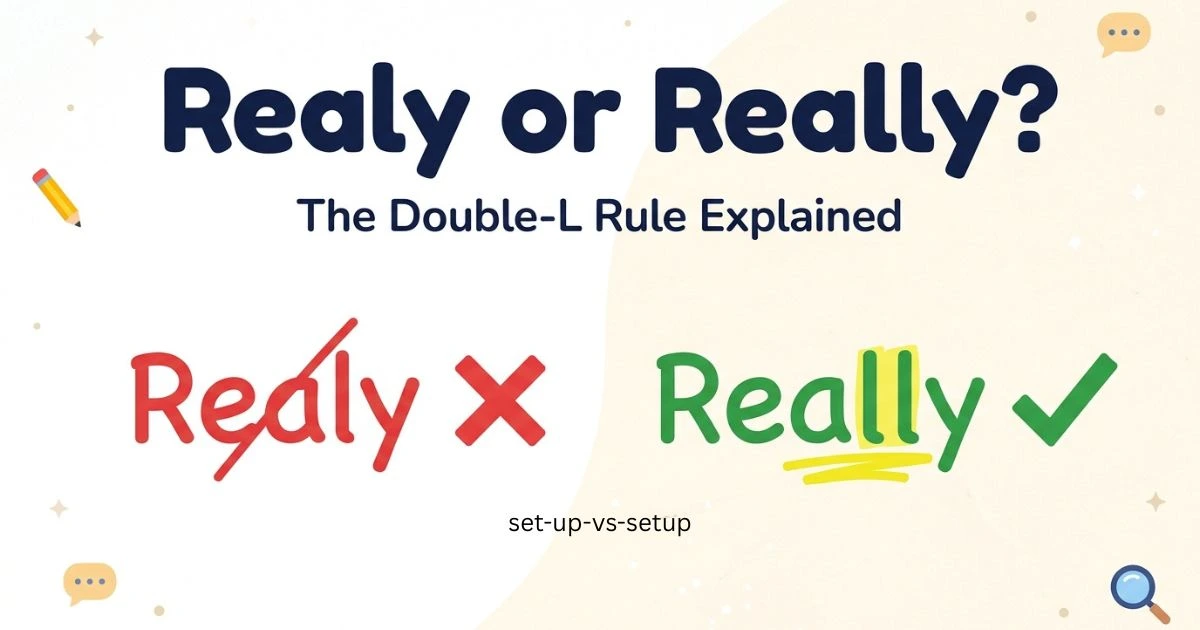
“Really” is the only correct spelling. “Realy” is a misspelling, in American and British English alike.
You are typing a quick text. “That was realy good.” Autocorrect underlines it in red, and you pause.
It happens to everyone. The word sounds like it has one L in the middle, so the second L feels optional. It isn’t. Dictionaries list only one form, and it has two Ls.
This guide shows why, gives you a rule that works for dozens of other words, and ends with 20 examples you can copy.
Table ofContents
- Why “Realy” Looks Right but Is Wrong
- Realy vs Really: The Difference Explained
- The Double-L Rule Behind “Really”
- Is “Really” Spelled Differently in US and UK English?
- Easy Memory Tricks
- What “Really” Means
- 20 Example Sentences
- Common Mistakes
- When to Use “Really” (and When to Skip It)
- Really vs Truly: A Rule That Flips
- FAQs
- Conclusion
- Key Takeaways
Quick Answer Box
Realy or really? The correct spelling is really, with two Ls. It is the adverb form of “real.” You make it by adding “-ly” to “real,” so the last L of the base word and the L of the ending sit side by side. “Realy” is always a spelling mistake.
⚡ Quick Rule in 1 Line
“Real plus ly equals really — keep both Ls, because nothing gets dropped.”
Why “Realy” Looks Right but Is Wrong
“Realy” feels right because we hear a single L sound. But English spelling follows how a word is built, not just how it sounds. “Really” is built from “real” plus “-ly,” and both Ls stay.
Say the word out loud: REE-lee. Your mouth makes one smooth L sound. Your brain then writes one L.
That is the whole trap. Spelling mistakes like this come from typing by ear.
The word itself is old. Dictionary.com says it was first recorded between 1400 and 1450. Merriam-Webster also places its first known use in the 15th century. Over 600 years, the spelling has settled on two Ls.
You can also see why the mistake feels natural. Many English words have a single L in the middle, such as “relate” or “reality.” Your eye has seen “rea-l-i-ty” a hundred times, so “rea-l-y” looks familiar.
But “reality” is a different word with a different ending. Only “really” needs the double L.
Realy vs Really: The Difference Explained
“Really” is a real English word, an adverb meaning “in fact” or “very.” “Realy” is not a word in any standard dictionary. It is only a typo, so there is nothing to compare: always choose “really.”
Here is the quick comparison.
| Feature | Really | Realy |
|---|---|---|
| Correct? | ✅ Yes | ❌ No |
| Part of speech | Adverb | None (not a word) |
| Letters | r-e-a-l-l-y (6) | r-e-a-l-y (5) |
| US English | ✅ Accepted | ❌ Error |
| UK English | ✅ Accepted | ❌ Error |
| Found in dictionaries? | Yes | No |
Some spelling pairs have two correct forms, like “gray” and “grey.” This is not one of them.
Spell-check tools will flag “realy” every time. Teachers and editors will too.
The Double-L Rule Behind “Really”
When a word ends in L and you add “-ly,” you keep both Ls. The base word keeps its L, and the ending adds its own. This gives you “really,” “usually,” “finally,” and “actually.”
This is the rule that makes “really” easy. Once you learn it, you can spell a whole family of words.
The steps are simple:
- Start with an adjective that ends in L.
- Add “-ly” to the end.
- Keep every letter. Drop nothing.
Look at how it works:
| Base word (ends in L) | Add -ly | Result |
|---|---|---|
| real | + ly | really |
| usual | + ly | usually |
| final | + ly | finally |
| actual | + ly | actually |
| total | + ly | totally |
| special | + ly | specially |
| beautiful | + ly | beautifully |
| careful | + ly | carefully |
| cool | + ly | coolly |
Every one of these has a double L. None of them is spelled with a single L.
So the question “Is it realy or really?” has the same answer as “Is it usualy or usually?” The Ls stack up.
This rule also connects to our other double-L pages. Words like “cancellation” keep a double L for their own reasons, which we cover in a separate guide.
Is “Really” Spelled Differently in US and UK English?
No. “Really” is spelled the same way in American, British, Canadian, and Australian English. There is no US-versus-UK split here. Only the pronunciation shifts a little between regions, not the letters.
Many spelling articles on this site cover US and UK differences, such as “color” and “colour.” Those pairs follow regional habits.
“Really” does not. Dictionary.com lists both an American and a British entry for the word. Both use the same spelling. Only the pronunciation notes differ slightly.
So you never need to switch spellings based on your audience. Whether you write for a US blog or a London company, use “really.”
This matters for ESL learners. You do not need to learn two forms. One spelling works everywhere.
Easy Memory Tricks
To remember “really,” use one of these short tricks: think “real + ly,” picture two Ls standing like two legs, or spot the “all” hidden inside the word. Pick the one that sticks for you.
Trick 1: Real + ly. Break it into two parts. “Real” has an L at the end. “Ly” starts with an L. Put them together and you get two Ls.
Trick 2: The word “all.” Look at the end of “really.” You can see “ally” there. The word “all” has two Ls, so “really” does too.
Trick 3: Two legs. Imagine the two Ls as two legs. A word that stands on one leg falls over. “Realy” is wobbly.
Trick 4: Say it in parts. Pronounce it as “real-ly” while you type. You will feel the second L arrive.
Try one trick for a week. After a few uses, the double L becomes automatic.
What “Really” Means
“Really” is an adverb. It means “in fact,” “truly,” or “very.” It adds emphasis to a verb, an adjective, or another adverb, and it can also stand alone as a reaction, like “Really?”
Merriam-Webster lists several senses. Here they are in plain English:
- In fact or actually: “I didn’t really mean it.”
- Without question or truly: “It was a really beautiful day.”
- Very (intensifier): “He runs really fast.”
- To be honest or frankly: “Really, you should rest.”
It can also work as an exclamation. When you say “Really?”, you show surprise, doubt, or annoyance.
The word is the adverb form of the adjective “real.” That link is why it keeps the full spelling of “real” inside it.
20 Example Sentences
These 20 examples show “really” in common situations: emphasis, doubt, honesty, and casual chat. Read them out loud and notice that every one uses the double L. The spelling never changes by region.
Emphasis (very):
- The soup is really hot, so wait a minute.
- She is a really kind person.
- We had a really good time at the lake.
- The test was really hard this year.
- He drives really carefully in the rain.
In fact (actually): 6. I don’t really know the answer. 7. Did you really finish the whole book last night? 8. It wasn’t really my fault. 9. What really happened at the meeting? 10. They are not really related.
Honesty (frankly): 11. Really, you should call your mother today. 12. I really think we should leave early. 13. To be honest, I really don’t like horror films.
Doubt or surprise: 14. “I won the prize.” “Really?” 15. Are you really going to wear that? 16. Is this really the last bus?
Formal and work settings: 17. We really appreciate your quick reply. 18. The team really did meet every deadline. 19. This project really needs more time. 20. I really enjoyed reading your report.
Notice how many sentences have “really” next to an adjective or a verb. That is its usual job.
Common Mistakes
The most common mistake is writing “realy” with one L. Other errors include three Ls (“reallly”), swapped letters (“raelly”), and mixing up “real” and “really.” Each one is wrong, and each is easy to fix.
Here are the typical errors and the fix:
| Wrong | Why it happens | Correct |
|---|---|---|
| realy | Typing by ear; one L sound | really |
| reallly | Finger slip, extra L | really |
| raelly | Letters swapped while typing fast | really |
| realyl | Letters swapped at the end | really |
| rreally | Doubled first letter | really |
| “real good” (formal) | Using an adjective as an adverb | “really good” |
A note on that last row. “Real good” is common in casual speech in the US. In school essays, work emails, and formal writing, use “really good” instead. “Real” is an adjective, so it describes nouns. “Really” is an adverb, so it describes verbs and adjectives.
Check these two sentences:
- ❌ This is a real important point.
- ✅ This is a really important point.
If you are not sure, ask yourself: is the word describing a thing (use “real”) or describing how much or how well (use “really”)?
When to Use “Really” (and When to Skip It)
Use “really” to add natural emphasis in everyday writing and speech. In formal writing, use it sparingly. Overuse weakens your sentences, and a stronger word is often a better choice.
“Really” is fine in both casual and professional settings. You can write “I really appreciate your help” in an email to a manager.
But watch for overuse. Writers often add “really” when a stronger word would do the job.
| Weak | Stronger |
|---|---|
| really tired | exhausted |
| really big | huge |
| really good | excellent |
| really bad | terrible |
| really happy | delighted |
| really important | essential |
Merriam-Webster lists related words you can use instead, such as “truly,” “genuinely,” “actually,” and “definitely.” Choose the one that fits your tone.
A simple editing test: delete “really” from the sentence. If the meaning stays the same, leave it out.
Really vs Truly: A Rule That Flips
“Really” keeps all its letters, but “truly” drops the E from “true.” Both are adverbs made with “-ly,” yet they follow different spelling paths. Learning the contrast helps you avoid errors with both words.
This is a useful side lesson. People who struggle with “realy” often also struggle with “truely.”
Here is the difference:
| Word | Base | Add -ly | What happens |
|---|---|---|---|
| really | real | real + ly | Both Ls kept |
| truly | true | tru + ly | Final E dropped |
Grammarly says “truly” is the only acceptable spelling, and “truely” is a mistake, not a variant. ProWritingAid agrees and notes that many writers add the extra E because the root word “true” has one.
So the lesson is simple. With “really,” add letters, but never remove any. With “truly,” remove the E.
Remember them as a pair: really keeps, truly drops.F
Key Takeaways
- Really is the only correct spelling.
- Realy is a typo, not a regional variant.
- The word is “real” plus “-ly,” so it keeps two Ls.
- Spelling is the same in US and UK English.
- The double-L rule also applies to “usually,” “finally,” and “actually.”
- “Truly” is the opposite case: the E is dropped from “true.”
- Use “really” for emphasis, but swap in a stronger word when you can.
- Use “real” for nouns and “really” for verbs and adjectives.
FAQs
1. Is it realy or really?
It is really. “Realy” is a misspelling. The word is built from “real” plus “-ly,” so it has two Ls.
2. Is “realy” a word in English?
No. Standard dictionaries do not list “realy.” It is only a typo. Spell-check will flag it in every English variant.
3. How do you spell “really”?
R-E-A-L-L-Y. Six letters, with two Ls in the middle. Think “real + ly” to remember.
4. Why does “really” have two Ls?
Because “real” ends in L and the suffix “-ly” begins with L. When you add the suffix, both letters stay. The same thing happens in “usually” and “finally.”
5. Is “really” spelled differently in British English?
No. American and British English use the same spelling. Only slight pronunciation differences exist.
6. Is “really” formal or informal?
It works in both. It is common in conversation and fine in most emails. In formal essays, use it sparingly and prefer stronger words.
7. What part of speech is “really”?
It is mainly an adverb. It can also act as an interjection, as in “Really?” when you feel surprised.
8. What is the difference between “real” and “really”?
“Real” is an adjective that describes nouns, as in “a real friend.” “Really” is an adverb that describes verbs, adjectives, or other adverbs, as in “really kind.”
9. Is it “truely” or “truly”?
It is truly. The E from “true” is dropped. “Truely” is a common misspelling, just like “realy.”
10. What is an easy way to remember how to spell “really”?
Split it into “real” and “ly.” Both words bring an L, so you write two. You can also spot “all” hidden inside the ending.
Conclusion:
The answer is clear: write really, with two Ls. “Realy” is a mistake in every kind of English, and no dictionary accepts it.
Remember the build: real + ly. Nothing is dropped, so both Ls stay. The same rule gives you “usually,” “finally,” and “actually.”
Next time autocorrect underlines a word in red, trust the rule, not your ear.

I’m Sophia Mitchell, an English grammar and writing enthusiast. I create simple, easy-to-understand content to help learners improve their English. My goal is to make grammar clear, practical, and enjoyable for everyone.