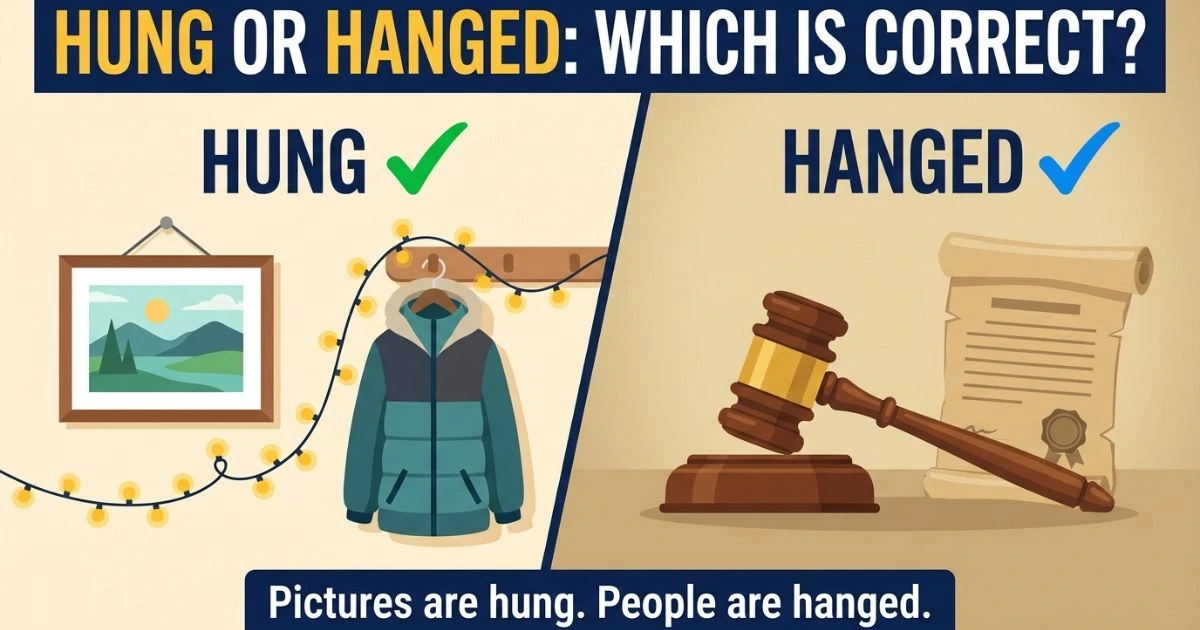
Use hung for almost everything: pictures, coats, lights, and hanging out. Use hanged only when a person is put to death by hanging.
Picture this. A student writes a caption for her class project. “We hanged the posters in the hallway,” she types. Her teacher pauses. Something sounds wrong, but what?
The problem is the verb form. Posters are things, not people. So the right word is “hung.” Both forms are real past tenses of “hang.”
They just do different jobs. This guide shows you the rule in plain English, with examples you can copy.
Table of Contents
- Quick Answer
- Hung vs Hanged: The Core Difference
- The Grammar Rule: Why Hang Has Two Past Tenses
- Hung vs Hanged Comparison Table
- When to Use Hung
- When to Use Hanged
- Is “Hung” for People Really a Mistake?
- Memory Trick
- 20 Example Sentences
- Common Mistakes
- FAQs
- Conclusion and Key Takeaways
- Internal Links, References, and Schema
Quick Answer
Hang has two past tense forms. Hung is the standard form for objects, actions, and idioms, such as “I hung a picture” or “we hung out.” Hanged is the traditional form for killing a person by hanging, such as “The prisoner was hanged at dawn.”
⚡ Quick Rule in 1 Line
“Pictures are hung; people are hanged — use hung for everything else.”
Hung vs Hanged: The Core Difference
Hung is the everyday past tense of hang. Hanged is a special past tense kept for executions. If you are not talking about killing a person with a rope, choose hung. This one habit fixes most mistakes.
Think of hang as a word with two jobs.
Job one is simple. You attach something to a high point, and it dangles. A coat on a hook. A picture on a nail. A flag on a pole. The past tense for this job is hung.
Job two is dark but narrow. A person is killed by a rope around the neck. The traditional past tense for this job is hanged.
Merriam-Webster says the past tense of hang in almost all situations is “hung.” It also says most usage guides keep “hanged” for people who have been put to death.
Here is the short version:
- You hung a coat on the hook.
- The outlaw was hanged in 1881.
Both sentences are correct. They just use different forms for different meanings.
The Grammar Rule: Why Hang Has Two Past Tenses
Hang is an irregular verb with two sets of past forms. The main set is hang, hung, hung. The second set is hang, hanged, hanged. The second set is only for death by hanging. Both sets use the same form for the simple past and the past participle.
Most English verbs add -ed to make the past tense. Walk becomes walked. Hang is different, and it has two paths.
| Meaning | Present | Past | Past Participle |
|---|---|---|---|
| To suspend or attach something | hang | hung | hung |
| To kill a person by hanging | hang | hanged | hanged |
The past tense and the past participle are always the same word in each row. That makes things easier. You do not need to learn four forms.
Why Are There Two Forms?
The two forms come from two different Old English verbs. Over time, they blended into one word. Ellii notes that the two forms were once used interchangeably. Later, one form (hung) became far more common.
Hung also follows a familiar pattern. It sounds like other irregular verbs:
- cling → clung
- swing → swung
- sting → stung
- wring → wrung
- fling → flung
That pattern is why “hung” feels natural to most native speakers. “Hanged” feels formal and a little old-fashioned.
Present Participle: No Confusion Here
The -ing form is simple. It is always hanging, no matter the meaning.
- She is hanging the curtains.
- The court is hanging no one today.
The only choice you must make is in the past tense and the past participle.
Hung vs Hanged Comparison Table
Use this table as a quick check. Hung covers objects, actions, and set phrases. Hanged covers only the execution sense. When you are unsure, look at who or what is being hung and ask: is a person being put to death?
| Feature | Hung | Hanged |
|---|---|---|
| Main meaning | Suspended, attached, or dangled | Killed by hanging |
| Used with objects | Yes | No |
| Used with people (execution) | Sometimes (informal) | Yes (preferred) |
| Used in idioms | Yes (hung out, hung up, hung over) | Rarely |
| Used in legal writing | No | Yes |
| Example | We hung the lights. | He was hanged for his crimes. |
| Tone | Everyday | Formal or historical |
When to Use Hung
Use “hung” when you attach something to a point and let it dangle, or when you use a hang-based phrase. This covers pictures, clothes, decorations, phone calls, and social time with friends. It is the correct choice in nearly every situation.
1. Putting Objects Up
This is the most common use.
- She hung her jacket on the chair.
- We hung the banner above the stage.
- He hung a mirror in the hallway.
2. Common Phrasal Verbs and Idioms
Many everyday phrases use “hung.” None of them use “hanged.”
- Hung out means spent time with friends. After school, we hung out at the park.
- Hung up means ended a phone call. She hung up without saying goodbye.
- Hung around means waited or stayed nearby. He hung around until the bus came.
- Hung on means held on or waited. We hung on until the storm passed.
- Hung back means stayed behind. The shy kids hung back near the wall.
3. Hung as an Adjective
Sometimes “hung” works as an adjective.
- Hung jury: a jury that cannot reach a decision or verdict. Merriam-Webster lists this meaning.
- Hung parliament: a British term for a parliament where no party has an overall majority.
- Hung over: feeling unwell after drinking too much.
None of these have anything to do with a rope. That is why “hung” is used.
4. Hung for Things That Are Not People
Here is a detail that surprises many learners. Merriam-Webster says that if an object, not a person, is suspended from a gallows, “hung” is correct. Hanging a figure in effigy is a good example. An effigy is a model of a person, not a real person.
- Angry voters hung the leader in effigy.
When to Use Hanged
Use “hanged” when a person is killed by hanging, whether as a legal execution or in a historical account. It is the safest choice in formal writing, law, and history. Outside of that meaning, “hanged” will sound strange to most readers.
1. Executions
This is the classic use. Courts, history books, and news stories lean on it.
- The pirate was hanged at sunrise.
- Many outlaws were hanged in the Old West.
- The judge ordered that he be hanged.
2. Death by Hanging in General
Writing Explained says to use “hanged” for executions and suicides. That keeps the meaning clear and the tone formal.
- The man was found to have hanged himself.
This is a sensitive topic. In news writing and formal text, “hanged” is the standard choice here.
3. The Mild Oath “I’ll Be Hanged”
Merriam-Webster lists a mild oath sense of “hanged.” It is old-fashioned, and you will mostly see it in books and old movies.
- Well, I’ll be hanged! I never expected to see you here.
- I’ll be hanged if I know the answer.
This is a fun exception. It uses “hanged,” but nobody is being executed.
Is “Hung” for People Really a Mistake?
Not exactly. Merriam-Webster’s usage notes say “hung” for a person is not an error. Educated writers have used it for many years. But “hanged” is more common in writing, and it is the safer choice for tests, news, and formal work.
This is the part most grammar articles skip.
Your teacher may have told you, “Pictures are hung and people are hanged.” That is a good rule of thumb. But the full story is more flexible.
Merriam-Webster’s usage research found that both forms are standard for executions. Its dictionary entry says “hanged” is most appropriate for official executions. It adds that “hung” is also used, and that “hung” fits less formal hangings.
Proofed gives a helpful extra example. If someone is suspended by the ankles, they are “hung upside down.” They are not “hanged.” The word “hanged” is only about killing.
So What Should You Do?
Follow this plan:
- School, tests, and ESL exams: Use the strict rule. Hanged for executions, hung for the rest.
- News, law, and history writing: Use “hanged” for executions.
- Casual speech: You may hear “hung” for executions. It is not a serious error, but avoid it in writing.
The strict rule keeps your writing clean. It also protects you from a teacher’s red pen.
Memory Trick
Link “hanged” with “killed” and “hung” with everything else. A short rhyme also helps: “Curtains are hung, and people are hanged.” Say it twice, and it will stick.
Try these three tricks.
Trick 1: The Curtain Rhyme
Curtains are hung. People are hanged.
Writing Explained also shares this idea. It is short, and it works.
Trick 2: The Letter Clue
The word hanged has an -ed ending, like ended. A hanging in this sense ends a life. Hanged = ended.
Trick 3: The Default Rule
When you are not sure, pick hung. You will be right in nearly every case. Merriam-Webster says “hung” is the past tense of hang in almost all situations.
20 Example Sentences
Read these examples out loud. Notice that every sentence about objects, phone calls, or social time uses “hung.” Only the sentences about a person put to death use “hanged.” The pattern becomes clear after a few lines.
Objects and Decorations
- She hung a painting above the sofa.
- We hung the wet towels on the line.
- He hung his keys on the hook by the door.
- The students hung paper stars from the ceiling.
- They hung the flag outside the school.
Phrasal Verbs
- After class, we hung out at the café.
- He hung up before I could answer.
- The cat hung around the kitchen all morning.
- She hung on to the railing during the storm.
- The new student hung back at first.
Adjectives and Other Meanings
- The jury was hung, so the judge ordered a new trial.
- The election ended with a hung parliament.
- He felt hung over after the party.
- The magician hung upside down for ten seconds.
- The voters hung the mayor in effigy.
Hanged: Executions and Special Uses
- The outlaw was hanged for his crimes.
- In the 1700s, many thieves were hanged in public.
- The king ordered that the spy be hanged.
- The prisoner was hanged at dawn.
- I’ll be hanged if I can find my glasses!
Common Mistakes
The most common mistake is using “hanged” for objects, such as “I hanged the picture.” The second most common mistake is writing “hung” in formal writing about an execution. Both are easy to avoid with the one-line rule.
1:Using Hanged for Objects
❌ I hanged the picture on the wall. ✅ I hung the picture on the wall.
This is the number one error. Remember, “hanged” is for people only.
2: Using Hanged for Phrasal Verbs
❌ We hanged out at the mall. ✅ We hung out at the mall.
Phrasal verbs always use “hung.”
3: Using Hanged for a Hung Jury
❌ The jury was hanged. ✅ The jury was hung.
A hung jury is stuck. Nobody is being put to death.
4: Using Hung in Formal Execution Writing
⚠️ The prisoner was hung at dawn. (Not an error, but weak in formal writing) ✅ The prisoner was hanged at dawn.
This one is a style choice. Merriam-Webster says “hung” is not wrong here. Still, “hanged” is the formal standard.
5: Making Up Words Like “Hanged Out” or “Hunged”
❌ She hunged her coat. ✅ She hung her coat.
There is no such word as “hunged.” The only past forms are hung and hanged.
6: Mixing Up Hang and Lay
Some learners confuse hang with other tricky verbs. Remember that each irregular verb has its own forms. Study them one at a time.
Quick Practice
Pick the correct word. Answers are below.
- They ___ the lights on the tree. (hung / hanged)
- The traitor was ___ at the castle gate. (hung / hanged)
- We ___ out all afternoon. (hung / hanged)
- The jury was ___. (hung / hanged)
- He ___ his coat on the door. (hung / hanged)
Answers: 1. hung. 2. hanged. 3. hung. 4. hung. 5. hung.
Key Takeaways
- Hang has two past tense forms: hung and hanged.
- Hung is the standard choice for objects, phrasal verbs, and most idioms.
- Hanged is for a person killed by hanging.
- “Hung jury” and “hung parliament” use “hung” as an adjective.
- “Hung” for an execution is not an official error, but “hanged” is more common and more formal.
- “I’ll be hanged” is a mild old-fashioned oath.
- The past tense and the past participle are the same word in each set.
- Memory line: Curtains are hung, and people are hanged.
FAQs
1. Is it hung or hanged?
Use “hung” for objects, phrasal verbs, and most everyday meanings. Use “hanged” when a person is put to death by hanging. Merriam-Webster says “hung” is the past tense of hang in almost all situations.
2. Is “hanged” a real word?
Yes. “Hanged” is a standard past tense and past participle of hang. It is used for executions and death by hanging. It also appears in the old oath “I’ll be hanged.”
3. What is the past tense of hang?
The past tense is hung in most cases. It is hanged when a person is killed by hanging. Both forms are correct for their own meanings.
4. What is the past participle of hang?
The past participle matches the past tense. It is hung for objects and general use. It is hanged for executions. Example: “The picture has been hung” and “The man has been hanged.”
5. Can you say “hung” for a person who was executed?
It is not an error. Merriam-Webster’s usage notes say “hung” is used by educated writers for this meaning. However, “hanged” is more common in writing and is the safer formal choice.
6. Why do we say “hung jury”?
A “hung jury” is a jury that cannot reach a decision or verdict. The word “hung” here is an adjective that means stuck or undecided. It has nothing to do with a rope.
7. Is it “hung out” or “hanged out”?
Always “hung out.” Phrasal verbs such as hang out, hang up, and hang around use “hung” in the past tense.
8. Do British and American English use hung and hanged differently?
Both forms are standard in both varieties. The sources I checked for this article are mostly American. Some terms, such as “hung parliament,” are tied to British politics. For UK style rules, check the Oxford and Cambridge dictionaries.
9. What is the difference between hanged and hung in one sentence?
Use “hanged” for executions and “hung” for everything else. That one line covers almost every case.
10. What is an easy way to remember hung and hanged?
Say this: “Curtains are hung, and people are hanged.” You can also remember that “hanged” ends in -ed, like “ended.”
Conclusion:
The past tense of hang depends on the meaning. Use hung for pictures, clothes, decorations, phone calls, and hanging out. Use hanged for a person put to death by hanging.
If you are ever unsure, choose “hung.” It is correct in almost every situation. Save “hanged” for formal writing about executions, or for the old phrase “I’ll be hanged.”
The rule is short. Pictures are hung. People are hanged.

I am an English language writer passionate about grammar and clear communication. I create simple, easy-to-understand content that helps readers improve their English skills. My goal is to make learning English both practical and enjoyable.