Your friend texts, “Can you pickup the kids today?” You pause. Something looks off.
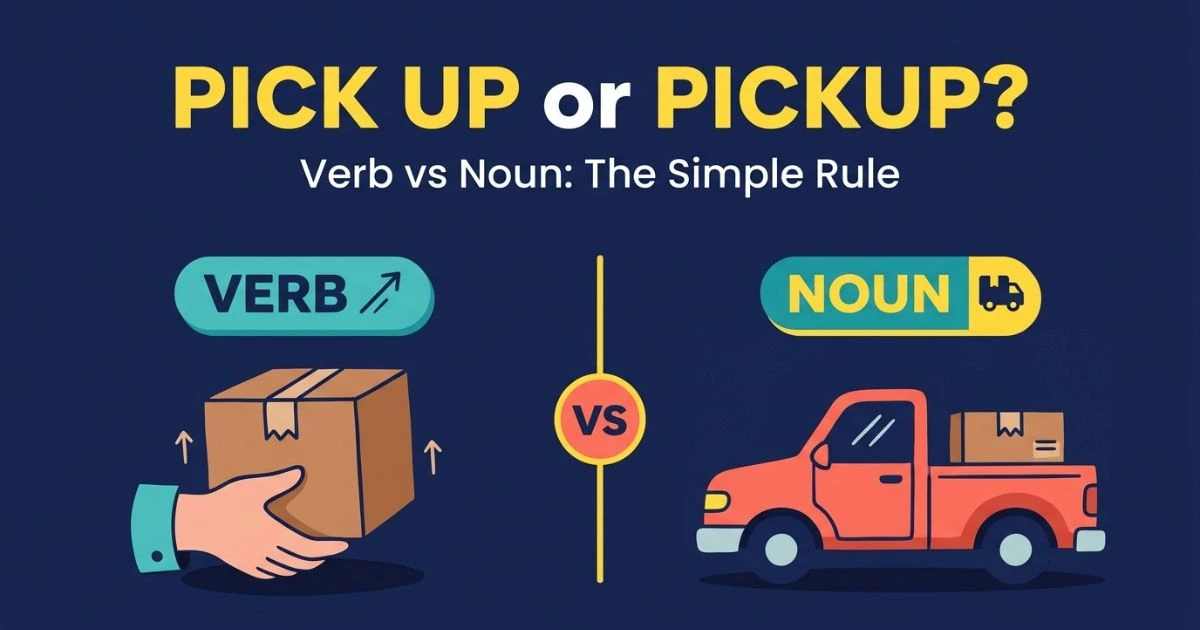
It is off. Use pick up (two words) when it is a verb, and pickup (one word) when it is a noun or adjective. “Pick up the kids” is an action, so it needs two words.
This mix-up is common because the two forms sound the same. Only the spelling shows the job each one does.
Most writers get stuck on one question: is it an action or a thing? Once you can answer that, you will pick the right form every time. This guide shows you how, with a memory trick and 20 real examples.
Table of Contents
- Introduction
- Quick Answer
- What Is the Difference Between Pick Up and Pickup?
- When to Use Pick Up (Verb)
- When to Use Pickup (Noun and Adjective)
- What About Pick-Up With a Hyphen?
- Pick Up vs. Pickup: Comparison Table
- Memory Trick: The Separation Test
- 20 Example Sentences
- Common Mistakes
- Other Words That Follow the Same Pattern
- FAQs
- Conclusion
- Key Takeaways
- Internal Linking Suggestions
- External References
- Schema Note
Quick Answer
Pick up (two words) is a verb. It means to lift, collect, or get something. Pickup (one word) is a noun or adjective. It names a thing, such as a pickup truck, a garbage pickup, or a pickup game. Verbs get two words. Nouns and adjectives get one.
⚡ Quick Rule in 1 Line
If you can do it, use two words; if you can name it, use one.
What Is the Difference Between Pick Up and Pickup?
Pick up is a verb phrase that describes an action. Pickup is a single word that works as a noun or an adjective. The spelling changes because the part of speech changes. Same sounds, different jobs.
Pick up is a phrasal verb. A phrasal verb is a verb plus a small word, like up, that together make one meaning. You need both words to get the full action.
Pickup came later. It formed when people started using the verb as a name for the thing or event. Merriam-Webster dates the noun to 1848 and the adjective to 1898. The verb goes back to the 14th century.
So the verb is the older form. The one-word version grew out of it.
That history explains the confusion. Pickup is just pick up squeezed into one word. But once it becomes a noun, English treats it as a different word with its own spelling.
When to Use Pick Up (Verb)
Use pick up as two words whenever it describes something a person or thing does. It can mean to lift, to collect, to buy, to learn, to detect, or to improve. If the sentence has an action, write two words.
Here are the main meanings of the verb, based on dictionary entries:
- Lift something: Please pick up that book from the floor.
- Collect a person or item: I will pick up my friend from the airport.
- Buy something casually: Pick up some milk on your way home.
- Tidy a space: Pick up your room before dinner.
- Learn without much effort: She picked up Spanish in a few months.
- Detect or receive: The radio can pick up distant stations.
- Improve or speed up: Sales picked up after the holidays.
- Resume after a break: Let’s pick up the discussion tomorrow.
The verb changes form like any other verb. You write picks up, picked up, and picking up. These are always two words, so “I pickuped the package” is wrong.
When to Use Pickup (Noun and Adjective)
Use pickup as one word when it names something or describes a noun. It can be an event, a vehicle, an increase, or part of an instrument. A noun takes “a,” “the,” or a plural form, which is a good clue.
Pickup as a noun can mean:
- The act of collecting something: Garbage pickup is on Tuesday.
- A pickup truck: He loaded the furniture into his pickup.
- An increase in activity: The store saw a pickup in business.
- A device that picks up a signal: The guitar has two pickups.
- A pickup line: That was a terrible pickup line.
Oxford’s learner dictionary also lists a North American meaning: a vehicle’s ability to speed up.
Pickup as an adjective describes another noun. Merriam-Webster defines this use as made up of whatever people or things are available, without formal planning. Think of a pickup basketball game or a pickup band.
The noun has a regular plural: pickups.
What About Pick-Up With a Hyphen?
Pick-up, with a hyphen, is an older alternative spelling of the noun and adjective. British dictionaries still list it. In American English, the one-word pickup is the standard choice. Never use the hyphen for the verb.
This is the one place the rule is not perfectly clean. Dictionary.com labels the hyphenated pick-up as British in its noun and adjective entries. Collins, a British dictionary, also lists pick-up. One writing blog even calls it a “disappearing alternative” to pickup.
Since your readers are in the United States, here is the simple plan:
- Write pickup for the noun and adjective.
- Write pick up for the verb.
- Skip pick-up, unless a style guide or your editor asks for it.
Whichever spelling you choose, stay consistent. Do not write “pickup truck” in one paragraph and “pick-up truck” in the next.
Pick Up vs. Pickup: Comparison Table
The table below puts the two forms side by side. Check the part of speech first, then match the spelling. If you can swap in “collect,” it is the verb. If you can put “the” or “a” before it, it is the noun.
| Feature | Pick up | Pickup |
|---|---|---|
| Spelling | Two words | One word |
| Part of speech | Verb (phrasal verb) | Noun or adjective |
| What it does | Describes an action | Names a thing or event |
| Changes form? | Yes: picks up, picked up, picking up | Plural: pickups |
| Quick test | Can you say “collect” or “lift”? | Can you put “a” or “the” before it? |
| Example | I will pick up the package. | The pickup is at noon. |
| Hyphen? | Never | Pick-up is a British variant |
Memory Trick: The Separation Test
Try to put the object between “pick” and “up.” If it sounds natural, the verb is correct, so write two words. If it does not work, you probably need the noun, so write one word.
Here is the test in action:
- “Pick the box up.” Natural. So write pick up.
- “The pick the box up is at noon.” Broken. So write pickup.
A second trick uses the spelling itself. The verb is two words because an action takes two steps: you pick, then you lift it up. The noun is one word because a thing is one piece.
A third trick: look for a small helper before it. Words like a, the, my, and this point to a noun. Helpers like will, to, can, and should point to a verb.
20 Example Sentences
These 20 examples are grouped by use. Read a few from each group and notice the pattern. Every verb is two words, and every noun or adjective is one.
Pick up as a verb
- I will pick up the kids at three o’clock.
- Can you pick up some bread on your way home?
- She picked up the phone on the second ring.
- He is picking up his dry cleaning today.
- The microphone can pick up very quiet sounds.
- Kids pick up new words quickly.
- Please pick up your toys before bed.
- Business should pick up after the holidays.
Pickup as a noun
- The pickup is scheduled for Monday morning.
- The school bus was late for its afternoon pickup.
- Garbage pickup is every Tuesday.
- Maria drives a red pickup to work.
- The company reported a pickup in sales.
- His guitar has a worn pickup that buzzes.
Pickup as an adjective
- We played a pickup basketball game after school.
- He plays in a pickup band on weekends.
- Choose the pickup location when you check out.
- The store offers curbside pickup service.
Both forms in one sentence
- While driving his pickup, Joe saw a hitchhiker and picked him up.
- I need to pick up my order, but the pickup window closes at six.
Common Mistakes
The most common error is using the noun as a verb, like “I will pickup the kids.” The reverse error is writing the verb form where a noun belongs. Check the part of speech and fix the spelling.
1: Using pickup as a verb
- ❌ Please pickup the package after work.
- ✅ Please pick up the package after work.
2: Adding endings to pickup
- ❌ She is pickuping the kids.
- ✅ She is picking up the kids.
3: Using pick up as a noun
- ❌ The pick up is at 3 p.m.
- ✅ The pickup is at 3 p.m.
4: Splitting the adjective
- ❌ We joined a pick up soccer game.
- ✅ We joined a pickup soccer game.
5: Mixing styles on one page
Switching between pickup and pick-up looks sloppy. Pick one and keep it.
A note on signs and labels
Shops often write “Order Pick Up” on signs. That label works as a noun, so the stricter form is “Order Pickup.” If you write for a business, use the correct form on your website and menus.
Other Words That Follow the Same Pattern
Many English verbs follow this split. The verb is two words, and the noun or adjective is one word. Learn the pattern once, and you can fix a whole group of common mistakes.
| Verb (two words) | Noun or adjective (one word) |
|---|---|
| Please set up the meeting. | The setup took too long. |
| I need to work out daily. | My workout starts at six. |
| The thief will run away. | He was a runaway. |
| Please pay back the loan. | The payback was quick. |
Some of these are hyphenated instead, such as check in (verb) and check-in (noun), or drop off (verb) and drop-off (noun). Always check a dictionary for the exact form.
The test stays the same: action or thing?
Key Takeaways
- Pick up (two words) is a verb: pick up, picks up, picked up, picking up.
- Pickup (one word) is a noun or adjective: a pickup, pickups, pickup truck, pickup game.
- Quick rule: if you can do it, use two words; if you can name it, use one.
- Separation test: “pick the box up” works, so write two words.
- Pick-up is a British variant. Use pickup in American English.
- The same split applies to set up/setup, work out/workout, and run away/runaway.
- Never add verb endings to pickup. Write “picked up,” not “pickuped.”
FAQs
Is it pick up or pickup?
Both are correct, but for different jobs. Use pick up (two words) as a verb. Use pickup (one word) as a noun or adjective. Check whether the sentence needs an action or a name.
Is pickup one word or two?
Pickup is one word when it is a noun or adjective, such as “pickup truck” or “garbage pickup.” The verb is two words: “pick up.”
Is pickup a verb?
No. Pickup is a noun or an adjective. The verb is always two words: pick up, picks up, picked up, and picking up.
Is it “pick up time” or “pickup time”?
Write pickup time. Here, pickup describes the word time, so it works as an adjective. The same goes for pickup location and pickup window.
Is it “curbside pickup” or “curbside pick up”?
Use curbside pickup. It names a service, so it is a noun, and nouns take one word.
What is the plural of pickup?
The plural is pickups. Example: “Three pickups were parked outside the store.”
Is it pick-up with a hyphen?
Pick-up is an older variant that British dictionaries list for the noun and adjective. In American English, pickup is the standard form. Do not use the hyphen for the verb.
How do I write the past tense?
Write picked up, always as two words. “I pickuped it” and “I picked-up it” are both wrong.
Do I write “pick up the kids” or “pickup the kids”?
Write pick up the kids. The sentence needs an action, so you need the verb.
Is a pickup truck one word?
Yes. Dictionaries list pickup as a single word for the vehicle, often with “truck” after it. The short form “pickup” alone also means the truck.
Conclusion:
Pick up and pickup sound identical, but they do different work. Pick up is the verb, so it takes two words. Pickup is the noun or adjective, so it takes one.
When you are unsure, ask yourself: is this an action or a thing? Then try the separation test. If “pick the box up” sounds natural, use two words.
In American English, skip the hyphen. Keep your spelling consistent, and your writing will look clean and professional.

I am an English language writer passionate about grammar and clear communication. I create simple, easy-to-understand content that helps readers improve their English skills. My goal is to make learning English both practical and enjoyable.