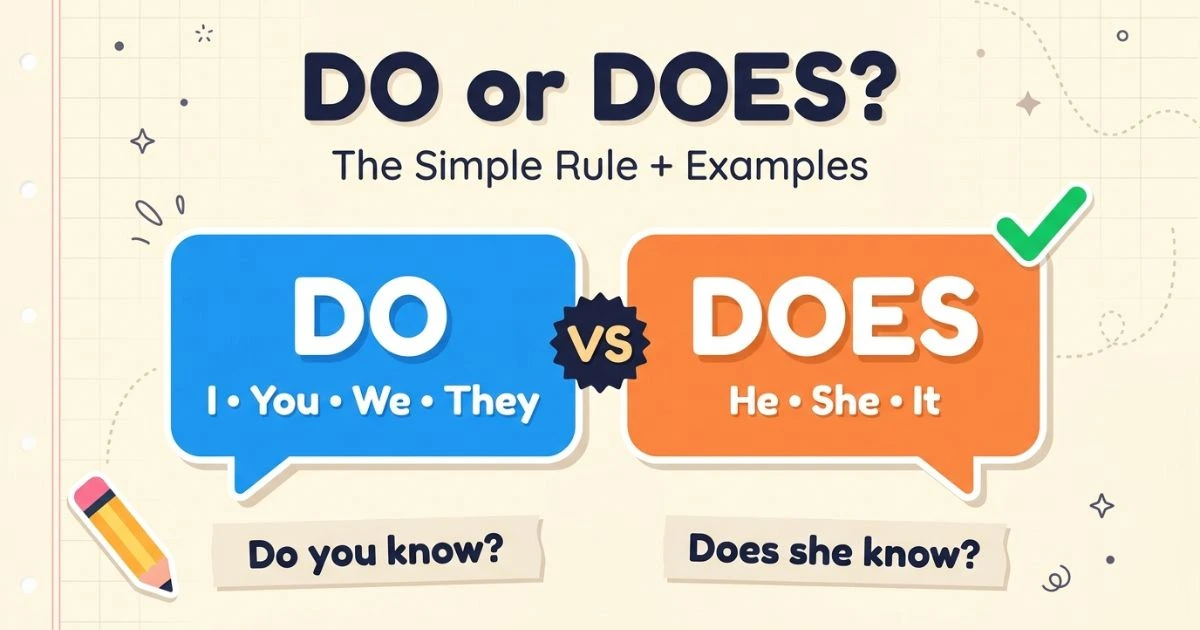
Use does with he, she, it, and any single person or thing. Use do with I, you, we, they, and plural nouns.
Picture this. You type “Does she knows the answer?” in an email and stop. Something feels off.
It is off. The fix takes two steps. First, match do or does to the subject. Second, keep the main verb plain: “Does she know the answer?”
This small rule shows up in almost every question and negative sentence you write. Once you see the pattern, you will not have to guess again.
Table of Contents
- Introduction
- Quick Answer
- What Is the Difference Between Do and Does?
- The Simple Present Rule
- How to Use Do and Does in Questions
- How to Use Do and Does in Negative Sentences
- Do and Does as a Main Verb
- Tricky Cases: Names, Nouns, and Special Words
- 20 Example Sentences
- Memory Trick
- Common Mistakes
- When to Use Each Form
- Quick Practice
- FAQs
- Conclusion
- Key Takeaways
- Internal Linking Suggestions
- External References
- Schema Note
Quick Answer
Use does when the subject is he, she, it, or one person or thing, like Maria or the dog. Use do with I, you, we, they, and plural subjects, like the students. In questions and negatives, the main verb stays in its base form: “Does she like it?” not “Does she likes it?”
Quick Rule in 1 Line
Use does for he, she, and it — use do for I, you, we, and they.
What Is the Difference Between Do and Does?
Do and does are two present-tense forms of the same verb. Does is the third-person singular form. It goes with he, she, it, and any single person, place, or thing. Do goes with I, you, we, they, and plural nouns.
The verb itself is “to do.” It has four forms: do, does, did, and done. This article focuses on do and does, which are both present tense.
Here is a quick lookup table:
| Subject | Correct form | Example |
|---|---|---|
| I | do | I do my work early. |
| you | do | Do you agree? |
| we | do | We do the laundry on Sunday. |
| they | do | They do not mind. |
| he | does | He does the shopping. |
| she | does | Does she know the way? |
| it | does | It does not matter. |
| one person or thing (Maria, the dog) | does | Does Maria know? |
| more than one (the dogs, my friends) | do | Do my friends know? |
If the subject is one, use does. If the subject is more than one, use do. The only extra exceptions are I and you. They are single, but they still take do.
The Simple Present Rule
In the simple present tense, a singular subject like he, she, or it takes a verb with an s. That is why “does” ends in s. Plural subjects, plus I and you, take the plain verb with no s.
This is called subject-verb agreement. The verb must match the subject.
Look at how a regular verb changes:
- I play guitar.
- You play guitar.
- She plays guitar.
- They play guitar.
The verb do follows the same idea. The s form is spelled “does,” not “dos.” It is also an irregular spelling, so it is worth memorizing.
Also remember that only the subject controls the verb. Extra words in between do not change the choice. In “Does the box of apples cost much?” the subject is box, not apples.
How to Use Do and Does in Questions
Start a present-tense question with do or does, then add the subject and the base verb. Use does for he, she, and it. Use do for everything else. The main verb never takes an s: write “Does he work here?” not “Does he works here?”
The pattern looks like this:
Do / Does + subject + base verb + rest of the sentence?
- Do you like pizza?
- Does he drive to work?
- Do they live nearby?
- Does the store open at nine?
You can also add a question word at the start:
- Where do you live?
- What does she want?
- Why do they leave so early?
- How does this machine work?
Why does the main verb stay plain? Because does already carries the s. English only needs one.
One more rule matters here. Do not use do or does with the verb be or with modal verbs like can, must, or should. Say “Can you swim?” not “Do you can swim?” Say “Is she ready?” not “Does she is ready?”
How to Use Do and Does in Negative Sentences
Make a present-tense negative with do not or does not, then add the base verb. Most writers use the short forms don’t and doesn’t. Use doesn’t with he, she, and it. Use don’t with I, you, we, and they.
The pattern is:
Subject + do not / does not + base verb
| Subject | Short form | Example |
|---|---|---|
| I | don’t | I don’t know the answer. |
| you | don’t | You don’t need a ticket. |
| he / she / it | doesn’t | She doesn’t like spicy food. |
| we | don’t | We don’t have class today. |
| they | don’t | They don’t live here anymore. |
Notice what happens to the s. In “She likes tea,” the s is on likes. In “She doesn’t like tea,” the s moves to doesn’t. The main verb goes back to plain.
For formal writing, such as reports and cover letters, “does not” and “do not” are a little more polished. Contractions are fine for emails, blogs, and everyday talk.
Do and Does as a Main Verb
Do and does can also be main verbs that mean “perform” or “complete.” Use does for he, she, and it, and do for the rest: “She does the laundry” and “They do the laundry.” Here the s belongs to does itself.
Here are common phrases that use do as the main verb:
- do homework
- do the dishes
- do your best
- do business
- do a favor
In a sentence:
- I do my best every day.
- He does the dishes after dinner.
- What do you do for work?
- What does your brother do?
The last two examples show both jobs at once. The first do is the helper. The second do is the main verb.
Do can also add emphasis. “She does love music” stresses that she really loves it. Short answers use do and does too:
- “Do you like it?” “Yes, I do.”
- “Does he know?” “No, he doesn’t.”
Tricky Cases: Names, Nouns, and Special Words
Find the real subject first, then pick the verb. Names and single nouns take does. Plural nouns take do. Words like everyone, nobody, and each take does. Extra words between the subject and verb do not change the choice.
Here are the cases that trip people up most.
Names and single nouns. Use does. “Does Maria work here?” “Does the teacher know?”
Plural nouns. Use do. “Do the students understand?” “Do your parents live nearby?”
Two subjects joined by and. Use do. “Do Tom and Sara work together?” Two people make a plural subject.
Everyone, someone, nobody, each, and every. These words feel plural, but they are singular. Use does. “Does everyone have a pen?” “Does each student get a book?”
Collective nouns like team, family, and class. In American English, these are usually singular. “Does the team practice on Saturdays?” “Does your family live in Texas?”
Uncountable nouns. Use does. “Does water boil faster with salt?” “Does the information help?”
Gerunds as subjects. An -ing word acting as a subject is singular. “Does running help you sleep?”
One rare case: does can also be a noun. It is the plural of doe, a female deer. In that case, it rhymes with “nose,” not “buzz.” “The does grazed near the road.” You will almost never need this, but it explains odd search results.
20 Example Sentences
Here are 20 example sentences, ten with do and ten with does. Read each one out loud. Notice that the main verb stays in its plain base form after both words, in questions and in negatives.
Sentences with Do
- I do my homework after dinner.
- Do you want some tea?
- We do not have class on Friday.
- Do they live near the park?
- What do you do for work?
- The students do their best every day.
- My parents do the shopping on Sundays.
- Where do we park?
- They don’t know the answer.
- Do Tom and Sara work together?
Sentences with Does
- She does her homework before dinner.
- Does he speak Spanish?
- It doesn’t work.
- Does the manager know about the change?
- What does your sister do for a living?
- Does everyone have a pen?
- Maria does the dishes every night.
- Does the team practice on Saturdays?
- Who does the cooking at your house?
- He doesn’t like coffee.
Memory Trick
Remember this: the S moves. In “She likes pizza,” the S sits on likes. In “Does she like pizza?” the S jumps over to does. One S per sentence, and it lives on the helper verb.
Here is the trick in action:
- She likes pizza. (S on the main verb)
- Does she like pizza? (S moved to does)
- She doesn’t like pizza. (S moved to doesn’t)
A second shortcut: think of the three S-words. He, she, it all point to does. Everything else points to do.
If you ever see “Does she likes,” you know two S marks are fighting for one spot. Delete the one on the main verb.
Common Mistakes
The most common mistakes are using do with he, she, or it, and adding an s to the main verb after does. Fix both by checking the subject first, then keeping the main verb plain.
1. Adding an s to the main verb after does
- Wrong: Does she likes pizza?
- Right: Does she like pizza?
2. Using don’t with he, she, or it
- Wrong: He don’t know the answer.
- Right: He doesn’t know the answer.
You may hear “he don’t” in some dialects and song lyrics. In school and work writing, use doesn’t.
3. Using do with a single subject
- Wrong: Do your sister work here?
- Right: Does your sister work here?
4. Using does with a plural subject
- Wrong: Does your parents live here?
- Right: Do your parents live here?
5. Adding do before a modal verb
- Wrong: Do you can swim?
- Right: Can you swim?
6. Using do with everyone
- Wrong: Do everyone agree?
- Right: Does everyone agree?
7. Using I does or you does
- Wrong: I does my best.
- Right: I do my best.
When to Use Each Form
Follow three quick steps. Find the subject. Decide if it is one person or thing, or more than one. Then pick does for he, she, it, and single subjects, or do for everything else.
Does when:
- The subject is he, she, or it.
- The subject is one person, place, or thing, like Maria or the dog.
- The subject is everyone, someone, nobody, each, or every.
- The subject is an uncountable noun like water or advice.
Do when:
- The subject is I, you, we, or they.
- The subject is a plural noun like the students or my friends.
- The subject is two things joined by and, like Tom and Sara.
Use the plain base verb after both. Do not add an s, -ed, or -ing to the main verb.
Quick Practice
Practice locks in the rule. Fill each blank with do or does, then check the answers below. If you miss one, find the subject first, then pick the verb.
- ____ she play the piano?
- ____ they live here?
- He ____ not like spicy food.
- What ____ you want for lunch?
- ____ everyone have a ticket?
- My parents ____ the shopping on Saturdays.
- ____ the team win often?
- It ____ not matter.
Answers: 1. Does, 2. Do, 3. does, 4. do, 5. Does, 6. do, 7. Does, 8. does.
Key Takeaways
- Does goes with he, she, it, and single subjects like Maria or the dog.
- Do goes with I, you, we, they, and plural subjects.
- After do or does, the main verb stays in its base form.
- Use doesn’t with he, she, and it. Use don’t with the rest.
- Everyone, nobody, and each take does.
- Collective nouns like team and family usually take does in American English.
- Do not use do or does with the verb be or with modals like can and must.
- Memory trick: the S moves from the main verb to does.
FAQs
Do or does with “you”?
Use do. You always takes do, even when you means one person. Say “Do you like tea?” and “You don’t need a ticket.” Never say “Does you.”
Do or does with “they”?
Use do. They is plural, so it takes do. Say “Do they live nearby?” and “They don’t know.” The same goes for we.
Do or does with “I”?
Use do. Although I is a single person, it takes the plain form. Say “I do my best” and “Do I need a pen?” Never say “I does.”
Do or does with names like John or Maria?
Use does. A name is one person, so it works like they. Say “Does Maria know?” and “John doesn’t live here.”
Do or does with “who”?
When who is the subject, use does: “Who does the cooking?” When another subject follows, match that subject: “Who do you trust?” Check which word is doing the action.
Do or does with “everyone”?
Use does. Everyone is singular, even though it points to many people. Say “Does everyone agree?” and “Everyone doesn’t like it.”
Why is it “Does she like” and not “Does she likes”?
Does already shows the third-person singular s. English only marks it once. After do, does, or did, the main verb stays in its base form.
Is it “don’t” or “doesn’t” with “it”?
Use doesn’t. It is third-person singular, just like he and she. Say “It doesn’t work,” not “It don’t work.”
Do or does with “team” or “family”?
In American English, use does. A team or family is treated as one group. Say “Does the team practice today?” British English sometimes uses do, but US readers expect does.
Conclusion:
The rule is short. Use does with he, she, it, and any single subject.
Use do with I, you, we, they, and plural subjects. Then keep the main verb plain.
If you get stuck, remember that the S moves.
It jumps from the main verb to does. Find the subject, pick the verb, and drop the extra s. That is all it takes.

As an American English writer, I specialize in creating clear and engaging content that makes grammar and language learning accessible to everyone. I enjoy breaking down complex English concepts into simple, practical lessons that readers can apply with confidence. My mission is to help learners strengthen their communication skills through easy and reliable content.