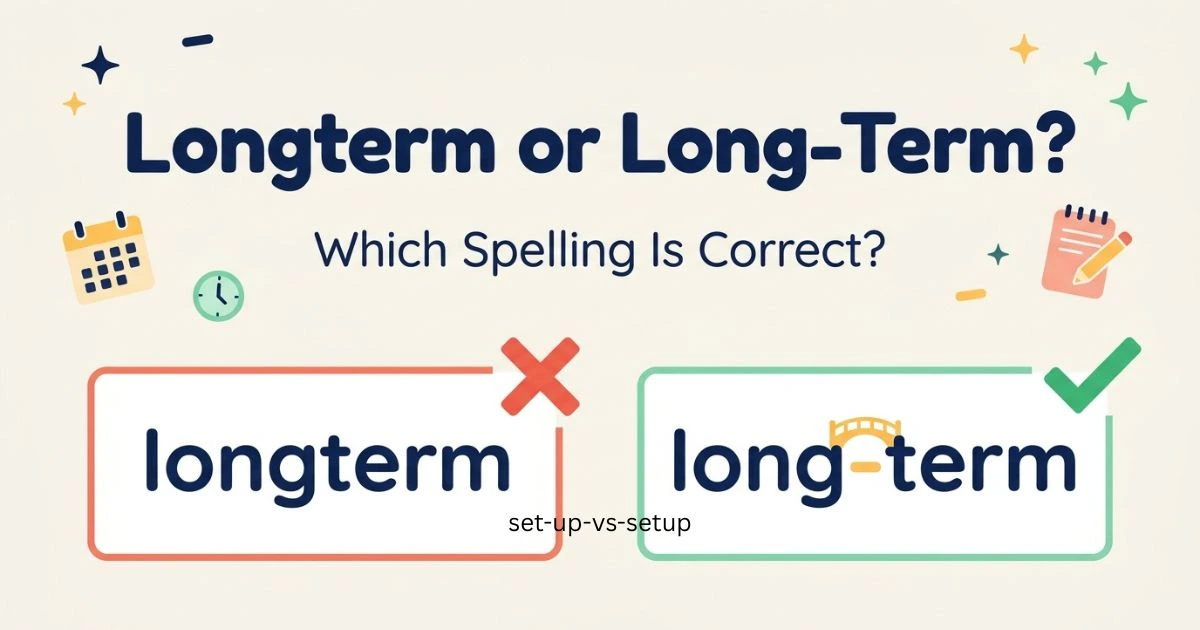
You type “longterm” on your resume, and a red line pops up. Fix it by writing long-term with a hyphen.
The one-word form “longterm” is not standard English. Major dictionaries such as Merriam-Webster and Oxford list the adjective with a hyphen. They list “the long term,” as two words, as a noun.
That is the whole mix-up. Many writers know that some compound words lose their hyphens over time. “Longtime” did. But “long-term” has not made that jump yet.
This guide shows when to use the hyphen and when to use two words. You will also see 20 examples, a memory trick, and a short FAQ.
Table of Contents
- Is “Longterm” a Real Word?
- Long-Term vs Long Term: What Is the Difference?
- The Grammar Rule: Why the Hyphen Is There
- What Happens After the Noun?
- Long-Term as an Adverb
- Longterm vs Longtime vs Long Time
- Memory Trick
- 20 Real Example Sentences
- Common Mistakes
- When to Use Each Form
- FAQs
- Conclusion
- Key Takeaways
Quick Answer
Write long-term with a hyphen when it describes a noun, as in “a long-term plan.” Write long term as two words when it is a noun, as in “in the long term.” The one-word spelling longterm is not standard, so avoid it in essays, emails, resumes, and web content.
⚡ Quick Rule in 1 Line
Use long-term before a noun, long term after “the,” and never squash it into longterm.
Is “Longterm” a Real Word?
No. “Longterm” is not a standard English word. Merriam-Webster and Oxford both list the adjective as long-term, with a hyphen. If you see “longterm” online, it is usually a typo, a hashtag, or a casual shortcut. For formal writing, always use the hyphenated form.
So why do so many people write it?
There are three common reasons:
- Autocorrect and typing speed. People skip the hyphen when they type fast.
- Search habits. Search engines often treat “longterm” and “long-term” as close matches, so writers think both work.
- The “longtime” effect. “Longtime” is one word, so writers assume “longterm” follows the same path.
This is also not a US vs UK spelling issue. Words like “color” and “colour” split by region. “Long-term” does not. American and British dictionaries both use the hyphen.
That makes this a punctuation question, not a regional one. You can use the same spelling for readers in the US, UK, Canada, and Australia.
Long-Term vs Long Term: What Is the Difference?
Long-term is an adjective. It describes a noun, as in “long-term goals.” Long term is a noun phrase. It names a period of time, as in “in the long term.” The hyphen tells readers the two words work as one unit.
Here is the difference at a glance.
| Form | Part of Speech | Example | Hyphen? |
|---|---|---|---|
| long-term | Adjective | A long-term plan | Yes |
| the long term | Noun phrase | In the long term | No |
| long-term | Adverb | Think long-term | Yes (safest choice) |
| longterm | Not standard | — | Avoid |
Notice that the meaning stays the same in each case. Both forms point to a long stretch of time. Only the job of the words changes.
As an adjective, long-term answers the question “What kind?” What kind of plan? A long-term plan.
As a noun, “the long term” answers the question “When?” When will the savings pay off? In the long term.
The Grammar Rule: Why the Hyphen Is There
A hyphen joins two words that act as one adjective before a noun. This is called a compound modifier. Long and term work together to describe the noun, so you hyphenate them: a long-term lease, a long-term goal, a long-term plan.
Think of it this way. The words “long” and “term” are not describing the noun separately. A “long term plan” does not mean a plan that is long and a term. It means one idea: a plan for the long run.
The hyphen helps readers see that idea fast. They do not have to pause and sort it out.
The same pattern works for many pairs:
- short-term loan
- full-time job
- well-known author
- high-quality video
Long-term is one of the most common examples. You will meet it in business, health, law, finance, and school writing.
Here is the main rule in two steps:
- If the phrase comes right before a noun, add the hyphen.
- If the phrase is a noun by itself, such as “in the long term,” write two words.
Related words follow the same habit. Terms like long-range and long-lived are also hyphenated adjectives. One writing commentary noted that long-term, long-lived, and long-suffering rarely appear without their hyphens.
What Happens After the Noun?
Many style guides drop the hyphen when the phrase comes after the noun: “The goal is long term.” Dictionaries such as Oxford still show a hyphen here. Both styles appear in print. Pick one and use it the same way across your site.
This is the one spot where the rule gets fuzzy.
Style A (no hyphen after the noun):
- The goal is long term.
- This job is long term.
Style B (hyphen kept):
- The goal is long-term.
- The contract is long-term.
Many writing guides teach Style A. They say the hyphen is only needed when the words sit before the noun. Oxford Learner’s Dictionary uses Style B in its examples.
Neither style will confuse your reader. What matters is being consistent.
Here is a simple way to choose:
- Writing for a company, school, or publisher? Follow their style guide.
- Writing for your own site? Pick one style and stick with it.
- Teaching ESL learners? Style B is easier. It gives one rule: long-term is always hyphenated as an adjective.
The mistake to avoid is the opposite one. Never drop the hyphen before a noun. “A long term plan” is the error editors catch most often.
Long-Term as an Adverb
Long-term can also work as an adverb, meaning “over a long period.” Dictionaries show it with a hyphen in this use too: “We need to think long-term.” Some writers use two words here, but the hyphenated form is the safer choice.
An adverb tells you how, when, or how long something happens. Here are some examples:
- We need to plan long-term.
- This fix will not work long-term.
- Can the team grow long-term?
You may also see “long term” as two words in this role. Some news sites and wiki-style dictionaries list that as an alternate form. Both appear, but the hyphenated version is the one most dictionaries show.
If you want to avoid the question, you can rewrite the sentence:
- “This fix will not work in the long term.”
- “This fix will not work over time.”
Either one is clear and needs no hyphen debate.
Longterm vs Longtime vs Long Time
Longtime is the one that did become a single word. It is an adjective meaning “for many years,” as in “a longtime friend.” Long time, as two words, is a noun phrase: “It took a long time.” Long-term keeps its hyphen.
This is the real exception in this word family, and it explains the confusion.
| Form | Part of Speech | Meaning | Example |
|---|---|---|---|
| longtime | Adjective | For many years | A longtime friend |
| long time | Noun phrase | A great amount of time | It took a long time |
| long-term | Adjective | Lasting into the future | A long-term plan |
| the long term | Noun phrase | The distant future | In the long term |
Notice the difference in focus:
- Longtime looks back. It describes something that has lasted for years already.
- Long-term looks ahead. It describes something planned or expected to last.
A “longtime customer” has been shopping with you for years. A “long-term customer” is one you hope to keep for years.
Language changes over time. “Longtime” lost its hyphen, so “long-term” might someday do the same. For now, the hyphen is standard.
Memory Trick
Think of the hyphen as a bridge. When long and term walk together to describe a noun, they hold hands, so add the bridge. When the phrase is a noun after “the,” the two words walk apart and need no bridge.
Here are two quick tests.
The noun test. Look at the word right after the phrase. If it is a noun, such as plan, goal, or care, use the hyphen.
- a long-term plan
- long-term care
The “the” test. If the word “the” comes right before it, write two words.
- in the long term
- for the long term
And one reminder for the extra-careful: look back or look ahead.
- Longtime looks back at years that passed.
- Long-term looks ahead at years to come.
20 Real Example Sentences
Long-term as an adjective (before a noun)
- She signed a long-term lease on the apartment.
- Our long-term goal is to save for a house.
- Sleep loss can have long-term effects on your health.
- He is looking for a long-term job, not a summer gig.
- The company needs a long-term plan for growth.
- Long-term care can be costly for families.
- They have been in a long-term relationship for six years.
- Regular exercise brings long-term benefits.
The long term as a noun
- In the long term, small habits add up.
- The fix is cheap now but costly in the long term.
- She is saving money for the long term.
- Over the long term, the stock has risen.
- Think about the long term before you quit.
Long-term as an adverb
- We need to think long-term.
- This diet may not work long-term.
- Can the team keep growing long-term?
Longtime and long time (not the same as long-term)
- Maria is a longtime fan of the band.
- It took a long time to finish the report.
- My longtime neighbor moved away last week.
- We waited a long time for the bus.
Common Mistakes
1. Writing “longterm” as one word
- ❌ We need a longterm solution.
- ✅ We need a long-term solution.
2. Skipping the hyphen before a noun
- ❌ She made a long term commitment.
- ✅ She made a long-term commitment.
3. Hyphenating the noun form
- ❌ This will help us in the long-term.
- ✅ This will help us in the long term.
4. Adding an “s” to the adjective
- ❌ Our long-terms goals are clear.
- ✅ Our long-term goals are clear.
Adjectives in English do not take a plural “s.” Only the noun changes.
5. Mixing up longtime and long-term
- ❌ He is a long-term friend of mine from childhood. (This is understandable, but “longtime” fits better for years already passed.)
- ✅ He is a longtime friend of mine from childhood.
6. Using the wrong form in a headline
- ❌ Longterm Care Costs Are Rising
- ✅ Long-Term Care Costs Are Rising
In title case, capitalize both parts of the hyphenated word: Long-Term.
When to Use Each Form
In every other case, the hyphen is the standard choice.
Here is a quick guide by situation.
| Where You Are Writing | Best Form | Example |
|---|---|---|
| Resume or cover letter | long-term | Built long-term client relationships |
| Essay or school paper | long-term | The long-term effects of pollution |
| Business email | long-term | We want a long-term partnership |
| Blog title or heading | Long-Term | Long-Term Goals for Beginners |
| After “in,” “for,” “over the” | long term | In the long term, it pays off |
| Hashtag or username | longterm | #longtermthinking |
| URL slug | long-term | /long-term-care-tips |
A few notes:
- Hashtags cannot hold hyphens. “#longterm” is fine there because the hashtag is a label, not formal writing.
- URL slugs use hyphens to separate words, so “long-term” works well.
- Search titles should use the standard spelling. It looks more trustworthy to readers.
Key Takeaways
- Long-term (hyphenated) is the standard adjective.
- Longterm (one word) is not standard English.
- Use the long term (two words) as a noun: “in the long term.”
- Hyphenate before a noun: a long-term plan, long-term care.
- After a noun, style guides differ. Pick one style and stay consistent.
- Long-term can be an adverb: “think long-term.”
- Longtime is a separate word that means “for many years.”
- There is no US vs UK difference for this word.
- Use “longterm” only in hashtags, usernames, and code.
FAQs
1. Is longterm one word or two?
Neither is the standard answer. The correct form is long-term, with a hyphen, when it describes a noun. As a noun, it is two words: “the long term.” One-word “longterm” is not standard English.
2. Is it long term or long-term?
Use long-term before a noun: “a long-term plan.” Use long term as a noun phrase: “in the long term.” After a verb like “is,” both forms appear, so follow your style guide.
3. Do you hyphenate long-term after the noun?
It depends on the style guide. Many guides say no hyphen: “The goal is long term.” Dictionaries like Oxford keep the hyphen: “The contract is long-term.” Choose one style and be consistent.
4. Is “in the long-term” correct?
Usually not. As a noun, the phrase is normally written as two words: “in the long term.” The hyphen belongs to the adjective form, such as “long-term plans.”
5. What is the difference between long-term and longtime?
Longtime looks back and means “for many years,” as in “a longtime friend.” Long-term looks ahead and means “lasting a long period,” as in “a long-term plan.” Longtime is one word. Long-term has a hyphen.
6. Is long-term hyphenated in British English?
Yes. The British and American versions of Oxford Learner’s Dictionaries both list long-term with a hyphen. Unlike “color” and “colour,” this word does not split by region.
7. Can long-term be an adverb?
Yes. In this role it means “over a long period”: “We need to think long-term.” Dictionaries show the hyphen. Some writers use two words here, but the hyphen is safer.
8. Is it “long-term care” or “long term care”?
Write long-term care. The phrase comes before the noun “care,” so it needs the hyphen. The same goes for long-term goals, long-term effects, and long-term plans.
9. How do you spell the opposite of long-term?
Write short-term, with a hyphen, before a noun: “a short-term loan.” The same rule applies. As a noun, write “in the short term.”
10. Is “longterm” ever acceptable?
Rarely. It works in hashtags, usernames, and code, where hyphens are not allowed. Do not use it in essays, emails, resumes, articles, or website copy.
Conclusion:
The correct spelling is long-term. Use the hyphen when the phrase describes a noun, as in “long-term goals.”
Use two words when it is a noun, as in “in the long term.” The one-word spelling “longterm” is not standard, so skip it in formal writing.
If you mean “for many years,” write longtime instead. After a noun, the hyphen varies by style guide, so choose one style and stay consistent.

As an American English writer, I specialize in creating clear and engaging content that makes grammar and language learning accessible to everyone. I enjoy breaking down complex English concepts into simple, practical lessons that readers can apply with confidence. My mission is to help learners strengthen their communication skills through easy and reliable content.