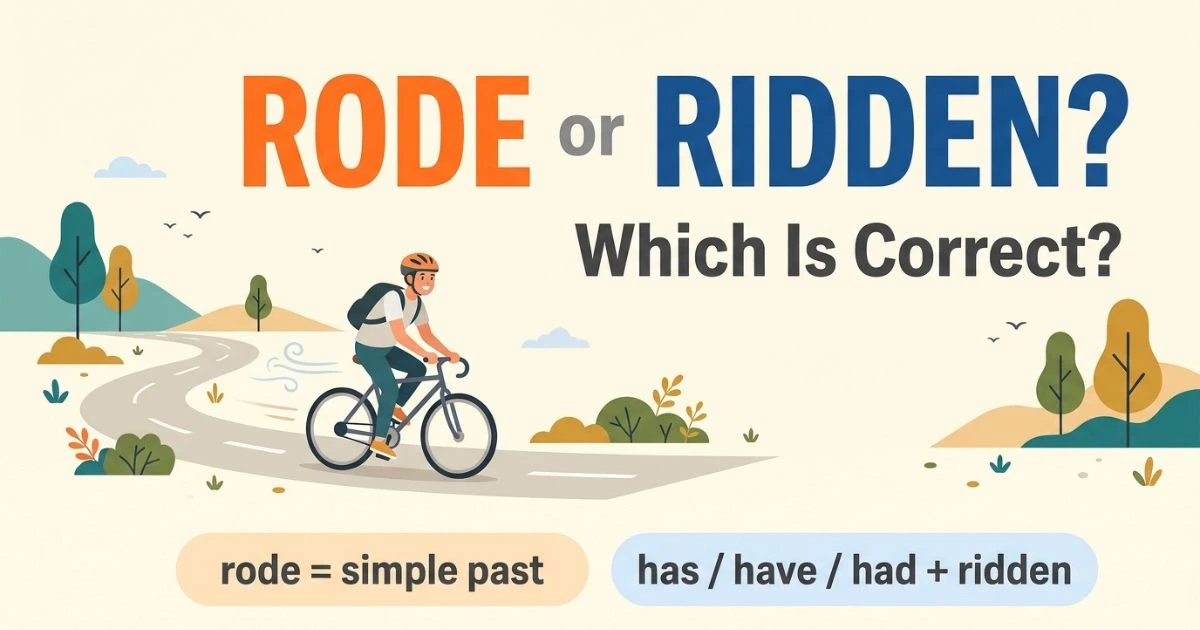
Rode is the simple past of “ride.” Ridden is the past participle, and it needs a helper like has, have, or had.
Picture this. You text a friend, “I have rode that bike before.” You hit send. Then you freeze. Something feels wrong.
Your gut is right. The fix is easy: “I rode that bike once” or “I have ridden that bike before.”
This guide shows exactly when to use each word. You will get clear rules, a memory trick, 20 examples, and a short test. By the end, you will never mix them up again.
Table of Contents
- Introduction
- Quick Answer
- Quick Rule in 1 Line
- Is “Rode or Ridden” a US vs UK Difference?
- What Is the Difference Between Rode and Ridden?
- When to Use “Rode”
- When to Use “Ridden”
- All Forms of the Verb “Ride”
- Memory Trick for Rode vs Ridden
- 20 Example Sentences
- Common Mistakes With Rode and Ridden
- Is “Have Rode” Ever Correct?
- Other Meanings: Rode, Road, and -Ridden
- Quick Practice Test
- FAQs
- Conclusion
- Key Takeaways
- Internal Linking Suggestions
- External References
- Schema Note
Quick Answer
Use “rode” for a finished action in the past: “She rode the bus.” Use “ridden” after has, have, had, will have, or a form of “be”: “She has ridden the bus.” Rode stands alone. Ridden always needs a helper verb in front of it. The words are the same in US and UK English.
⚡ Quick Rule in 1 Line
Use rode by itself for the past; use ridden whenever has, have, had, or been comes first.
Is “Rode or Ridden” a US vs UK Difference?
No. American and British English use the same forms. Rode is the simple past and ridden is the past participle in both. This is a tense question, not a spelling question.
Many word pairs on this site are spelling splits, like color and colour. Others, like cancelled and canceled, change by region. “Rode” and “ridden” are different.
They are two forms of one verb. Each one has its own job.
So you do not need to pick a side of the Atlantic. You only need to pick the right tense. That is why this mistake shows up in every English-speaking country.
The real confusion comes from the verb itself. “Ride” is irregular. It does not follow the usual “add -ed” rule. Learners often guess, and the guess is often wrong.
What Is the Difference Between Rode and Ridden?
Rode is the past simple form. It describes one finished action in the past. Ridden is the past participle. It appears with a helper verb to build perfect tenses and the passive voice.
Here is the split at a glance:
| Form | Name | Needs a helper verb? | Example |
|---|---|---|---|
| rode | Simple past | No | I rode a camel last year. |
| ridden | Past participle | Yes | I have ridden a camel. |
The main test is simple. Look at the word right before the verb. If it is has, have, had, will have, is, was, or been, use ridden. If there is no helper, use rode.
Think of a participle as a word that cannot walk alone. It needs a partner. “Ridden” is that kind of word.
When to Use “Rode”
Use “rode” for an action that started and ended in the past. It sits right after the subject. No helper verb comes before it.
The pattern looks like this:
Subject + rode + object or place
Examples of the pattern:
- Maya rode the bus.
- We rode to the lake.
- He rode his bike every morning.
A time word often shows up near “rode.” Words like yesterday, last week, in 2019, or when I was ten point to the simple past.
If you can add a clear past time, “rode” is usually right. “I rode my bike yesterday” works. “I ridden my bike yesterday” does not.
Use “rode” for stories too. Writers use the simple past to tell what happened, step by step. “The knight rode into town. He rode past the market. He rode up to the gate.”
When to Use “Ridden”
Use “ridden” after a helper verb. It forms the perfect tenses and the passive voice. It also works as an adjective in some phrases.
There are four main spots for “ridden.”
1. Present perfect (has/have + ridden) This links the past to now. “I have ridden that trail many times.”
2. Past perfect (had + ridden) This shows an action that happened before another past action. “We had ridden two miles when the rain started.”
3. Future perfect (will have + ridden) This looks ahead to a finished action. “By noon, they will have ridden 20 miles.”
4. Passive voice (be + ridden) Here, the thing being ridden is the focus. “The horse was ridden by a young boy.”
In all four, a helper verb sits right before “ridden.” That is your signal.
All Forms of the Verb “Ride”
The verb “ride” has five main forms. It is irregular, so the past forms do not end in -ed.
| Form | Word | When you use it |
|---|---|---|
| Base form | ride | I ride to work. |
| Third-person singular | rides | She rides to work. |
| Simple past | rode | She rode to work. |
| Past participle | ridden | She has ridden to work. |
| Present participle | riding | She is riding to work. |
Notice that “ride” is not alone. Many English verbs follow the same three-step pattern.
| Base | Simple Past | Past Participle |
|---|---|---|
| ride | rode | ridden |
| drive | drove | driven |
| write | wrote | written |
| rise | rose | risen |
| arise | arose | arisen |
See the pattern? The past participle ends in -en. That helps a lot, as the next section shows.
Memory Trick for Rode vs Ridden
The best trick is to match “ride” to “drive.” You already know “I have driven” sounds right and “I have drove” sounds wrong. Do the same with ride.
Here are three easy tricks.
Trick 1: The Drive Test. Swap “ride” for “drive” in your head. If “drove” fits, use “rode.” If “driven” fits, use “ridden.”
- “I have ___ a bike.” You would say “I have driven a car.” So pick ridden.
- “I ___ a bike.” You would say “I drove a car.” So pick rode.
Trick 2: Short and Long. Rode is short and goes solo. Ridden is longer and needs a helper. Long word, long partner.
Trick 3: The Helper Check. Look one word back. If you see has, have, had, or been, write ridden. If you see a plain subject like “I” or “she,” write rode.
Use whichever one sticks. Most learners say the Drive Test works fastest.
20 Example Sentences
Simple past: “rode” (no helper verb)
- Maya rode the bus to work this morning.
- We rode horses on the beach last summer.
- He rode his bike to school every day in fifth grade.
- The kids rode the Ferris wheel twice.
- She rode her scooter to the store yesterday.
- The knight rode into the village at dawn.
- I rode in the back seat all the way to Texas.
- They rode out the storm in the basement.
Perfect tenses: “ridden” (helper verb first)
- I have never ridden a horse.
- She has ridden the same train for ten years.
- We had ridden for two hours before we stopped.
- They will have ridden 50 miles by noon.
- Have you ever ridden a motorcycle?
- He has ridden that trail many times.
Passive voice: “ridden” (be + ridden)
- The bike has not been ridden in months.
- This horse is ridden only by experienced riders.
- The roller coaster was ridden by thousands of visitors last week.
Adjective use: “-ridden”
- The old cabin is mold-ridden.
- He felt guilt-ridden after the argument.
- The team was injury-ridden all season.
Common Mistakes With Rode and Ridden
The most common mistake is using “rode” after a helper verb. The second is using “ridden” with no helper. A third is adding -ed, as in “rided.”
Here are the errors you will see most.
| Wrong | Right | Why |
|---|---|---|
| I have rode a horse. | I have ridden a horse. | “Have” needs a past participle. |
| She has rode that train. | She has ridden that train. | “Has” needs a past participle. |
| We had rode for hours. | We had ridden for hours. | “Had” needs a past participle. |
| I ridden my bike yesterday. | I rode my bike yesterday. | No helper, so use the simple past. |
| He rided to school. | He rode to school. | “Ride” is irregular. It has no -ed form. |
| The bike was rode by Sam. | The bike was ridden by Sam. | Passive voice needs a past participle. |
Why does this mistake happen so often?
People hear “rode” far more than “ridden” in daily talk. “Rode” is shorter and easier to say. So it sneaks into places where “ridden” belongs.
Also, in some irregular verbs the past and the participle match. “Made” and “made.” “Bought” and “bought.” Learners expect the same from “ride.” It does not work that way here.
A quick fix for your own writing.
Read the sentence out loud. Then change the verb to “driven” or “written.” If the sentence still sounds right, you probably picked the correct form.
Is “Have Rode” Ever Correct?
In standard writing, no. “Have rode” is treated as an error. Dictionaries label “rode” as a nonstandard past participle, though some list it as a dialect form.
You may hear “I have rode” in casual speech in some regions. Some dictionaries note it as a chiefly dialectal variant. That does not make it right for school, work, or publishing.
For essays, emails, resumes, and blog posts, stay with “have ridden.” It is the safe, correct choice. Editors and teachers will mark “have rode” as a mistake.
The same goes for “had rode” and “has rode.” Use “had ridden” and “has ridden.”
There is one more old form to know. Dictionaries list “rid” as an archaic past form of ride. You will only see it in very old books. Skip it in modern writing.
Other Meanings: Rode, Road, and -Ridden
Some people mix “rode” up with similar words. “Rode” has one more meaning, and “ridden” shows up in common phrases. Knowing these keeps your writing clear.
Rode vs road
They sound the same but mean different things.
- Rode is the past tense of ride. “She rode to town.”
- Road is a path for cars. “Follow the road to town.”
Rode as a noun
There is a rare second word spelled “rode.” It means a rope that holds a boat at anchor. You will mostly meet it in sailing books.
Ridden as an adjective
“Ridden” can mean “filled with” or “troubled by” something bad. It often joins another word with a hyphen.
- debt-ridden — full of debt
- bug-ridden — full of bugs or errors
- guilt-ridden — full of guilt
Merriam-Webster also lists a sense where a person is “ridden by anxiety.” It means anxiety weighs on them.
This form is still a past participle at heart. That is why it ends in -en and not -ed.
Quick Practice Test
Pick “rode” or “ridden” for each blank. Cover the answers first.
- Last week, we ___ our bikes to the park.
- I have never ___ a train in Europe.
- She ___ in the front seat.
- The horse had been ___ every day.
- By Friday, he will have ___ 100 miles.
- They ___ the subway home last night.
- Has your sister ever ___ a camel?
- Tom ___ his scooter down the hill.
Answers: 1. rode. 2. ridden. 3. rode. 4. ridden. 5. ridden. 6. rode. 7. ridden. 8. rode.
How did you do? If you missed any, go back to the Helper Check. Look one word before the blank.
FAQs
1. Is it “rode” or “ridden”?
Both are correct, but each has its own job. Use “rode” for a simple past action, like “I rode the bus.” Use “ridden” after has, have, had, or a form of “be,” like “I have ridden the bus.”
2. What is the past tense of ride?
The past tense of ride is “rode.” It describes a finished action in the past. For example: “She rode her bike to school yesterday.” The past tense never needs a helper verb.
3. What is the past participle of ride?
The past participle of ride is “ridden.” You use it with helper verbs to build perfect tenses and passive sentences. For example: “He has ridden that horse before” and “The bike was ridden daily.”
4. Is “have rode” correct?
No. In standard English, “have rode” is a mistake. The word “have” needs a past participle, and the past participle of ride is “ridden.” Write “have ridden” in school, work, and published writing.
5. Is “I have ridden” correct?
Yes. “I have ridden” is correct present perfect. It talks about an experience or a past action that still matters now. For example: “I have ridden a horse, but I have never ridden a camel.”
6. Can I say “I ridden my bike”?
No. “Ridden” cannot stand alone. It needs a helper verb like have, has, or had. Without a helper, use “rode”: “I rode my bike.” Or add the helper: “I have ridden my bike.”
7. Is “rode or ridden” different in British and American English?
No. Both versions of English use “rode” as the simple past and “ridden” as the past participle. There is no spelling split here. The only choice is which tense your sentence needs.
8. Is “rided” a word?
No. “Ride” is an irregular verb, so it does not take -ed. Always use “rode” for the simple past and “ridden” for the past participle. Never write “rided.”
9. What is the difference between “rode” and “road”?
“Rode” is the past tense of the verb ride. “Road” is a noun for a paved path where vehicles travel. They sound alike, but they are not interchangeable. “I rode down the road.”
10. Which verbs follow the same pattern as ride?
Drive, write, rise, and arise follow the same pattern. Each has a past form and a different past participle ending in -en: drove and driven, wrote and written, rose and risen, arose and arisen.
Key Takeaways
- Rode is the simple past of ride. It needs no helper verb.
- Ridden is the past participle. It needs has, have, had, will have, or a form of “be.”
- Both forms are the same in US and UK English.
- “Have rode” is nonstandard. Write “have ridden” instead.
- “Rided” is not a word. Ride is an irregular verb.
- Use the Drive Test: drove goes with rode, driven goes with ridden.
- “Ridden” also works as an adjective, as in debt-ridden or guilt-ridden.
- “Rode” and “road” sound alike but mean different things.
Conclusion:
The answer is simple. Use “rode” for a plain past action and “ridden” after a helper verb.
“I rode a horse” and “I have ridden a horse” are both correct. They just belong in different sentences.
If you doubt a sentence, use the Helper Check. Look at the word before the verb. If it is has, have, had, or been, choose ridden. Otherwise, choose rode.
There is no US or UK split here. One rule works everywhere.

I’m Sophia Mitchell, an English grammar and writing enthusiast. I create simple, easy-to-understand content to help learners improve their English. My goal is to make grammar clear, practical, and enjoyable for everyone.