Bare fruit or bear fruit? You’re typing a quick email, a caption, or an essay, and you pause.
Both spellings look fine, and they sound exactly the same, which is why this slip gets past so many careful writers.
The short answer: it’s bear fruit. In this guide, you’ll get the meaning in plain English, the reason “bare” doesn’t fit, the right verb forms (bear, bore, borne), the most common mistakes, and a few memory tricks that actually stick.
A short practice quiz at the end lets you test yourself before you hit send.
Bare Fruit or Bear Fruit? The Quick Answer
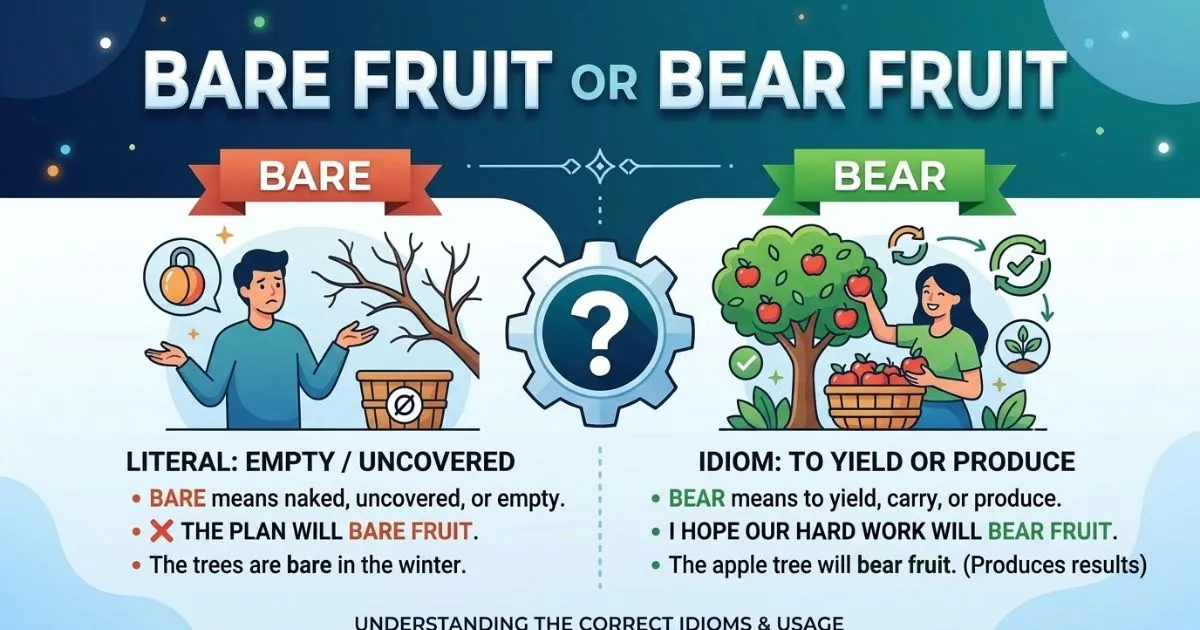
Bear fruit is the correct phrase. It means to produce fruit, or to produce a good result.
Bare fruit is not an idiom. Bare means uncovered, empty, or exposed, so it has nothing to do with results.
- ✅ The apple tree will bear fruit this summer.
- ✅ Her hard work finally bore fruit.
- ❌ Her hard work finally bared fruit.
The one-line rule: if something is producing, use bear. If something is uncovered, use bare.
What Does “Bear Fruit” Mean?
To bear fruit means to produce something. What gets produced depends on the subject of the sentence.
The Literal Meaning
Here, a plant produces actual fruit. Trees, bushes, and garden plants all do it.
- The cherry tree bears fruit every July.
- Our lemon tree began to bear fruit this year.
- The young tree hasn’t borne fruit yet.
The Figurative Meaning
Here, effort, planning, or patience produces a positive result. The “fruit” is the payoff.
- The new marketing plan is finally bearing fruit.
- Years of research bore fruit.
- We hope these negotiations will bear fruit soon.
You don’t need a garden for this to work. The phrase fits school, work, business, sport, and personal goals equally well.
Where You’ll See It
You’ll meet this phrase in everyday conversation, motivational posts, news headlines, academic writing, and religious texts such as the Bible.
Notice the pattern: it usually describes results that took time to arrive. That’s why words like finally, eventually, and yet often sit right next to it.
Read More: Flesh Out or Flush Out: Which One Do You Actually Mean?
Why Is It “Bear” and Not “Bare”?
Bear and bare are homophones. They sound identical (both are pronounced /beər/) but have different spellings and meanings. Your ears can’t settle this one, so meaning has to.
What “Bear” Means
As a verb, bear has three main jobs:
- Carry or support: The bridge can bear heavy loads.
- Endure: I can’t bear the noise.
- Produce or yield: The tree bears apples every fall.
Bear fruit uses the third meaning. (Bear is also the animal, but that meaning never pairs with fruit.)
What “Bare” Means
Most of the time, bare is an adjective meaning uncovered, naked, plain, or empty.
- She walked across the room in bare feet.
- The walls were bare.
- The cupboard was bare after the guests left.
It can also work as a verb meaning to uncover or reveal, as in to bare your soul.
Bear vs. Bare at a Glance
| Word | Meaning | Example |
| Bear | to carry, endure, or produce | The tree will bear fruit. |
| Bare (adjective) | uncovered or empty | The room was completely bare. |
| Bare (verb) | to reveal | She decided to bare her soul. |
| Bear fruit | to produce results | The plan finally bore fruit. |
Can “Bare Fruit” Ever Be Correct?
Only in a literal way that has nothing to do with the idiom. For example, you could describe fruit served without its peel or wrapping as “bare.” That’s a description of how the fruit looks.
It is never the right choice when you mean a tree produced fruit or an effort paid off.
Why the Mix-Up Happens
When you learn a word by hearing it, you store the sound, not the spelling. Add fast typing, and the problem gets worse. Both bear and bare are real words, so spellcheck often lets either one through.
That’s why you need a quick mental check, which brings us to the next section.
How to Choose the Right Word in Seconds
Use these four checks when you’re unsure.
- The action clue. Is something producing, carrying, or enduring? Use bear.
- The coverage clue. Is something uncovered, empty, or exposed? Use bare.
- The animal clue. Is it a large furry animal? That’s the noun bear.
- The swap test. Replace the word with produce. If the sentence still makes sense, you need bear.
Here’s the swap test in action:
- “Her efforts finally produced fruit.” Works, so write bore fruit.
- “She walked with produce feet.” Nonsense, so write bare feet.
It takes five seconds and works almost every time.
Bear Fruit Grammar: Bear, Bears, Bore, Borne, Bearing
Choosing bear over bare is step one. Step two is getting the verb form right, because bear is an irregular verb: bear → bore → borne.
| Form | When to use it | Example |
| bear fruit | base form, or after will, can, may | Your efforts can bear fruit. |
| bears fruit | present tense, singular subject | The tree bears fruit every year. |
| bore fruit | simple past | Their efforts bore fruit last year. |
| bearing fruit | ongoing action | The campaign is bearing fruit. |
| has/have borne fruit | present perfect | Her work has borne fruit. |
| had borne fruit | past perfect | The strategy had borne fruit. |
Bore or Borne?
Use bore for a simple past action. Use borne after has, have, or had.
- Their efforts bore fruit last year.
- Their efforts have borne fruit.
Borne or Born?
Born belongs to birth. You may spot “born fruit” in casual writing, but when you mean results or effort, borne is the correct spelling.
Two Forms That Don’t Exist
There is no “beared fruit.” And bared is the past tense of bare (to uncover), so “the project bared fruit” is wrong too. The correct past tense is always bore.
British vs. American English
Good news: there’s no difference. Both use bear fruit, bore fruit, and borne fruit in the same way.
More Examples You Can Borrow
Literal
- The orchard bore fruit earlier than expected.
- These plants bear fruit in warm weather.
- The farmer hopes the new trees will bear fruit soon.
- Healthy plants can bear fruit for many seasons.
Figurative
- Her daily practice bore fruit during the final exam.
- Years of training bore fruit at the competition.
- Patience often helps good ideas bear fruit.
- The company hopes its investment will bear fruit.
- Her decision to practice every day has borne fruit.
When Results Haven’t Arrived
The phrase works just as well for things that aren’t working yet.
- The partnership hasn’t borne fruit yet.
- Peace talks have yet to bear fruit.
- The new plan failed to bear fruit.
Common Mistakes to Avoid
| Incorrect❌ | Correct✅ | Why |
| Our efforts will bare fruit. | Our efforts will bear fruit. | Efforts produce results, they don’t uncover them. |
| The project bared fruit. | The project bore fruit. | Bore is the past tense of bear. |
| Their efforts have bore fruit. | Their efforts have borne fruit. | Use borne after have. |
| The tree bear fruit every year. | The tree bears fruit every year. | Singular subject needs bears. |
| Bare with me, please. | Bear with me, please. | Bear with me means “be patient with me.” |
| The bare market hit stocks hard. | The bear market hit stocks hard. | In finance, it’s bear market. |
| Keep costs to the bear minimum. | Keep costs to the bare minimum. | Bare minimum means the least possible. |
Most of these come from the same root: two words that sound alike. Slow down on the one word, check its meaning, and the error disappears.
Other Phrases With “Bear” and “Bare”
Since you’re already sorting these two words out, here are the phrases people mix up most often.
- Bear with me: be patient with me.
- Bear in mind: keep in mind.
- Bear the cost: to pay for something.
- Bear weight: to support weight.
- Bear the pain: to endure the pain.
- Bare minimum: the least possible.
Notice that every bear phrase involves carrying, supporting, or enduring. The only bare phrase here is about “nothing extra.”
What Can You Say Instead of “Bear Fruit”?
Sometimes you want a fresh way to say the same thing. For the figurative meaning, these work well:
| Alternative | Example |
| pay off | Her hard work finally paid off. |
| yield results | The new strategy yielded results. |
| produce results | Their efforts produced results. |
| lead to success | The plan led to success. |
| come to fruition | Their idea finally came to fruition. |
One caution: these only work for the figurative meaning. “The apple tree pays off” sounds odd, so stick with bear fruit when you’re talking about real fruit.
Memory Tricks That Actually Work
Trick 1: Remember “Forbear”
Forbear means to stay patient despite annoyance. Look inside it: bear is right there. Link bear to forbear and you won’t confuse it with bare.
Trick 2: Picture a Bear Carrying Fruit
Imagine a bear walking along with a basket of apples on its back. A bear carries things, and so does the verb bear. It’s a silly image, which is exactly why it sticks.
Trick 3: Presence vs. Absence
Bear is about something being present: produced, carried, delivered. Bare is about something being absent: no covering, no contents, nothing extra.
Trick 4: Write Three Sentences
Write one literal bear fruit sentence, one figurative bear fruit sentence, and one sentence with bare. Look at them again tomorrow. Writing your own examples beats re-reading someone else’s.
Quick Practice: Test Yourself
Fill in the blank (bear, bare, bore, or borne):
- After months of practice, her English finally began to ___ fruit.
- The cupboard was ___ after the party.
- Please ___ with me while I find the file.
- Their research has ___ fruit.
Fix the sentence:
- The campaign bared fruit last year.
- He walked along the beach with bear feet.
Answers:
- bear (practice produces results)
- bare (empty)
- bear (be patient)
- borne (after has)
- The campaign bore fruit last year.
- He walked along the beach with bare feet.
FAQ
Is it “bare fruit” or “bear fruit”?
It’s “bear fruit.” This idiom means to produce fruit or to achieve a good result. “Bare” means uncovered or empty, so it doesn’t fit. The mistake happens because the two words are homophones, meaning they sound exactly the same but have different spellings and meanings.
What does “bear fruit” mean?
It means to produce something, either literally or figuratively. Literally, a tree produces apples or cherries. Figuratively, hard work, a plan, or a decision produces a positive result. For example, “Years of studying finally bore fruit when she passed the exam.”
What is the past tense of “bear fruit”?
The simple past is “bore fruit,” as in “Their efforts bore fruit.” After has, have, or had, use “borne fruit,” as in “Her work has borne fruit.” The ongoing form is “bearing fruit.” There’s no such form as “beared fruit” or “bared fruit.”
Is “bare fruit” ever correct?
Only in a literal description unrelated to the idiom, such as fruit served without peel or packaging. It is never correct when you mean a tree produced fruit or an effort succeeded. In those cases, always write “bear fruit,” in whatever tense your sentence needs.
What is the difference between bear and bare?
Bear is a verb meaning to carry, endure, or produce. It’s also the animal. Bare usually means uncovered, naked, or empty, and as a verb it means to reveal. A quick check: if “produce,” “carry,” or “endure” fits your sentence, use bear.
Is it “bear with me” or “bare with me”?
It’s “bear with me.” The phrase means “please be patient with me.” “Bare with me” is a common mistake that uses the wrong word and changes the meaning entirely. The same logic applies: bear covers enduring and patience, while bare covers things uncovered.
Is it “borne fruit” or “born fruit”?
It’s “borne fruit.” Born relates to birth, as in “She was born in May.” When you talk about results or effort, the past participle of bear is borne. You might see “born” in casual writing, but “borne” is the correct choice.
Conclusion:
So, bare fruit or bear fruit? Bear fruit every time you mean producing fruit or achieving results. Bare means uncovered, empty, or exposed, and it doesn’t belong in this phrase.
Remember the essentials:
- Use the swap test: if “produce” fits, write bear.
- Watch the verb forms: bear, bears, bore, borne.
- Use the “forbear” or “bear carrying fruit” trick when you’re stuck.
Your next step: before you publish your next email, essay, or post, search your draft for the word “bare.” If it isn’t about something uncovered or empty, it probably should be bear.

As an American English writer, I specialize in creating clear and engaging content that makes grammar and language learning accessible to everyone. I enjoy breaking down complex English concepts into simple, practical lessons that readers can apply with confidence. My mission is to help learners strengthen their communication skills through easy and reliable content.