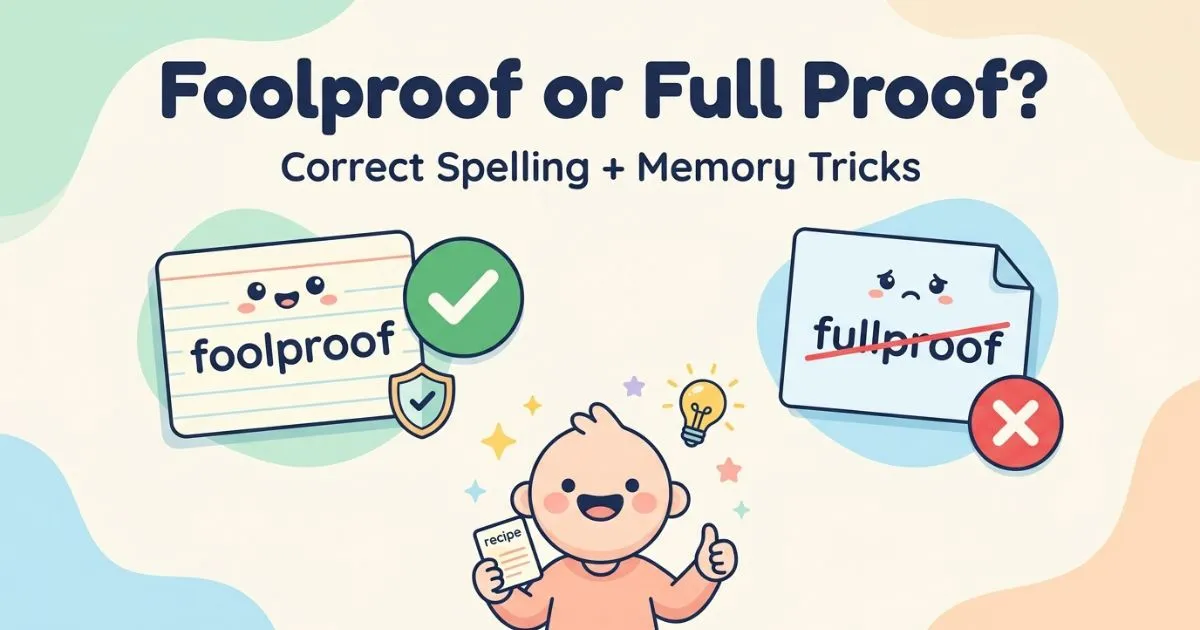
You are typing a sentence about a perfect plan, and your fingers stop. Is it “foolproof” or “full proof”? Both look believable, and your spellcheck may stay silent.
That tiny doubt is common because “fool” and “full” sound almost alike.
Choose wrongly, and a reader may see a typo, or decide you don’t know the word.
This guide gives you the answer in one line, explains what foolproof really means, shows when “full proof” is a different (and rare) phrase, and ends with simple tricks and a quick editing check. After reading, you won’t second-guess this word again.
Foolproof or Full Proof? The Quick Answer
Write foolproof: one word, double O, no space. Use it when something is so simple or well designed that it is very unlikely to go wrong.
| Form | Verdict | Example |
| Foolproof | Correct | This recipe is foolproof. |
| Fullproof | Always an error | Use foolproof instead. |
| Full proof (two words) | A real phrase, but it means “complete evidence” and is rare | The detective wanted full proof before naming a suspect. |
| Fool-proof | Sometimes seen, but not the standard form | Prefer foolproof. |
If you remember only one thing, remember this: when you describe a plan, method, recipe, or system that is hard to get wrong, the word is foolproof.
What Does Foolproof Mean?
Foolproof is an adjective. It describes a plan, tool, or process built so well that it can’t easily go wrong, even in the hands of a beginner.
The Strict Definition
Dictionary-style definitions sound absolute. One describes foolproof as “incapable of going wrong.” Another says it means designed to work correctly under all possible conditions, even when used incorrectly.
That is the ideal. Real life is a bit looser, as you’ll see below.
Think “Immune to Fools”
The easiest way to picture it: foolproof means immune to fools. The “fool” here isn’t a real person you are insulting. It stands for anyone who might make a careless mistake.
A foolproof set of instructions is one a total beginner can follow and still get right.
How the Word Is Built
Foolproof is a compound word, made from fool and proof. The ending -proof means “protected against.” You already know other words built the same way:
- Waterproof: protected against water
- Fireproof: protected against fire
- Bulletproof: protected against bullets
- Foolproof: protected against fools, or more precisely, against careless mistakes
The word is a fairly recent arrival in English. It was first recorded at the beginning of the 20th century.
Everyday Meaning vs. Strict Meaning
When someone calls a recipe foolproof, they don’t mean it is physically impossible to burn. They mean it is very hard to mess up if you follow the steps.
The novelist Douglas Adams joked about this gap in Mostly Harmless. His point: people who try to build something completely foolproof tend to underestimate how inventive fools can be.
So treat foolproof as a strong promise of simplicity, not a promise of perfection.
Read More: Affect or Effect: What’s the Difference and Which One Should You Use?
Why Fullproof and Full Proof Feel Right (But Aren’t)
If the mistake is so common, there must be reasons. There are two.
The Sound-Alike Trap
“Fool” and “full” are near-homophones, which means they sound very similar when spoken. In casual speech, and in some accents, the difference almost disappears.
Many people hear this word long before they ever see it written. Writing what you hear leads straight to fullproof.
The “Full of Proof” Logic
Some writers also assume a reliable plan must be “full of proof,” as if it were fully tested and certain.
It sounds sensible, but the grammar doesn’t work. Since -proof means “protected against,” fullproof would mean “protected against fullness.” That means nothing.
Why Spellcheck Doesn’t Always Help
Here is a sneaky part. “Full” and “proof” are both correct English words. A basic spellchecker looks at individual words, so “full proof” may pass without a warning.
Grammar and style checkers can flag it, but your own eyes are the best backup. We’ll build a simple check for that shortly.
Is “Full Proof” Ever Correct?
Yes, but only as two separate words with a completely different meaning. Here, full means complete and proof means evidence.
- The court wanted full proof of the payment.
- She had no full proof, only a strong suspicion.
Even then, the phrase is uncommon. “Complete proof” or “conclusive evidence” usually sounds more natural.
You may read online that “full proof” isn’t a real phrase at all. A more precise statement is this: the two-word phrase exists, but it is not a spelling of foolproof. And the one-word fullproof is not correct in any context. Editors, teachers, and readers will treat it as an error.
A Quick Test
Ask yourself one question: Am I talking about evidence, or about something hard to get wrong?
- Evidence: “full proof” is possible, though “complete proof” is often better.
- Hard to get wrong: foolproof, every time.
How to Use Foolproof in a Sentence
Foolproof works in two common positions.
Before a Noun
Place it right before the thing you are describing:
- We need a foolproof method for tracking expenses.
- She shared a foolproof recipe for homemade bread.
- The team built a foolproof system for checking orders.
- He wrote foolproof instructions for beginners.
After a Linking Verb
You can also place it after verbs like be, seem, and look:
- This method seems foolproof.
- The setup looks almost foolproof.
- No solution is entirely foolproof.
The spelling never changes. You can soften it with words like almost, nearly, or not completely, which is often more honest anyway.
Examples From Everyday Life
Home
- My aunt has a foolproof way to keep rice from sticking.
- Labeling every box is a nearly foolproof way to stay organized when moving.
School
- Reading your answer aloud is a simple, almost foolproof way to catch silly errors.
- The lab guide was so clear that the experiment felt foolproof.
Work
- A shared checklist gives the team a foolproof reminder of each step.
- Dropdown menus make the form close to foolproof, because nobody can mistype a country name.
Technology
- Automatic backups are a nearly foolproof way to protect your photos.
- The app’s setup is simple, but nothing about it is truly foolproof.
Foolproof Does Not Mean Guaranteed
This is the gap most competing guides skip, and it matters if you write for customers, clients, or readers who make decisions.
Foolproof describes how easy and reliable a method is. It does not promise success. Compare these two sentences:
- Too strong: “This foolproof investment plan guarantees a profit.”
- Better: “This plan is designed to reduce common investment mistakes.”
Be extra careful with money, health, and safety. A bold claim in those areas can mislead people.
Also remember that “foolproof” can sound like marketing hype. Specific details usually persuade better. Instead of “a foolproof signup,” try “a three-step signup that needs no technical skills.”
Common Mistakes and Quick Fixes
1. Writing “fullproof.”
Wrong: This is a fullproof plan.
Right: This is a foolproof plan.
2. Splitting the word when you mean “hard to get wrong.”
Wrong: I found a full proof way to do it.
Right: I found a foolproof way to do it.
3. Adding a hyphen out of habit.
You may spot “fool-proof” in the wild, but the standard form is one word. Use foolproof and keep your writing consistent.
4. Treating foolproof as a guarantee.
Wrong: The system is foolproof, so errors can never happen.
Right: The system is designed to make errors unlikely.
Foolproof Synonyms (and When Not to Use Them)
Sometimes you want a different word. Just remember that these aren’t perfect swaps.
| Word | Best when you mean | Example |
| Reliable | Something can be trusted to work well | We need a reliable system. |
| Infallible | Incapable of making mistakes | No person is infallible. |
| Flawless | Without any fault | Her presentation was flawless. |
| Surefire | Almost certain to succeed | A surefire way to save time. |
| Fail-safe | Designed to prevent serious failure or danger | The machine has a fail-safe mechanism. |
| Error-resistant | Built to reduce mistakes | The form is error-resistant. |
| Straightforward | Easy to understand or complete | The process is straightforward. |
Notice that “simple” and “straightforward” describe ease, not protection from mistakes. A task can be simple and still easy to get wrong.
The opposites are words like fallible, unreliable, and uncertain.
How to Pronounce It
Say it as “FOOL-proof.” The first syllable rhymes with pool, not with full. Saying it aloud a few times also helps your spelling.
Five Memory Tricks That Actually Work
1. Count the O’s.
Fool and good both have a double O. Choosing foolproof is always a good choice.
2. Use the pool rhyme.
If the first syllable rhymes with pool, you need the double O.
3. Ask “protected against what?”
Since -proof means “protected against,” fill in the blank. Protected against fools makes sense. Protected against full does not.
4. Link the F to “fail.”
Foolproof starts with an F, just like fail. It describes something designed so it can’t easily fail.
5. Picture a beginner with a recipe.
Imagine someone who has never cooked following clear steps and getting a great result. That recipe is foolproof.
A 30-Second Editing Check
Before you publish, run this quick routine:
- Use your search shortcut (Ctrl+F or Cmd+F) to look for “fullproof,” “full proof,” and “fool proof.”
- For each match, ask: evidence, or hard to get wrong?
- If it means hard to get wrong, replace it with foolproof.
- If you kept “foolproof,” check that you haven’t promised more than you can deliver.
- Read the sentence aloud once.
This takes less than a minute and catches the mistake that spellcheck often misses.
FAQs
1. Is it foolproof or full proof?
Foolproof is correct when you mean something designed to be easy to use and hard to get wrong. “Full proof” is a different two-word phrase meaning complete evidence. It is not an alternative spelling of foolproof, and it is rarely the most natural choice.
2. Is fullproof a real word?
No. Fullproof is a common misspelling of foolproof, caused by the similar sound of “fool” and “full.” There is no context in which the one-word version is considered correct, and editors will mark it as an error. Use foolproof instead.
3. What does foolproof mean?
Foolproof describes a plan, method, or system that is very unlikely to go wrong, even when a beginner uses it. Think “immune to fools.” A foolproof recipe, for example, has steps so clear that almost anyone can follow them successfully.
4. Is foolproof one word or two?
It is one word. Write “a foolproof method,” not “a fool proof method” or “a full proof method.” The word is a compound of fool and proof, built like waterproof and fireproof. A hyphenated version appears occasionally, but one word is standard.
5. Does foolproof mean guaranteed to work?
Not really. In everyday use, it means a method is designed to make mistakes unlikely. Even a well-designed process can fail under unusual conditions. Avoid using it as a promise of success, especially when talking about money, health, or safety.
6. What is another word for foolproof?
Good alternatives include reliable, infallible, flawless, surefire, fail-safe, and error-resistant. They aren’t identical. Reliable focuses on trust, fail-safe on preventing serious or dangerous failure, and error-resistant on reducing everyday mistakes. Pick the one that matches what you actually mean, rather than swapping words blindly.
7. How do you pronounce foolproof?
Say “FOOL-proof,” with the first syllable rhyming with pool. It should not sound like “full.” Since the sound of the word is exactly what leads people to misspell it, practicing the pronunciation out loud a few times also helps you remember the double O when you write.
Conclusion:
The foolproof or full proof question has a simple answer. Use foolproof (one word) for anything designed to be easy to use and hard to get wrong.
Avoid fullproof completely. Keep the two-word phrase full proof for the rare moments when you truly mean complete evidence.
Remember, too, that foolproof signals reliability, not a guarantee. Use it with a little care, especially when money, health, or safety is involved.
Your next step: open your latest draft and run the 30-second editing check above. It’s the quickest way to turn this rule into a habit.

I’m Sophia Mitchell, an English grammar and writing enthusiast. I create simple, easy-to-understand content to help learners improve their English. My goal is to make grammar clear, practical, and enjoyable for everyone.