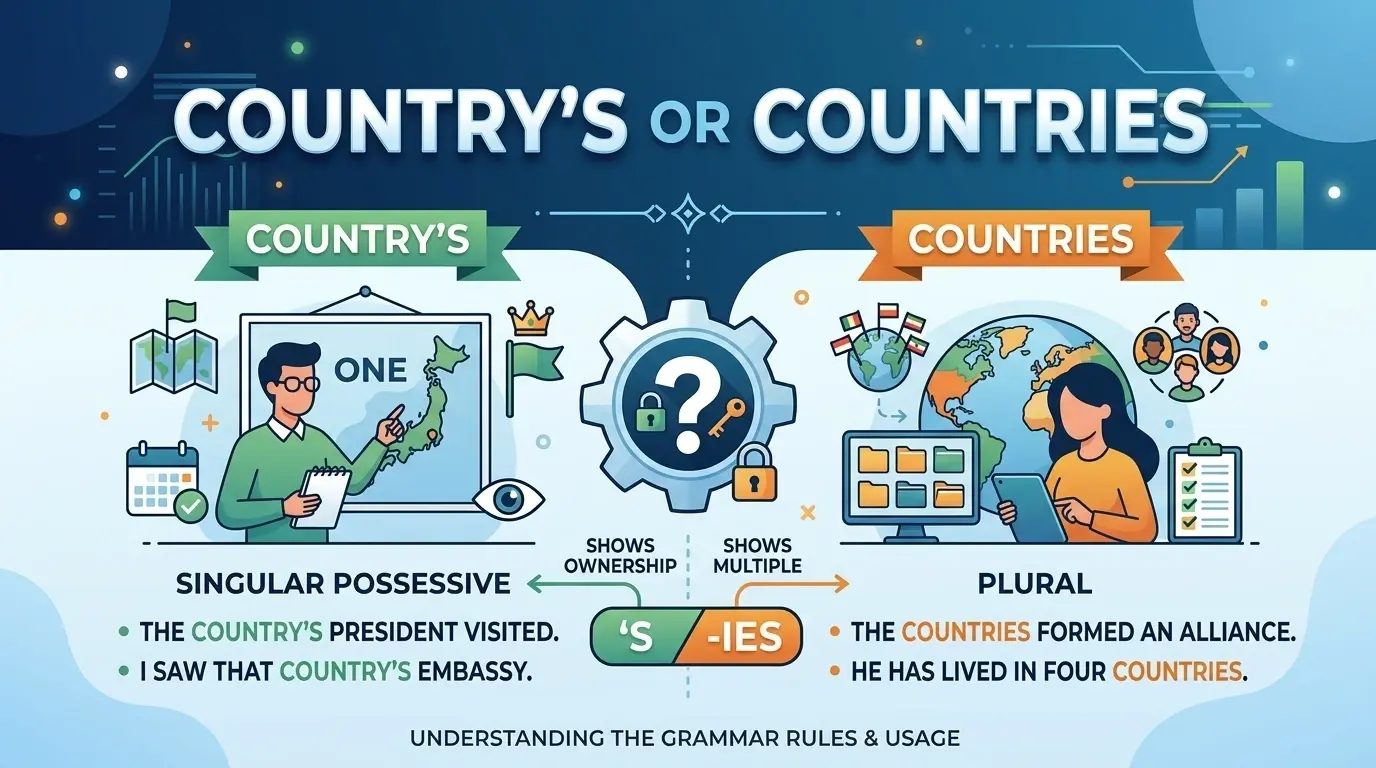
Country’s is the correct possessive form for one country, while countries’ is used when you mean two or more countries. The difference depends on whether the noun is singular or plural.
You may notice both forms while writing about a country’s history, economy, people, or laws. This can make you wonder whether the apostrophe should come before or after the s.
The rule is simple: country’s means something belongs to or relates to one country. Countries’ means something belongs to or relates to multiple countries. For example, “the country’s economy” refers to one country, while “the countries’ economies” refers to several countries.
Once you understand the singular and plural forms, choosing the correct apostrophe becomes much easier.
Country’s or Countries’: Quick Answer
Country’s is the singular possessive form of country, while countries’ is the plural possessive form. Use country’s when one country has or is connected to something. Use countries’ when two or more countries have or share something. This follows the standard apostrophe rule for possessive nouns.
Quick Rule
One country = country’s; two or more countries = countries’.
Is “Countries” Singular or Plural?
Countries is plural. The singular form is country. Countries means two or more, while country means only one.
The plural is formed by changing y to ies because country ends with a consonant plus y.
- One country: Pakistan is a country.
- Two or more: Pakistan and India are countries.
So countries is never singular, and countrys is not a correct plural.
Each Country or Each Countries?
Each country is correct. Each is always followed by a singular noun, so each countries is wrong.
- ✅ Each country has its own laws.
- ❌ Each countries has its own laws.
If you need the possessive, use each country’s:
- ✅ Each country’s economy is different.
If you want a plural noun, use all, many, or both instead:
- ✅ All countries have their own laws.
- ✅ Both countries’ leaders attended.
What Does “Country’s” Mean?
Country’s shows that something belongs to, comes from, or is connected with one country. It is formed by adding ‘s to the singular noun country. The apostrophe comes before the final s because country is singular.
For example:
The country’s economy is growing.
This means the economy of one country is growing.
You can also write:
The country’s capital is very large.
Here, country’s refers to one country’s capital.
Other common examples include:
- the country’s government
- the country’s history
- the country’s population
- the country’s borders
- the country’s culture
- the country’s economy
- the country’s president
- the country’s laws
In each case, country’s connects something with one country.
Why Is the Apostrophe Before the S?
The word country is singular.
For most singular nouns, English uses ‘s to show possession.
For example:
- the girl’s book
- the teacher’s desk
- the company’s policy
- the country’s economy
Cambridge Grammar explains that ‘s is normally used after a singular noun to show possession.
Read More: Everyones or Everyone’s? Which Is Correct?
What Does “Countries'” Mean?
Countries’ shows that something belongs to, comes from, or is connected with two or more countries. The word countries is already plural, so the apostrophe comes after the final s.
For example:
The countries’ economies are different.
This means the economies of multiple countries are different.
Another example:
The countries’ leaders met to discuss the issue.
Here, more than one country has a leader involved in the discussion.
Common examples include:
- the countries’ governments
- the countries’ economies
- the countries’ leaders
- the countries’ borders
- the countries’ cultures
- the countries’ laws
- the countries’ populations
- the countries’ histories
The key is that countries’ refers to more than one country.
Country’s or Countries’ Comparison
The easiest way to understand the difference is to compare the number of countries.
| Form | Number | Meaning | Example |
| country | One | A single country | The country is large. |
| country’s | One | Belonging to one country | The country’s capital is large. |
| countries | Two or more | Multiple countries | The countries are neighbors. |
| countries’ | Two or more | Belonging to multiple countries | The countries’ capitals are different. |
The apostrophe does not determine whether the noun is singular or plural.
First, the noun changes from country to countries.
Then the apostrophe shows possession.
So the pattern is:
country → country’s
countries → countries’
This is the same general rule used with other regular nouns.
The Grammar Rule Behind Country’s and Countries’
Country’s follows the singular possessive rule, while countries’ follows the plural possessive rule for nouns ending in s. The apostrophe position tells readers whether the possessive noun is singular or plural.
The basic pattern looks like this:
Singular noun + ‘s
country → country’s
teacher → teacher’s
student → student’s
company → company’s
Regular plural noun ending in s + apostrophe
countries → countries’
teachers → teachers’
students → students’
companies → companies’
There is one important detail with country.
The plural is not countrys.
The correct plural is:
country → countries
The y changes to ies.
Then the possessive apostrophe is added:
countries → countries’
So:
❌ countrys’
❌ countrie’s
✅ countries’
Country vs Countries
Before choosing between country’s and countries’, you need to know whether you mean one country or multiple countries.
Country
Country is singular.
This country has a large population.
You are talking about one country.
Countries
Countries is plural.
These countries have large populations.
You are talking about multiple countries.
Country’s
Country’s is singular possessive.
The country’s population is growing.
One country has a population.
Countries’
Countries’ is plural possessive.
The countries’ populations are growing.
Multiple countries have populations.
This four-form pattern makes the difference much easier to remember.
When to Use “Country’s”
Use country’s when the noun refers to something belonging to or associated with one country. The following noun can describe its people, government, economy, history, culture, land, or other characteristics.
Example 1: Country’s economy
The country’s economy is improving.
One country’s economy is being discussed.
Example 2: Country’s population
The country’s population has increased.
The population belongs to one country.
Example 3: Country’s government
The country’s government announced a new policy.
One government is being discussed.
Example 4: Country’s history
The museum explains the country’s history.
The history belongs to one country.
Example 5: Country’s capital
The country’s capital attracts many visitors.
One country’s capital is being discussed.
In all these examples, country’s is singular possessive.
When to Use “Countries'”
Use countries’ when you are talking about something belonging to or associated with multiple countries. The countries must be plural before you add the possessive apostrophe.
Example 1: Countries’ economies
The countries’ economies are closely connected.
The sentence discusses the economies of multiple countries.
Example 2: Countries’ governments
The countries’ governments signed an agreement.
More than one government is involved.
Example 3: Countries’ leaders
The countries’ leaders attended the meeting.
The leaders represent multiple countries.
Example 4: Countries’ populations
The countries’ populations have changed over time.
Multiple countries are being compared.
Example 5: Countries’ borders
The countries’ borders were clearly marked.
The borders belong to multiple countries.
20 Real Examples of “Country’s”
Here are natural examples using the singular possessive form country’s:
- The country’s economy is growing.
- The country’s population is increasing.
- The country’s capital is crowded.
- The country’s government announced new rules.
- The country’s history is fascinating.
- The country’s culture attracts many visitors.
- The country’s borders are closely guarded.
- The country’s president gave a speech.
- The country’s laws apply to everyone.
- The country’s education system needs more funding.
- The country’s largest city is near the coast.
- The country’s economy depends heavily on tourism.
- The country’s people celebrated the holiday.
- The country’s climate varies across regions.
- The country’s official language is widely spoken.
- The country’s national team won the match.
- The country’s natural resources are valuable.
- The country’s history includes many important events.
- The country’s coastline attracts tourists.
- The country’s future depends on several factors.
In each sentence, country’s refers to one country.
20 Real Examples of “Countries'”
Here are natural examples using the plural possessive form countries’:
- The countries’ economies are closely connected.
- The countries’ governments signed the agreement.
- The countries’ leaders met yesterday.
- The countries’ populations are growing.
- The countries’ borders were clearly marked.
- The countries’ cultures are very different.
- The countries’ laws vary significantly.
- The countries’ histories are worth studying.
- The countries’ capitals attract many tourists.
- The countries’ languages have different origins.
- The countries’ national teams competed in the tournament.
- The countries’ economies depend on different industries.
- The countries’ citizens voted in the election.
- The countries’ education systems have different structures.
- The countries’ governments worked together.
- The countries’ natural resources are important to trade.
- The countries’ policies affect international business.
- The countries’ representatives attended the conference.
- The countries’ populations differ greatly in size.
- The countries’ relationships have changed over time.
Here, countries’ always refers to multiple countries.
Common Mistakes With “Country’s” and “Countries'”
The most common mistakes involve placing the apostrophe incorrectly or forgetting that countries is already plural. Learning the difference between the singular and plural forms prevents these errors.
Mistake 1: Using “country’s” for multiple countries
❌ The country’s governments agreed to cooperate.
If several governments are involved, use:
✅ The countries’ governments agreed to cooperate.
Mistake 2: Using “countries'” for one country
❌ The countries’ capital is Paris.
If you mean one country, write:
✅ The country’s capital is Paris.
Mistake 3: Writing “countrys'”
❌ The countrys’ leaders met.
The plural of country is countries.
Correct:
✅ The countries’ leaders met.
Mistake 4: Writing “country’s” when you only need “country”
Not every use of country needs an apostrophe.
Compare:
The country is beautiful.
There is no possession.
But:
The country’s capital is beautiful.
Now capital is connected with one country, so the possessive form is appropriate.
An apostrophe should not be added simply because the word refers to a country.
Common Misspellings of Country’s and Countries
Many search errors come from typing mistakes or missing apostrophes. Here is the correct version of each:
| Incorrect | Problem | Correct |
|---|---|---|
| countrys | Wrong plural, or missing apostrophe | countries (plural) or country’s (possessive) |
| the countrys | Same problem | the countries or the country’s |
| countrys’ | Wrong plural plus apostrophe | countries’ |
| countries’s | Double ending | countries’ |
| countrie’s | Not a valid word | country’s or countries’ |
| countrie | Not a valid word | country or countries |
| contry’s | Spelling mistake | country’s |
| country s | Apostrophe missing | country’s |
Tip: if you can replace the word with “of the country,” use country’s. For example, “the country’s capital” means “the capital of the country.”
Straight vs Curly Apostrophe: Country’s or Country’s?
Both country’s (straight) and country’s (curly) are correct. The only difference is typography, not grammar. Word processors often change straight apostrophes to curly ones automatically. Choose one style and use it consistently throughout your writing.
Does “Country’s” Always Show Ownership?
Country’s does not always mean literal ownership. The possessive form can show a broader relationship or connection. Cambridge notes that possessive constructions can express relationships beyond simple ownership.
For example:
The country’s history is complex.
A country does not literally own its history.
Instead, country’s means the history associated with that country.
The same applies to:
- the country’s culture
- the country’s population
- the country’s climate
- the country’s laws
- the country’s government
So think of the apostrophe as showing connection, not only ownership.
Country’s Name or Countries’ Names?
Both forms can be correct.
The choice depends on how many countries you mean.
One country
I know the country’s name.
This means the name of one country.
Multiple countries
I know the countries’ names.
This means the names of several countries.
The same pattern works with many nouns.
| One country | Multiple countries |
| country’s name | countries’ names |
| country’s capital | countries’ capitals |
| country’s leader | countries’ leaders |
| country’s economy | countries’ economies |
| country’s culture | countries’ cultures |
| country’s history | countries’ histories |
Countries’ Economy or Country’s Economies?
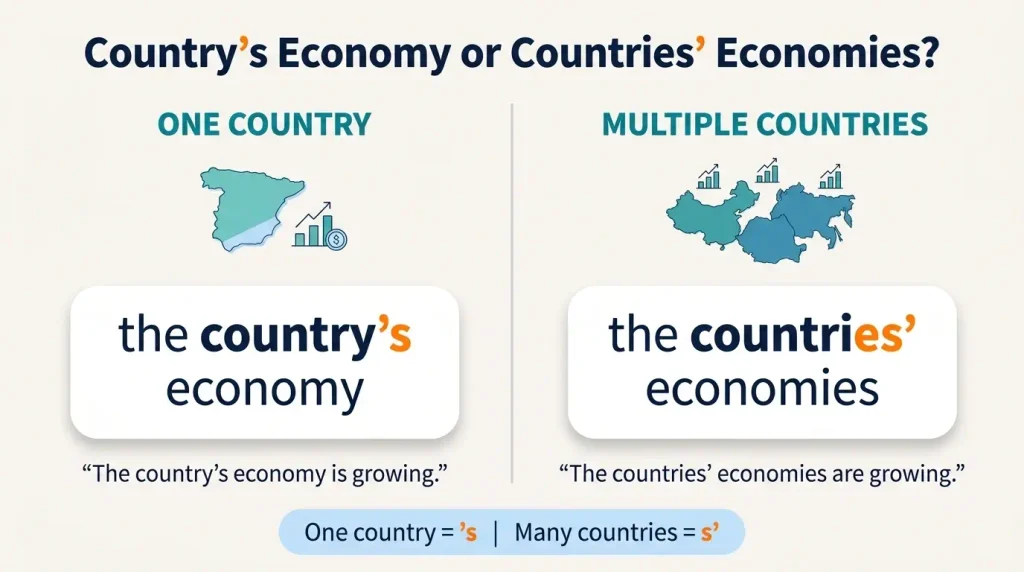
This is another common point of confusion.
Use country’s economy when discussing one country’s economy.
The country’s economy is growing.
Use countries’ economies when discussing multiple economies.
The countries’ economies are growing.
Notice another important change.
When the subject is plural, the noun after the possessive may also need to be plural.
One
the country’s economy
Multiple
the countries’ economies
This is not always required. It depends on what you mean.
For example:
The countries’ government representatives met.
The phrase can refer to representatives from multiple countries.
The key is to think about the meaning of the whole sentence.
Is “Country’s” a Contraction?
No. In country’s economy, the apostrophe shows possession.
It does not shorten two words.
Compare:
The country’s economy is growing.
Here, country’s means something associated with the country.
But apostrophes can also form contractions:
It’s raining.
Here, it’s means it is.
Cambridge explains that apostrophes can show both possession and omitted letters in contractions.
So do not assume every ‘s is a contraction.
What Is the Possessive Form of “Countries”?
The possessive form of the plural noun countries is countries’. Because countries already ends in s, you add only an apostrophe at the end.
The process is:
country
↓ plural
countries
↓ possessive
countries’
For example:
The countries’ leaders met.
This is different from:
country → country’s
Here, the singular noun receives ‘s.
County’s or Counties’? Do Not Confuse It With Country
County and country are two different words. County is a region within a state or country, while country is a nation. County follows the same possessive rules:
| Form | Meaning | Example |
|---|---|---|
| county | One county | The county is large. |
| county’s | Belonging to one county | The county’s budget increased. |
| counties | More than one county | Both counties are rural. |
| counties’ | Belonging to more than one county | The counties’ roads need repair. |
Quick check: country → countries → countries’, and county → counties → counties’.
Memory Trick
Use this simple rule:
One country → ‘s
Many countries → s’
Think of it this way:
country’s = one
countries’ = many
You can also count the s.
country’s
The s comes after the apostrophe.
countries’
The s comes before the apostrophe because countries is already plural.
A quick test
Ask:
Am I talking about one country or more than one?
If the answer is one, use:
country’s
If the answer is more than one, use:
countries’
This works in most ordinary cases.
FAQs
Is “country’s” or “countries'” correct?
Both are correct, but they have different meanings. Country’s is singular possessive. Countries’ is plural possessive.
What is the plural possessive of country?
The plural possessive form is countries’. For example, the countries’ governments refers to governments belonging to or associated with multiple countries.
What is the singular possessive of country?
The singular possessive form is country’s. For example, the country’s government refers to the government of one country.
Is “countries’s” correct?
No. Countries is already a plural noun ending in s, so the possessive form is countries’, with only an apostrophe after the final s.
Is “countrys'” correct?
No. The plural of country is countries, not countrys. Therefore, the plural possessive is countries’.
What is the difference between country’s and countries’?
Country’s refers to one country. Countries’ refers to two or more countries. The apostrophe position reflects the singular or plural form.
Should I write “country’s name” or “countries’ names”?
Use country’s name for one country. Use countries’ names for multiple countries.
Should I write “country’s economy” or “countries’ economy”?
Use country’s economy when discussing one country. For multiple countries, countries’ economies is usually appropriate when each country has its own economy.
Does “country’s” mean ownership?
It can show ownership, but it can also show a broader relationship. For example, the country’s history means the history associated with that country.
Is the apostrophe different in American and British English?
The basic possessive rule is the same. A singular noun normally takes ‘s, while a regular plural noun ending in s takes an apostrophe after the s.
Conclusion:
Country’s and countries’ are both correct possessive forms, but they refer to different numbers. Use country’s for one country and countries’ for two or more countries.
For example, the country’s government refers to one country, while the countries’ governments refers to multiple countries.
The easiest rule is simple: one country = country’s; many countries = countries’. Remember that country becomes countries in the plural before the possessive apostrophe is added.

I am an English language writer passionate about grammar and clear communication. I create simple, easy-to-understand content that helps readers improve their English skills. My goal is to make learning English both practical and enjoyable.