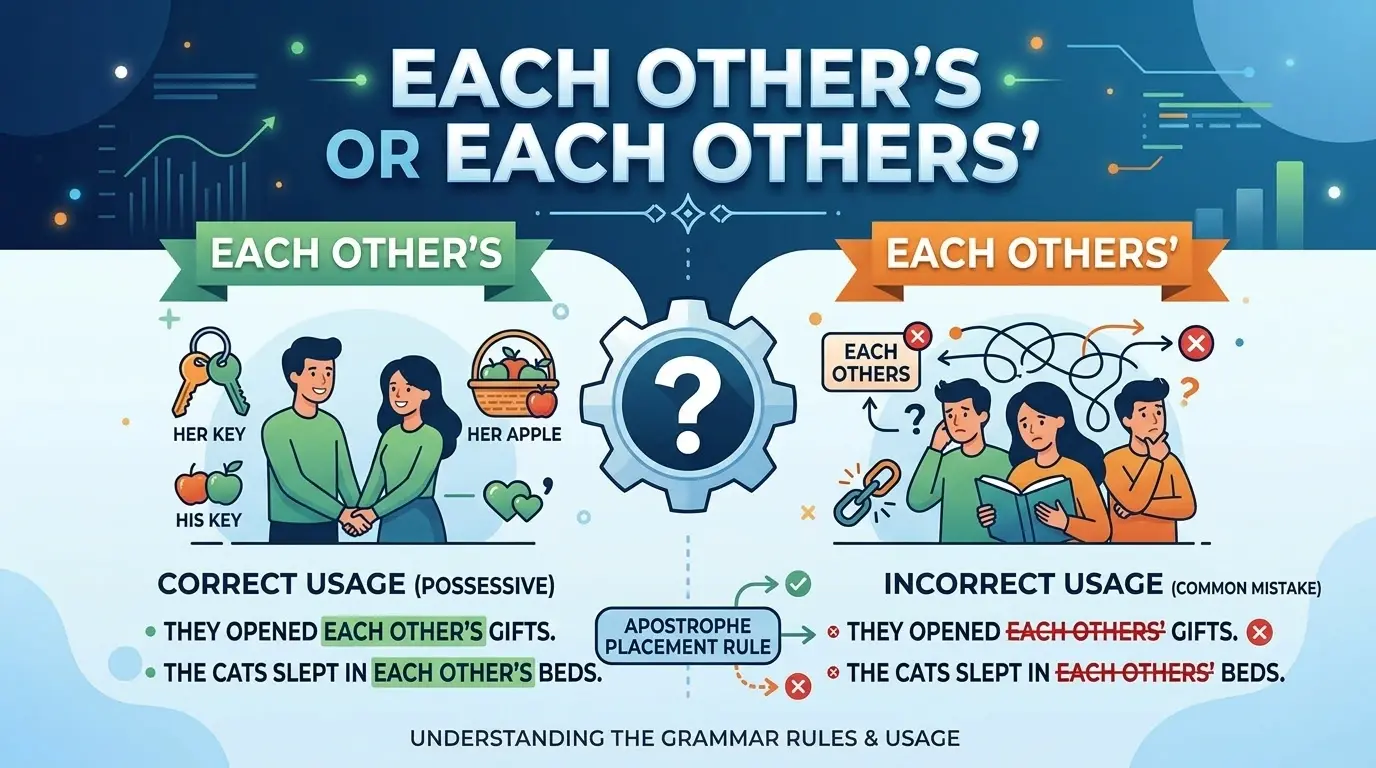
Each other’s is the correct possessive form, while each others’ is not standard English. The apostrophe comes before the s in each other’s.
You may have written a sentence like, “They borrowed each other’s books,” and suddenly questioned the apostrophe. Since each can refer to several people, it may seem logical to write each others’.
But that is not how the expression works. Each other is a fixed reciprocal expression that refers to people or things acting toward one another. When it becomes possessive, we add ‘s to form each other’s. Cambridge lists each other’s as the possessive form of each other.
The good news is that the rule is simple once you see how each other works.
Quick Answer
Each other’s is correct, while each others’ is incorrect in standard English. Each other is a reciprocal pronoun used for mutual actions. When it shows possession, add ‘s to form each other’s, such as “They respect each other’s opinions.”
Quick Rule
Use “each other’s” because “each other” stays singular and takes ’s for possession.
Why Is “Each Other’s” Correct?
Each other’s is correct because each other is used as a reciprocal expression, and its possessive form is each other’s. The apostrophe comes before the s, just as it does in many singular possessive forms.
Consider this sentence:
They respect each other’s opinions.
The phrase means that each person respects the opinions of the other people.
The important point is that each other does not become each others simply because more than two people are involved.
Cambridge explains that each other is used when each person in a group of two or more does something to the others. It also specifically gives each other’s as its possessive form.
So the pattern is:
each other → each other’s
Not:
each other → each others’
Compare these examples:
They help each other.
They help with each other’s work.
The first example shows a mutual action.
The second shows possession.
Read More: Is Each Singular or Plural? The Correct Grammar Rule ExplainedWhat Does “Each Other’s” Mean?
Each other’s means that something belongs to or is connected with the other person or people in a group. It expresses mutual possession, such as “each other’s ideas,” “each other’s phones,” or “each other’s opinions.”
For example:
The two friends borrowed each other’s books.
This means:
- Friend A borrowed Friend B’s books.
- Friend B borrowed Friend A’s books.
The possession works in both directions.
Another example:
The students read each other’s essays.
This means the students read the essays written by the other students.
The phrase each other’s therefore often has a meaning similar to:
the other’s
or
of each other
depending on the sentence.
Read More:
Why Is “Each Others'” Incorrect?
Each others’ is incorrect because each other does not become plural when it refers to several people. The expression remains each other, and its possessive form is each other’s. Cambridge specifically warns against using each others as a plural form.
This can be confusing.
You may think:
There are several people, so “other” should become “others.”
But that reasoning does not work with each other.
Consider:
They support each other.
You would not write:
They support each others.
The same rule applies when the phrase becomes possessive:
They support each other’s ideas.
Not:
They support each others’ ideas.
The word each keeps the expression in its standard form.
Each Other or Each Other’s
The difference between each other and each other’s is mainly possession.
| Form | Function | Example |
| each other | Shows a mutual action or relationship | They help each other. |
| each other’s | Shows mutual possession | They help with each other’s work. |
| each others’ | Not standard in this use | ❌ Avoid this form. |
Example 1: No possession
The sisters trust each other.
This means one sister trusts the other, and the other sister trusts the first.
Example 2: Possession
The sisters respect each other’s opinions.
This means each sister respects the opinion of the other.
Adding ‘s changes the grammatical function.
The Grammar Rule Behind Each Other’s
Each other is a reciprocal pronoun or reciprocal expression. It describes an action or relationship that goes between members of a group. Its possessive form is each other’s, not each others’.
A simple way to understand the structure is:
Each + other
Then, for possession:
Each + other’s
For example:
They know each other.
becomes:
They know each other’s families.
The first phrase describes a mutual relationship.
The second phrase shows something connected to the people involved.
Cambridge classifies each other/each other’s as a reciprocal pronoun form.
Does “Each Other” Have a Plural Form?
No. The standard expression remains “each other,” even when it refers to a group of more than two people. You do not add s to make it plural. Cambridge states that each other and one another are used for groups of two or more people.
For example:
The two brothers help each other.
Correct.
But you can also say:
The five team members help each other.
Still correct.
You do not need:
❌ The five team members help each others.
The number of people in the group does not change the form.
This is one of the main reasons each others’ is not the standard possessive form.
One Another’s vs Each Other’s
Each other’s and one another’s are both possessive forms that can describe mutual relationships or possession. Cambridge says there is little difference between each other and one another, and they can normally be used in the same places.
Compare:
They respect each other’s opinions.
They respect one another’s opinions.
Both sentences can express the same basic idea.
The phrase each other is generally more common in everyday English. Cambridge also notes that each other is more common than one another.
For most everyday writing, each other’s is a natural choice.
Each Other vs One Another: Two People or More?
Traditional grammar advice says to use each other for two people and one another for three or more. In modern English, most writers use both freely, but one another sounds a little more formal.
Here is how the traditional rule looks:
Two people: The two partners trust each other.
A larger group: The club members support one another.
The same pattern works in the possessive form:
- The two partners trust each other’s judgment.
- The club members value one another’s time.
If you are writing something formal, such as an essay or a report, following the traditional rule is a safe choice. In everyday writing, each other’s works for groups of any size.
Whichever phrase you choose, the possessive stays the same. Write each other’s or one another’s. Never write each others’ or one anothers’.
Other’s vs Others’: What Is the Possessive Form of “Other”?
Other’s is the singular possessive, used for one other person or thing. Others’ is the plural possessive, used for more than one. Both are correct, but neither is the same as each other’s.
Many readers learn that each others’ is wrong and then wonder if others’ is wrong too. It is not. Others’ is a normal form when other stands alone.
The difference is the word each. Once each or one comes before other, the phrase becomes each other’s or one another’s. Without it, the usual possessive rules apply.
Others’ (Plural Possessive)
Use others’ when something belongs to several other people. The apostrophe goes after the s because others is already plural.
- Good leaders listen to others’ ideas.
- She never takes credit for others’ work.
- Please respect others’ privacy.
A simple test is to replace the phrase with “of other people.” If it still makes sense, others’ is correct. For example, “the ideas of other people” becomes others’ ideas.
If others’ feels awkward in a sentence, you can also rewrite it with a clearer noun, such as other people’s or other teams’.
Other’s (Singular Possessive)
Use other’s when something belongs to one other person or thing. It often follows the or one.
- One sister wore the other’s scarf.
- The captain shook the other’s hand.
The test here is to replace it with “the other person’s.” If that works, other’s is the right form.
Is “Others” Correct Without an Apostrophe?
Yes. Others is the regular plural of other, and it needs no apostrophe unless something belongs to those people.
- Some guests stayed, but others left early.
- He always puts others first.
Compare these two sentences:
❌ Think of other’s feelings.
✅ Think of others’ feelings.
The first sentence uses the singular form, but the meaning is plural. The second uses the plural possessive.
Is “Others’s” Correct?
No. Others already ends in s, so the standard plural possessive adds only the apostrophe.
❌ others’s
✅ others’
Each Other’s or Others’? How to Choose
Use each other’s when people share a mutual relationship. Use others’ when you mean people outside that exchange.
| Phrase | Meaning | Example |
|---|---|---|
| each other’s | Mutual, between the people in the group | The coworkers praised each other’s ideas. |
| one another’s | Same idea, slightly more formal | The coworkers praised one another’s ideas. |
| others’ | Belonging to other people in general | Good coworkers listen to others’ ideas. |
| other’s | Belonging to one other person | He read the other’s report. |
A quick 3-step check:
- Is there each or one before other? If yes, use each other’s or one another’s.
- If not, does it mean one other person or thing? Use other’s.
- Does it mean several other people? Use others’.
Each Other’s With Singular and Plural Nouns
The noun after each other’s can be singular or plural depending on what you mean. The choice depends on the noun and the intended meaning, not on changing each other’s into each others’.
For example:
They held each other’s hand.
This can describe each person holding the other person’s hand.
You can also see:
They held each other’s hands.
This is common when the sentence refers to the hands of the people involved.
The important point is that the possessive phrase remains:
each other’s
The noun after it can change according to the intended meaning.
More examples
They shared each other’s ideas.
They respected each other’s opinion.
They respected each other’s opinions.
The children copied each other’s drawings.
The friends visited each other’s homes.
In every example, the possessive form remains each other’s.
Singular or Plural After “Each Other’s”: How to Decide
Both singular and plural nouns can follow each other’s. Try the singular first if each person has only one of that thing, and use the plural if it sounds more natural or if each person has several.
Style guides do not fully agree here. The plural is very common in everyday English, while the singular is often considered more logical. Either way, each other’s itself never changes.
Here is a simple way to decide:
- Does each person have just one? Try the singular. “They stood by each other’s side.”
- Does each person have several, or does the plural sound more natural? Use the plural. “They checked each other’s answers.”
- Do both work? Choose the one that sounds natural and keep going.
Sometimes the meaning changes slightly:
- The twins attended each other’s graduation. (One ceremony each.)
- The twins attended each other’s graduations. (This suggests more than one ceremony each, such as school and college.)
The same logic applies to each other’s side and each other’s sides. The singular is the usual choice in common phrases like “by each other’s side.” The plural fits when you mean the sides of something physical.
Common Phrases With “Each Other’s”
In every common phrase, the form stays each other’s. Only the noun after it changes: company and work usually stay singular, while names and lives are usually plural.
Searchers often type these phrases with the apostrophe in the wrong place, or with no apostrophe at all. Here are the most common ones.
Each Other’s Company and Each Other’s Work
Each other’s company and each other’s work are both correct. These nouns usually stay singular because they are uncountable in this sense.
- They enjoy each other’s company.
- The writers reviewed each other’s work.
Here, company means time spent together, and work means the result of someone’s effort. You do not add an s to either word.
A few things to watch for:
❌ each others company
❌ each others’ company
✅ each other’s company
Business sentences can change the meaning. In “The two founders studied each other’s companies,” the word means actual firms, so the plural works. Likewise, works can appear when you mean separate pieces of writing or art.
Each Other’s Lives
Each other’s lives is correct. Each others’ lives is not standard English.
- They have been part of each other’s lives for years.
The plural lives sounds natural because each person has their own life. The possessive phrase still stays each other’s.
Each Other’s Names
Each other’s names is correct. Each person has a name, so the plural noun is the natural choice.
- On the first day, they learned each other’s names.
The apostrophe comes before the s, just as it does in every other example of this phrase.
Common Mistakes With “Each Other’s”
1. Writing “Each Others'”
❌ They respect each others’ opinions.
✅ They respect each other’s opinions.
The expression does not become each others.
2. Writing “Each Others”
❌ The children helped each others.
✅ The children helped each other.
When there is no possession, simply use each other.
3. Writing “Eachother”
❌ They helped eachother.
✅ They helped each other.
Cambridge specifically notes that each other is written as two separate words without a hyphen.
4. Confusing “Each Other” With “Themselves”
These phrases can have different meanings.
They looked at each other.
This means they looked at one another.
They looked at themselves.
This means each person looked at himself or herself.
The distinction matters because each other describes a reciprocal relationship.
5. Typing “Eachother’s,” “Eachothers” or “Each Other S”
Each other’s is always two words with one apostrophe before the s. Typing it as one word, adding a second apostrophe, or leaving out the apostrophe are all mistakes.
Fast typing and phone keyboards cause many of these errors. Here is how the common slips compare:
| Mistake | What went wrong | Correct form |
|---|---|---|
| ❌ eachothers | Joined into one word and made plural | ✅ each other |
| ❌ eachother’s | Joined into one word | ✅ each other’s |
| ❌ each other s | Apostrophe missing, space added | ✅ each other’s |
| ❌ each other’s’ | Extra apostrophe at the end | ✅ each other’s |
| ❌ eachoters | Letters mistyped | ✅ each other |
When you are unsure, remember the basic pattern: each other + ’s = each other’s. Two words, one apostrophe.
20 Examples of “Each Other’s”
Here are natural examples using the correct possessive form:
- They respect each other’s opinions.
- The sisters borrowed each other’s clothes.
- The friends know each other’s secrets.
- The students reviewed each other’s work.
- The players understood each other’s strategies.
- The brothers shared each other’s concerns.
- We should respect each other’s differences.
- The two companies studied each other’s products.
- The children admired each other’s drawings.
- The teammates celebrated each other’s success.
- The couple remembered each other’s birthdays.
- The neighbors helped with each other’s problems.
- The writers read each other’s stories.
- The teachers discussed each other’s ideas.
- The friends visited each other’s homes.
- The students checked each other’s answers.
- The families supported each other’s needs.
- The players praised each other’s efforts.
- The coworkers appreciated each other’s contributions.
- The twins often finished each other’s sentences.
Every sentence uses each other’s, not each others’.
When Should You Use “Each Other”?
Use each other when two or more people or things perform an action toward one another. It does not need an apostrophe unless you are showing possession.
Without possession
We help each other.
They call each other every day.
The children laughed at each other.
The teams competed against each other.
The friends talked to each other.
These sentences do not need ‘s.
With possession
We know each other’s families.
They borrowed each other’s phones.
The children read each other’s stories.
Here, ‘s is needed because the phrase shows possession or association.
When Should You Use “Each Other’s”?
Use each other’s when something belongs to, comes from, or is associated with the other members of a group. The phrase is possessive and normally appears before a noun.
For example:
They know each other’s names.
The names are associated with the other people.
The students checked each other’s answers.
Each student’s answers are checked by the others.
The friends visited each other’s homes.
Each friend visited the home of another friend.
A useful test is to replace each other’s with the other person’s or a similar phrase.
If the meaning still works, you likely need the possessive form.
Memory Trick
The easiest way to remember this rule is:
Each other → each other’s
Never add an extra s to other.
Think:
each other + ‘s = each other’s
Not:
each others + ‘ = each others’
Another simple trick is to remember that each other is already the complete expression.
If you want possession, simply add ‘s.
No possession:
They help each other.
Possession:
They know each other’s names.
FAQs
Is “each other’s” or “each others'” correct?
Each other’s is the standard correct form. Each others’ is not standard English for the possessive form of each other.
Why is “each other’s” correct?
Each other is a reciprocal expression that stays in this form, even for groups. Its possessive form is each other’s.
Is “each others” correct?
No. Use each other instead. Cambridge specifically lists each others as an incorrect plural form.
Should I write “each other’s” with an apostrophe?
Yes, when you need the possessive form. For example, They respect each other’s opinions.
Is “eachother” one word?
No. Write each other as two separate words. Cambridge notes that the expression does not use a hyphen.
What does “each other’s” mean?
It shows mutual possession or connection. For example, They borrowed each other’s books means each person borrowed books belonging to another person.
Can “each other” refer to more than two people?
Yes. Each other can refer to people in a group of two or more.
Is “one another’s” also correct?
Yes. One another’s is the possessive form of one another. Cambridge says each other and one another can normally be used in the same places.
Is “each other’s” a possessive pronoun?
It is commonly described as the possessive form of the reciprocal pronoun each other. Cambridge lists each other/each other’s under reciprocal pronouns.
What is an example of “each other’s”?
The two friends respect each other’s opinions.
This means each friend respects the opinion of the other.
Conclusion:
Each other’s is the correct possessive form. Each others’ is not the standard form. The reason is simple: each other remains unchanged when it refers to two or more people.
When you need to show possession, add ‘s:
each other → each other’s
For example, They respect each other’s opinions is correct. The apostrophe belongs before the s, not after it.
Also remember that each other is always written as two words. This small rule can help you avoid several common apostrophe and spelling mistakes.

As an American English writer, I specialize in creating clear and engaging content that makes grammar and language learning accessible to everyone. I enjoy breaking down complex English concepts into simple, practical lessons that readers can apply with confidence. My mission is to help learners strengthen their communication skills through easy and reliable content.










1 thought on “Each Other’s or Each Others’? The Correct Possessive Form”