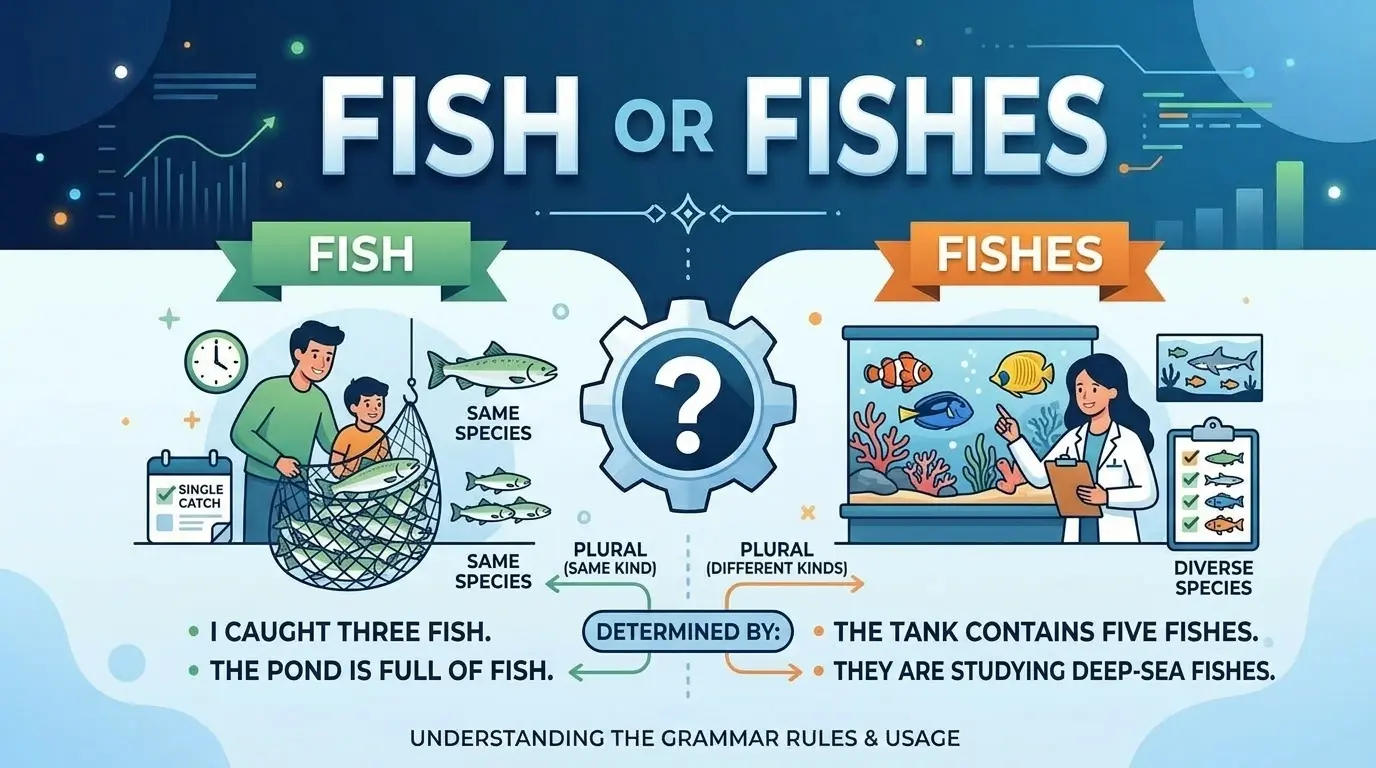
Fish is usually the correct plural form when you mean more than one fish. Fishes is also correct, but it is mainly used when talking about different species or kinds of fish.
Imagine writing a sentence about a trip to the aquarium. You might type, “I saw five fishes,” then wonder if fish would be better. The confusion is understandable because fish has an unusual plural pattern.
For ordinary situations, use fish for both one and multiple fish. You can say, “I caught one fish” and “I caught three fish.”
When you are discussing different species, fishes can be appropriate. For example, a scientist may study “the fishes of the Pacific Ocean.” The choice depends on what you mean, not simply on the number of animals.
Quick Answer
Fish is normally used as the plural of fish, especially when referring to multiple individual fish. Fishes is also a valid plural, but it is commonly used when referring to different species or kinds of fish. For everyday writing, fish is usually the natural choice.
Quick Rule
Use fish for multiple individual fish; use fishes mainly when referring to different species or kinds.
Is Fish Singular or Plural?
Fish can be both singular and plural when referring to individual animals. You can say “one fish” for a single animal and “two fish” for multiple animals. This makes fish different from many regular nouns that take -s in the plural.
Consider these examples:
I saw one fish in the pond.
I saw five fish in the pond.
Both sentences are correct.
The first sentence uses fish as a singular noun.
The second uses fish as a plural noun.
This is sometimes called a zero plural, where the singular and plural forms are the same.
Other nouns have similar patterns.
For example:
- one sheep → two sheep
- one deer → two deer
- one fish → two fish
However, fishes also exists.
It has a more specific use.
Read More: Play It by Ear or Year? The Correct Phrase ExplainedWhen to Use “Fish”
Use fish when you mean multiple individual fish, especially when discussing the animals generally or counting fish. This is the form you will usually see in everyday conversation and general writing.
For example:
- I saw three fish.
- There are many fish in this lake.
- We caught several fish.
- The aquarium has hundreds of fish.
- She bought two fish for her tank.
If you are simply counting individual animals, fish is usually the best choice.
One fish
I saw one fish near the rocks.
Two fish
I saw two fish near the rocks.
Many fish
The lake contains many fish.
The word does not need an -s simply because the number is greater than one.
That is one of the main reasons learners find this word confusing.
When to Use “Fishes”
Use fishes when you are talking about multiple species or kinds of fish rather than simply counting individual animals. It is especially useful in scientific, biological, or formal contexts where different species are being discussed.
For example:
The study examines the fishes of the Amazon River.
Here, the writer is not simply counting individual fish.
The focus is on different types or species.
Another example:
The reef contains many colorful fishes.
This can emphasize different kinds of fish rather than individual animals.
The important point is that fishes is not simply a “more correct” plural of fish.
It has a different use.
Fish or Fishes: Comparison Table
| Form | Main use | Example |
| fish | One fish | I saw one fish. |
| fish | Multiple individual fish | I saw five fish. |
| fishes | Multiple species or kinds | The study covers several fishes. |
| fishes | Formal or scientific contexts | The fishes of this region are diverse. |
In ordinary writing, fish will usually be the better choice for multiple animals.
Use fishes when the distinction between species or kinds matters.
Why Can Fish Be Both Singular and Plural?
Fish can remain unchanged in the plural because English has several nouns with identical singular and plural forms. The meaning comes from the surrounding sentence, number words, and verb agreement.
Compare:
The fish is swimming.
Here, fish is singular.
Now compare:
The fish are swimming.
Here, fish is plural.
The verb helps you understand the meaning.
You can also use numbers:
One fish is missing.
Six fish are missing.
The number tells you whether fish refers to one or more animals.
This pattern is normal English grammar.
You do not need to add -s every time you mean more than one fish.
Fish for Different Species
The word fishes can be useful when the focus is on different species. It helps distinguish several kinds of fish rather than several individual animals.
For example:
The researcher studied the fishes of the Indian Ocean.
The focus is on the variety of fish species.
Compare that with:
The researcher counted 50 fish.
Here, the focus is on individual animals.
The distinction is about what you are counting or describing.
Individual animals
The aquarium has 200 fish.
Different species
The researcher studied several fishes.
Both sentences can be correct.
They simply focus on different things.
Fish or Fishes in Everyday English
Fish is much more common in everyday English when referring to multiple fish. If you are talking about fishing, aquariums, pets, food, or animals in general, fish will usually sound natural.
For example:
We caught four fish.
There are several fish in the tank.
The children watched the fish swim.
I bought two fish for my aquarium.
Using fishes in these situations can sound unnecessarily formal.
For everyday writing, ask yourself whether you are simply talking about multiple individual fish.
If the answer is yes, choose fish.
Fishes vs Fish for Different Types
When the sentence clearly discusses different types or species, fishes may be appropriate.
For example:
The museum has information about the fishes of the region.
This focuses on different species.
However, you will also often see fish used with phrases such as:
- different types of fish
- different kinds of fish
- several species of fish
- many species of fish
For example:
Scientists discovered several new species of fish.
So, you should not assume that fishes is required whenever you mention different species.
Both constructions can occur.
The choice depends on the context and style.
Is “Two Fishes” Correct?
Two fishes can be grammatically correct, but it usually sounds less natural when you simply mean two individual fish. In ordinary English, two fish is the usual choice.
Compare:
I caught two fish.
This is the natural everyday form.
I caught two fishes.
This may sound unusual if you simply mean two animals.
But consider a different context:
The researcher identified two fishes from different species.
Here, fishes can emphasize that the animals represent different kinds or species.
For everyday counting, stick with two fish.
Common Mistakes
Mistake 1: Adding “s” to every plural
❌ I saw five fishes at the aquarium.
✅ I saw five fish at the aquarium.
The first sentence is not necessarily impossible, but fish is more natural when simply counting individual animals.
Mistake 2: Thinking “fishes” is always wrong
❌ Fishes is never correct.
✅ Fishes can be correct when referring to different species or kinds.
The word fishes has a legitimate grammatical use.
Mistake 3: Thinking “fish” is always singular
❌ Fish can only mean one animal.
✅ Fish can refer to one or multiple animals.
For example:
One fish was swimming.
Ten fish were swimming.
Mistake 4: Using fishes for ordinary counting
❌ We caught six fishes yesterday.
✅ We caught six fish yesterday.
When the meaning is simply six individual fish, fish is the natural choice.
Fish or Fishes in Scientific Writing
Scientific writing can use fishes when researchers discuss different species, groups, or kinds of fish. The term can help make the intended meaning clearer when species-level differences are important.
For example:
The study compares freshwater fishes from three regions.
The focus is not simply on the number of animals.
The study is comparing different groups or species.
However, scientific writers may also use fish as a general term.
Therefore, do not treat fishes as a requirement for scientific writing.
Context still matters.
Real Example Sentences
Examples with “fish”
- I saw one fish in the pond.
- We caught three fish yesterday.
- The aquarium has hundreds of fish.
- She feeds the fish every morning.
- There are many fish in this lake.
- He bought two fish for his tank.
- The children watched the fish swim.
- We saw colorful fish near the reef.
- The fisherman caught several fish.
- These fish live in freshwater.
Examples with “fishes”
- The study examines the fishes of the region.
- Scientists documented several fishes from different species.
- The researchers studied the fishes living near the reef.
- The book describes tropical fishes from around the world.
- The museum displays information about local fishes.
- The survey identified several species of fishes.
- The researchers compared the fishes found in different habitats.
- The report discusses endangered fishes in the area.
- The scientist specializes in freshwater fishes.
- The project focuses on the fishes of the Pacific.
The first group focuses mainly on individual fish.
The second group focuses more strongly on species or varieties.
Memory Trick
Use this simple rule:
Fish = individual animals.
Fishes = different species or kinds.
If you are counting fish in a tank, pond, lake, or ocean, fish is usually the right choice.
If you are comparing different species, fishes may be appropriate.
A quick question can help:
Am I counting animals or discussing kinds?
Counting animals → fish
Discussing different kinds → fishes
Remember that fishes is not simply the regular plural of fish.
It has a more specific meaning in many contexts.
FAQs
Is “fish” singular or plural?
Fish can be singular or plural. You can say “one fish” and “two fish.” The surrounding words and verb show whether you mean one or more.
Is “fishes” a correct word?
Yes. Fishes is a correct plural form. It is often used when referring to different species or kinds of fish.
Should I say “two fish” or “two fishes”?
Two fish is normally the better choice when you mean two individual animals. Two fishes can be used when different species or kinds are being emphasized.
What is the plural of fish?
The most common plural is fish. Fishes is also a plural form with a more specific use, often involving different species.
Is “fishes” grammatically wrong?
No. Fishes is grammatically correct in appropriate contexts. It can refer to different species or kinds of fish.
Can I say “many fishes”?
Yes, but the context matters. Many fish is more natural when you mean many individual animals. Many fishes can refer to different kinds or species.
Why does fish not become fishes?
English has nouns whose singular and plural forms are the same. Fish is one of them. The plural fish is especially common when referring to individual fish.
What is the difference between fish and fishes?
Fish usually refers to individual fish, whether singular or plural. Fishes often emphasizes multiple species or kinds.
Conclusion:
Fish is usually the correct plural when you mean multiple individual fish.
Fishes is also correct, but it often refers to different species or kinds of fish. For everyday writing, phrases such as two fish, many fish, and several fish are the natural choices.
When the focus is on different species, fishes can be useful.
The key is to look at the meaning rather than simply adding -s to make a plural.

As an American English writer, I specialize in creating clear and engaging content that makes grammar and language learning accessible to everyone. I enjoy breaking down complex English concepts into simple, practical lessons that readers can apply with confidence. My mission is to help learners strengthen their communication skills through easy and reliable content.










2 thoughts on “Fish or Fishes? Understanding the Correct Plural Form”