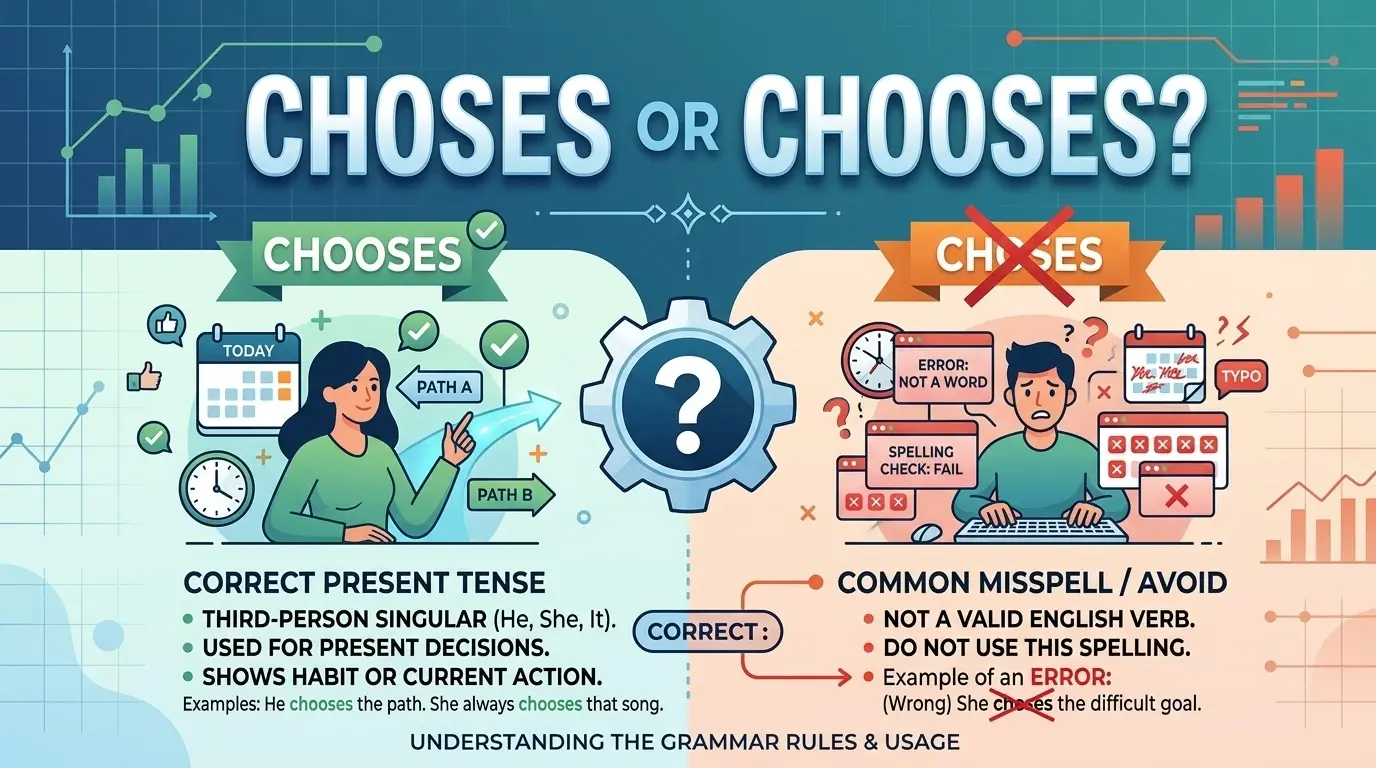
Chooses is the correct spelling when you mean “selects” or “picks.” Choses is not the standard spelling of the verb choose in this meaning.
You are writing a sentence about someone making a decision. Then you stop and wonder: is it choses or chooses?
The extra o can feel easy to miss, especially because chose is the past tense of choose. That small difference causes many spelling mistakes.
The rule is simple. Chooses is the third-person singular present form of choose. You use it with he, she, it, or a singular noun.
For example, “She chooses the blue dress.” Oxford lists chooses as the third-person singular form, while chose is the past tense and chosen is the past participle.
Quick Answer
Chooses is correct when you mean that someone selects or picks something. Choses is not the standard spelling for this verb form. The word chooses is the third-person singular present form of choose, as in “He chooses carefully.”
Quick Rule
Use “chooses” for he, she, or it; use “chose” for a completed choice in the past.
Why Is “Chooses” Correct?
Chooses is correct because it is the third-person singular present form of the irregular verb choose. The base verb is choose, and adding -s to its third-person singular form produces chooses, not choses.
The basic verb forms are:
- choose — base form
- chooses — third-person singular present
- chose — simple past
- chosen — past participle
- choosing — -ing form
For example:
I choose the red one.
But:
She chooses the red one.
The subject changes from I to she, so the verb changes from choose to chooses.
Oxford gives the same verb pattern:
I / you / we / they choose
he / she / it chooses
past: chose
past participle: chosen
-ing form: choosing
Read More: Fish or Fishes? Understanding the Correct Plural FormWhat Does “Chooses” Mean?
Chooses means selects, picks, or decides on something. It describes a present or regular action performed by one person or thing. It is used with singular third-person subjects such as he, she, it, or a singular noun.
For example:
She chooses a different route every morning.
The sentence means that she selects a different route.
Another example:
My brother chooses his clothes carefully.
Here, chooses means he selects his clothes carefully.
The verb choose can describe selecting something from several possibilities.
For example:
You can choose from three options.
Oxford defines choose as deciding which person or thing you want from the available possibilities.
When the subject becomes third-person singular, choose becomes chooses.
Compare:
I choose the restaurant.
She chooses the restaurant.
They choose the restaurant.
The meaning stays similar.
Only the verb form changes based on the subject.
What Does “Choses” Mean?
For normal English writing about the verb choose, choses is not the standard spelling. If you mean that someone selects something, use chooses instead. Major learner dictionaries list chooses as the third-person singular form of choose.
So this sentence is incorrect:
❌ She choses the blue dress.
Write:
✅ She chooses the blue dress.
However, there is an important vocabulary detail.
Choses can appear as a plural noun in specialized legal English. It is the plural of the legal noun chose. This is different from the everyday verb choose.
For your normal grammar and spelling question, though, the distinction is straightforward:
If you mean “selects,” write “chooses.”
Choose, Chooses, Chose, Chosen, and Choosing
Choose, chooses, chose, chosen, and choosing are different forms of the same verb. They are used in different grammatical situations, so replacing one with another can change the meaning or make the sentence incorrect.
| Form | Use | Example |
| choose | Base/present form | I choose the blue one. |
| chooses | Third-person singular present | She chooses the blue one. |
| chose | Simple past | She chose the blue one yesterday. |
| chosen | Past participle | She has chosen the blue one. |
| choosing | -ing form | She is choosing a dress. |
Understanding this group makes chooses much easier to remember.
Choose
Use choose with I, you, we, and they in the simple present.
Examples:
I choose carefully.
You choose the movie.
We choose our seats.
They choose the restaurant.
It can also follow modal verbs.
She can choose the color.
Notice that we do not write can chooses.
After a modal such as can, use the base form choose.
Chooses
Use chooses with he, she, it, or another singular third-person subject.
Examples:
He chooses the best option.
She chooses a different seat.
The customer chooses the payment method.
My sister chooses carefully.
This is the form that people often accidentally write as choses.
Chose
Chose is the simple past form of choose.
Use it when the selection happened in the past.
She chose the red dress yesterday.
He chose the restaurant last night.
They chose a new team captain.
The spelling changes from choose to chose.
Do not write choosed.
Chosen
Chosen is the past participle of choose.
It normally appears with a helping verb such as has, have, or had.
She has chosen a new laptop.
They have chosen their seats.
He had chosen the blue option.
Oxford lists chosen as the past participle of choose.
Choosing
Choosing is the present participle and -ing form of choose.
She is choosing a dress.
We are choosing a new design.
They are choosing between two options.
The spelling keeps the two o’s:
choose → choosing
The Grammar Rule for “Chooses”
Use “chooses” when a singular third-person subject performs the action in the present tense. The ending -es is added because the base verb choose ends in the sound represented by s.
Look at these examples:
He chooses carefully.
She chooses quickly.
The student chooses a book.
My friend chooses the restaurant.
The subjects are all singular and third person.
Now compare them with plural subjects:
They choose carefully.
The students choose their books.
My friends choose the restaurant.
The plural subjects use choose, not chooses.
Simple pattern
I choose
You choose
He chooses
She chooses
It chooses
We choose
They choose
This pattern is one of the easiest ways to remember when chooses is needed.
Why Does “Choose” Become “Chooses”?
The spelling chooses follows the normal third-person singular pattern for verbs ending in -s, -sh, -ch, -x, or -z sounds. Instead of simply adding s, English commonly adds -es in these cases.
For example:
- go → goes
- watch → watches
- wash → washes
- fix → fixes
- choose → chooses
So:
choose + es = chooses
This is why choses is not the correct third-person singular form of choose.
The spelling must keep both o’s:
C-H-O-O-S-E-S
Chose or Chooses
Chooses and chose are different because they refer to different grammatical forms. Chooses is present tense for a singular third-person subject, while chose is the simple past form.
Compare:
She chooses the blue dress every time.
This describes a present or repeated action.
She chose the blue dress yesterday.
This describes a completed action in the past.
A quick comparison
| Word | Grammar | Example |
| chooses | Present, third-person singular | He chooses wisely. |
| chose | Simple past | He chose yesterday. |
A useful memory is:
Chooses = now or regularly
Chose = already happened
20 Real Examples of “Chooses”
Here are natural examples showing how chooses works in everyday English.
- She chooses the blue dress.
- He chooses his words carefully.
- My brother chooses the restaurant.
- Sarah chooses a book every weekend.
- The customer chooses a payment option.
- He always chooses the healthier meal.
- She chooses her friends carefully.
- The student chooses a topic for the project.
- My father chooses the morning flight.
- The player chooses the first option.
- She usually chooses tea instead of coffee.
- He chooses a different route to work.
- The teacher chooses a new activity.
- My sister chooses simple clothes.
- The buyer chooses the cheaper model.
- She chooses carefully before making a decision.
- He chooses the movie for the family.
- The child chooses a toy from the shelf.
- The manager chooses the final design.
- Every customer chooses what works best for them.
Common Mistakes With “Chooses”
The most common mistake is leaving out the second o.
Mistake 1: Choses
❌ She choses the blue one.
✅ She chooses the blue one.
The correct spelling contains two o’s.
Mistake 2: Choosed
❌ He choosed the wrong option.
✅ He chose the wrong option.
Chose is the simple past form.
Mistake 3: Choosen
❌ They have choosen a winner.
✅ They have chosen a winner.
Chosen is the past participle.
Mistake 4: Chooses after “can”
❌ She can chooses the color.
✅ She can choose the color.
After can, use the base form choose.
Mistake 5: Choose with a singular third-person subject
❌ He choose the red one.
✅ He chooses the red one.
The subject he requires the third-person singular form.
How to Remember the Spelling
The easiest trick is to remember the complete verb family:
Choose → chooses → chose → chosen → choosing
Focus on the first two forms:
choose → chooses
The two o’s stay in the word.
Another useful comparison is:
She chooses.
The word chooses looks longer because the third-person singular ending is added.
Do not remove an o simply because chose has only one.
Remember:
choose = present/base
chooses = he/she/it
chose = past
chosen = past participle
choosing = -ing form
This makes the spelling much easier to remember.
Is “Choses” Ever Correct?
In ordinary writing about the verb choose, use chooses, not choses. However, choses can occur as the plural of the specialized legal noun chose, so it is not accurate to say the letter sequence can never appear in English.
For example, if you are writing:
She choses the best option.
That is not the correct spelling.
Write:
She chooses the best option.
The legal noun is a separate matter.
For an English learner asking about the verb meaning “select,” the rule is:
chooses = correct
choses = incorrect
Is “Chooses” an American or British Spelling?
Chooses is used in both American and British English. It is the third-person singular present form of choose in standard English. Oxford lists the same form in its American English entry.
So this is not a US-versus-UK spelling difference.
American English:
She chooses the blue one.
British English:
She chooses the blue one.
The spelling stays the same.
FAQs
Is it “choses” or “chooses”?
Chooses is the standard spelling when you mean “selects” or “picks.” It is the third-person singular present form of choose.
Is “choses” a correct English word?
Choses can appear as a specialized plural noun in legal English, but it is not the standard third-person form of choose. For “selects,” use chooses.
What is the third-person singular of choose?
The third-person singular present form is chooses.
She chooses carefully.
Oxford lists chooses as the third-person singular form.
What is the past tense of choose?
The simple past tense is chose.
He chose the blue shirt.
What is the past participle of choose?
The past participle is chosen.
They have chosen a new leader.
Is “choosed” correct?
No. The simple past of choose is chose, not choosed. The verb is irregular.
How do you spell chooses?
The correct spelling is:
C-H-O-O-S-E-S
Remember the two o’s:
choose → chooses
Conclusion:
Chooses is the correct spelling when you mean “selects,” “picks,” or “decides on.” It is the third-person singular present form of choose.
Use chooses with he, she, it, or a singular noun:
She chooses the blue dress.
Use chose for the simple past:
She chose the blue dress yesterday.
Although choses can occur as a specialized legal plural noun, it is not the normal spelling of the verb form. For everyday English, remember: choose → chooses.

I’m Sophia Mitchell, an English grammar and writing enthusiast. I create simple, easy-to-understand content to help learners improve their English. My goal is to make grammar clear, practical, and enjoyable for everyone.









1 thought on “Choses or Chooses? The Correct Spelling Explained”