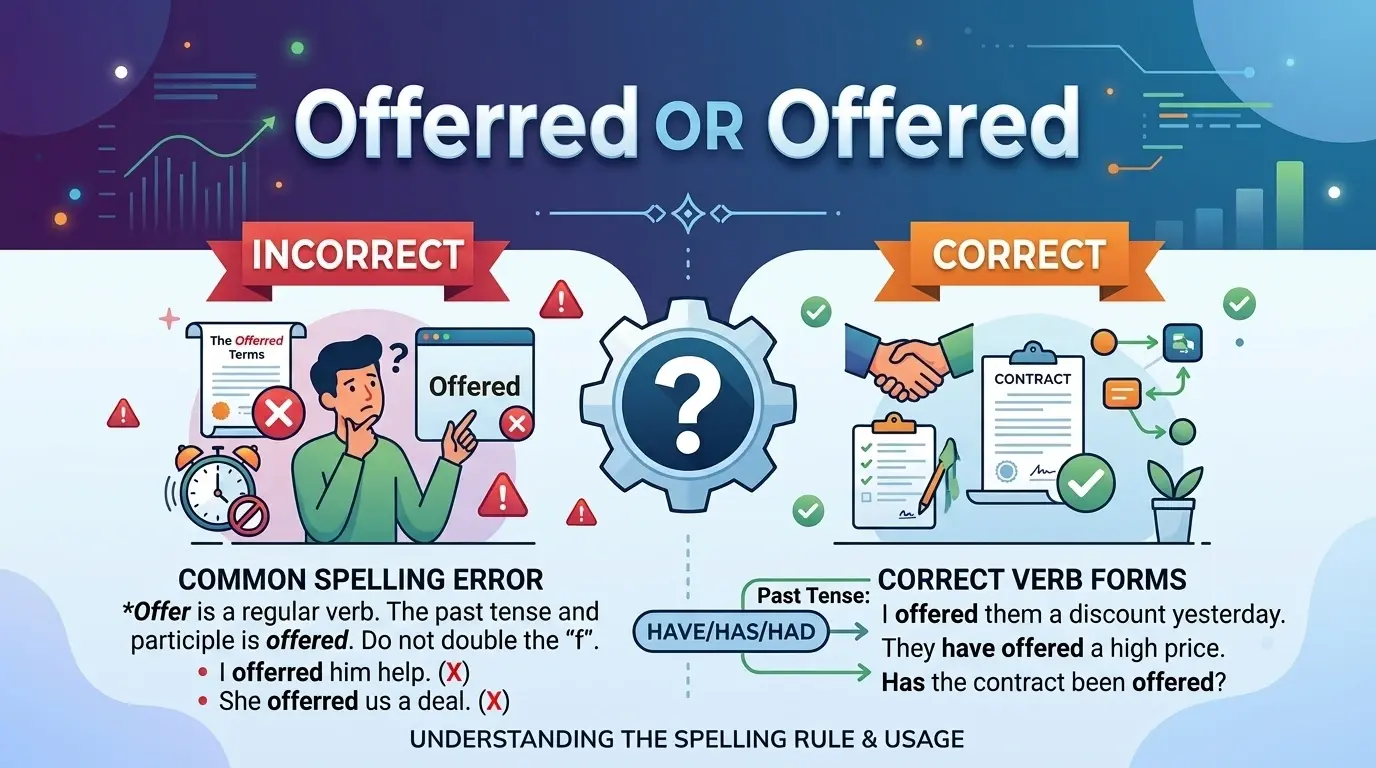
Offered is the correct spelling, while offerred is incorrect. The past tense of offer is spelled offered, with two f letters and one r.
You might type a sentence such as, “She offerred me a job,” and pause over the spelling. The extra r can look tempting because English often doubles consonants when adding -ed.
However, offer does not follow that pattern.
The correct form is:
offer → offered
Not:
offer → offerred
Cambridge lists offered as both the past simple and past participle of offer. The verb can mean asking someone if they want something or saying that you are willing to do something.
Once you understand the spelling pattern, this mistake becomes much easier to avoid.
Offered or Offerred: Quick Answer
Offered is the correct spelling. Offerred is incorrect in standard English. The word offered is the past simple and past participle of offer. When you add -ed to offer, you keep the existing double f but do not add another r.
What Does “Offered” Mean?
Offered is the past tense and past participle of offer. It can describe something someone gave as a choice, suggested, promised to do, or made available in the past. Cambridge gives several uses of offer, including asking whether someone wants something and providing or supplying something.
For example:
She offered me a cup of tea.
This means she asked whether I wanted a cup of tea.
You can also use offered when someone agrees to do something:
He offered to drive me home.
Here, he said he was willing to drive you home.
The word can also describe something that was provided:
The company offered free training.
In this sentence, the company made free training available.
So, offered has several common uses.
The spelling stays the same in all of them.
Read More: Congratulations or Congradulations? The Correct Spelling Explained
Why Is “Offered” Correct?
Offered is correct because the standard past-tense form of offer is made by adding -ed without doubling the final r. The spelling becomes offer + ed = offered. Cambridge directly lists offered as the past simple and past participle of offer.
Look at the word carefully:
O F F E R + E D
This gives:
O F F E R E D
So the correct spelling is:
offered
There are already two f letters in offer.
The word does not need another r.
Correct
The company offered me a new position.
Incorrect
The company offerred me a new position.
The second version contains an unnecessary r.
Why Is “Offerred” Incorrect?
Offerred is incorrect because standard English does not form the past tense of offer by adding another r. The correct form is offered, which keeps the two f letters from the base word and adds -ed.
The mistake usually happens because writers know that English sometimes doubles a final consonant before adding a suffix.
For example:
- stop → stopped
- plan → planned
- prefer → preferred
That can make offerred look reasonable.
But the doubling rule does not work that way for offer.
The correct form remains:
offer → offered
Not:
offer → offerred
This is an important reminder that English spelling rules depend on the structure and stress pattern of the word.
Is “Offerred” a Real Word?
No, offerred is not a real English word. It is only a spelling mistake. Standard dictionaries list offered, and no regional rule makes offerred acceptable.
You may still see it in emails, comments, and social media posts. It usually appears because of fast typing or because writers copy the double r from words like preferred and referred.
Keep these points in mind:
- Offerred has no meaning of its own.
- Offerred is not a British or American variant.
- Offered is the only form to use.
If you spot offerred in a draft, replace it with offered.
The Spelling Rule Behind “Offered”
Offer does not double its final r when forming offered. English does have consonant-doubling rules, but they depend on factors such as the final vowel-consonant pattern and syllable stress. Grammarly explains that consonants are commonly doubled in certain forms, but the rule has exceptions and does not apply to every word ending in a consonant.
Consider these examples:
| Base Verb | Past Tense |
| stop | stopped |
| plan | planned |
| refer | referred |
| prefer | preferred |
| offer | offered |
| open | opened |
| visit | visited |
The important difference is that offer has an unstressed final syllable.
The final r is not doubled when -ed is added.
Cambridge explains that consonant doubling depends partly on whether the final syllable is stressed. It gives refer → referred but distinguishes verbs such as benefit and offer from verbs that require doubling.
This is why you should not assume that every verb needs a doubled final consonant.
More Verbs That Follow the Same Pattern as “Offer”
Offer is not the only verb that keeps a single r. Many verbs ending in -er stay the same when you add -ed, as long as the last syllable is not stressed.
| Base Verb | Past Tense |
|---|---|
| enter | entered |
| answer | answered |
| suffer | suffered |
| differ | differed |
| gather | gathered |
| order | ordered |
Now compare verbs where the last syllable is stressed:
- refer → referred
- prefer → preferred
- defer → deferred
- occur → occurred
Here is a quick test. Say the word out loud.
If your voice lands on the last syllable (re-FER), double the consonant. If it lands earlier (OF-fer), keep the single r.
Offerred or Offered in UK English? (US vs UK Spelling)
Offered is the correct spelling in both UK and US English. Offerred is wrong in both. The same goes for offering, since neither variety uses offerring.
Some British spellings do double a final letter, so it is easy to assume offer might too. But that rule mostly applies to verbs ending in l, such as travel.
| Base Verb | US Spelling | UK Spelling |
| ————- | ————— | ————— |
| offer | offered, offering | offered, offering |
| refer | referred, referring | referred, referring |
| travel | traveled, traveling | travelled, travelling |
| label | labeled, labeling | labelled, labelling |
The UK and US difference in travel and label is about the letter l, not r.
So if you are writing for a UK school, a UK employer, or a British audience, you still write offered.
For example:
The university offered her a place on the course.
This sentence is correct in every variety of English.
Offer, Offered, and Offering
Offer, offered, and offering are different forms of the same verb. The spelling changes according to the grammatical form, but none of the standard forms uses offerr-. Cambridge lists offer as a verb with meanings related to giving, providing, or asking whether someone wants something.
Here are the main forms:
| Form | Example |
| offer | I will offer some help. |
| offers | She offers useful advice. |
| offered | He offered me a job. |
| offering | They are offering free support. |
Notice the spelling:
offer
offers
offered
offering
There is no standard form spelled:
offerr
offerred
offerring
The base word already contains ff.
How Do You Spell “Offer”?
Offer is spelled O-F-F-E-R. It has two f letters, then e and r. The spelling is the same for the noun (“a job offer”) and the verb (“to offer help”).
Here is an easy trick:
off + er = offer
If you can spell off, you already have the double f.
Writers sometimes mistype the base word too:
| Typo | What Went Wrong | Correct |
|---|---|---|
| ofer | One f is missing | offer |
| offfer | One extra f | offer |
| offr | The e is missing | offer |
| ofter | t instead of f | offer |
Ofter is not a standard spelling of offer. If you meant “how frequently,” the word is often.
For the verb, add s for he, she, or it:
She offers free advice every week.
What Is the Plural of Offer?
The plural of offer is offers. Just add s.
- one offer
- two offers
For example:
The company made three offers.
We compared several offers before choosing one.
Do not add an apostrophe. Offer’s is a possessive form, as in “the offer’s terms.”
Offered vs Offerred
Offered is the standard and correct spelling. Offerred is a spelling error created by incorrectly doubling the final r. If you are writing an email, assignment, resume, or professional document, use offered.
| Form | Correct? | Explanation |
| offered | ✅ Yes | Standard past tense of offer |
| offerred | ❌ No | Incorrect extra r |
| offer | ✅ Yes | Base form |
| offering | ✅ Yes | Present participle |
| offers | ✅ Yes | Third-person singular |
Example
Correct:
The company offered her a promotion.
Incorrect:
The company offerred her a promotion.
The difference is only one letter, but that letter makes the second spelling incorrect.
When to Use “Offered”
Offered is used when something happened in the past. You can use it when someone gave a choice, suggested help, made something available, or said they were willing to do something. Cambridge provides these different meanings for offer.
1. Offering something to someone
She offered me some coffee.
This means she asked whether I wanted coffee.
2. Offering to help
He offered to help with the project.
This means he said he was willing to help.
3. Offering a job
The company offered her a position.
This means the company proposed giving her the job.
4. Providing something
The school offered free classes.
This means the school made the classes available.
5. Making a suggestion
She offered a possible solution.
Here, she suggested a solution for consideration.
20 Real Examples of “Offered”
Here are natural examples showing how offered works in different situations.
- The company offered me a new job.
- She offered to help with my homework.
- He offered me a glass of water.
- The teacher offered some useful advice.
- They offered free delivery.
- My friend offered to drive me home.
- The hotel offered breakfast to its guests.
- The manager offered her a promotion.
- He offered a reasonable explanation.
- The school offered several new courses.
- She offered me her seat.
- They offered support during the project.
- The store offered a large discount.
- He offered to pay for dinner.
- The organization offered free advice.
- The doctor offered several suggestions.
- The company offered employees flexible hours.
- She offered an alternative solution.
- The hotel offered us a better room.
- He offered to carry the bags.
In every example, the spelling is offered.
Common Mistakes With “Offered”
The most common mistake is adding an unnecessary r. However, writers can also confuse offered with other forms of the verb. Understanding the basic forms helps you avoid these errors.
Mistake 1: Writing “offerred”
❌ The company offerred me a job.
✅ The company offered me a job.
The correct spelling contains only one r.
Mistake 2: Writing “offerring”
❌ They are offerring free delivery.
✅ They are offering free delivery.
The present participle is offering, not offerring.
Mistake 3: Using “offered” for the present
❌ She offered free classes every Monday.
If you mean this is a current regular activity, use:
✅ She offers free classes every Monday.
The correct form depends on the time of the action.
Mistake 4: Confusing “offered” with “gave”
Offer and give can have related meanings, but they are not always interchangeable.
Cambridge explains that offer can mean asking whether someone would like something, while give can mean actually providing it.
Compare:
She offered me a cup of tea.
This means she asked whether I wanted tea.
She gave me a cup of tea.
This means she actually gave me the tea.
The distinction can matter depending on the sentence.
Other Common Misspellings of “Offered”
Offerred is not the only wrong spelling. Writers also type oferred, offerrred, offerered, offfered, offerted, iffered, and offerd. All of these are incorrect. The only correct form is offered.
| Misspelling | What Went Wrong |
|---|---|
| oferred | Only one f |
| offerrred | Too many r letters |
| offerered | The er is repeated |
| offfered | Three f letters |
| offerted | A stray t |
| iffered | The first letter is i, not o |
| offerd | The e before d is missing |
Here is a quick letter check. Offered has 7 letters:
O – F – F – E – R – E – D
That means two f, two e, and only one r.
Offered vs Gave
Offered often describes a choice or proposal, while gave usually describes something actually being provided. The two verbs can overlap in some contexts, but they do not always communicate the same action.
Consider this example:
My friend offered me a ride.
Your friend said they were willing to give you a ride.
Now compare:
My friend gave me a ride.
The ride actually happened.
This difference is useful when choosing the right verb.
Offered a Job or Offered to Help?
Both structures are correct, but they are used differently.
Offered a job
The company offered her a job.
This means the company proposed giving her a job.
Offered to help
She offered to help me.
This means she said she was willing to help.
Cambridge gives examples of both structures, including offered to take someone somewhere and someone being offered a job.
A useful pattern is:
offer + someone + something
They offered me a job.
Or:
offer + to + verb
They offered to help.
Is Offered or Are Offered? Offered in the Passive Voice
Use “is offered” with one thing and “are offered” with more than one. Both are passive forms. They show what was made available, not who made it available.
| Tense | Singular | Plural |
|---|---|---|
| Present | Free delivery is offered. | Free classes are offered. |
| Past | A discount was offered. | Several discounts were offered. |
| Present perfect | A discount has been offered. | Discounts have been offered. |
For example:
The scholarship is offered every year.
Evening courses are offered at the main campus.
The spelling stays the same in every form. Is offerred and are offerred are both wrong.
Offered Me or Offered to Me?
Both can be correct, but the word order changes. Use offered me when the thing offered comes right after. Use offered it to me when you use a pronoun like it or them.
Correct:
She offered me a cup of tea.
He offered it to me yesterday.
Less natural:
He offered me it yesterday.
Many readers find this awkward, so offered it to me is the safer choice.
There is one common slip to avoid:
❌ He offered me to help.
✅ He offered to help me.
When you use offer + to + verb, the person offering is the one who will do the action.
Offered You and Offered It: Which Pattern Works?
Offered you works just like offered me. Put it before the thing being offered. When you use it, offered it to you is the natural order.
| Pattern | Example |
| ———– | ———– |
| offered you + thing | They offered you a discount. |
| offered it to you | They offered it to you last week. |
| offered it (no receiver named) | I had a spare ticket, so I offered it for free. |
| were offered (passive) | You were offered a place on the team. |
The spelling never changes. It is always offered you and offered it, never offerred you or offerred it.
Offered at, Offered in, or Offered to: Which Preposition?
The preposition depends on what comes next.
| Preposition | Use It For | Example |
|---|---|---|
| at | Price, place, time | The phone is offered at a lower price. / Breakfast is offered at 7 a.m. |
| in | Language, size, term | The guide is offered in three languages. / The class is offered in the spring term. |
| to | The receiver | The discount was offered to new customers. |
| for | A purpose | The house was offered for sale last month. |
On a product or course page, you may see a label like Offered in: followed by a list of languages or sizes. It simply means those options are available.
Offered in Different Contexts
The word offered is common in everyday, academic, professional, and business writing.
At Work
My manager offered me a promotion.
This means the manager proposed giving you a higher position.
In School
The university offered several new courses.
This means the university made those courses available.
In Everyday Conversation
She offered to make dinner.
She said she was willing to make dinner.
In Business
The company offered customers a special discount.
The company made the discount available.
In Customer Service
The representative offered to replace the damaged item.
The representative said they were willing to provide a replacement.
Synonyms for “Offered”
Common synonyms for offered include provided, proposed, extended, suggested, volunteered, and proffered. The best choice depends on the situation. Note that offerred has no synonyms because it is not a word.
| Synonym | Best Used When | Example |
|---|---|---|
| provided | Something was supplied | The hotel provided free breakfast. |
| proposed | A plan or idea was put forward | He proposed a new schedule. |
| extended | You use formal language | They extended an invitation to everyone. |
| suggested | You gave an idea | She suggested a quick fix. |
| volunteered | Someone freely offered help | He volunteered to organize the event. |
| proffered | You want a formal or literary tone | She proffered her hand. |
These words are not always interchangeable. “She offered me a job” and “She provided me a job” do not sound the same, so check the meaning before you swap them.
Is “Offered” the Past Tense of “Offer”?
Yes. Offered is the past simple form and the past participle of offer. Cambridge explicitly lists offered as both forms.
The basic forms are:
Present: offer
Past: offered
Past participle: offered
The spelling remains offered in both the past simple and past participle.
Is “Offered” a Verb?
Yes, offered is a verb form. It is the past form of offer, and it also works as a participle in other structures.
You can see it in three ways:
- As a past verb: They offered help.
- With a helper verb: They have offered help.
- As a describing word: The services offered by the clinic are free.
In every case, it comes from the verb offer.
Offer or Offered? How to Choose the Right Form
Use “offer” for the present, the future, and after words like will, can, and to. Use “offered” for finished actions and after have, has, had, was, or were.
| Clue Word | Use | Example |
|---|---|---|
| yesterday, last week, ago | offered | She offered me a job last week. |
| have, has, had | offered | They have offered their help. |
| was, were | offered | I was offered a seat. |
| will, can, should, must | offer | They will offer a discount. |
| to | offer | He wants to offer advice. |
| he, she, it (habit) | offers | She offers free tips every week. |
Here is a common slip:
❌ She wants to offered help.
✅ She wants to offer help.
After to, always use the base form.
Why Doesn’t “Offer” Become “Offerred”?
The short answer is that offer does not meet the spelling conditions that require doubling the final r. The final syllable is unstressed, so adding -ed does not produce offerred. Cambridge’s verb-form guidance explains that consonant doubling depends on the final syllable and stress pattern.
Compare:
refer → referred
The final syllable of refer is stressed.
But:
offer → offered
The final syllable is not stressed in the same way.
So these verbs behave differently.
This is why simply remembering “double the final consonant” is not enough.
You need to consider the actual spelling pattern of the verb.
A Simple Way to Remember “Offered”
Use this formula:
Offer + ed = Offered
Do not add another r.
Think:
offer
↓ add -ed
offered
The two f letters are already there.
The word needs only:
one r + ed
So:
❌ offerred
✅ offered
A quick visual check can also help.
If you see offerr-, stop and check the spelling.
The standard word is:
offered
Offered in Questions and Negative Sentences
You can use offered in questions and negative sentences just like other regular past-tense verbs.
Questions
Did she offer you a job?
Notice that after did, we use the base form offer, not offered.
Statement
She offered me a job.
Negative
She did not offer me a job.
Again, did not is followed by the base form.
This gives you an important grammar pattern:
Did + offer
Not:
Did + offered
For example:
Did they offer you any help?
Not:
Did they offered you any help?
Offerred or Offered in Professional Writing
Offered is the form to use in professional emails, resumes, applications, reports, and other formal writing. Offerred is a spelling error and should not be used as an alternative form.
For example:
I was offered a position at the company.
This is correct.
A resume might say:
Offered a full-time position after completing the internship.
Again, offered is the correct spelling.
Because spelling mistakes can distract readers, checking words such as offered is especially useful in professional writing.
FAQs
Is “offered” or “offerred” correct?
Offered is correct. Offerred is a misspelling. The past tense and past participle of offer are both spelled offered.
Why is “offerred” wrong?
Offerred is wrong because the final r in offer is not doubled when -ed is added. The correct form is offer + ed = offered.
What is the past tense of offer?
The past tense of offer is offered. For example, “The company offered me a job.”
What is the past participle of offer?
The past participle is also offered. For example, “She has offered to help.”
Is “offering” or “offerring” correct?
Offering is correct. Offerring is incorrect. The standard present participle is formed as offer + ing = offering.
Does offer double the R?
No. The standard forms are offer, offered, and offering. The r is not doubled.
Can “offered” mean “gave”?
Sometimes the meanings overlap, but offer often means asking whether someone wants something or saying you are willing to provide it. Give usually describes actually providing something.
Is “offered to help” correct?
Yes. Offered to help is a standard structure. For example: “She offered to help me with my homework.” Cambridge lists offer + to-infinitive as a common pattern.
Is “I was offered a job” correct?
Yes. I was offered a job is correct. It means someone offered you a job. Cambridge gives similar examples using the passive form of offer.
Conclusion:
Offered is the correct spelling, while offerred is incorrect. The word is the past simple and past participle of offer.
The easiest rule is simple:
offer + ed = offered
Do not add another r.
English has many consonant-doubling rules, but they do not apply to every word in the same way. That is why offer becomes offered, not offerred.
If you remember only one thing, remember this:
Correct: offered.
Incorrect: offerred.

As an American English writer, I specialize in creating clear and engaging content that makes grammar and language learning accessible to everyone. I enjoy breaking down complex English concepts into simple, practical lessons that readers can apply with confidence. My mission is to help learners strengthen their communication skills through easy and reliable content.