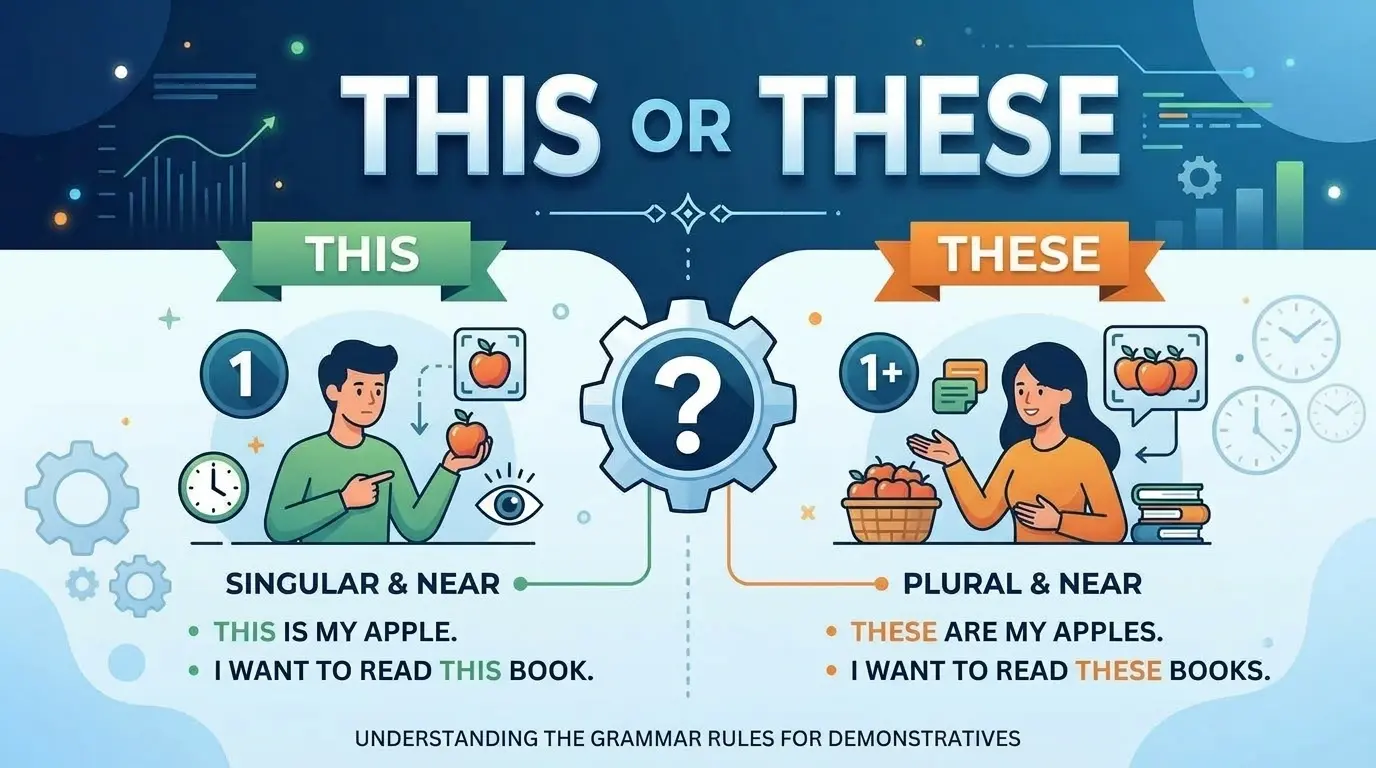
This is used with singular nouns, while these is used with plural nouns. Both can point to people or things that are close to you.
Imagine you are holding a book and talking to a friend. You might say, “This book is interesting.” Then your friend picks up three books, and you say, “These books are interesting.”
The difference looks small, but it matters in English grammar. This points to one person or thing, while these points to more than one. The words can also stand alone when the noun is already understood.
For example, “This is my phone” refers to one phone. “These are my phones” refers to more than one phone.
Once you remember the singular and plural rule, choosing between this or these becomes much easier.
Quick Answer
Use this with one person or thing, and use these with two or more. Both can point to people or things that are near the speaker. For example, say “this book” for one book and “these books” for several books.
Quick Rule in 1 Line
This means one; these means more than one.
This or These: What Is the Difference?
This is the singular form, while these is the plural form. Use this before a singular noun and these before a plural noun. Both usually refer to people or things that are close to the speaker or writer.
Compare:
- This book is mine.
- These books are mine.
The first sentence refers to one book.
The second sentence refers to multiple books.
The same rule works with people:
- This student needs help.
- These students need help.
It also works when the words stand alone:
- This is my bag.
- These are my bags.
So, the easiest question to ask is:
Am I talking about one thing or more than one?
If it is one, use this.
If it is more than one, use these.
Read More: Were or Was? The Simple Difference Explained
Read More: What’s or Whats? The Correct Spelling, Plus a 5-Second Test You’ll Never Forget
What Does “This” Mean?
This is a demonstrative word used with a singular noun or an uncountable noun. It commonly points to something near the speaker, something happening now, or something the speaker wants to identify clearly.
Examples include:
- this book
- this car
- this student
- this idea
- this problem
- this water
- this information
For example:
This book belongs to me.
There is one book.
Another example:
This information is useful.
Here, information is an uncountable noun, so this is correct.
You can also use this without a noun:
This is my phone.
The noun phone is understood from the situation.
Cambridge explains that this can work as both a determiner before a noun and a pronoun by itself.
What Does “These” Mean?
These is the plural form used with plural nouns. It commonly points to two or more people or things that are near the speaker or writer.
Examples include:
- these books
- these cars
- these students
- these ideas
- these problems
- these shoes
- these questions
For example:
These books belong to me.
There is more than one book.
Another example:
These students need extra help.
The noun students is plural, so these is correct.
You can also use these without a noun:
These are my shoes.
The word shoes is understood.
Oxford gives the same basic pattern: this is singular, while these is plural.
This vs These: The Main Difference
This refers to one person or thing, while these refers to two or more. The choice depends mainly on whether the noun is singular or plural. Both words commonly refer to something close to the speaker.
| Word | Number | Example |
| This | Singular | This book is new. |
| These | Plural | These books are new. |
The difference becomes clearer when you compare several pairs.
One phone
This phone is expensive.
More than one phone
These phones are expensive.
One question
This question is difficult.
More than one question
These questions are difficult.
One student
This student is ready.
More than one student
These students are ready.
The noun after the demonstrative usually gives you the answer.
This and These in the Same Sentence
Yes, you can use this and these in one sentence. Each word matches its own noun: this for one, these for more than one.
For example: This pen and these pencils are mine.
Check each noun separately:
- This shirt and these shoes are new.
- I like this song more than these songs.
- This is my bag, and these are my books.
When two nouns are joined by and, the verb is usually plural.
This pen and these pencils are mine.
The Simple Grammar Rule
Use “this” with singular nouns and “these” with plural nouns. The same distinction applies when they stand alone: this is refers to one thing, while these are refers to multiple things.
Think of the rule as a simple pair:
This → one
These → many
For example:
This apple is fresh.
One apple.
These apples are fresh.
More than one apple.
The verb also changes when these words stand alone.
This is my book.
These are my books.
This happens because this is singular and these is plural.
Cambridge and Oxford both identify this as singular and these as plural.
This With Singular Nouns
This goes before a singular countable noun when you mean one person or thing. It can also go before an uncountable noun, such as information, water, advice, or music.
Examples:
This car is fast.
This student is absent.
This question is important.
This chair is broken.
This idea sounds good.
With uncountable nouns:
This information is helpful.
This advice is useful.
This water tastes strange.
You should not normally use these with these singular or uncountable nouns.
Incorrect:
These information is useful.
Correct:
This information is useful.
The key is not simply whether something is physically close.
You must also consider whether the noun is singular, plural, or uncountable.
These With Plural Nouns
These goes before a plural noun when you mean two or more people or things. It is the plural partner of this when the people or things are near the speaker.
Examples:
These books are mine.
These students are ready.
These shoes are comfortable.
These questions are difficult.
These pictures look great.
The noun must normally be plural.
Incorrect:
These book is expensive.
Correct:
This book is expensive.
Incorrect:
These student is absent.
Correct:
This student is absent.
If there are several books or students, use these:
These books are expensive.
These students are absent.
What Is the Plural of “This”?
The plural of this is these. The singular of these is this. English does not add an -s here. It uses a different word.
Compare:
- this book → these books
- this student → these students
- this idea → these ideas
To go the other way, change these back to this:
- these cars → this car
- these questions → this question
Do not write thises or thiss. Those forms do not exist.
What about the plural form of these? You do not need one. These is already plural.
Is “Theses” the Plural of “This”?
No. Theses is the plural of thesis, which means a long piece of academic writing.
- This thesis is well researched.
- These theses were submitted last month.
Do not use theses when you mean these.
Incorrect:
Theses books are mine.
Correct:
These books are mine.
Spelling Check: These, Not Theese or Thse
The correct spelling is these: t-h-e-s-e. Spellings like theese and thse are mistakes.
A sound clue can help:
- This ends with a soft s sound, like kiss.
- These ends with a z sound, like please.
Say them aloud: this, these. The longer, stronger ending belongs to the plural word.
Is This or Are These? (Questions)
Use is this for one person or thing, and are these for two or more. Is these is not correct.
Compare:
- Is this your bag?
- Are these your bags?
- Is this seat free?
- Are these seats free?
Incorrect:
Is these your keys?
Correct:
Are these your keys?
The verb changes with the number, just like in normal sentences.
You can also leave the noun out when it is clear:
Do you want this or these?
Here, the speaker may be pointing at one item and then several items.
This Is vs These Are
This is is used for one person or thing, while these are is used for two or more. This difference is especially important when the demonstrative appears without a noun.
Compare:
This is my friend.
One friend.
These are my friends.
More than one friend.
Another example:
This is my new computer.
These are my new computers.
The same pattern works with objects, people, and other nouns.
Singular
This is + one
Plural
These are + more than one
This makes the verb easy to remember.
Do not write:
These is my books.
Write:
These are my books.
Do not write:
This are my books.
Write:
This is my book.
The British Council also teaches the pattern this is for singular references and these are for plural references.
This and These as Pronouns
This and these can work without a noun when the listener already knows what you mean. In these cases, they act as pronouns rather than appearing directly before a noun.
For example:
This is delicious.
The speaker may be talking about food.
Or:
These are expensive.
The listener can understand that these refers to several objects.
Compare:
This book is expensive.
Here, this comes before the noun book.
This is expensive.
Here, this stands alone.
The same happens with these:
These shoes are expensive.
These are expensive.
The noun can disappear when the context already makes it clear.
Introducing People and Saying Who You Are
Use this is to introduce one person and these are to introduce more than one. On the phone, people also say this is plus their name to say who is speaking.
Examples:
- Mom, this is my friend Sara.
- Mom, these are my friends, Sara and Ali.
- Hello, this is Ahmed speaking.
You can also ask who is calling:
Who is this?
In these cases, this and these work as pronouns, so no noun is needed.
These and This for Things Near You
This and these commonly point to people or things that are close to the speaker. This is singular, while these is plural.
For example, imagine you are holding one phone:
This phone is new.
Now imagine you are holding two phones:
These phones are new.
The distance rule works together with the number rule.
| Number | Near | Example |
| Singular | This | This book |
| Plural | These | These books |
English also has that and those for things that are farther away.
| Number | Near | Farther away |
| Singular | this | that |
| Plural | these | those |
So the complete pattern is:
this → one and near
these → more than one and near
that → one and farther away
those → more than one and farther away
Cambridge describes this/these as forms commonly used for things and people close to the speaker, while that/those commonly refer to things farther away.
Can “This” Refer to an Idea?
Yes. “This” can refer to an idea, situation, event, or statement rather than a physical object. When it refers to one whole idea or situation, it remains singular.
For example:
I missed the bus. This is a problem.
Here, this refers to the situation.
Another example:
She got the job. This is wonderful news.
The word this points to the whole event.
You can also use this to introduce information:
This is what I mean.
It does not always have to point at a physical object.
When referring to several separate things, these can be used instead.
For example:
We need more time and money. These are our main concerns.
The choice still depends on whether you are referring to one idea or several separate points.
Why a Vague “This” Can Confuse Readers
When this or these stands alone, the reader must know exactly what it points to. If it is not clear, add a noun after it.
Vague:
The results were late. This upset the students.
Clearer:
The results were late. This delay upset the students.
Another example:
Vague:
These are important.
Clearer:
These steps are important.
This small fix is especially helpful in essays, emails, and exam answers.
This or These With Time Words
Use this with one period of time and these with more than one. Time words follow the same singular and plural rule as objects.
| One period | More than one |
|---|---|
| this morning | these mornings |
| this week | these weeks |
| this year | these years |
| this day | these days |
The “closeness” here is in time, not distance. This and these point to the present or a time very near it.
This Year or These Year?
This year is correct because year is singular. These year is incorrect.
If you mean more than one year, write these years.
- This year has been busy.
- These years have changed my life.
“These Days” and Other Fixed Phrases
These days means “nowadays.” It is a common fixed phrase.
- Many people shop online these days.
Do not write this days. If you mean one day, use this day.
You will also see plural time phrases like these:
- these past few weeks
- these last few days
For one period, use the singular form: this past week.
Common Mistakes With This and These
Mistake 1: Using “this” with a plural noun
Incorrect:
This books are expensive.
Correct:
These books are expensive.
Books is plural, so use these.
Mistake 2: Using “these” with a singular noun
Incorrect:
These book is mine.
Correct:
This book is mine.
Book is singular, so use this.
Mistake 3: Using “these is”
Incorrect:
These is my shoes.
Correct:
These are my shoes.
These is plural, so it takes are in this structure.
Mistake 4: Using “this are”
Incorrect:
This are my books.
Correct:
This is my book.
If you have multiple books, write:
These are my books.
Mistake 5: Forgetting that uncountable nouns can use “this”
Incorrect:
These information is important.
Correct:
This information is important.
Information is uncountable, so this can be used.
Other examples include:
- this advice
- this music
- this water
- this furniture
- this equipment
This or These With Irregular and Always-Plural Nouns
Choose this or these by the meaning of the noun, not only by the -s ending. Some plural nouns have no -s, and some nouns are always plural.
Regular nouns
| One | More than one |
|---|---|
| this thing | these things |
| this word | these words |
| this item | these items |
Incorrect: this things, this words, this items
Correct: these things, these words, these items
Irregular plurals
Some plurals change the whole word. They still need these.
| One | More than one |
|---|---|
| this child | these children |
| this man | these men |
| this woman | these women |
| this foot | these feet |
| this tooth | these teeth |
| this mouse | these mice |
| this person | these people |
These people are waiting outside.
This people is not normally used for a group of individuals.
Nouns that are always plural
Words like scissors, jeans, trousers, and glasses are plural, so they take these.
- These jeans are comfortable.
- These scissors are sharp.
To talk about one item, use pair:
This pair of jeans is comfortable.
This or These: Real Examples
Here are natural examples showing how the two forms work.
Examples with “this”
- This book belongs to me.
- This student needs help.
- This question is difficult.
- This phone is new.
- This idea could work.
- This chair is broken.
- This problem needs attention.
- This picture looks beautiful.
- This information is useful.
- This advice helped me.
Examples with “these”
- These books belong to me.
- These students need help.
- These questions are difficult.
- These phones are new.
- These ideas could work.
- These chairs are broken.
- These problems need attention.
- These pictures look beautiful.
- These examples are useful.
- These suggestions helped me.
The pattern is consistent.
One = this.
More than one = these.
This Book or These Books?
This book is correct when you mean one book. These books is correct when you mean two or more books. The noun determines whether you need the singular or plural demonstrative.
Compare:
This book is interesting.
One book.
These books are interesting.
Several books.
This is one of the easiest examples to remember because the plural -s makes the difference visible.
The same pattern works with:
- this car / these cars
- this house / these houses
- this student / these students
- this question / these questions
- this answer / these answers
This Sentence vs These Sentences?
Use this sentence when referring to one sentence.
This sentence is grammatically correct.
Use these sentences when referring to multiple sentences.
These sentences are grammatically correct.
This distinction is useful when writing or editing articles.
For example:
Can you check this sentence?
You are asking about one sentence.
But:
Can you check these sentences?
You are asking about several sentences.
This or These With Numbers and Quantities
Any number above one goes with a plural noun, so use these. Write these three books, not this three books.
This 3 or These 3?
These 3 is correct before a plural noun, whether you write the number in words or digits.
- These two phones are new.
- These three students are ready.
- These 3 answers are correct.
Incorrect:
This two phones are new.
Correct:
These two phones are new.
There is one common exception. A hyphenated number can work as an adjective before a singular noun:
- This three-day trip was fun.
- This 3-day course is free.
Here, the noun trip or course is singular, so this is correct.
This Many or These Many?
This many is the usual choice when you point to a number or amount. It is followed by a plural noun.
- I did not expect this many people.
- She asked this many questions.
These many is much less common. You will mostly see it in phrases like these many years.
For uncountable nouns, use this much:
- I did not expect this much water.
This or These After a Verb or Preposition
A verb or preposition does not change the rule. Use this for one thing and these for more than one, whatever word comes before.
With This or With These?
The same rule works after with, for, and from:
- I write with this pen. / I write with these pens.
- This gift is for this student. / This gift is for these students.
- Take a card from this box. / Take a card from these boxes.
It also works after verbs:
- I need this pen. / I need these pens.
- Do you need this or these?
One of This or One of These?
After one of, two of, or some of, use these when you mean a group of separate things. Use this when you mean a single or uncountable thing.
| Correct | Why |
|---|---|
| one of these books | books is plural |
| two of these pens | pens is plural |
| most of this information | information is uncountable |
| more of this music | music is uncountable |
| more of these songs | songs is plural |
| which of these | choosing from a group |
Incorrect: one of this books
Correct: one of these books
Watch the verb. The subject is one, so the verb is singular:
One of these books is mine.
Which of this is not common on its own. It usually needs more words, such as which part of this.
A Simple Test for Choosing This or These
When you are unsure, look at the noun.
If the noun is singular:
Use this.
this book
this car
this question
If the noun is plural:
Use these.
these books
these cars
these questions
If the noun is not written, ask yourself:
Am I pointing to one thing or several things?
One:
This is good.
Several:
These are good.
This quick test can solve most everyday questions.
Memory Trick
Remember this simple pattern:
This = one
These = two or more
You can also remember the spelling:
this → one
these → many
Then connect the verbs:
This is
These are
Try saying the pairs aloud:
This is my book.
These are my books.
The s in these can remind you that you are talking about several things.
For a complete four-word pattern, remember:
This = one, near
These = many, near
That = one, farther away
Those = many, farther away
This gives you the whole demonstrative system in one simple pattern.
This or These Quiz and Practice Worksheet
Try this short quiz to test yourself. Answers are at the end.
Part A: Fill in the blank with this or these
- ___ book is on the table.
- ___ shoes are too small.
- ___ information is helpful.
- ___ are my friends.
- Are ___ your keys?
- I have been busy ___ week.
- ___ days, many people shop online.
- One of ___ pens is mine.
- ___ three-day trip was fun.
- ___ children are playing outside.
Part B: Choose the correct sentence
- (a) This apples are fresh. (b) These apples are fresh.
- (a) Is these your bag? (b) Is this your bag?
- (a) I need more of this music. (b) I need more of these music.
- (a) I bought these two phones. (b) I bought this two phones.
- (a) Theses books are mine. (b) These books are mine.
Answers
Part A: 1. This 2. These 3. This 4. These 5. these 6. this 7. These 8. these 9. This 10. These
Part B: 1. b 2. b 3. a 4. a 5. b
FAQs
Is “this” singular or plural?
This is singular. It is used with singular nouns and can also be used with uncountable nouns.
Is “these” singular or plural?
These is plural. It is used with plural nouns.
Should I say “this book” or “these book”?
Say this book when you mean one book. If you mean several books, say these books.
Should I say “this is” or “these are”?
Use this is for one person or thing. Use these are for two or more people or things.
Can “this” be used with uncountable nouns?
Yes. You can say this information, this advice, this water, and this music.
Can “these” stand alone?
Yes. You can use these as a pronoun when the noun is understood from the context.
What is the plural of “this”?
The plural of this is these. For example, this book becomes these books.
Is it “this year” or “these year”?
Say this year. Year is singular, so these year is incorrect. For more than one year, use these years.
Should I say “this three” or “these three”?
Say these three before a plural noun, such as these three books. Use this only with a hyphenated phrase like this three-day trip.
Is it “one of this” or “one of these”?
Say one of these with a group of separate things, such as one of these books. Use of this with a single or uncountable thing, such as most of this information.
Is “theses” the plural of “this”?
No. Theses is the plural of thesis. The plural of this is these.
Conclusion:
Choosing between this and these is mainly about number. Use this for one person or thing, and use these for two or more. Both commonly point to people or things that are close to the speaker.
For example, say “this book” when you mean one book. Say “these books” when you mean several books.
You can also use them without a noun: “This is my phone” and “These are my phones.”
Once you remember this = singular and these = plural, the difference becomes much easier.

I’m Sophia Mitchell, an English grammar and writing enthusiast. I create simple, easy-to-understand content to help learners improve their English. My goal is to make grammar clear, practical, and enjoyable for everyone.











3 thoughts on “This or These? The Correct Choice Explained”