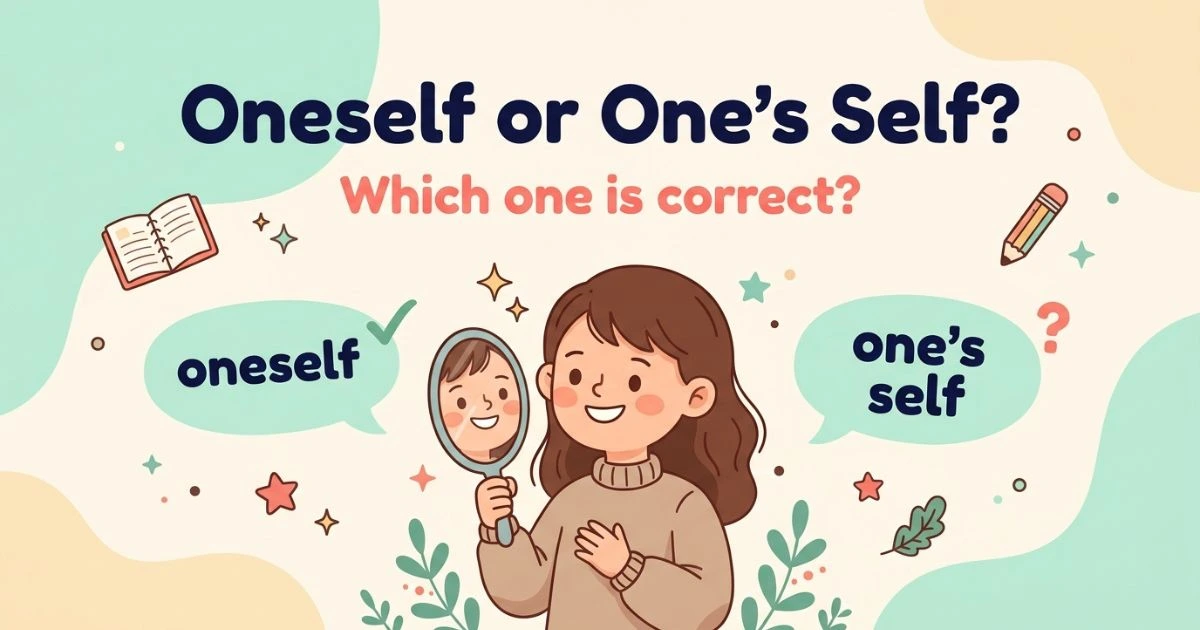
You are typing a sentence like “One should be kind to ___” and suddenly you freeze. Is it oneself or one’s self?
Both look plausible, and both exist in English, so which one is correct?
Here is the short answer. Oneself is a reflexive pronoun, and it is the form you need most of the time.
One’s self is a different construction: a possessive plus the noun self. It fits only when you mean a person’s identity or inner character.
In this guide, you will get clear definitions, a three-step test you can run in seconds, original examples, the mistakes to avoid, and a short practice quiz. By the end, you will know exactly which form to type.
Oneself or One’s Self: The Quick Answer
Think of it this way:
- Oneself = a reflexive pronoun, like himself or herself. It points back to the subject.
- One’s self = one’s (possessive) + self (a noun meaning identity, character, or personality).
If you are not sure, choose oneself. The writing guides we reviewed agree that in most sentences the two-word form can simply give way to the one-word form. The reverse is not true: oneself cannot always replace one’s self without changing the meaning.
What Does Oneself Mean?
Oneself is the reflexive form of the indefinite pronoun one. It lets you talk about people in general rather than a specific person. That makes it useful for advice, general truths, and formal writing.
Where the word comes from
Oneself is built the same way as other reflexive pronouns. Myself grows out of me, yourself out of you, and oneself out of one.
According to Grammarist, the phrase first appeared in the mid-14th century as two words. It was merged into a single word during the 1800s, once the two-word phrase had taken on a separate meaning of its own.
Oneself as a reflexive pronoun
A reflexive pronoun refers back to someone who already appears in the sentence. That is why it can never be the subject itself. Oneself belongs in the same family as himself, herself, and themselves, and it has the added benefit of being gender-neutral.
Here are a few fresh examples:
- It takes courage to forgive oneself after a mistake.
- One can only protect oneself from stress so much.
- Learning is easier when one sets small goals for oneself.
In each sentence, the action comes back to the same general person: one.
Oneself for emphasis
Oneself can also stress that someone did something personally, without help.
- Fixing a leaking tap is simple enough to do oneself.
- Writing a first draft is something one must do oneself.
Here, the word is not the object of the action. It simply adds emphasis.
Read More: Data Is or Data Are? Both Are Correct Here’s When
What Does One’s Self Mean?
In one’s self, the two words do separate jobs. One’s is a possessive pronoun, and self is a noun. The noun stands for a person’s identity, personality, character, or inner being. You will often see it in psychological, spiritual, or philosophical writing.
Examples:
- A journal can help one get to know one’s inner self.
- It is hard to hide one’s true self for long.
- One’s sense of self can shift after a big life change.
Notice that you can swap self for a word like identity or character and the sentence still works. A reflexive pronoun would never pass that test.
You will also meet common phrases such as one’s true self, one’s inner self, and one’s sense of self. These are ordinary possessive phrases. They do not mean the reflexive oneself needs an apostrophe.
Oneself vs One’s Self: Side-by-Side Comparison
| Feature | Oneself | One’s self |
| Written as | One word | Two words, with an apostrophe |
| Part of speech | Reflexive pronoun | Possessive + noun |
| Meaning | The same general person, as receiver or for emphasis | A person’s identity or inner nature |
| Replace test | Can be swapped with himself, herself, themselves | Can be swapped with identity, character, personality |
| Typical use | Advice, general statements, formal writing | Psychology, spirituality, philosophy |
| Safe default? | Yes | Only when self clearly means identity |
A 3-Step Test to Choose the Right Form
Memorizing rules is hard. A quick test is easier. Run through these steps whenever you are stuck.
Step 1: Is the word pointing back at “one”?
Look at the subject of your sentence. If the action goes back to that same general person, you need a reflexive pronoun.
One should be honest with ___. The honesty is directed at the same person who is being honest. That points to oneself.
Step 2: Try swapping in himself, herself, or themselves
Replace the blank with himself or herself. If the sentence still makes sense grammatically, oneself is the right fit.
One must remind ___ of the goal. → He must remind himself of the goal. Works, so use oneself.
Step 3: Try swapping “self” with identity or character
If step 2 fails, replace self with identity, character, or personality.
It is hard to hide one’s true ___. → It is hard to hide one’s true identity. Works, so self is a noun here, and one’s self (or one’s true self) is correct.
What if both tests pass?
Sometimes both work, and the meaning shifts a little. When that happens, ask what you really mean. If you mean the person as a whole, go with oneself. If you mean the deeper “inner” person, one’s self may be the better choice. When you still cannot decide, rewrite the sentence with a clearer subject.
Examples You Can Learn From
Oneself in sentences
- One should not compare oneself with everyone online.
- It helps to give oneself a rest day after a hard week.
- A good teacher shows one how to challenge oneself without burning out.
- Before judging others, one should look at oneself honestly.
- Setting aside time for oneself is not selfish.
- Some jobs are too small to hire out. One can do them oneself.
One’s self in sentences
- Moving abroad can change how one sees one’s self.
- Real confidence starts with accepting one’s true self.
- Writing a diary lets one explore one’s inner self.
- Pressure from others can make one forget one’s own sense of self.
In the first list, the person is acting on, or for, the same person. In the second, self is a thing being discovered, hidden, or described.
Can Oneself and One’s Self Appear in the Same Sentence?
Yes, but it sounds heavy. Writers sometimes combine them, as in “Thinking about oneself may improve one’s self.” LiveXP points out that sentences like this are extremely formal and uncommon today.
In everyday writing, most people would rewrite it: “Thinking about yourself can improve your character.”
Sentences where both forms work
A few sentences accept either form, and the meaning shifts slightly. Take “Being in love with oneself” and “Being in love with one’s self.” One guide suggests the first leans toward the whole person, while the second leans toward the deeper, philosophical self.
That distinction is subtle, and many readers will not notice it. If you want a plain, clear sentence, pick oneself.
Oneself vs Yourself: Which Sounds Better?
Oneself belongs with the pronoun one. Yourself belongs with you. Mixing them is a common slip.
- Formal: One should be proud of oneself.
- Conversational: You should be proud of yourself.
Both mean much the same thing. The second sounds more natural in speech, emails, and blog posts. Writing Explained also points out that oneself can feel unwieldy, especially when it is repeated many times in a row.
Tips for keeping your writing natural
- Use one and oneself for formal essays, speeches, and general statements.
- Switch to you and yourself when you are talking directly to the reader.
- Avoid stacking several one… oneself… one’s in the same paragraph.
- If a sentence starts to sound stiff, rewrite it with a specific subject, such as a student or a writer.
Common Mistakes to Avoid
1. Adding an apostrophe to oneself. Wrong: one’self. Right: oneself. The apostrophe belongs only in the possessive one’s.
2. Using one’s self as a default reflexive pronoun. Writing Explained is clear that one’s self is not a reflexive pronoun. Wrong: One should respect one’s self. Better: One should respect oneself.
3. Using oneself as the subject. Reflexive pronouns need something to refer back to. Wrong: Oneself should always be honest. Right: One should always be honest with oneself.
4. Mixing oneself with yourself. Wrong: You should believe in oneself. Right: You should believe in yourself. Keep the subject and the pronoun matched.
5. Overusing “one” in casual writing. It is grammatically fine, but it can sound stiff. Use it with intention, not by habit.
Quick Practice: Test Yourself
Fill in the blanks, then check the answers below.
- One must learn to forgive ___.
- It is hard to hide one’s true ___ for long.
- You should be proud of ___.
- Doing the repairs ___ saves money.
- ___ should always tell the truth.
- A diary can help one explore one’s inner ___.
Answers:
- oneself (reflexive, points back to one)
- self (a noun meaning identity, after the possessive one’s)
- yourself (the subject is you, not one)
- oneself (used for emphasis: without help)
- One (a reflexive pronoun cannot be the subject)
- self (a noun, after one’s inner)
FAQs
Is it oneself or one’s self?
Both exist, but they are different. Oneself is a reflexive pronoun, written as one word. One’s self is a possessive plus the noun self, meaning a person’s identity. For ordinary reflexive sentences, such as “One should trust oneself,” oneself is the correct choice.
Is oneself one word or two?
Oneself is written as one word, just like himself, herself, and themselves. Writing it as two words is not the reflexive pronoun. According to Grammarist, the two words were combined in the 1800s, once the two-word phrase had taken on its own separate meaning.
Does oneself need an apostrophe?
No. Oneself never takes an apostrophe. The apostrophe belongs to the possessive one’s in the phrase one’s self, as in one’s true self. If you catch yourself typing one’self, remove the apostrophe and write it as one clean, single word.
When should I use one’s self?
Use it when self is a noun meaning identity, personality, or inner character. It appears in psychological, spiritual, or philosophical writing, such as one’s true self or one’s inner self. A quick check: if you can replace self with identity, one’s self fits.
What is the difference between oneself and yourself?
Oneself refers back to the pronoun one, while yourself refers back to you. “One should trust oneself” and “You should trust yourself” mean much the same thing. The second is more natural in conversation, emails, and blog posts. Keep the subject and pronoun matched.
Can oneself be the subject of a sentence?
No. A reflexive pronoun must refer back to a subject that already appears in the sentence. Instead of “Oneself should be honest,” write “One should be honest with oneself.” The pronoun one acts as the subject, and oneself points back to it.
Conclusion:
Choosing between oneself or one’s self comes down to one question: is it a reflexive pronoun, or the noun self?
If the sentence points back to “one,” use oneself. If you mean a person’s identity or inner nature, use one’s self, usually in phrases like one’s true self.
When you are unsure, run the three-step test: check the subject, swap in himself or herself, then swap self for identity. And if the sentence still feels stiff, rewrite it with you or a specific subject.
Next step: reread your last draft, search for “one’s self,” and test each one. You may find a few that should simply be oneself.

I am an English language writer passionate about grammar and clear communication. I create simple, easy-to-understand content that helps readers improve their English skills. My goal is to make learning English both practical and enjoyable.










2 thoughts on “Oneself or One’s Self? A Simple Test to Pick the Right One”