You have used the word “good” four times in one paragraph, and your writing is starting to sound flat.
Or maybe an exam question asked for the opposite of a word and your mind went blank. Both problems come down to one skill: understanding how words relate to each other.
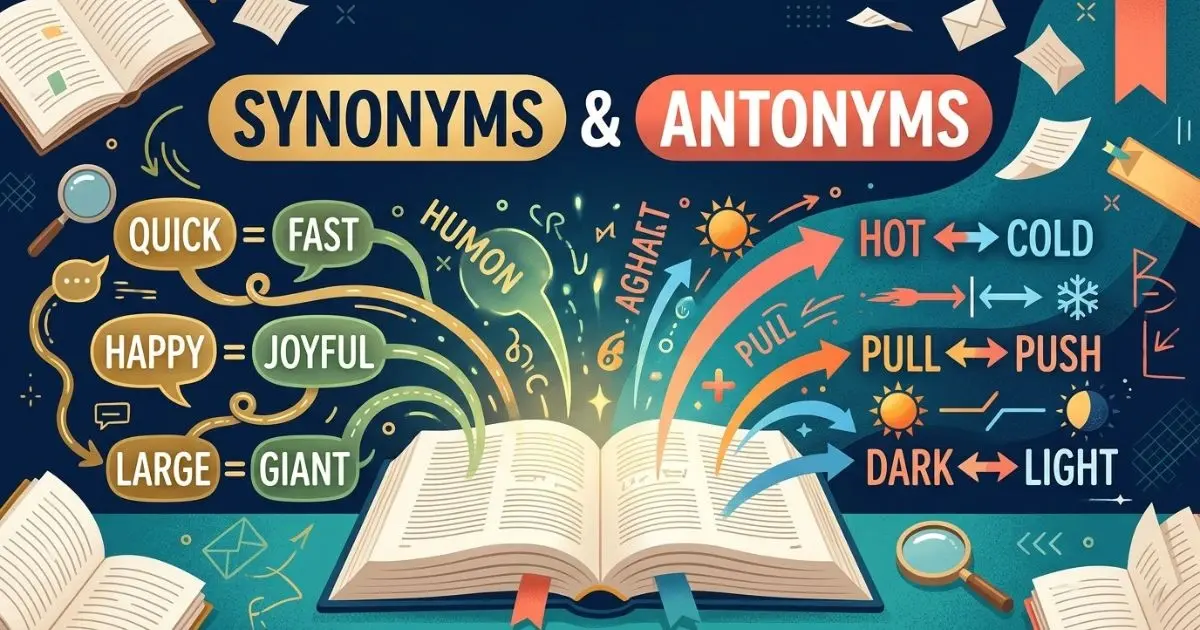
Synonyms are words with the same or nearly the same meaning. Antonyms are words with opposite meanings.
The idea is simple, but choosing the right word takes care, because similar words are rarely identical.
This guide to synonyms and antonyms gives you clear definitions, the main types of each, a step-by-step method for choosing the best word, common mistakes to avoid, and a short practice set with answers.
What Are Synonyms and Antonyms?
Synonyms and antonyms are two ways words connect to each other. Synonyms link words that mean about the same thing. Antonyms link words that mean the opposite.
Quick rule: synonyms are alike, antonyms are opposite.
Here are two pairs to start with:
- Synonyms: begin and start
- Antonyms: begin and end
- Synonyms: smart and intelligent
- Antonyms: smart and foolish
These relationships work for nouns, verbs, adjectives and adverbs, so you will meet them in conversations, textbooks, emails and exams. One warning: context decides everything. A word that fits one sentence perfectly can sound odd in another.
What Is a Synonym?
A synonym is a word that means the same, or almost the same, as another word. You can describe a task as “easy” or “simple”, and a large city as a “metropolis”. The word synonym itself comes from Greek. Study.com adds that synonyms are more plentiful than antonyms, because most English words have a close relative.
Synonyms do two useful jobs. First, they stop your writing from sounding repetitive. Second, they let you say exactly what you mean. Compare these two versions:
- Repetitive: The movie was good. The acting was good, and the story was good.
- Varied: The movie was excellent. The acting was impressive, and the story was enjoyable.
Synonyms in Sentences
| Word | Synonym | Example |
| Happy | Joyful | She felt joyful after the good news. |
| Big | Large | They live in a large house. |
| Fast | Quick | He gave a quick answer. |
| Begin | Start | We will start the lesson now. |
| Smart | Intelligent | She is an intelligent student. |
| Easy | Simple | This question is simple. |
| Buy | Purchase | We purchased tickets online. |
| Help | Assist | Can you assist me with this form? |
Why Shades of Meaning Matter
Synonyms are rarely perfect swaps. Take the word good. Okay, fine, great, excellent and wonderful all describe something positive, but an “okay day” is clearly weaker than an “excellent day”.
Boring and insipid both describe something dull, yet insipid sounds more scholarly and a little pretentious. The same care applies at work. In an email about your earnings, pay, salary and hourly wage all fit, but each sends a slightly different message.
Even a common word can mislead. Mad can mean angry or wild, so “He was mad about the delay” is fine in casual speech but may confuse a formal reader.
Read More: Oneself or One’s Self? A Simple Test to Pick the Right One
What Is an Antonym?
An antonym is a word with the opposite meaning of another word. Hot and cold, early and late, and presence and absence are all antonym pairs.
Antonyms
| Word | Antonym | Example |
| Happy | Sad | He felt sad after the game. |
| Fast | Slow | This computer is slow. |
| Ancient | Modern | The museum mixes ancient and modern art. |
| Conceal | Reveal | The report reveals the real cause. |
| Abundant | Scarce | Water is scarce in the desert. |
| Permanent | Temporary | This job is temporary. |
| Intentional | Accidental | The mistake was accidental. |
| Borrow | Lend | Can you lend me a pen? |
Antonyms Made With Prefixes
Many antonyms are built by adding a prefix to the original word. Accurate becomes inaccurate, obedient becomes disobedient, qualified becomes unqualified, and justice becomes injustice. This makes them easy to spot and easy to learn.
Do not rely on this trick everywhere, though. Big has no “unbig”, and the opposite of ancient is modern, not “unancient”. Many antonyms are completely different words, so they need to be learned as pairs.
Synonyms vs. Antonyms: What Is the Difference?
The difference is the relationship. Synonyms share meaning. Antonyms oppose it. Both help you build vocabulary, but they do different work in a sentence.
| Synonyms | Antonyms | |
| Meaning | Same or similar | Opposite |
| Main use | Variety and precision | Contrast and comparison |
| Example | easy / simple | easy / difficult |
| Common risk | Small differences in tone or strength | Choosing the wrong opposite for the context |
Here is a handy connection from Study.com: every synonym of good is also an antonym of bad. So terrible, awful and unpleasant all mean “bad”, and all oppose “good”. Learn one set, and you get the other almost free.
Types of Synonyms
Not all synonyms are equally close. It helps to sort them into three groups.
1. Close Matches
Some pairs can swap places with almost no change. Sofa and couch usually point to the same furniture, so “We bought a new sofa” and “We bought a new couch” say the same thing. Perfect swaps in every situation are rare, though.
2. Same Idea, Different Strength
Angry and furious both describe anger, but furious is much stronger. Annoyed sits below both. Words like these form a ladder, so choose the rung that matches your feeling.
3. Same Area, Different Scope or Tone
Car and vehicle overlap, but vehicle also covers trucks, buses and motorcycles. Start and commence mean the same, yet commence sounds formal. Cheap and inexpensive both mention low price, but cheap can hint at poor quality.
Types of Antonyms
Opposites do not all work the same way. Language teachers usually describe three kinds.
1. Complementary Antonyms
These are two states where one cancels the other: alive and dead, true and false, on and off. In the basic sense, there is no middle ground.
2. Gradable Antonyms
These sit at opposite ends of a scale, with room in between: hot and cold, big and small, happy and sad. Warm is neither hot nor cold. Because they sit on a scale, you can compare them: bigger, colder, slower.
3. Relational Antonyms
These describe opposite roles in the same relationship: teacher and student, buy and sell, employer and employee, landlord and tenant. One cannot exist without the other. If Maya sells a book to Alex, she is the seller and he is the buyer, in one single transaction.
How to Choose the Right Synonym
A thesaurus gives you options, not answers. Use this five-step check before you swap a word.
- Pin down the meaning. Ask what the word really means in this sentence, not in general.
- Check the strength. Is your replacement weaker, equal or stronger? Furious is not annoyed.
- Check the tone. Is it formal, casual, or loaded with praise or criticism? Cheap and inexpensive are a good example.
- Read the sentence aloud. If it sounds unnatural, such as “I procured a car” instead of “I bought a car”, leave it.
- Keep the simpler word when it works. Clear writing beats advanced-sounding writing.
Try it: take “The speech was long.” Lengthy keeps the meaning. Endless adds frustration. Thorough changes the meaning completely. Same starting word, three very different results.
How to Use Antonyms in Writing
Antonyms are at their best when you want contrast. Charles Dickens opens A Tale of Two Cities with a run of opposites, starting with “the best of times” and “the worst of times”.
You can use the same idea in everyday writing:
- Comparison: The first test was easy, but the second was difficult.
- Change: The room was dark before sunrise and bright afterward.
- Persuasion: We need to increase output, not decrease it.
Study.com also notes that antonyms let you look at a topic from the opposite side. Used together with synonyms, they keep writing lively.
Common Mistakes to Avoid
- Treating synonyms as identical. House and home overlap, but home carries a feeling of belonging.
- Calling any two different things antonyms. Apple and orange are different, but they are not opposites.
- Forgetting multiple meanings. Light is the opposite of dark when talking about brightness, and the opposite of heavy when talking about weight.
- Using a fancy word to sound smart. If help says it clearly, you do not need facilitate.
- Swapping every repeated word. Sometimes repetition keeps instructions clear or stresses a point.
How to Learn Synonyms or Antonyms Faster
Memorising long lists rarely works. These habits do:
- Learn in pairs and groups. The Saylor Academy writing text points out that we remember words better when we link them to related words.
- Build a ladder. Pick a word like good and line up its synonyms from weakest to strongest.
- Write one sentence per word. Using a word once beats reading it five times.
- Try the food exercise. Describe your favourite dish using as many synonyms as you can, then trim it to what sounds natural.
- Review daily. Ten minutes a day, plus regular reading, builds vocabulary steadily.
Practice Questions
- Which word is a synonym of begin? (start / stop / leave)
- Which word is an antonym of scarce? (abundant / rare / tiny)
- Which pair is relational? (teacher–student / hot–cold / alive–dead)
- Which word is the strongest synonym of angry? (annoyed / upset / furious)
- What is the opposite of light when talking about weight? (heavy / dark / dim)
- Add a prefix to make an antonym of accurate.
Answers: 1. start 2. abundant 3. teacher–student 4. furious 5. heavy 6. Inaccurate
FAQs
1. What is the difference between synonyms and antonyms?
Synonyms are words with the same or nearly the same meaning, like easy and simple. Antonyms are words with opposite meanings, like easy and difficult. Synonyms help you vary and sharpen your wording, while antonyms help you show contrast.
2. Can a word have more than one synonym or antonym?
Yes. Happy can be replaced by joyful, cheerful or content, depending on the sentence. Antonyms can also vary with meaning: light is the opposite of dark when describing brightness, but the opposite of heavy when describing weight. Always identify the meaning first.
3. Are synonyms always interchangeable?
No. Synonyms often differ in strength, tone or context. Angry and furious both describe anger, but furious is far stronger. Start and commence mean the same, yet commence sounds formal. Check the sentence before swapping one word for another.
4. What are the three types of antonyms?
The three main types are complementary, gradable and relational. Complementary pairs are all-or-nothing, like true and false. Gradable pairs sit on a scale, like hot and cold. Relational pairs describe linked roles, like teacher and student.
5. How can I learn synonyms and antonyms quickly?
Learn a few words at a time, ideally in pairs or groups, and write a sentence for each. Ranking synonyms from weakest to strongest helps too. Review for ten minutes daily and check a dictionary or thesaurus whenever a word feels uncertain.
6. Are any two different words antonyms?
No. Two words must truly oppose each other to count as antonyms. Apple and orange are different fruits, not opposites. Hot and cold, however, sit at opposite ends of a temperature scale, and buy and sell describe opposite roles.
Conclusion:
Synonyms and antonyms are simple to define and tricky to use well. Synonyms give you variety and precision. Antonyms give you contrast and clarity.
In both cases, context decides, so check meaning, strength and tone before you choose.
Your next step: pick one word you overuse, such as good. Write three synonyms ranked from weakest to strongest, add one antonym, and use each in a sentence today.

I’m Sophia Mitchell, an English grammar and writing enthusiast. I create simple, easy-to-understand content to help learners improve their English. My goal is to make grammar clear, practical, and enjoyable for everyone.







1 thought on “Synonyms and Antonyms: Meaning, Types and Easy Examples”