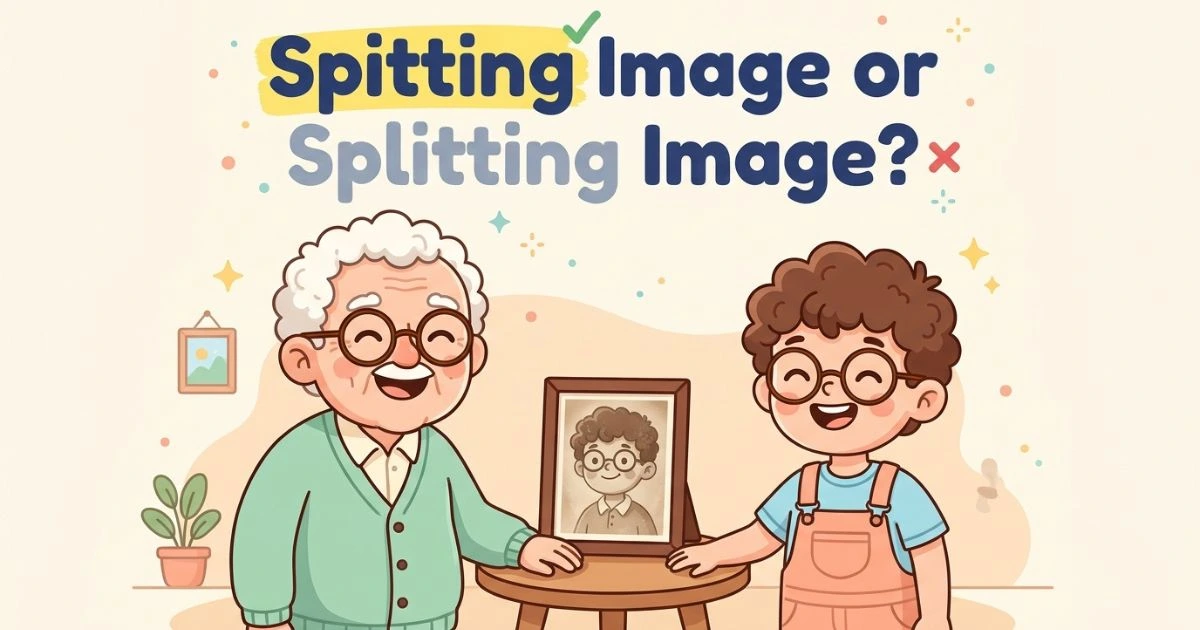
You are flipping through an old photo album and stop at a picture of your grandfather as a boy. Then you look at your nephew sitting across the room.
The words come to you: “He’s the spitting image of Grandpa.” But wait. Is it spitting image or splitting image?
Plenty of smart people say it both ways, so the doubt is fair. This guide gives you the answer straight away.
Then it explains what the phrase means, why the mix-up happens, where the idiom came from, and how to use it with confidence.
The Quick Answer
The standard phrase is “spitting image.”
It means one person looks almost exactly like another. “She’s the spitting image of her mother” is correct. “She’s the splitting image of her mother” is a common slip that most style-conscious writers avoid.
If you only remember one thing, remember this: when you describe a close likeness, write “spitting.”
What Does “Spitting Image” Mean?
“Spitting image” is an informal idiom for an exact or very close likeness. It is most often used when a child looks like a parent or grandparent, but it works for any two people who look strikingly alike.
The phrase almost always follows one pattern:
the spitting image of + [person]
Two small details matter here. Keep the word the in front, and keep the word of after. “She is spitting image of her aunt” sounds off because the article is missing.
Does It Have to Be Family?
No. You can use it for friends, strangers, actors, or even someone you spotted on the train.
- “My coworker is the spitting image of a famous cricketer.”
- “The statue is the spitting image of the old king.”
People also use it, loosely, for objects and places. A rebuilt house can be “the spitting image of the original.” That use is fine in casual writing, but people are the natural subject.
Is It About Looks Only?
Mostly, yes. Dictionaries define it as physical resemblance. Some writers stretch it to behavior, and you may see that in casual speech. But if you want your meaning to be clear, use different words for personality.
- Looks: “He’s the spitting image of his father.”
- Behavior: “He acts just like his father.”
Keeping the two apart saves your reader from guessing which kind of similarity you mean.
Read More: Apostrophe Before or After the Year? The Simple Rule
Why Do So Many People Say “Splitting Image”?
There are two good reasons, and neither means you are careless.
Reason 1: It Sounds the Same When Spoken
In everyday speech, most people say “spittin’ image,” with a soft ending. When you hear a word you do not fully recognize, your brain looks for the closest real word. “Spittin’” is vague. “Splitting” is a word you know well. The ear fills in the gap.
Reason 2: “Splitting” Seems More Logical
Think about it. “Spitting” feels odd. Why would saliva have anything to do with a likeness? Meanwhile, “splitting” suggests something divided into two matching halves, which fits the idea of two people who look alike.
Language experts often point out that idioms do not follow logic. They follow history. When a phrase’s original meaning fades, people quietly rebuild it into something that makes more sense. That is exactly what happened here.
One more note, in case it trips you up: “spitting image” has nothing to do with “spitting distance.” Those two expressions developed separately.
Where Did “Spitting Image” Come From?
No single origin story is accepted by everyone, and even language scholars admit the trail is messy. Still, the broad path is clear enough.
The Likely Journey of the Phrase
Most accounts describe a gradual change like this:
- “The very spit of”: An older way to say someone is a perfect likeness. Examples appear in the early 1800s, such as a nurse describing a child as “the very spit of the old Captain.”
- “Spit and image”: By the mid to late 1800s, writers were using this longer form.
- “Spitting image”: This version is recorded around the start of the 1900s and slowly became the normal one.
- “Splitting image”: This variant shows up later, by the 1930s at least, as people tried to make the phrase feel more logical.
Exact dates differ between sources, so treat any single year with some caution. The order of events, though, is consistent: spit came first, split came later.
So Why “Spit” at All?
Here are the main theories, from most to least popular:
- Literal spit. One person looks so much like another that they seem to have been spat out of that person’s mouth. Older English even had a line close to “as if he were spit out of his mouth.”
- A worn-down older form. One linguist argued that the original was “spitten image,” using an old form of the verb, which later shifted to “spit and image” and then “spitting image.”
- “Spirit and image.” Some suggest “spit” is a shortened “spirit.” Phrase historians call this unproven, since early examples of “spirit and image” are hard to find.
- A parallel in French. French has a similar saying that roughly means “he is his father, completely spat out.” That shows the spitting picture is not unique to English.
You do not need to pick a favorite. For writing, the useful fact is simply that every serious theory starts with “spit.”
What About the Split-Wood Theory?
This one deserves a fair hearing, because it is clever. When a plank is split down the middle, the two halves have matching grain. Woodworkers have long used this to make mirror-image patterns. So “splitting image” could mean “a perfect match, like two halves of one board.”
It is a pleasing idea, but the timeline is against it. The “spit” versions appear decades before any “split” version, so the wood story looks like a later explanation, not the source. In other words, it is a tidy story that people attached to the phrase afterward.
Spit and Image vs. Spitting Image vs. Splitting Image
Here is how the three forms compare:
| Form | Status | Feel | Best use |
| Spitting image | Standard, most common | Modern, natural | Almost everywhere |
| Spit and image | The older form | Old-fashioned, a bit folksy | Historical flavor, dialogue |
| Splitting image | Later variant, widely seen as an error | Sounds logical but is non-standard | Avoid in careful writing |
A fair note: “spit and image” is not wrong. It is simply the older cousin. “Splitting image” is the one most editors will correct.
Which Form Should You Use?
The easy answer is “spitting image,” but here is how it plays out in real situations.
- Work emails, reports, essays, exams: Use “spitting image.” It is the safest, most widely understood choice.
- Blog posts and social media: Use “spitting image.” You avoid comments pointing out the slip.
- Fiction narration: Use “spitting image.”
- Fiction dialogue: Use whatever fits the character. An older people village storyteller might say “spit and image.” A character who gets idioms slightly wrong might say “splitting image,” and that can be a deliberate detail.
- Casual chat: Nobody will mind either way, but “spitting image” keeps you consistent.
What If a Friend Says “Splitting Image”?
You do not need to correct anyone. If you want to share the fun fact, keep it light: “Funny thing, it’s actually ‘spitting image.’ It goes back to an older phrase, ‘spit and image.’” Most people enjoy a little word history when it comes without a lecture.
“Spitting Image” in Real Sentences
Seeing the phrase in use helps it stick.
Family Examples
- “My daughter is the spitting image of her mother at that age.”
- “Everyone says I’m the spitting image of my grandfather.”
- “The twins are the spitting image of each other.”
- “In this old photo, he is the spitting image of his son.”
Beyond Family
- “That singer is the spitting image of a young Elvis.”
- “The replica is the spitting image of the original painting.”
- “Our new puppy is the spitting image of his dad.”
Common Mistakes to Avoid
1: Writing “splitting image.”
- ❌ He is the splitting image of his father.
- ✅ He is the spitting image of his father.
2: Dropping “the.”
- ❌ She is spitting image of her mother.
- ✅ She is the spitting image of her mother.
3: Using it for personality alone.
- ❌ He’s the spitting image of his dad when it comes to patience.
- ✅ He’s just as patient as his dad.
4: Reading it literally.
The phrase does not involve anyone actually spitting. It is a fixed idiom, and you cannot swap its words for synonyms. “The saliva picture of his father” would make no sense to anyone.
Other Ways to Say “Spitting Image”
If you use the phrase often, a few alternatives keep your writing fresh.
| Expression | Example |
| Dead ringer | “He’s a dead ringer for his uncle.” |
| Look-alike | “She’s a look-alike of the lead actress.” |
| Doppelgänger | “I met my doppelgänger at the airport.” |
| Mirror image | “She’s a mirror image of her sister.” |
| Carbon copy | “The younger brother is a carbon copy of the older one.” |
| Like two peas in a pod | “The sisters are like two peas in a pod.” |
A small warning: these are close, but not identical. “Doppelgänger” is a German word meaning something like “double-goer,” and it often carries a slightly eerie tone. “Like two peas in a pod” can describe personality as well as looks. Choose the one that fits your meaning.
Easy Ways to Remember It
You do not need a complicated rule. Try one of these.
- The order trick. “Spit” came first in history, and “split” came later. So the shorter word is the original one.
- The family-photo trick. Picture a child who looks like a parent, as if the child were “spit out” from the parent’s own likeness. It is a slightly silly image, and that is exactly why it sticks.
- The one-line rule. If it looks the same, say “spitting.”
When you are unsure, default to spitting image. You will be right in nearly every situation.
FAQs
Is it “spitting image” or “splitting image”?
“Spitting image” is the standard form. It means a very close likeness, as in “He’s the spitting image of his dad.” “Splitting image” appears often in speech and writing, but it is a later variant that most editors and dictionaries treat as non-standard. Use “spitting” in anything you want to look polished.
What does “spitting image” mean?
It means someone looks almost exactly like another person. It is most common between relatives, such as a child and parent, but it also works for friends, actors, or lookalikes. The phrase is informal and focuses mainly on appearance rather than personality or behavior.
Where does “spitting image” come from?
It likely grew out of older forms such as “the very spit of” and “spit and image.” One popular explanation is that a person looks so much like another that they seem to have been spat out from that person. Scholars still debate the exact origin, so no single story is certain.
Is “splitting image” ever acceptable?
It is understood by almost everyone, and it has been around for a long time, so it is hardly a disaster in casual talk. But in school work, business writing, or published content, “spitting image” is the safer choice. You can use “splitting” in fictional dialogue if a character would naturally say it.
Is “spit and image” correct?
Yes. “Spit and image” is the older form from which “spitting image” developed. It is not an error, but it sounds more old-fashioned today. Most modern writers prefer “spitting image,” so choose “spit and image” only when you want a traditional or folksy tone.
Is “spitting image” formal or informal?
It is an informal idiom, but it is common and widely understood. You can use it in friendly emails, blog posts, stories, and conversation. In very formal writing such as legal or academic documents, you might prefer plain wording like “bears a strong resemblance to.”
Does “spitting image” have anything to do with “spitting distance”?
No. They look related because both contain “spit,” but they developed separately. “Spitting distance” is about being very close in space, while “spitting image” is about being very close in appearance. Treat them as two unrelated idioms that happen to share a word.
Conclusion
So, spitting image or splitting image? The answer is spitting image. The shorter word is the older one, the standard one, and the safest one in nearly any setting.
“Splitting” feels logical, which is exactly why it keeps creeping in, but logic is not what decides an idiom’s form.
Keep the pattern simple: the spitting image of someone. Use “spit and image” if you want an old-fashioned touch, and reach for “dead ringer” or “look-alike” when you want variety.
Your next step is easy. Pick one sentence you wrote recently that describes a likeness, check that it says “the spitting image of,” and you are done.

I am an English language writer passionate about grammar and clear communication. I create simple, easy-to-understand content that helps readers improve their English skills. My goal is to make learning English both practical and enjoyable.










1 thought on “Spitting Image or Splitting Image? Which Is Correct?”