Yesterday someone you know was recovering well. Today the news is bad, and you start typing: “His condition took a turn for the worst…” Then you stop. Does that look right?
Your instinct is sound. The standard phrase has taken a turn for the worse. “Worst” sounds stronger and more dramatic, which is exactly why so many people slip.
This guide gives you the quick answer, the grammar reason behind it (including one detail most articles skip), related phrases like “from bad to worse,” memory tricks, a short practice quiz, and answers to common questions.
Took a Turn for the Worse or Worst? The Quick Answer
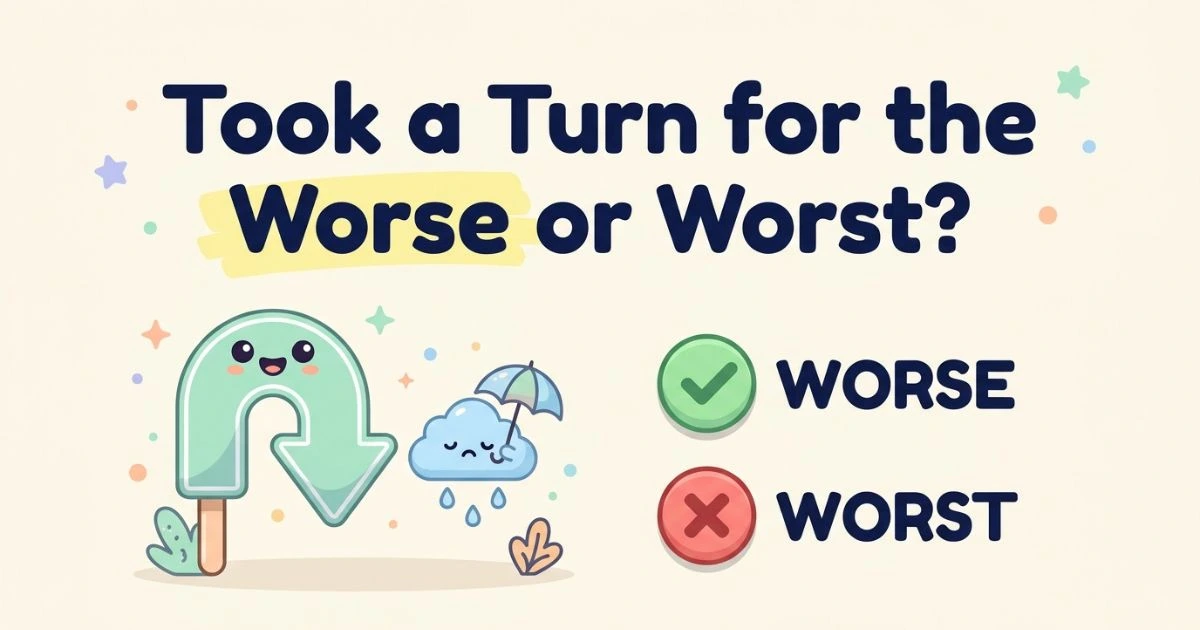
“Took a turn for the worse” is correct. It means a situation, condition, or problem became worse than it was before.
- Correct✅: His health took a turn for the worse.
- Avoid❌: His health took a turn for the worst.
You may see “turn for the worst” in casual posts and messages. Treat it as a mix-up, not a style choice. For emails, essays, exams, and professional writing, stick with “worse.”
The one-line rule: use worse when something gets worse, and worst when you name the most unfavorable thing of all.
What Does “Took a Turn for the Worse” Mean?
The phrase describes a negative change. It is most often used for health, weather, business, and relationships, but it works for anything that can decline.
The three parts of the phrase
- Took: the past tense of take.
- A turn: a change in direction or development.
- For the worse: toward a less favorable state.
Put together, the phrase says: things changed direction, and the new direction is worse than the old one.
The verb changes, the ending does not
You can use the idiom in any tense, but the ending stays fixed:
- She takes a turn for the worse. (present)
- The weather took a turn for the worse. (past)
- Things have taken a turn for the worse. (present perfect)
- His health is taking a turn for the worse. (continuous)
Only the verb moves. “For the worse” never becomes “for the worst,” whatever the tense.
Read More: Spitting Image or Splitting Image? Which Is Correct?
Why Is “Worse” Correct✅?
There are two reasons, and the second one is rarely explained.
Reason 1: the bad, worse, worst ladder
Bad has two irregular forms. Unlike big, bigger, biggest, it does not follow the usual -er/-est pattern.
| Form | Name | Meaning | Example |
| bad | base | unpleasant | The weather is bad. |
| worse | comparative | more unpleasant | The weather is worse today. |
| worst | superlative | most unpleasant | This is the worst weather of the year. |
A “turn for the worse” is a step from one condition to a poorer one. That is a comparative idea, so the comparative form fits.
Reason 2: “worse” is acting as a noun
Notice the word the before “worse.” That is a clue. In this idiom, worse works as a noun meaning a more serious or unpleasant situation. Read it as “a turn toward something more unpleasant.”
Worst can also be a noun, meaning the most unpleasant thing that could happen. That is how it appears in “What’s the worst that can happen?” and “prepare for the worst.”
So both words can follow “the” and look similar in a sentence. That is why mixing them up feels natural, even though the meanings differ.
Is it really about “two things”?
You will often read that worse compares two things and worst compares three or more. It is a handy shortcut, but not the whole truth.
Worse can describe an ongoing change without naming both conditions, as in “The situation is getting worse.” And worst can appear in fixed phrases like “worst-case scenario” without any group being counted.
A better test is this: is there a before-and-after change, or an extreme? Change calls for worse. An extreme calls for worst.
Worse vs Worst: When to Use Each
When to use “worse”
Use worse when something becomes less favorable, or compares unfavorably with something else.
- My headache is worse today.
- This road is worse than the other one.
- Her condition took a turn for the worse.
You do not always need “than.” Context can carry the comparison, as in “The situation is getting worse.”
When to use “worst”
Use worst for the most unfavorable item, result, or possibility.
- That was the worst day of my life.
- It was the worst mistake in the report.
- She prepared for the worst.
Side-by-side
| Sentence | Why it works |
| Things are getting worse. | Describes a negative change. |
| This is the worst result so far. | Names the most unfavorable result. |
| Her health took a turn for the worse. | Uses the fixed idiom. |
| He prepared for the worst. | Refers to the most unfavorable possibility. |
Worst or Worse in Related Phrases
Once you know the logic, the same pattern solves several other expressions.
Change for the worse. A change, like a turn, moves from one state to another. So it is “a change for the worse,” never “for the worst.”
From bad to worse. This describes a situation that keeps sliding downhill. “From bad to worst” is the same mix-up as “turn for the worst.”
A turn for the better. This is the opposite idiom. Her health took a turn for the better means she improved. Both idioms share one pattern: a turn, then a direction.
Prepare for the worst. Here worst is correct. It names the most unfavorable possible outcome, not a decline from an earlier state.
Worst-case scenario. Again, worst is correct. It points to the extreme end of what could happen.
A quick way to remember all five:
- Moving from one state to a poorer one? Use worse.
- Naming the extreme or the ultimate bad outcome? Use worst.
Why Do People Say “Worst” by Mistake?
Three reasons explain most slips:
- They sound almost identical. The two words differ by one final sound, and it is easy to mishear or skip it.
- “Worst” feels more dramatic. When news is bad, a strong word seems natural, even when the grammar calls for the comparative.
- “The” invites a superlative. After “the,” many people expect “-est” forms like “the best” or “the biggest,” so “the worst” feels automatic.
Knowing the reason helps you catch the habit before it reaches your writing.
Common Mistakes and How to Fix Them
| Mistake | Correction | Why |
| His condition took a turn for the worst. | …for the worse. | The idiom is fixed and uses the comparative. |
| The weather is getting worst. | …getting worse. | An ongoing change needs worse. |
| This is the worse day of my life. | …the worst day… | It names the most unfavorable day. |
| Things went from bad to worst. | …from bad to worse. | The established phrase uses worse. |
| Her mood is the worse it’s ever been. | …the worst it’s ever been. | It ranks this mood against all earlier ones. |
Notice that mistakes go in both directions. Some people use worst where worse belongs, and others do the reverse. The fix is the same each time: ask whether you mean a change or an extreme.
Do not confuse two different idioms. “Take a turn for the worse” describes a decline. “Prepare for the worst” describes readiness for the most unfavorable outcome. The words look related, but the phrases do different jobs.
Easy Ways to Remember the Difference
Try the swap test. Replace the word with “more bad.” If the sentence still works, use worse. If “most bad” fits better, use worst.
- “His health took a turn for the more bad.” Awkward, but the meaning is worse.
- “That was the most bad day.” The meaning is worst.
Use the alphabet. In the order bad, worse, worst, the “e” in worse comes before the “t” in worst. Intensity rises the same way.
Think about the direction. A turn can go better or worse. A turn is a direction, not a ranking. So “worse” is the natural partner.
Learn the phrases whole. Memorize these three as complete units:
- a turn for the worse
- from bad to worse
- prepare for the worst
12 Examples You Can Borrow
Health
- Her recovery took a turn for the worse after several days.
- The patient’s condition took a turn for the worse overnight.
- His symptoms took a turn for the worse during the night.
Weather and travel
4. The weather took a turn for the worse before the storm.
5. Our trip took a turn for the worse when the car broke down.
6. Road conditions took a turn for the worse after heavy rain.
Work and business
7. The company’s finances took a turn for the worse last year.
8. The project took a turn for the worse after the manager resigned.
9. Negotiations took a turn for the worse after the disagreement.
Relationships and daily life
10. Their friendship took a turn for the worse after the argument.
11. The conversation took a turn for the worse when accusations began.
12. The peaceful evening took a turn for the worse when the power went out.
Each sentence has a clear “before” and a clear “after.” That is the pattern to look for.
Quick Practice
Choose worse or worst for each sentence. Answers follow.
- Her health took a turn for the ____.
- This is the ____ pizza I have ever eaten.
- Things went from bad to ____.
- The traffic is getting ____ every minute.
- We prepared for the ____.
- After the delay, the plan took a turn for the ____.
Answers: 1. worse, 2. worst, 3. worse, 4. worse, 5. worst, 6. worse.
If you missed one, check whether the sentence describes a change (worse) or an extreme (worst).
FAQs
1. Is it “took a turn for the worse” or “took a turn for the worst”?
“Took a turn for the worse” is the standard phrase. It means the situation has become worse than before. “Worst” in this spot is a common slip, so avoid it in formal writing, exams, emails, and professional content.
2. Why do we say “worse” and not “worst”?
In this idiom, “worse” works as a noun meaning a more unpleasant situation, and the phrase describes a change from an earlier state. “Worst” ranks something at the extreme, which doesn’t match a simple decline.
3. What is the opposite of “took a turn for the worse”?
The opposite is “took a turn for the better.” It describes a situation that improves, such as a patient recovering or the weather clearing. Both phrases follow the same pattern: a turn, then a direction.
4. Is it “from bad to worse” or “from bad to worst”?
It is “from bad to worse.” The phrase describes a situation that keeps declining step by step, so the comparative form fits. “From bad to worst” is a mix-up, just like “turn for the worst.”
5. Can I say “a change for the worse”?
Yes. “A change for the worse” follows the same logic as “a turn for the worse.” Both describe movement from an earlier state to a poorer one, so the word after “for the” is always “worse,” never “worst.”
6. When is “worst” correct near this phrase?
Use “worst” when naming the most unfavorable outcome, as in “prepare for the worst” or “worst-case scenario.” There, “worst” points to an extreme possibility rather than a decline from an earlier state, which is why it fits those phrases.
Conclusion:
When you wonder whether it is “took a turn for the worse or worst,” the answer is always worse.
The idiom describes a move from one state to a poorer one, and worse is the word that carries that meaning. Save worst for extremes, such as “the worst day” or “prepare for the worst.”
Your next step: pick three sentences from your own writing that describe something declining, and check each one with the swap test.
If they pass, you have the rule down. Bookmark the practice quiz if you want a refresher.

As an American English writer, I specialize in creating clear and engaging content that makes grammar and language learning accessible to everyone. I enjoy breaking down complex English concepts into simple, practical lessons that readers can apply with confidence. My mission is to help learners strengthen their communication skills through easy and reliable content.