You are typing a quick message: “Someone tried to my bike.” Your fingers freeze. Steal or steel? Both look right, both sound identical, and because both are real words, spellcheck may not catch the wrong one.
That is why this pair trips up so many writers. One word is mainly an action. The other is mainly a material. Once you see that split, the choice gets easy.
In this guide, you will learn what each word means, how their past-tense forms differ, which side meanings cause confusion, and which memory tricks actually help.
You will also find ten practice sentences with answers, so you can test yourself before you hit send.
Steal or Steel: The Quick Answer
Steal is a verb. It means to take something that belongs to someone else without their permission. Steel is a strong metal made mainly from iron and a small amount of carbon, and it is used in everything from buildings to tools.
Here is the rule in one line:
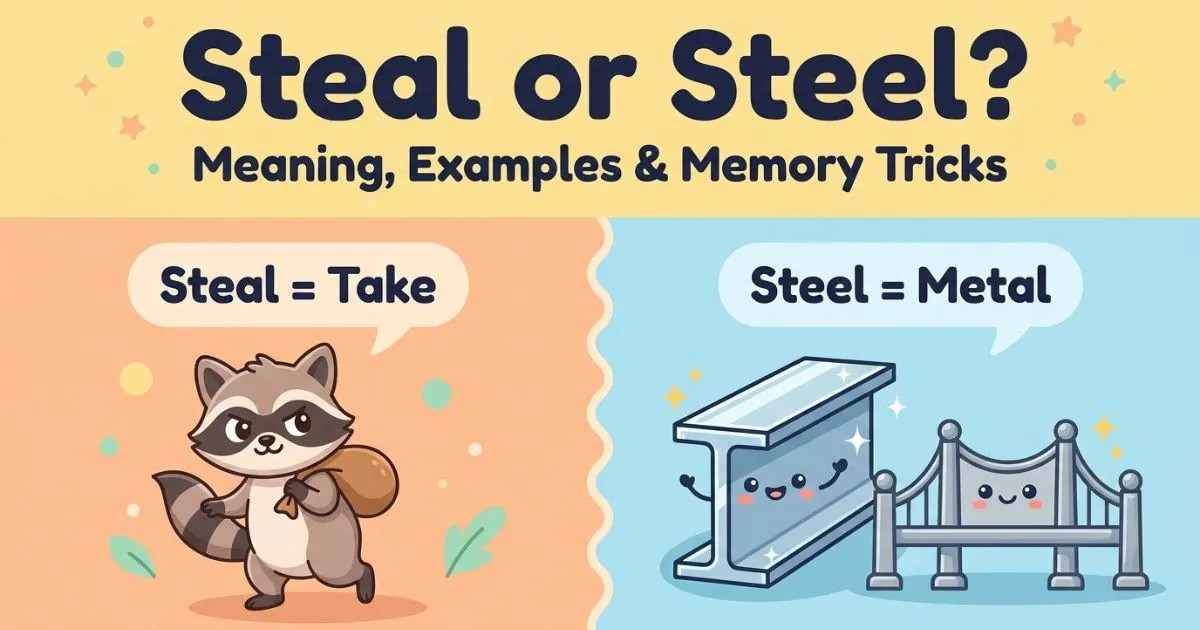
Steal means take. Steel means metal.
If your sentence is about someone taking something, write steal. If it is about what something is made of, write steel. There is also a smaller case: steel can be a verb meaning to prepare yourself for something hard. We will cover that below.
How Do You Pronounce Steal and Steel?
Both words are pronounced /stiːl/. They rhyme with feel, peel, and reel. There is no difference in sound at all, which makes them homophones: words that sound alike but differ in spelling and meaning.
That is the root of the problem. When you say a sentence out loud, your ear gives you no clue, so you have to rely on meaning. English has plenty of similar pairs, such as sea and see, or flour and flower. The same habit works for all of them: stop and ask what you actually mean.
Read More: Faze or Phase? The Simple Trick to Never Mix Them Up
What Does Steal Mean?
Steal has more uses than most people expect. Learn the main one first, then the side meanings.
Steal as a Verb: Taking Without Permission
The core meaning is to take something without the owner’s consent. This is the sense most people reach for first.
- Someone tried to steal my bicycle.
- It is wrong to steal from friends.
- The thief planned to steal the money.
Useful synonyms include pilfer, thieve, and snatch. The opposites are words like give, donate, and return. That gives you a handy check: if “give” would be the opposite of what you mean, you are almost certainly looking at steal.
Steal for Ideas, Words, and Time
The thing taken does not have to be a physical object. People can also steal ideas and written work. A writer who copies whole paragraphs from someone else’s thesis has stolen them. In everyday speech, a person who wastes your time might even be accused of stealing it.
- Never steal another person’s work.
- He did not want anyone to steal his idea.
Steal for Doing Something Unnoticed
Steal can also mean doing something quietly, without being noticed. The classic example is stealing a glance, which means looking at something briefly and secretly.
- She stole a glance at the clock during the meeting.
Nothing is taken here, and nobody is a thief. The word simply carries the idea of being sneaky or quick.
Steal in Sports
In baseball, a runner can steal a base, which means advancing safely without the help of a hit or a walk. In other games, a player can steal the ball by taking it away from an opponent.
- The runner managed to steal second base.
- The player stole the ball and raced down the court.
Steal as a Noun: A Bargain
As a noun, a steal is something bought at a very low price compared with its value. This use is informal, so it fits conversation better than formal writing.
- That jacket was a steal at $20.
- The hotel room was a steal for the price.
Steal in Popular Expressions
Two expressions use steal in a figurative way:
- Steal the show: to attract the most attention or impress people the most.
- Steal someone’s heart: to make someone fall in love with you.
Neither expression involves real theft. The meaning comes from the whole phrase.
What Does Steel Mean?
Steel as a Noun: The Metal
It is widely used in construction and manufacturing, and its properties can be adjusted over a wide range, which helps explain why it shows up in so many products.
- The bridge is made of steel.
- She bought a steel water bottle.
- The building has a steel frame.
- The workers wore steel-toed boots.
There is also a lesser-known noun sense. A ridged steel rod used to sharpen knives is sometimes simply called a steel.
Steel as an Adjective
Steel often sits in front of another noun to describe what it is made of: a steel gate, steel beams, steel pipes. It can also describe a person’s qualities, as in steel resolve, meaning a very firm and unshakable determination.
Steel as a Verb: Preparing Yourself
Drawing on the toughness of the metal, steel is also used as a verb. To steel yourself means to get ready mentally for something difficult or unpleasant. You will usually see it with a reflexive word such as yourself, himself, or herself.
- She steeled herself for the difficult conversation.
- He steeled himself to hear the bad news.
A rarer verb sense means to cover, plate, or edge something with steel.
Steal vs. Steel: Side-by-Side Comparison
Use this table when you need a fast answer.
| Feature | Steal | Steel |
| Main meaning | Take without permission | A strong metal alloy |
| Usual part of speech | Verb | Noun |
| Other uses | Noun (a bargain), baseball term | Adjective, verb (prepare yourself) |
| Pronunciation | /stiːl/ | /stiːl/ |
| Past tense | Stole | Steeled (verb use) |
| Related word | Stolen | Steelworker |
| Quick test | Can you swap in “take”? | Can you swap in “metal”? |
| Example | Someone tried to steal my laptop. | The gate is made of steel. |
Both words can sit in the same sentence without trouble:
The thief tried to steal the steel tools.
Steal is the action. Steel tells you what the tools are made of.
Steal, Stole, Stolen, and Steeled: Getting the Forms Right
Spelling is only half the problem. Writers also mix up the verb forms, especially because stole looks close to steel.
| Form | Verb | Example |
| Base form | steal | I never steal other people’s belongings. |
| Present (he/she/it) | steals | He steals glances at the clock. |
| Simple past | stole | They stole the car last night. |
| Past participle | stolen | Someone has stolen my keys. |
| -ing form | stealing | The person was caught stealing. |
Now compare the verb steel:
| Form | Verb | Example |
| Base form | steel | I need to steel myself. |
| Past tense | steeled | She steeled herself before the interview. |
Two points are worth remembering:
- Stole belongs to steal, never to steel. If the action is theft in the past, write stole.
- Stealed is not a standard form. The past participle is stolen, used with has, have, or had.
Three Quick Tests to Pick the Right Word
When you are stuck, run one of these tests. Each takes about three seconds.
Test 1: Swap in “take”
Replace the word with “take” or “take without asking.” If the sentence still makes sense, write steal.
Someone tried to ____ my phone. Does “take” work? Yes, so it is steal.
Test 2: Swap in “metal” or “made of metal”
If the word describes a material, write steel.
The bridge is made of ____. Does “metal” work? Yes, so it is steel.
Test 3: Swap in “prepare”
For sentences with a reflexive word like herself, try “prepare.”
She ____ herself for bad news. Does “prepared” work? Yes, so it is steeled.
Memory Tricks That Actually Work
Pick whichever of these feels most natural to you. You only need one.
- Steel and reel. Steel cable can come wound on a reel, and both words have a double e. If you picture a metal cable on a reel, you will not forget the spelling.
- Steal and meal. Both end in the same “eal” pattern. A thief might steal a meal, and the shared letters can help you link steal with taking.
- Acquire and element. Steal has an a, like acquire (as in acquiring something wrongly). Steel has an e, like element, because it is a material.
- Think “take.” When you see steal, think of take. It is that direct.
- One sentence to rule them all. The thief tried to steal a watch made of steel. Both words appear, and each has a clear job.
If you want a single shortcut, use the take-versus-metal test from the section above.
Common Mistakes With Steal and Steel
1.Writing steel when you mean steal
- Incorrect: The thief tried to steel my phone.
- Correct: The thief tried to steal my phone.
The sentence describes an action, not a material.
2.Writing steal when you mean steel
- Incorrect: The bridge is made of steal.
- Correct: The bridge is made of steel.
The sentence describes a building material.
3.Steal for the past tense
- Incorrect: Yesterday, he steal my wallet.
- Correct: Yesterday, he stole my wallet.
4.Steel for the past tense of the verb
- Incorrect: She steel herself before the interview.
- Correct: She steeled herself before the interview.
5.Writing stealed
- Incorrect: Someone has stealed my bag.
- Correct: Someone has stolen my bag.
6.Assuming steal always means theft
Not every use of steal involves a crime. When a comedian steals the show, nobody calls the police. The comedian simply gave the most memorable performance. Read the phrase as a whole before deciding what it means.
Practice: Choose the Right Word
Fill in each blank with steal, stole, stolen, steel, or steeled. Answers follow the list.
- Someone broke into the shop to ____ the cash.
- The new stadium roof is supported by ____ beams.
- The thief ____ my bag last night.
- My phone has been ____.
- She ____ herself before opening the exam results.
- That jacket at half price was a real ____.
- Never ____ another writer’s work.
- The factory produces ____ pipes.
- He ____ a quick look at the answer sheet.
- The singer managed to ____ the show.
Answers: 1. steal, 2. steel, 3. stole, 4. stolen, 5. steeled, 6. steal, 7. steal, 8. steel, 9. stole (stole a look), 10. steal.
If you missed any, go back to the three quick tests. Most mistakes come from skipping the “take or metal?” question.
FAQs
Is it steal or steel?
Use steal when someone takes something without permission. Use steel when you mean the strong metal made from iron and carbon. A quick test: if you can swap in “take,” choose steal; if you can swap in “metal,” choose steel.
Are steal and steel pronounced the same?
Yes. Both are pronounced /stiːl/ and rhyme with feel, peel, and reel. They are homophones, so the sound gives no clue. When you write, rely on the meaning of your sentence to choose the spelling.
What is the past tense of steal?
The simple past is stole, as in “He stole my phone.” The past participle is stolen, used with has, have, or had: “Someone has stolen my bike.” The form “stealed” is not correct in standard English, so avoid it.
Can steel be used as a verb?
Yes. To steel yourself means to prepare mentally for something unpleasant or difficult, as in “She steeled herself for the interview.” Its past tense is steeled, not stole, which belongs to steal. Context makes the meaning clear.
Does steal always mean theft?
No. Steal can also mean doing something unnoticed, as in stealing a glance, and in baseball a runner can steal a base. As an informal noun, a steal is a bargain bought at a very low price.
How do I remember steal vs. steel?
Link steel with reel, since both have a double e, and steal with meal, which shares the same “ea”. Or just think take for steal and metal for steel. Pick one trick and use it every time.
Conclusion:
Steal or steel? The answer depends on what you mean, not on how the word sounds. Use steal when someone takes something without permission, or in expressions like steal the show. Use steel for the strong metal, or for the verb that means preparing yourself for something difficult.
Remember the pair of ideas: steal means take, steel means metal. Add the verb forms, stole and stolen for steal and steeled for steel, and you have covered almost every case.
Your next step is simple. Pick one memory trick from this guide, use it the next time you write either word, and retake the practice quiz tomorrow without looking at the answers.

I’m Sophia Mitchell, an English grammar and writing enthusiast. I create simple, easy-to-understand content to help learners improve their English. My goal is to make grammar clear, practical, and enjoyable for everyone.