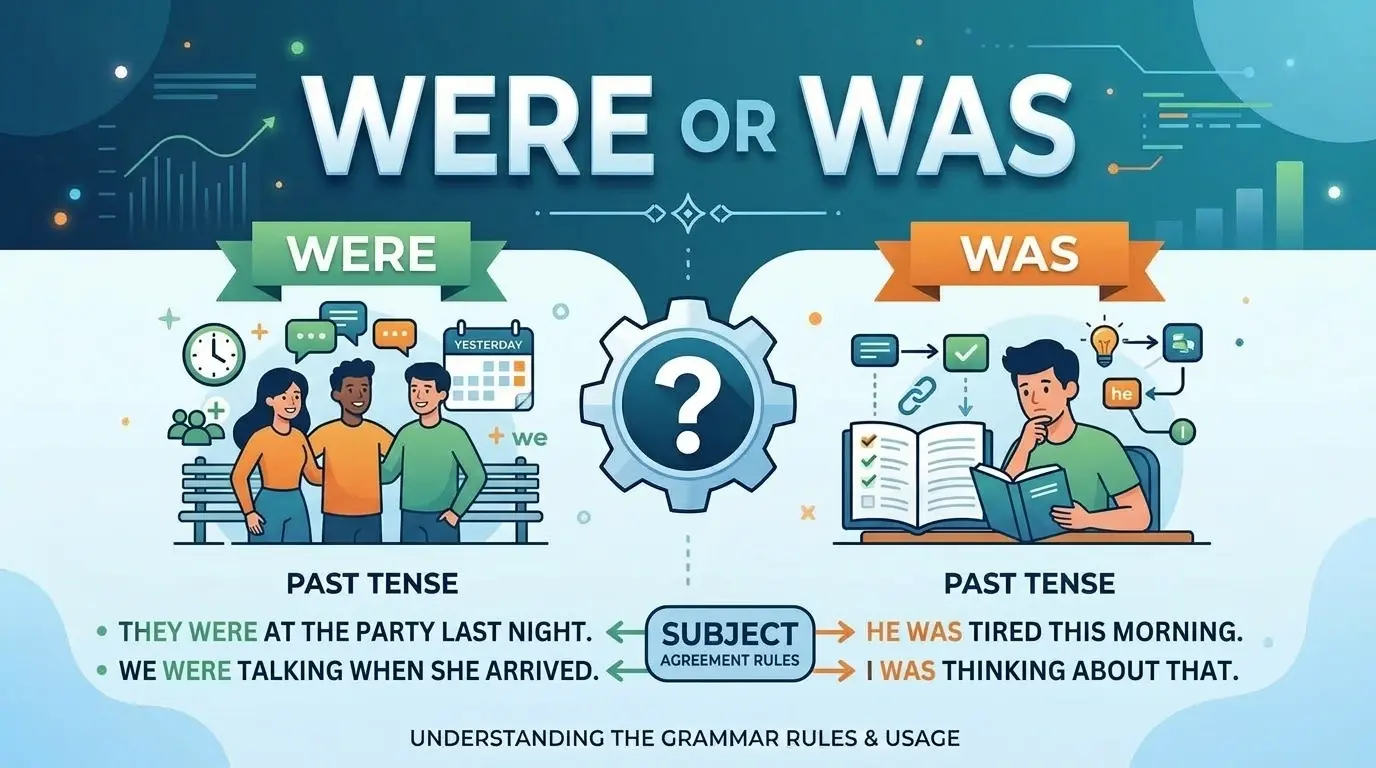
Was is generally used with singular subjects, while were is used with you, we, and they. However, were is also used with I in hypothetical or unreal situations, such as “If I were you.”
You may be writing an email, school assignment, or quick message and suddenly wonder: were or was?
The two words look simple, but choosing the wrong one can make a sentence sound grammatically incorrect.
The basic rule is easy once you connect each form to its subject. We say “She was tired,” but “They were tired.” With you, we always use were, as in “You were right.” The special case is were in unreal situations: “If I were rich, I would travel.”
This guide explains the difference with simple rules and clear examples.
Was or Were: Quick Answer
Was is usually used with singular subjects such as I, he, she, and it. Were is usually used with you, we, and they. However, were can also be used with I in hypothetical or unreal situations, such as “If I were you.”
Quick Rule
Use was for most singular subjects and were for you, we, they, and unreal situations.
What Is the Difference Between Was and Were?
Was and were are past-tense forms of the verb be. The main choice depends on the subject, but were also has a special use for hypothetical or unreal situations. This makes the rule slightly more complex than simply matching singular and plural subjects.
Compare:
I was tired.
They were tired.
Both sentences describe something in the past.
The difference comes from the subject.
Was normally goes with:
- I
- he
- she
- it
- singular nouns
Were normally goes with:
- you
- we
- they
- plural nouns
For example:
She was at home.
They were at home.
But there is one important exception:
If I were you, I would apologize.
Here, were is used with I because the sentence describes an unreal or hypothetical situation.
Read More: Grate or Great? The Correct Word and Meaning ExplainedWhen to Use Was
Was is normally used with I, he, she, it, and singular nouns when talking about the past. It is the singular past form of be in ordinary statements.
Examples:
I was tired after work.
He was late for class.
She was happy.
It was cold yesterday.
You also use was with singular nouns:
The student was ready.
My brother was busy.
The car was outside.
The teacher was helpful.
The basic pattern is:
I + was
He + was
She + was
It + was
Singular noun + was
Examples with “was”
- I was at school yesterday.
- She was tired after the trip.
- He was excited about the game.
- It was raining this morning.
- The movie was interesting.
- My friend was at the library.
- The dog was asleep.
- The teacher was busy.
- My phone was on the table.
- The student was ready for the test.
When to Use Were
Were is normally used with you, we, they, and plural nouns when talking about the past. It is the standard past form of be for these subjects.
Examples:
You were right.
We were tired.
They were happy.
You also use were with plural nouns:
The students were ready.
My friends were outside.
The cars were parked nearby.
The basic pattern is:
You + were
We + were
They + were
Plural noun + were
Examples with “were”
- You were very helpful.
- We were late.
- They were at the store.
- The students were ready.
- My parents were happy.
- The children were outside.
- The books were on the table.
- The teachers were busy.
- My friends were excited.
- The houses were empty.
Was or Were Subject Rules
Was and were become easier when you connect each form to its usual subject. Use was with I, he, she, it, and singular nouns. Use were with you, we, they, and plural nouns.
| Subject | Correct form | Example |
| I | was | I was tired. |
| You | were | You were tired. |
| He | was | He was tired. |
| She | was | She was tired. |
| It | was | It was cold. |
| We | were | We were tired. |
| They | were | They were tired. |
| One student | was | The student was ready. |
| Two students | were | The students were ready. |
This table covers the normal past-tense pattern.
The main exception is the hypothetical or unreal use of were, which we will cover below.
Was vs Were With “I”
I normally takes was when describing a real past situation. However, I can take were when the sentence describes an unreal, hypothetical, or contrary-to-fact situation.
Real past situation
I was sick yesterday.
This describes something that actually happened.
I was at home last night.
Again, this describes a real past situation.
Hypothetical situation
If I were rich, I would travel more.
This does not say that I am rich.
It describes an imagined situation.
Another common example is:
If I were you, I would wait.
This means the speaker is imagining being the other person.
The phrase if I were you is especially common in English.
The Special Rule: “If I Were”
If I were is a common example of the subjunctive mood. It is used for hypothetical, unreal, or imagined situations. This is why English uses were instead of the usual past form was.
Consider:
If I were you, I would talk to the teacher.
The speaker is not actually the listener.
The situation is imaginary.
Another example:
If I were taller, I would play basketball.
The speaker is imagining being taller.
You can also use were after expressions such as:
- if I were
- if he were
- if she were
- if it were
- I wish I were
- as if I were
For example:
I wish I were better at math.
If she were here, she could help us.
He talks as if he were the boss.
These sentences describe situations that are unreal, unlikely, imagined, or contrary to fact.
Were vs Was in Hypothetical Sentences
This is where many learners become confused.
Compare these sentences:
I was tired yesterday.
If I were less tired, I would go out.
The first sentence describes a real past condition.
The second sentence imagines a different condition.
Another comparison:
She was at home last night.
If she were here, she could help us.
The first is a statement about the past.
The second describes an imagined situation.
Simple test
Ask yourself:
Am I describing what actually happened, or imagining something?
If you are describing a real past event, use the normal was/were rule.
If you are describing an unreal or hypothetical situation, were may be required.
Was or Were in Questions
Was and were are also used in past-tense questions. The same subject rules generally apply.
More examples
- Was he at work?
- Was she your teacher?
- Was it expensive?
- Was the store open?
- Were you busy?
- Were they at home?
- Were we late?
- Were the children asleep?
A useful pattern is:
Was/Were + subject + rest of sentence?
For example:
Was she happy?
Were they happy?
Was vs Were in Negative Sentences
For negative statements, use was not or were not.
The contractions are:
was not → wasn’t
were not → weren’t
Examples:
I wasn’t tired.
He wasn’t home.
She wasn’t ready.
We weren’t late.
They weren’t happy.
You weren’t wrong.
The subject still determines whether you use wasn’t or weren’t.
Comparison
The student wasn’t ready.
The students weren’t ready.
The first sentence refers to one student.
The second refers to multiple students.
Were or Was With Collective Nouns
Collective nouns can sometimes create confusion because they refer to groups.
In American English, collective nouns are often treated as singular when the group acts as one unit.
For example:
The team was ready.
The family was at home.
But if you are focusing on individual members, the wording may differ.
The team members were ready.
Here, members is clearly plural.
For learners, the easiest approach is to identify the actual grammatical subject.
Team is singular in the first sentence.
Team members is plural in the second.
Therefore:
The team was ready.
The team members were ready.
Was and Were With “There”
The same subject agreement applies when a sentence begins with there was or there were.
Use there was with a singular noun:
There was a problem.
There was one student outside.
Use there were with plural nouns:
There were several problems.
There were three students outside.
Compare:
There was a book on the desk.
There were two books on the desk.
The noun after the verb helps you choose the correct form.
Common Mistakes With Was or Were
Mistake 1: “I were” for a real past event
Incorrect:
I were tired yesterday.
Correct:
I was tired yesterday.
The sentence describes a real past condition.
Mistake 2: “They was”
Incorrect:
They was happy.
Correct:
They were happy.
They normally takes were in the past tense.
Mistake 3: “We was”
Incorrect:
We was late.
Correct:
We were late.
Use were with we.
Mistake 4: “You was”
Incorrect in standard English:
You was right.
Correct:
You were right.
The standard past form with you is were.
Mistake 5: Missing the hypothetical “were”
Incorrect:
If I was you, I would apologize.
Standard formal English:
If I were you, I would apologize.
The sentence describes an unreal situation.
20 Real Example Sentences
Here are examples showing how was and were work in everyday English.
- I was tired after work.
- She was at the library.
- He was late for class.
- It was cold yesterday.
- The student was nervous.
- My friend was busy.
- You were very helpful.
- We were ready to leave.
- They were excited about the trip.
- The students were in the classroom.
- My parents were at home.
- The books were on the table.
- There was a problem with the computer.
- There were several people outside.
- I wasn’t ready for the test.
- They weren’t interested.
- Was she at work?
- Were you at the meeting?
- If I were you, I would wait.
- I wish I were there.
These examples show both the normal past-tense rule and the special hypothetical use of were.
Memory Trick: Was vs Were?
A simple memory trick is:
I, he, she, it → was
I was
He was
She was
It was
You, we, they → were
You were
We were
They were
Then remember one important exception:
Imaginary “I” → were
If I were you…
I wish I were taller.
So the easiest formula is:
Real past → follow the subject.
Unreal or hypothetical → use were.
Was or Were: Quick Comparison
| Situation | Correct form | Example |
| One person | was | She was happy. |
| I in a real past situation | was | I was tired. |
| He | was | He was busy. |
| She | was | She was home. |
| It | was | It was cold. |
| You | were | You were right. |
| We | were | We were ready. |
| They | were | They were late. |
| Plural noun | were | The students were ready. |
| Unreal “I” | were | If I were you. |
| Wish about an unreal state | were | I wish I were there. |
FAQs
Is it “I was” or “I were”?
Use I was for a real past situation. Use I were in certain hypothetical or unreal situations, such as “If I were you.”
Is it “you was” or “you were”?
In standard English, use you were. For example, “You were right.”
Is it “they was” or “they were”?
Use they were. They is normally followed by were in the past tense.
Is “if I were” grammatically correct?
Yes. If I were is standard in hypothetical or unreal situations. For example, “If I were you, I would wait.”
Why do we say “if I were” instead of “if I was”?
Were is used in this pattern because the sentence expresses a hypothetical or unreal situation. This is commonly called the subjunctive use of were.
Is “I was” always correct?
No. I was is correct for normal past situations, but I were is standard in many hypothetical expressions. For example, “If I were you.”
Should I say “there was” or “there were”?
Use there was with a singular noun and there were with a plural noun. For example, “There was one problem” and “There were two problems.”
Is “was” singular or plural?
Was is normally used with singular subjects and I in ordinary past-tense statements.
Is “were” singular or plural?
Were is normally used with you, we, they, and plural subjects. It also appears with singular subjects in certain hypothetical constructions.
Is “I wish I were” correct?
Yes. I wish I were is the standard form for expressing a wish about an unreal or contrary-to-fact situation.
Conclusion:
The basic difference between was and were depends on the subject. Use was with I, he, she, it, and singular nouns in ordinary past-tense statements. Use were with you, we, they, and plural nouns.
The important exception is hypothetical language. In expressions such as “If I were you” and “I wish I were there,” were is used even with I.
Remember the simple pattern: I/he/she/it was; you/we/they were. Then watch for hypothetical situations where were is needed.

I am an English language writer passionate about grammar and clear communication. I create simple, easy-to-understand content that helps readers improve their English skills. My goal is to make learning English both practical and enjoyable.







1 thought on “Were or Was? The Simple Difference Explained”