You are typing a quick message to your bank: “I want to withdrawal $100.” Something looks off, but you can’t say what. So, is it withdraw or withdrawal?
Good news: both words are correct. They simply do different jobs. One describes an action, and the other names it. Mix them up and your sentence sounds clumsy, even if everyone understands what you meant.
This guide gives you the simple verb-versus-noun rule, a three-step test you can run in seconds, the right past-tense forms, the mistakes people make most, and real examples from banking, school, work, and health.
By the end, you will choose the right word without guessing.
The Quick Answer
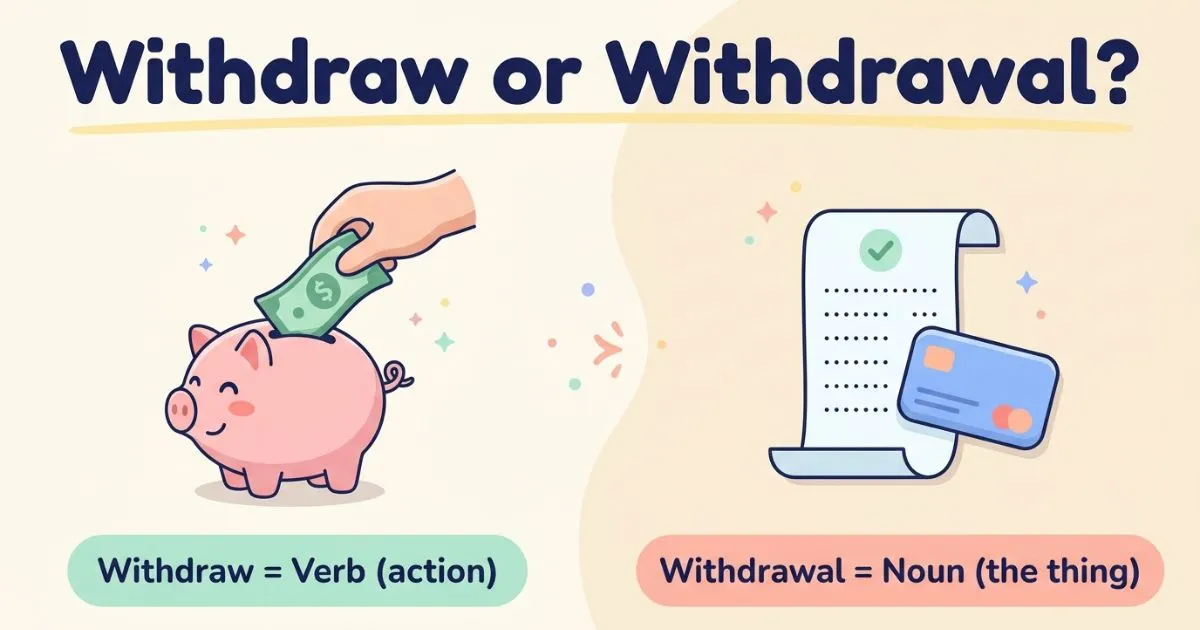
Withdraw is a verb. Withdrawal is a noun.
You withdraw money, and you make a withdrawal. The idea is the same. The grammar job is different.
| Word | Part of speech | Example |
| Withdraw | Verb (the action) | I will withdraw my application. |
| Withdrawal | Noun (the act, event, or result) | My withdrawal was approved. |
A handy way to picture it: the verb is what someone does, and the noun is the thing or event that results.
Why These Two Words Get Mixed Up
There are three reasons people stumble here.
- They share a root. Both come from the same Middle English building blocks, so they feel like twins.
- They sound alike. In fast speech, the only difference is a small “l” sound at the end.
- They describe the same event. When you withdraw money, you also make a withdrawal. The event is one thing, but the grammar changes depending on how you talk about it.
Once you see that the event stays the same and only the sentence structure changes, the confusion starts to fade.
Read More: Everyones or Everyone’s? Which Is Correct?
What Does “Withdraw” Mean?
Withdraw means to take something away, pull it back, or step back from something. The word comes from Middle English, where with meant “away” and draw meant “take.” That origin explains why it covers so many situations: taking cash out, pulling an offer, leaving a race.
It works in two ways.
Withdraw With an Object
Here, something is being withdrawn. That “something” is the object.
- Ali withdraws cash every Friday.
- The company will withdraw its offer.
- Please withdraw your application if you no longer want the job.
Withdraw Without an Object
Sometimes nothing is named. The subject simply steps back.
- I picked the wrong course, so I will withdraw.
- The troops had to withdraw before nightfall.
- Some people withdraw when they meet a big group.
The last sentence shows a quieter meaning: pulling back socially or emotionally.
What Does “Withdrawal” Mean?
Withdrawal is a noun. It names the act of withdrawing, or the thing you took out. Like any noun, it can be a subject, an object, or follow a preposition.
Withdrawal as the Subject
- Yesterday’s withdrawal will cover the electricity bill.
- The withdrawal of the offer surprised everyone.
Withdrawal After “Make” and Other Verbs
The most common pattern is make a withdrawal. Other verbs work too.
- Can I make a withdrawal right after depositing a cheque?
- She requested a withdrawal of $200.
- The candidate announced his withdrawal.
Withdrawal After a Preposition
You will often see withdrawal from or withdrawal of.
- Her withdrawal from the race was unexpected.
- The withdrawal of funds takes two days.
Withdrawal as a Describing Word
Nouns can sit in front of other nouns. That is why you see these phrases on forms and websites:
- withdrawal request
- withdrawal form
- withdrawal deadline
- withdrawal limit
Notice that “withdraw form” or “withdraw deadline” would be wrong. A verb cannot describe a noun this way.
Other Meanings of Withdrawal
Besides banking, withdrawal also names stopping a substance, pulling back forces, and pulling away from people. The verb is still withdraw in each case.
- Drugs or alcohol: “Withdrawal from drugs” names the physical and mental effects after someone stops. Example: Her withdrawal from painkillers lasted several days. Medical writing sometimes uses the verb for the person (“patients withdrawing from opioids”). But “withdrawal from” is the usual phrase for the experience.
- Military: The troops began their withdrawal at dawn.
- Social life: His social withdrawal worried his family.
- Taking something back: The withdrawal of the statement came a day later.
If you or someone close is going through substance withdrawal, speak to a doctor first. It can be risky for some substances.
The 3-Step Test: Withdraw vs Withdrawal?
When you are stuck, run these three checks. They take about ten seconds.
- Look for an action. Is someone doing something in this sentence? If yes, you probably need withdraw.
- Try “a” or “the.” Put one before the word. If “a withdrawal” or “the withdrawal” sounds natural, you need the noun.
- Check the word right before the gap. After to, will, can, may, or must, use withdraw. After a, the, make, request, or of, use withdrawal.
Try it on two gaps:
- “I need to ___ some money.” The word to comes before the gap, so write withdraw.
- “The ___ was approved.” The word the comes before the gap, so write withdrawal.
There is also a spelling clue. Withdrawal ends in -al, just like arrival and refusal. Those are nouns too. If the word has no -al, it is the action.
Sentence Patterns at a Glance
Some patterns repeat again and again. Learn these and you will rarely need the full test.
| Pattern | Correct example |
| need to + verb | I need to withdraw cash. |
| will + verb | She will withdraw her request. |
| can + verb | You can withdraw before the deadline. |
| make a + noun | He made a withdrawal. |
| submit a + noun + noun | I submitted a withdrawal request. |
| complete the + noun | They completed the withdrawal. |
If the word before the gap is a helper like will or can, the verb belongs there. If it is an article like a or the, or a word like make, the noun belongs there.
“Withdraw From” vs. “Withdrawal From”
Both phrases are common, and both are correct. They just sit in different kinds of sentences.
- Withdraw from describes the action of leaving: “She withdrew from the course.”
- Withdrawal from names that action: “Her withdrawal from the course was confirmed.”
The first sentence tells us what she did. The second tells us what happened as a result. Swap them and the sentence breaks: “She withdrawal from the course” is not grammatical.
Withdraw, Withdrew, and Withdrawn
Withdraw is an irregular verb, like draw. It does not follow the usual “add -ed” pattern.
| Form | When to use it | Example |
| withdraw | Base form, after to or will | I will withdraw the money. |
| withdraws | He, she, or it | She withdraws cash weekly. |
| withdrew | Simple past | He withdrew $200 yesterday. |
| withdrawn | After has, have, had, or in passive sentences | She has withdrawn her application. |
| withdrawing | Ongoing action | They are withdrawing their offer. |
Two things to remember:
- Use withdrew on its own: “He withdrew his support.”
- Use withdrawn with a helper: “He has withdrawn his support” or “The offer was withdrawn.”
The noun does not change with tense. You say “The withdrawal was approved” whether it happened today or last year. For more than one, add -s: withdrawals.
Withdrawn as an Adjective
Withdrawn can also describe a person who seems quiet, shy, or reserved. The person has not literally left anywhere. They are just holding back.
- My brother is shy and withdrawn in big groups.
- The puppy seemed withdrawn after the move.
Withdrew or Withdrawn? How to Choose
Use withdrew on its own for a finished action in the past. Use withdrawn after has, have, had, or a be-word like is, was, or will be.
Look at the word just before the gap. If there is a helper, pick withdrawn.
| What comes before | Use | Example |
| Nothing, past time word (yesterday, last week) | withdrew | I withdrew $50 yesterday. |
| has / have / had | withdrawn | I have withdrawn $50. |
| is / was / were / been / will be | withdrawn | The offer will be withdrawn. |
| to / will / can / would | withdraw | I will withdraw my offer. |
Two quick cases:
- “Will be withdrawn” or “will withdraw”? Use will be withdrawn when the offer is the subject (The offer will be withdrawn). Use will withdraw when a person acts (I will withdraw the offer).
- “I withdrew” or “I withdrawn”? Write I withdrew money. “I withdrawn money” is wrong because there is no helper. With one, it becomes I have withdrawn money.
All the forms at a glance
| Word | What it is | Example |
| withdraw | Verb, base form | I will withdraw my application. |
| withdrew | Verb, simple past | I withdrew my application. |
| withdrawn | Past participle (or adjective) | I have withdrawn my application. |
| withdrawal | Noun | My withdrawal was approved. |
Other Irregular Verbs Like Withdraw
Yes, withdraw is irregular. It follows the same pattern as draw, so it does not take -ed.
Many common verbs work this way. Here are ten, including run and sit:
| Base | Past | Past participle |
| withdraw | withdrew | withdrawn |
| draw | drew | drawn |
| run | ran | run |
| sit | sat | sat |
| give | gave | given |
| take | took | taken |
| write | wrote | written |
| see | saw | seen |
| go | went | gone |
| eat | ate | eaten |
Notice that run keeps the same word for the participle (has run), and sit uses sat for both. Withdraw gives three different forms, so it is easy to mix up.
Withdraws or Withdrawals? Plural Explained
Withdrawals is the plural of the noun. Withdraws is a verb form used with he, she, or it.
Withdraw is a verb, so it has no plural. If you need “more than one,” you need the noun: one withdrawal, two withdrawals.
| Word | Job | Example |
| withdraws | Verb (one person, present tense) | She withdraws cash every Friday. |
| withdrawals | Noun (more than one) | She made three withdrawals this week. |
A quick check: if the word follows a number or words like many, several, or few, use withdrawals. If it follows he, she, it, or a single name, use withdraws.
- Some accounts limit the number of withdrawals per month.
- Ali withdraws only what he needs.
Seven Common Mistakes and Quick Fixes
| Mistake | Fix | Why |
| I want to withdrawal $50. | I want to withdraw $50. | To needs a verb. |
| I made a withdraw. | I made a withdrawal. | A needs a noun. |
| I requested a withdrawl. | I requested a withdrawal. | The noun ends in -al, with no hyphen. |
| She withdrawed her application. | She withdrew her application. | Irregular past tense. |
| He has withdrew his support. | He has withdrawn his support. | Has needs the participle. |
| Submit the withdraw form. | Submit the withdrawal form. | A noun describes a noun. |
| Make withdraws weekly. | Make withdrawals weekly. | The plural noun is withdrawals. |
Most errors come from the same slip: using a noun where a verb belongs, or the other way round. The 3-step test catches nearly all of them.
Withdrawing or Withdrawling? More Spelling Slip-Ups
Withdrawing is the only correct spelling of the -ing form. “Withdrawling” is not a word.
Like the withdrawl slip-up above, these errors come from typing by sound:
| Wrong | Right | Why |
| widraw | withdraw | It starts with with, not wi. |
| withdrawling | withdrawing | Verb + -ing, with no extra l. |
| withdrawaling | withdrawing | The noun withdrawal never takes -ing. |
| withdrawled | withdrew / withdrawn | Withdraw is irregular, so there is no -led form. |
Memory trick: split the word into with + draw + ing. If you can spot “draw” inside it, you will not drop or add letters.
- She is withdrawing from the race.
- He withdrew his name yesterday.
Real-Life Examples
Banking
- I need to withdraw $100 from my savings account.
- I made a $100 withdrawal this morning.
- The ATM has a daily withdrawal limit.
A bank statement may list a “cash withdrawal,” while you would say, “I withdrew cash.” Same event, two grammar forms.
School and Applications
- She wants to withdraw from the course before the deadline.
- Her withdrawal was confirmed by the registrar.
- Submit the withdrawal form to the office.
Work and Business
- The company may withdraw its proposal.
- The withdrawal of the proposal surprised the client.
- He decided to withdraw his support for the plan.
Health and Habits
In health writing, withdrawal usually appears in the phrase “withdrawal symptoms.” The verb withdraw describes stopping something or leaving a study.
- She felt withdrawal symptoms after she stopped drinking coffee.
- The volunteer asked to withdraw from the study.
A Short Case Study: Fixing a Bank Email
Fatima wants to take money out of her savings account, so she writes this message:
“I would like to make a withdraw of $500. I plan to withdrawal the money tomorrow.”
The bank will probably understand her. But the message has two mistakes.
In the first sentence, make a needs a noun, so it should be “make a withdrawal.” In the second sentence, to needs a verb, so it should be “withdraw.”
Here is the corrected version:
“I would like to make a withdrawal of $500. I plan to withdraw the money tomorrow.”
Later, the bank replies: “Your withdrawal has been processed.” Here, withdrawal is a noun again, because it names the finished transaction. In one short exchange, both words appear, and each one fits its own job.
Messages You Can Copy
Use these as templates and change the details.
- Bank: “Please process a withdrawal of $200 from my savings account.”
- School: “I would like to withdraw from Biology 101. Please send me the withdrawal form.”
- Job application: “I am writing to withdraw my application for the marketing role. Thank you for your time.”
Each template uses the verb where someone acts and the noun where something is named.
Withdraw or Withdrawal Application? Labels and Buttons
Use withdraw for a button or a request. Use withdrawal when the word names a form or a title.
| Where you see it | Use | Example |
| A button you click | withdraw | Withdraw application |
| Title of a form or page | withdrawal | Application withdrawal form |
| A polite request | withdraw | I would like to withdraw my application. |
| An email subject | withdrawal | Withdrawal request for Biology 101 |
After “would like to,” you always need the verb. So “I would like to withdrawal my application” is wrong.
Banking apps work the same way. You tap Deposit or Withdraw (two opposite actions), and your statement later lists a withdrawal.
Withdraw vs. Retreat vs. Remove
These verbs overlap, but they are not identical.
- Retreat often suggests a tactical move backward.
- Remove is more general or physical.
- Withdraw is broader and often means stepping back from a commitment.
That is why “She retreated her application” sounds wrong. Say “She withdrew her application.” In the same way, “He made a remove of funds” should be “He made a withdrawal of funds.”
Withdraw vs Withhold and Withstand
Withdraw means to take back or step away. Withhold means to refuse to give. Withstand means to endure.
They look alike but do different jobs.
- Withhold (withheld): The landlord chose to withhold payment until the repairs were done.
- Withstand (withstood): The bridge can withstand heavy rain.
- Withdraw (withdrew): The company will withdraw its offer.
How to Say Them
The two words sound almost the same. Withdraw is “with-DRAW.” Withdrawal is “with-DRAWL,” with an “l” sound at the end. In conversation, that final “l” is the only clue, so listen for it. In writing, remember that the noun carries the extra -al.
Quick Practice
Fill each gap. Answers follow.
- I need to ___ some cash before the trip.
- The bank approved my ___ this morning.
- She has ___ her name from the list.
- The ___ deadline is Monday.
- He ___ from the race yesterday.
- You can ___ your application any time before Friday.
- Her sudden ___ from the team surprised everyone.
- The offer was ___ after the meeting.
- Please fill in the ___ form.
- Last week I ___ cash from the ATM.
Answers: 1. withdraw. 2. withdrawal. 3. withdrawn. 4. withdrawal. 5. withdrew. 6. withdraw. 7. withdrawal. 8. withdrawn. 9. withdrawal. 10. withdrew.
If you got eight or more right, you have the pattern. If not, run the 3-step test on the ones you missed and try them again.
FAQs
Is it withdraw or withdrawal?
Both are correct, but they play different roles. Withdraw is a verb for the action, as in “I will withdraw money.” Withdrawal is a noun for the act or event, as in “I made a withdrawal.”
Is “make a withdraw” correct?
No. After “make a,” you need a noun, so the correct phrase is “make a withdrawal.” Some people say “withdraw” this way in casual speech, but standard English does not accept it. Write “I made a withdrawal.”
What is the past tense of withdraw?
The simple past is “withdrew,” as in “She withdrew her application yesterday.” The past participle is “withdrawn,” used after has, have, or had, as in “She has withdrawn it.” “Withdrawed” is not standard English, so avoid it completely.
Is “withdrawl” a real spelling?
No, it is a common misspelling. The correct noun is “withdrawal,” which ends in -al like “arrival” and “refusal.” It is also one word with no hyphen, so write it exactly as “withdrawal” every single time.
Can I say “withdrawal money”?
No. When you describe the action, write “withdraw money,” because the action needs the verb. If you prefer the noun, use a full phrase such as “make a withdrawal” or “cash withdrawal,” but never “withdrawal money.”
Is “withdrawn” the same as “withdrawal”?
No. “Withdrawn” is a verb form that can also describe a shy, reserved person, while “Withdrawal” is a noun. Compare “The offer was withdrawn” with “The withdrawal surprised everyone.” Each one fits a different job in the sentence.
Conclusion:
So, withdraw or withdrawal? Use withdraw when someone is doing something, and withdrawal when you are naming that action, event, or amount.
You withdraw money, but you make a withdrawal. Remember the verb forms too: withdraw, withdrew, withdrawn. And keep the noun spelled with -al.
Your next step is simple. Open the last email or message you wrote that includes either word, and run the 3-step test on it.
Fix any slip, and the pattern will start to feel natural.

I am an English language writer passionate about grammar and clear communication. I create simple, easy-to-understand content that helps readers improve their English skills. My goal is to make learning English both practical and enjoyable.