You type, “The harsh feedback didn’t phase me,” press send, and then a small doubt creeps in. Wait, is that the right spelling?
Faze or phase? Because the two words sound identical, your ear can’t help you, and spell-checkers rarely complain since both are real words. That is why even careful writers get this one wrong.
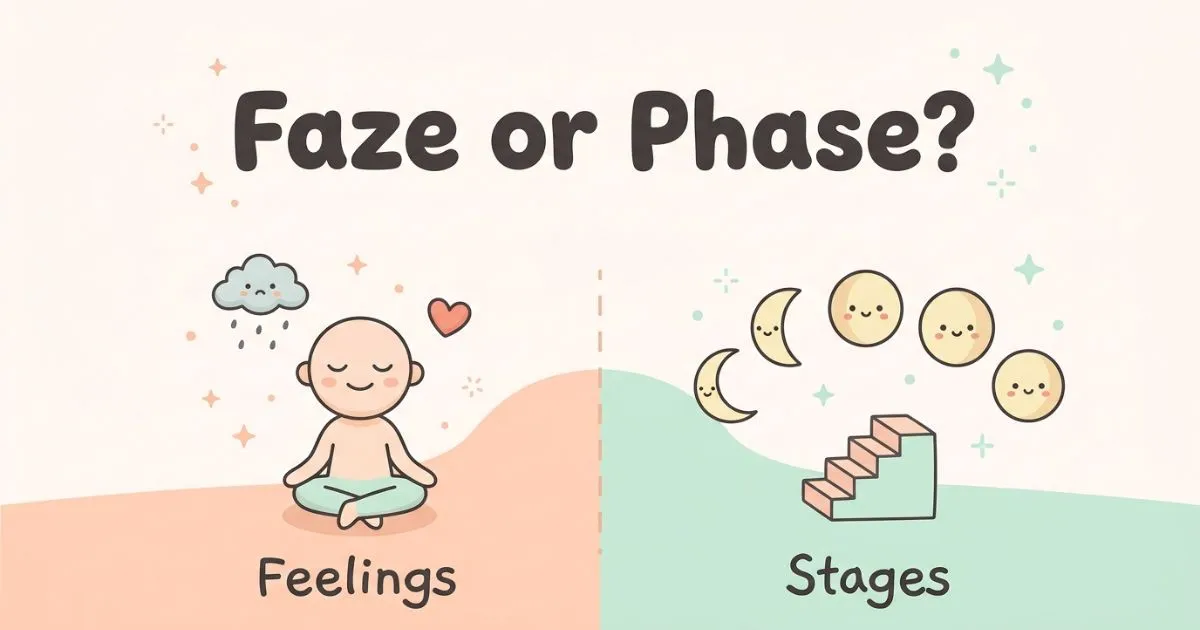
The fix is simpler than it looks. One word is about how something makes you feel. The other is about stages and gradual change.
This guide gives you clear definitions, everyday examples, a two-second swap test, memory tricks, a proofreading routine, and a short quiz, so you can choose the right word with confidence.
Faze or Phase: The Quick Answer
Faze is a verb. It means to disturb, bother, or unsettle someone. Phase is mostly a noun for a stage or period inside a bigger process, though it also works as a verb meaning to do something in stages.
Here is the whole difference at a glance:
| Faze | Phase | |
| Part of speech | Verb | Noun and verb |
| Core idea | Feelings: bother, rattle, unsettle | Stages: period, step, gradual change |
| Typical sentence | Criticism never fazes her. | The project is in its second phase. |
| Common partners | doesn’t faze, nothing fazes, unfazed | phase in, phase out, final phase |
One rule covers most situations. f the sentence is about an emotional reaction, write faze. If it is about a stage, a step, or a gradual change, write phase.
Read More: There vs. Their: 3 Quick Tests to Choose the Right Word
What Does Faze Mean?
To faze someone is to knock them off balance. A person who is fazed feels disturbed, embarrassed, or worried enough that it shows. A person who can’t be fazed stays steady, even when things get tense.
Where the Word Comes From
Faze is an American arrival. It entered English around 1830 as a variant of an older word, feeze, which meant to frighten. That shaken-up feeling still lives inside the word today, even though it now describes much milder situations.
Why Faze Usually Appears in Negative Sentences
Notice how often faze shows up with “didn’t,” “never,” “nothing,” or the prefix “un-“. We mostly use it to describe someone who stayed calm when something could have rattled them.
That is worth knowing, because those negative patterns are exactly where the wrong spelling sneaks in: “didn’t phase me,” “nothing phases her,” “unphased.” Whenever you spot one of these patterns, pause and check the meaning.
Faze in Sentences
- The tough interview questions didn’t faze her.
- Loud thunder never fazes our dog.
- Nothing seems to faze my grandfather.
- He wasn’t fazed by the sudden change of plans.
- Does speaking in front of a crowd faze you?
- Constant nagging finally began to faze him.
- The goalkeeper looked unfazed by the shouting from the stands.
In every one of these, something affects (or fails to affect) a person’s calm or confidence.
What Does Phase Mean?
Phase belongs to the world of stages, steps, and periods. It works as both a noun and a verb.
Phase as a Noun
A phase is one part of something that unfolds over time. Think of the phases of the moon, the first phase of a building project, or the awkward phase many teenagers go through.
It also covers the temporary stages of personal life. A toddler who insists on wearing the same costume every day is in a phase. A person recovering from a painful breakup moves through phases too.
Phase as a Verb
As a verb, phase means to do something in stages. Two expressions matter most:
- Phase in: to introduce something gradually.
- Phase out: to withdraw something gradually instead of all at once.
The related adjective, phased, describes things arranged in steps, such as a phased rollout or a phased payment plan. The verb forms are phase, phases, phased, and phasing.
Phase in Sentences
- The project has entered its final phase.
- My little cousin is in a dinosaur phase, and every conversation ends with a T. rex.
- The airline will phase out paper tickets over the coming years.
- The school plans to phase in the new timetable gradually.
- The moon passes through several phases each month.
- We finished phase one on schedule and moved on to phase two.
- The new software was phased in department by department.
Each sentence points to a stage or a gradual change, never to a feeling.
Is It “It Didn’t Faze Me” or “It Didn’t Phase Me”?
This is the question that sends most people searching. The standard spelling is “it didn’t faze me.” You mean the thing didn’t bother, upset, or rattle you, and that is faze’s job.
“It didn’t phase me” is a common mistake. It looks natural because phase is such a familiar word, but it doesn’t match what the writer is trying to say.
Compare:
- Correct: The online comments didn’t faze her.
- Mistake: The online comments didn’t phase her.
The same goes for “Nothing fazes me” (not “Nothing phases me”) and “I wasn’t fazed by the news” (not “I wasn’t phased by the news”).
Now look at a sentence where phase is exactly right: “Her career has entered a new phase.” No emotional reaction is involved here. A stage of life is being described.
Fazed, Phased, Unfazed, and Unphased
Once you know which verb you need, the endings are easy, because each verb has its own set of forms.
| Verb | Forms |
| Faze | faze, fazes, fazed, fazing |
| Phase | phase, phases, phased, phasing |
And here are the pairs people trip over most:
| Word | Meaning | Example |
| Fazed | Upset or unsettled | He wasn’t fazed by the criticism. |
| Unfazed | Calm and unaffected | She stayed unfazed by the delay. |
| Phased | Introduced or arranged in stages | The new rules were phased in gradually. |
| Phased out | Gradually discontinued | The old system was phased out. |
A quick word on “unphased.” You will see it in the wild, usually where the writer means unfazed. For staying calm and unbothered, unfazed is the standard word. Save phased for things that happen in stages.
Faze vs Phase in Everyday Situations
Seeing both words in familiar settings makes the difference stick.
School
- The surprise quiz didn’t faze the top student.
- The course is taught in three phases: basics, practice, and revision.
- The school will phase out printed report cards.
Work
- The client’s tough questions didn’t faze the new manager.
- The team will launch the product in phases, starting with one city.
- The company plans to phase out its old email system.
Home
- Fireworks don’t faze our cat, but they terrify the neighbor’s dog.
- My nephew is in a phase where he only eats rice.
- We are phasing in a new chore chart, one room at a time.
The Swap Test: A Two-Second Way to Choose
You don’t need to memorize grammar rules. Just swap in a simpler word and see what fits.
Steps
- Replace the mystery word with “bother” or “rattle.” If the sentence still makes sense, use faze.
- Replace it with “stage” or “period.” If that works, use phase.
- If the word is a verb about gradual change (“introduce slowly” or “remove slowly”), use phase.
- If nothing fits, reread the sentence. You may need a completely different word.
Worked Examples
- The delay didn’t ___ her. “Bother” fits, so the answer is faze.
- We are in the testing ___. “Stage” fits, so the answer is phase.
- They will ___ out the old rules. “Gradually remove” fits, so the answer is phase.
- Nothing ___ him during the exam. “Bother” fits, so the answer is fazes.
Memory Tricks That Stick
Pick the one that feels natural to you:
- Faze = feelings. Both start with F. If the sentence is about how someone feels or reacts, you want faze.
- Phase = process. Phase starts with P, like period, part, progress, and plan. If the sentence is about a stage or a step, you want phase.
- Picture the moon. The moon visibly moves through phases. If you can picture a before and an after, it’s phase.
- Keep one sentence in your head. “Nothing fazes me, but I’m going through a phase.”
Why Do So Many People Mix Them Up?
There are two reasons. First, faze and phase are homophones, so you can’t hear the difference. Second, both are real words, so spell-check usually stays quiet. Writing the wrong one produces a valid sentence that simply says something else.
Usage expert Bryan Garner, as cited by Vocabulary.com, places this mix-up at stage 2 of language change. That means the error has spread through a significant part of the language community but is still not accepted in standard usage. In plain terms, plenty of people write it, but careful readers will notice.
Common Mistakes and Quick Fixes
Mistake 1: “Nothing phases me.” Fix: “Nothing fazes me.” You mean nothing bothers you.
Mistake 2: “I wasn’t phased by the news.” Fix: “I wasn’t fazed by the news.” Again, this is an emotional reaction.
Mistake 3: “The project entered its final faze.” Fix: “The project entered its final phase.” This is a stage of a process.
Mistake 4: “The company will faze out the product.” Fix: “The company will phase out the product.” Phasing out is gradual removal.
Mistake 5: “She stayed unphased by the pressure.” Fix: “She stayed unfazed by the pressure.” Unfazed is the standard word for calm.
Notice that the mistakes go in both directions. Sometimes phase replaces faze, and sometimes faze replaces phase. The swap test catches both.
A Quick Proofreading Routine
If you write regularly, build this one-minute check into your editing:
- Search your document for phase, phases, phased, phasing, and unphased. For each hit, ask whether it describes a stage or gradual change. If it describes a feeling, change it to a form of faze.
- Search for faze, fazes, fazed, fazing, and unfazed. For each hit, ask whether it describes an emotional reaction. If it describes a stage, change it to a form of phase.
- Pay extra attention to negative sentences with “didn’t,” “never,” and “nothing.” This is where the mistake hides most often.
- Read the sentence aloud with “bother” or “stage” in place of the word. If it sounds right, your spelling is right.
Does It Matter in Formal Writing?
Yes, because this is a slip that stands out. The rest of your sentence can be perfect, but a reader who knows the difference will still notice “criticism never phases me” in a cover letter or an essay.
Getting it right is a small detail that makes your writing look careful. In emails, school assignments, and reports, a correct spelling costs you nothing and keeps the reader focused on your message.
Quick Practice
Fill in each blank with faze, fazes, fazed, unfazed, phase, phases, or phased. Answers are below.
- The loud crowd didn’t ___ the singer.
- The school will ___ in the new timetable gradually.
- She stayed calm and ___ throughout the interview.
- We have reached the second ___ of the plan.
- Nothing ___ my sister, not even exams.
- The old software was ___ out last year.
- He didn’t seem ___ by the bad news.
- Every toddler goes through a biting ___.
Answers: 1. faze. 2. phase. 3. unfazed. 4. phase. 5. fazes. 6. phased. 7. fazed. 8. phase.
If you scored 8 out of 8, you have the difference down. If you missed one or two, rerun the swap test on those sentences and notice which word you reached for first.
FAQ
1. What is the difference between faze and phase?
Faze is a verb meaning to bother, disturb, or unsettle someone. Phase usually means a stage or period within a process, and it can also be a verb for doing something in steps. They sound identical but never swap places.
2. Is it “it didn’t faze me” or “it didn’t phase me”?
Write “it didn’t faze me.” You mean the thing didn’t bother or upset you, and that is the job of faze. “Phase” belongs to stages and gradual changes, so “it didn’t phase me” is a common spelling mistake.
3. Are faze and phase pronounced the same?
Yes. They are homophones, so they sound exactly alike in everyday speech. That is why the confusion happens only in writing. Your ear can’t help here, so rely on meaning: feelings call for faze, stages call for phase.
4. Is it unfazed or unphased?
Use unfazed for someone who stays calm and unbothered. Some people write unphased, but it is not the standard choice for that meaning. Reserve phased for things done in stages, such as a phased rollout.
5. What do “phase in” and “phase out” mean?
Phase in means to introduce something gradually, in stages. Phase out means to stop using or providing something step by step instead of all at once. Both use phase, never faze, because both describe gradual change.
6. Can phase be a verb?
Yes. As a verb, phase means to do or introduce something in stages, as in “the company will phase in the new system.” Its forms are phase, phases, phased, and phasing, which are separate from faze, fazes, fazed, and fazing.
7. What is the easiest way to remember which to use?
Try the swap test. If “bother” fits the sentence, write faze. If “stage” or “gradually introduce or remove” fits, write phase. Faze goes with feelings, and phase goes with process. It takes only seconds to check.
Conclusion:
The faze or phase question comes down to meaning, not sound. Use faze when something bothers, worries, or unsettles a person.
Use phase when you are talking about a stage, a period, or a change that happens gradually.
Your next step is easy: the next time you write a sentence like “it didn’t ___ me,” run the swap test before you hit send.
Then spend one minute on the proofreading routine above for your last important document. A few seconds of checking is all it takes to stop making this mistake for good.

I’m Sophia Mitchell, an English grammar and writing enthusiast. I create simple, easy-to-understand content to help learners improve their English. My goal is to make grammar clear, practical, and enjoyable for everyone.