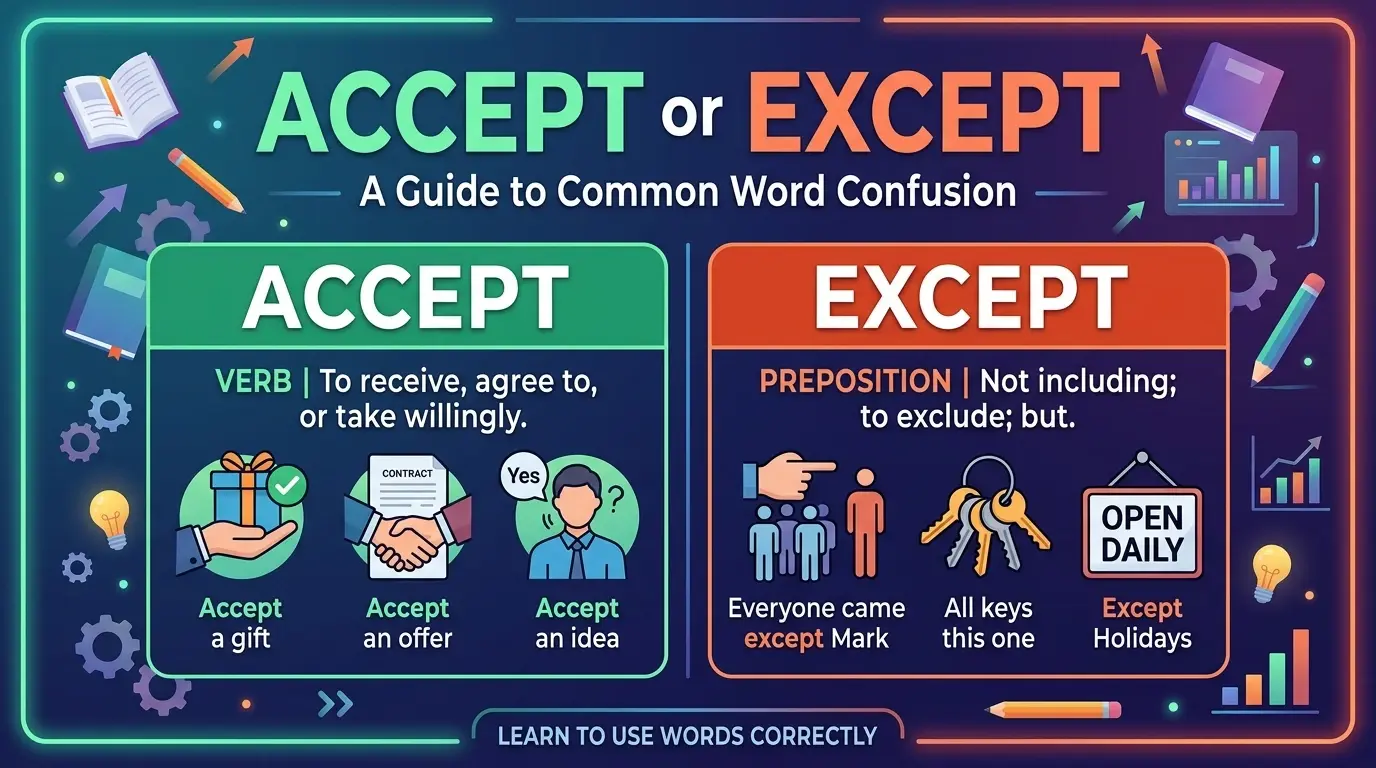
Accept means to receive, agree to, or approve something, while except means to leave someone or something out. They sound similar, but their meanings are completely different.
You might type a quick email and write, “I will except your offer.” Then you stop and wonder if accept is the right word. This mix-up is common because the two words have similar sounds and almost identical spelling.
The difference becomes much easier when you focus on the meaning. Use accept when someone receives, agrees to, or approves something. Use except when something or someone is excluded.
For example, you can accept an invitation, but you might invite everyone except John. Once you connect each word with its meaning, choosing the correct one becomes much easier.
Quick Answer
Accept or Except – Quick Answer
Accept is a verb meaning to receive, agree to, or approve something. Except means excluding someone or something. For example, “I accept your offer” means I agree to it, while “Everyone came except Sam” means Sam was not included.
Quick Rule
Accept means receive or agree; except means leave out or exclude.
The Difference Between Accept and Except
Accept and except have different meanings and different grammatical roles. Accept is mainly a verb used for receiving, agreeing, or approving. Except is usually a preposition or conjunction used to show an exclusion.
The easiest way to separate them is to ask what the sentence means.
If someone is receiving or agreeing to something, use accept.
If someone or something is left out, use except.
Compare these two sentences:
- I accept your invitation.
- Everyone came except Maria.
In the first sentence, the person says yes to an invitation.
In the second sentence, Maria is excluded from the group.
So, accept is about saying yes, while except is about leaving out.
Read More : Affect or Effect: What’s the Difference and Which One Should You Use?What Does Accept Mean?
Accept is a verb that means to agree to take something, say yes to an offer, or consider something satisfactory or true. It can also mean allowing someone to join a group.
You can accept:
- an offer
- an invitation
- a gift
- a job
- an apology
- responsibility
- advice
- a decision
- a fact
- a payment
Examples of Accept
- I accept your offer.
- She accepted the job.
- He accepted my apology.
- We accepted their invitation.
- Please accept this gift.
- They accepted the new plan.
- She refused to accept the truth.
- He accepted responsibility for the mistake.
- The college accepted her application.
- Do you accept credit cards?
Notice that accept usually describes an action.
A useful replacement is often receive, agree, or approve, depending on the sentence.
For example:
I accept your invitation.
This means:
I say yes to your invitation.
Another example:
She accepted the job.
This means:
She agreed to take the job.
What Does Except Mean?
Except means “not including” or “with the exclusion of.” It is commonly used when one person, thing, or situation is left outside a group or statement.
Examples include:
- Everyone came except Tom.
- I like all fruit except bananas.
- The store is open every day except Sunday.
- We have class every day except Friday.
- She eats everything except fish.
Except can also appear as except for.
For example:
- Everyone was ready except for James.
- The room was clean except for one corner.
- The trip was great except for the weather.
Cambridge notes that except and except for can both mean “not including” in many noun-based constructions.
Another Use of Except
Except can also connect ideas.
For example:
- I would go, except that I am busy.
- Everything was fine, except that we arrived late.
The phrase except that introduces a reason or difference that changes the situation.\
Except vs Accept: Grammar Rule
Accept is a verb, while except is usually a preposition or conjunction. This grammar difference can help you choose the correct word quickly.
Accept as a Verb
Use accept when someone performs an action.
Examples:
- I accept the offer.
- She accepted the invitation.
- They accepted the decision.
- He accepted responsibility.
You can also change its tense:
- accept
- accepts
- accepted
- accepting
Examples:
I accept your apology.
She accepted the apology.
They are accepting applications.
Except as a Preposition
Use except to show that someone or something is not included.
Examples:
Everyone passed except Mike.
The museum is open every day except Monday.
Except as a Conjunction
Except can also connect clauses.
Examples:
I would help, except I am working.
Everything was ready, except that the printer stopped working.
This is why accept and except cannot simply replace each other.
Accept or Except Comparison Table
| Word | Main Meaning | Grammar | Example |
| Accept | Receive or agree to something | Verb | I accept your offer. |
| Except | Leave out or exclude | Preposition/conjunction | Everyone came except John. |
| Accept | Approve or recognize | Verb | She accepted the decision. |
| Except for | Exclude one person or thing | Prepositional phrase | The room was empty except for one chair. |
| Except that | Show a difference or reason | Conjunction | I would go, except that I am tired. |
The key difference is simple:
Accept = receive, agree, or approve.
Except = exclude or leave out.
Except and Accept in Real Sentences
Seeing the words in context makes the difference easier to remember.
Examples With Accept
- I accept your apology.
- She accepted the job offer.
- We accept credit cards.
- He accepted the invitation.
- They accepted our proposal.
- Please accept this small gift.
- She accepted responsibility for the mistake.
- I cannot accept that explanation.
- The school accepted his application.
- He finally accepted the truth.
Examples With Except
- Everyone was there except Sarah.
- I like every color except orange.
- The store is closed every day except Sunday.
- We invited everyone except Mark.
- She eats all vegetables except onions.
- The room was empty except for one chair.
- Everything was ready except for the food.
- I would join you except that I have work.
- The movie was good except for the ending.
- Nobody knew the answer except Lisa.
These examples show a clear pattern.
When the sentence involves receiving, agreeing, or approving, choose accept.
When the sentence involves excluding, choose except.
Common Mistakes With Accept vs Except
The most common mistake happens when writers choose the word by sound instead of meaning.
Mistake 1: Using Except for Accept
Incorrect:
I except your invitation.
Correct:
I accept your invitation.
An invitation is something you receive or agree to.
Therefore, accept is correct.
Mistake 2: Using Accept for Except
Incorrect:
Everyone came accept John.
Correct:
Everyone came except John.
John is being excluded from the group.
Therefore, except is correct.
Mistake 3: “I Except Your Apology”
Incorrect:
I except your apology.
Correct:
I accept your apology.
An apology can be received or approved.
That requires the verb accept.
Mistake 4: “Everyone Was There Accept Sarah”
Incorrect:
Everyone was there accept Sarah.
Correct:
Everyone was there except Sarah.
Sarah is the person who was not included.
Mistake 5: Confusing “Except” With “Accept” in Emails
This mistake can look especially noticeable in professional writing.
Incorrect:
We will accept all applications accept those received late.
Correct:
We will accept all applications except those received late.
The first accept means the company will receive or approve applications.
The second except introduces the group being excluded.
Easy Memory Trick for Except or Accept
Try this simple memory trick:
Accept = Agree.
Both words begin with A.
Think:
A = Agree = Accept
If you agree to something, you accept it.
Examples:
- Accept an offer.
- Accept an invitation.
- Accept a gift.
- Accept responsibility.
For except, think:
Except = Exclude
Both ideas start with the sound ex.
If something is excluded, use except.
Examples:
- Everyone came except John.
- I like all fruit except grapes.
- The shop is open every day except Sunday.
So remember:
Accept = agree.
Except = exclude.
When to Use Accept and Except
Use accept when you mean receiving, agreeing to, approving, or recognizing something. Use except when you mean excluding someone or something from a group or statement.
Use Accept When:
- You receive something.
- You agree to an offer.
- You say yes to an invitation.
- You approve something.
- You recognize something as true.
- You take responsibility.
Examples:
I accept your offer.
She accepted the invitation.
He accepted responsibility.
Use Except When:
- You leave something out.
- You exclude someone.
- You identify an exception.
- You mean “not including.”
Examples:
Everyone came except David.
I like every subject except math.
The office is open every day except Saturday.
A Quick Test
Replace the word with agree.
If the sentence still makes sense, accept may be correct.
I accept your offer.
I agree to your offer.
Now replace it with exclude.
If that makes sense, except is likely correct.
Everyone came except David.
Everyone came, excluding David.
This simple test can prevent many mistakes.
Except vs Accept in Questions
These words can also appear in questions.
Examples With Accept
- Will you accept the offer?
- Did she accept the invitation?
- Do you accept credit cards?
- Can you accept this responsibility?
- Will they accept the proposal?
Examples With Except
- Did everyone come except John?
- Do you eat everything except meat?
- Is the store open every day except Sunday?
- Who was there except Sarah?
- Did anyone except Mark know the answer?
The same meaning-based rule still works.
Are Accept or Except Homophones?
Accept and except are commonly confused because they have very similar pronunciation, but they are not normally exact homophones. Their vowel sounds differ slightly in standard pronunciation.
The similarity is enough to cause mistakes in speech and writing.
That is especially true when someone is typing quickly or relying on autocorrect.
The spelling also looks similar:
- accept
- except
Only the first vowel changes.
This small spelling difference creates a major difference in meaning.
Is “Except” a Verb?
Yes, except can also function as a verb, although this use is much less common than its use as a preposition or conjunction. It means to exclude something or someone.
For example:
The rule excepts certain cases.
However, most English learners will use except as a preposition or conjunction.
In everyday writing, you are much more likely to see:
Everyone came except James.
than:
The rule excepts James.
Is “Accept” Always a Verb?
In standard modern English, accept is used as a verb.
Its forms include:
- accept
- accepts
- accepted
- accepting
Examples:
I accept your decision.
She accepts the offer.
They accepted the invitation.
He is accepting applications.
The related noun is acceptance.
For example:
We received her acceptance of the offer.
This is a different word from accept, but it keeps the same basic idea of agreeing or receiving.
FAQs
Is it accept or except?
Both words are correct, but they have different meanings. Accept means to receive, agree to, or approve something. Except means to exclude someone or something.
What is the easiest way to remember accept and except?
Remember A = Agree = Accept. Remember Except = Exclude. This connects each word with its main use.
Do you accept or except an invitation?
You accept an invitation. For example: “I am happy to accept your invitation.”
Do you accept or except an apology?
You accept an apology. For example: “I accept your apology.”
Is it everyone accept John or everyone except John?
The correct sentence is “Everyone except John.” John is being excluded from the group.
Is accept a verb?
Yes. Accept is a verb. It can mean to receive, agree to, approve, or recognize something.
Is except a verb?
Except can be a verb, but it is more commonly used as a preposition or conjunction. Its common meaning is “not including.”
What does except for mean?
Except for usually means “not including” or “with the exclusion of.” For example: “Everyone was ready except for Tom.”
Conclusion:
Accept and except are easy to confuse, but their meanings are different.
Use accept when you mean receive, agree to, approve, or recognize something. Use except when you mean exclude or leave something out.
A simple memory trick can help: A = Agree = Accept, while Except = Exclude.
So, you accept an invitation, but everyone may attend except one person. Once you focus on the meaning instead of the spelling, choosing the correct word becomes much easier.

I am an English language writer passionate about grammar and clear communication. I create simple, easy-to-understand content that helps readers improve their English skills. My goal is to make learning English both practical and enjoyable.










1 thought on “Accept or Except? Meaning, Difference, & Easy Examples”