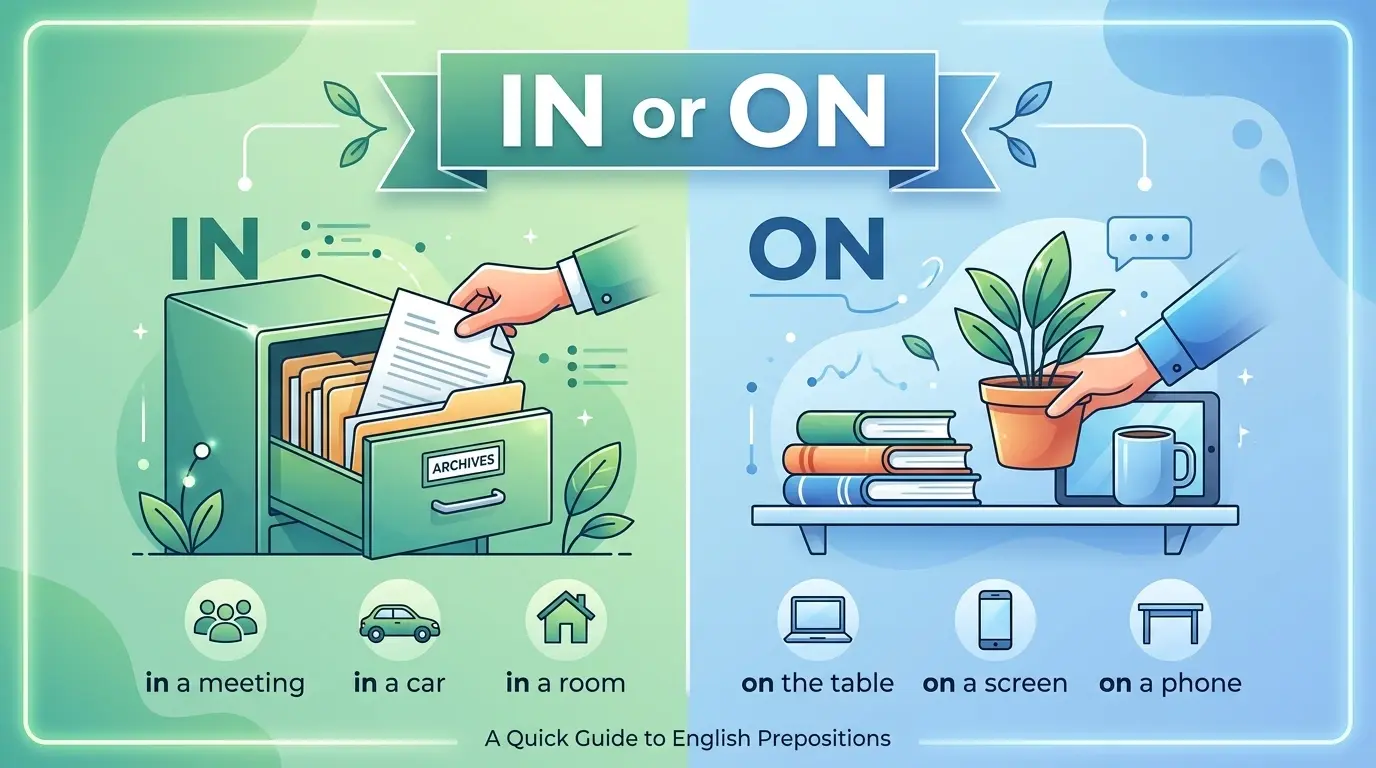
Use “in” for something inside an area or period, and use “on” for a surface, specific day, or connected position. The correct choice depends on what you are describing.
You may know the rule until a simple sentence makes you pause. Is it in the car or on the car? Do you say in Monday or on Monday? What about in the internet or on the internet?
These small prepositions cause many mistakes because their meanings change with context. In often suggests being inside something or within a period. On often suggests contact with a surface or a specific day.
The good news is that you can learn a few simple patterns. Once you understand those patterns, choosing between in and on becomes much easier.
Quick Answer
In usually describes something inside an area, place, or period. On commonly describes something touching a surface or happening on a specific day or date. However, the correct preposition depends on the expression, so some common phrases must be learned individually.
Quick Rule
Use “in” for enclosed spaces and periods; use “on” for surfaces, specific days, and dates.
The Difference Between In and On
In and on are both prepositions, but they describe different relationships. In often shows that something is inside a space or within a period. On often shows contact with a surface or a specific point in time.
The same basic idea works with time.
I was born in 2005.
A year is a larger period.
I was born on May 10.
A date is a specific day.
However, English has many fixed expressions.
For example:
She is on the bus.
You might expect in because a bus is an enclosed vehicle. English commonly uses on with buses, trains, planes, and other forms of public transportation.
That is why learning the main patterns is helpful.
Read More: Accept or Except? Meaning, Difference, & Easy ExamplesWhen to Use “In”
Use “in” when something is inside an enclosed space, within a larger area, or during a longer period. It is also common with months, years, seasons, countries, cities, and many enclosed places.
In for enclosed spaces
Use in when something is physically inside something else.
Examples:
- The clothes are in the closet.
- There is water in the bottle.
- She is in the room.
- My phone is in my bag.
- The children are in the house.
The idea is usually inside.
In for cities and countries
Use in with many geographical areas.
- I live in Pakistan.
- She lives in Lahore.
- He works in New York.
- They stayed in France.
- We met in London.
The city or country is treated as an area containing the person or thing.
In for months
Use in with months.
- in January
- in March
- in July
- in December
Example:
My birthday is in July.
In for years
Use in with years.
- in 1999
- in 2010
- in 2025
- in 2030
Example:
She graduated in 2024.
In for seasons
Use in with seasons.
- in spring
- in summer
- in fall
- in autumn
- in winter
Example:
We usually travel in summer.
When to Use “On”
Use “on” when something rests against a surface or when an event happens on a particular day or date. It also appears in many fixed expressions involving transport, technology, and communication.
On for surfaces
Use on when something is touching or resting on a surface.
Examples:
- The book is on the table.
- The picture is on the wall.
- The phone is on the desk.
- There is a stain on my shirt.
- The keys are on the floor.
The basic idea is contact with a surface.
On for days
Use on with specific days.
- on Monday
- on Tuesday
- on Friday
- on Sunday
Example:
The meeting is on Monday.
On for dates
Use on with specific dates.
- on January 5
- on July 4
- on December 25
Example:
The event starts on December 25.
On for specific day expressions
Use on with expressions such as:
- on my birthday
- on Christmas Day
- on Monday morning
- on Friday night
Example:
We are leaving on Friday morning.
In vs On for Place
For physical location, “in” usually means inside an area or enclosed space, while “on” often means touching a surface. The correct choice depends on the relationship between the object and the place.
| Use | Example | Meaning |
| in | The phone is in the bag. | Inside |
| in | She is in the room. | Inside |
| on | The phone is on the table. | On a surface |
| on | The picture is on the wall. | Attached to a surface |
In the box
The toys are in the box.
The toys are inside the box.
On the box
The label is on the box.
The label is attached to or resting on its surface.
The difference can change the image in your mind.
In or On the Street?
Both in the street and on the street can be correct, but they can describe different situations.
On the street commonly refers to a location along a street or an address. In the street can refer to being physically within the street area, especially when contrasting it with the sidewalk.
Examples:
The restaurant is on Main Street.
There were children playing in the street.
American English commonly uses on when giving a street address or describing a location along a street.
For example:
She lives on Oak Street.
In or On for Time?
Use “in” for broader periods such as months, years, seasons, and parts of the day. Use “on” for specific days and dates. These patterns are among the most useful rules for choosing between the two prepositions.
Use in
- in January
- in 2026
- in summer
- in the morning
- in the afternoon
- in the evening
Examples:
I was born in 2000.
We travel in summer.
She works in the morning.
Use on
- on Monday
- on Saturday
- on June 15
- on my birthday
- on Christmas Day
Examples:
The exam is on Monday.
My appointment is on June 15.
Why the difference?
Think about the size of the time period.
In often points to a larger period:
in 2026
On points to a specific day:
on June 15
You can also combine them:
The meeting is on Monday morning.
Here, on belongs with the specific day, while morning identifies the part of that day.
In or On With Transportation?
Transportation is one area where the basic “inside versus surface” rule does not always work. English commonly uses “in” with cars and taxis but “on” with buses, trains, planes, and other public transport.
Use in
- in a car
- in a taxi
- in a truck
Examples:
She is in the car.
We went in a taxi.
Use on
- on a bus
- on a train
- on a plane
- on a ship
- on a bicycle
- on a motorcycle
Examples:
I am on the bus.
They are on the train.
She is on the plane.
This is a useful example of why you should not apply one physical rule to every expression.
You can be physically inside a bus, but English normally says on the bus.
In or On a Car?
Use in a car when you mean that someone is inside the vehicle.
I left my wallet in the car.
Use on the car when something is physically located on the outside or surface of the vehicle.
There is snow on the car.
The meaning changes completely.
In or On a Plane?
Use on a plane when talking about traveling by plane or being a passenger.
We are on the plane.
You can use in the plane in contexts that focus on being physically inside the aircraft, but on the plane is the common expression for passengers and travel.
In or On With Technology
Modern English uses “on” in many technology-related expressions. We commonly say “on the internet,” “on a website,” and “on the phone,” although “in” appears in some technology expressions.
On the internet
Correct:
I found the information on the internet.
Not:
I found the information in the internet.
On a website
The article is on the website.
On social media
She posted the picture on social media.
On the phone
I am on the phone right now.
In an email
Use in when referring to something contained within an email.
I mentioned the details in the email.
But:
I saw the post on the website.
The preposition depends on the relationship you are describing.
In or On a Page?
Both can be correct depending on meaning.
Use on the page when referring to something displayed or located on a page.
The answer is on page 10.
There is a picture on the page.
Use in the page much less often. When referring to written content contained within a page, English often still uses on the page.
For example:
The information on the page is useful.
So on the page is the standard choice in most everyday situations.
Common Mistakes With In and On
Most mistakes happen when learners translate directly from another language or apply one rule to every situation. The best approach is to learn the main patterns and remember common fixed expressions.
Mistake 1: In Monday
❌ The meeting is in Monday.
✅ The meeting is on Monday.
Use on with specific days.
Mistake 2: On 2026
❌ She graduated on 2026.
✅ She graduated in 2026.
Use in with years.
Mistake 3: In the table
❌ The book is in the table.
✅ The book is on the table.
Use on when the book rests on the surface.
Mistake 4: On the car
❌ I am on the car.
✅ I am in the car.
If you mean that you are inside the vehicle, use in.
Mistake 5: In the bus
❌ I am in the bus.
✅ I am on the bus.
In the bus can occur when emphasizing physical location, but on the bus is the normal expression for riding it.
20 Real Examples of “In”
- She lives in New York.
- The keys are in my bag.
- I was born in 2001.
- We arrived in June.
- He works in an office.
- The children are in the classroom.
- I usually exercise in the morning.
- They travel in winter.
- There is water in the bottle.
- She is in the kitchen.
- We met in 2025.
- He lives in Canada.
- The documents are in the folder.
- She is in the car.
- I read it in the newspaper.
- The answer is in the book.
- He works in the city.
- They arrived in the afternoon.
- There is a mistake in the sentence.
- She is in the room.
20 Real Examples of “On”
- The book is on the table.
- We have a meeting on Monday.
- My birthday is on July 10.
- She is on the bus.
- He is on the train.
- They are on the plane.
- The picture is on the wall.
- I saw it on the internet.
- The information is on the website.
- She is on the phone.
- The keys are on the desk.
- There is a mark on the shirt.
- The children are on the floor.
- We met on Friday.
- The answer is on page five.
- He posted it on social media.
- There is snow on the roof.
- The clock is on the wall.
- She arrived on Sunday morning.
- The name is written on the list.
Easy Memory Trick
Use this simple pattern:
IN = inside or within
Think:
in a box
in a room
in a city
in January
in 2026
ON = surface or specific day
Think:
on a table
on a wall
on Monday
on July 10
on a bus
This trick will not cover every English expression.
However, it gives you a strong starting point.
For unusual expressions, learn the complete phrase rather than translating word by word.
FAQs
Is it “in Monday” or “on Monday”?
Use on Monday. We use on with specific days of the week.
Is it “in January” or “on January”?
Use in January when you mean the whole month. Use on with a specific date, such as on January 10.
Is it “in 2026” or “on 2026”?
Use in 2026. We normally use in with years.
Is it “in the car” or “on the car”?
Use in the car when someone or something is inside the vehicle. Use on the car for something located on its surface.
Is it “in the bus” or “on the bus”?
On the bus is the standard expression when you mean traveling by bus or being a passenger.
Is it “in the table” or “on the table”?
Use on the table when something is resting on its surface. Use in only when something is actually contained within the table.
Is it “in the internet” or “on the internet”?
The standard expression is on the internet.
Is it “in the website” or “on the website”?
Use on the website when referring to information or content displayed there.
Is it “in the wall” or “on the wall”?
Both can be correct. On the wall means something is attached to or resting against the surface. In the wall means something is inside the wall.
How can I remember in vs on?
Think in = inside or within and on = surface or specific day. Then learn common fixed expressions separately.
Conclusion:
The choice between in and on depends on the relationship between the words. Use in for things inside spaces and for larger periods such as months and years. Use on for surfaces, specific days, dates, and many common expressions.
For example, say in the room, in July, and in 2026. Say on the table, on Monday, and on July 10.
Some expressions, such as on the bus and on the internet, must be learned as common English phrases. Once you understand these patterns, choosing between in and on becomes much easier.

I’m Sophia Mitchell, an English grammar and writing enthusiast. I create simple, easy-to-understand content to help learners improve their English. My goal is to make grammar clear, practical, and enjoyable for everyone.











1 thought on “In or On: What’s the Difference? Simple Rules and Examples”