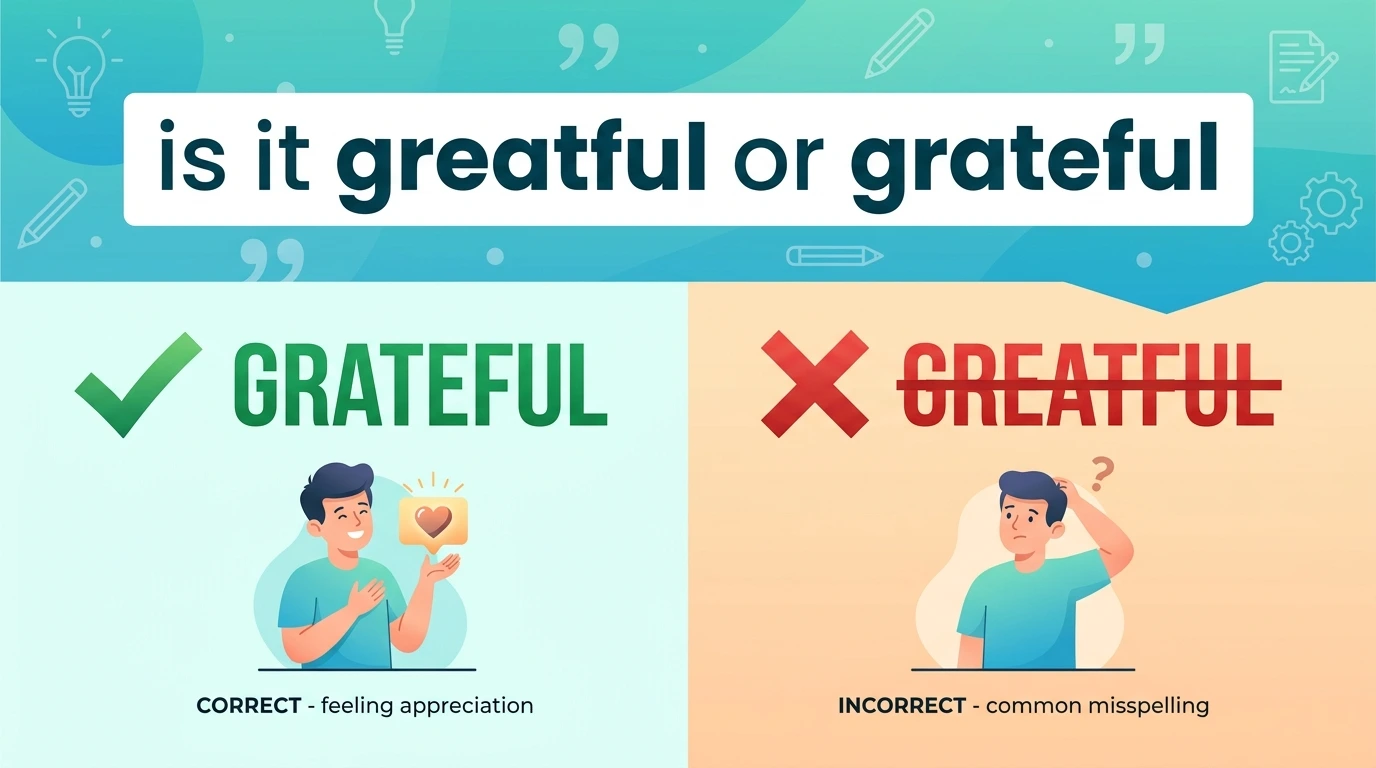
Grateful is the correct spelling when you mean thankful or appreciative. Greatful is a common misspelling and is not the standard spelling in English.
You may type a thank-you message, finish an email, or write a sentence about someone who helped you. Then you stop and wonder: is it greatful or grateful?
The confusion is understandable. The word sounds like it could come from great, so greatful may look natural at first. But English does not build this word from great + ful.
The correct word is grateful, with “grat” at the beginning and one l at the end.
For example:
- I am grateful for your help.
- She was grateful to her teacher.
- We are grateful for your support.
In this guide, you will learn why grateful is correct, what it means, how to use it, and how to remember the spelling easily.
Is It Greatful or Grateful? – Quick Answer
Grateful is the correct spelling. It means feeling or showing thanks for something kind, helpful, or positive. Greatful is a common spelling mistake caused by connecting the word with great. There is no US vs. UK spelling difference here. Use grateful in both American and British English.
⚡ Quick Rule
Remember gratitude: grateful starts with “grat,” not “great,” and ends with one L.
What Is the Difference Between Greatful and Grateful?
There is no standard spelling choice between greatful and grateful. Only grateful is the correct modern spelling when you mean thankful or appreciative. Greatful is a misspelling that often happens because the word sounds like it begins with great.
Compare these forms:
| Word | Correct? | Meaning |
| grateful | ✅ Yes | Thankful or appreciative |
| greatful | ❌ No | Common misspelling |
| gratefull | ❌ No | Incorrect spelling |
| gratefully | ✅ Yes | In a thankful way |
| gratitude | ✅ Yes | The feeling of being thankful |
For example:
I am grateful for your kindness.
Not:
I am greatful for your kindness.
The spelling may seem small, but it matters in school assignments, resumes, emails, business writing, and other formal situations.
Read More: Is It Leafs or Leaves? Correct Plural, Meaning & ExamplesWhy Is “Grateful” Correct?
Grateful is correct because the word is connected to the grat- word family rather than the modern word great. English speakers often make the mistake because greatful looks like a simple combination of great and -ful.
That explanation is important because many English words do follow a pattern like this:
- helpful
- useful
- careful
- hopeful
- thoughtful
So it is easy to think:
great + ful = greatful
But that is not how grateful developed.
The word is related to the idea of being thankful and has a history connected with Latin gratus, meaning pleasing or thankful. The related noun gratitude also uses the same grat- beginning.
That gives you a useful spelling connection:
gratitude → grateful
The word great is not the spelling source you should use to remember it.
Is “Greatful” a Real Word?
Greatful is not the standard spelling of the adjective meaning thankful. In normal modern English, you should use grateful instead.
You may still see greatful online, in informal writing, or in spelling questions. Its appearance does not make it an accepted alternative spelling.
For school, work, applications, emails, articles, and other careful writing, choose grateful.
Correct:
I am grateful for the opportunity.
Incorrect:
I am greatful for the opportunity.
The same applies to gratefull, which is another common spelling mistake.
Grateful or Greatful: Spelling Comparison
The easiest way to see the difference is to compare the letters.
| Feature | Grateful | Greatful |
| Correct spelling | ✅ | ❌ |
| Starts with | grat- | great- |
| Means thankful | Yes | No |
| Used in standard English | Yes | No |
| US English | Yes | No |
| UK English | Yes | No |
There is no American spelling greatful and British spelling grateful.
Both varieties use grateful.
This is different from genuine spelling differences such as color/colour or canceled/cancelled.
Is “Grateful” the Same in American and British English?
Yes. Grateful is used in both American and British English.
The spelling does not change based on region. If you are writing for an American audience, use grateful. If you are writing for a British audience, use grateful as well.
This means you do not need to remember two versions.
| English variety | Correct spelling |
| American English | grateful |
| British English | grateful |
| Canadian English | grateful |
| Australian English | grateful |
So if your question is “Is it greatful or grateful?”, the answer stays the same across standard English varieties.
What Does “Grateful” Mean?
Grateful means feeling or showing thanks because someone has helped you, treated you kindly, or given you something valuable.
Cambridge defines grateful as showing or expressing thanks, especially to another person. Oxford also uses it for feeling or showing thanks because someone has done something kind or helpful.
You can be grateful for:
- someone’s help
- someone’s kindness
- an opportunity
- good news
- support
- a gift
- someone’s time
- a second chance
- a safe outcome
- something positive in your life
Examples
I am grateful for your advice.
She was grateful to her parents.
We are grateful for your support.
He felt grateful to be alive.
The word often appears with to and for.
How to Use “Grateful” Correctly
The most common structures are grateful to someone and grateful for something.
1. Grateful to someone
Use grateful to when you identify the person you appreciate.
I am grateful to my parents.
She is grateful to her doctor.
We are grateful to everyone who helped.
2. Grateful for something
Use grateful for when you identify the thing or situation you appreciate.
I am grateful for your support.
She is grateful for the opportunity.
They are grateful for the extra time.
3. Grateful to someone for something
You can combine both structures.
I am grateful to you for your help.
She is grateful to her parents for their support.
We are grateful to everyone for their hard work.
4. Grateful to do something
You can also use grateful + to + verb.
I am grateful to have this opportunity.
She was grateful to receive the award.
He was grateful to be home.
20 Examples of “Grateful” in Real Sentences
Here are natural examples you can use as models.
- I am grateful for your help.
- She is grateful to her parents.
- We are grateful for your support.
- He felt grateful for the second chance.
- I am truly grateful to everyone who helped.
- They were grateful for the good news.
- She was grateful to receive the scholarship.
- We are grateful for your kindness.
- I am grateful that you came.
- He is grateful to have another opportunity.
- The students were grateful for their teacher’s help.
- She gave me a grateful smile.
- I will always be grateful for your advice.
- They are grateful to their friends.
- We feel grateful for everything you have done.
- He was grateful to be safe.
- I am grateful for the opportunity to learn.
- She is grateful to everyone who supported her.
- The family was grateful for the community’s help.
- I would be grateful if you could reply soon.
Common Mistakes With “Grateful”
Several spelling mistakes appear because grateful does not look exactly how it sounds.
Mistake 1: Greatful
❌ I am greatful for your help.
✅ I am grateful for your help.
The incorrect version uses great, which is a different word.
Mistake 2: Gratefull
❌ She is gratefull for the support.
✅ She is grateful for the support.
Do not add a second l.
Mistake 3: Greatfull
❌ I am greatfull for this opportunity.
✅ I am grateful for this opportunity.
This combines two spelling mistakes.
Mistake 4: Using “grateful” incorrectly with “to” and “for”
❌ I am grateful for my teacher.
This sentence can be understood, but if you mean you appreciate the person, grateful to my teacher is usually clearer.
Better:
✅ I am grateful to my teacher for the extra help.
The common patterns are:
grateful to + person
grateful for + thing
grateful to + person + for + thing
Why Do People Spell “Grateful” as “Greatful”?
The mistake happens because grateful sounds very close to greatful.
When people hear the word, they may connect it with great. That connection feels logical because great is a familiar English word.
There is another reason. Many adjectives are formed by adding -ful to a word:
- beauty → beautiful
- care → careful
- hope → hopeful
- help → helpful
This can make great + ful look reasonable.
But spelling is not always predictable from modern word parts. Grateful has its own history and belongs with words such as gratitude.
So instead of thinking:
great + ful
Think:
gratitude → grateful
That simple connection can prevent the mistake.
Grateful, Gratitude, and Gratefully
These words belong to the same word family.
Grateful
Grateful is an adjective.
I am grateful for your help.
Gratitude
Gratitude is a noun meaning the feeling of being thankful.
She expressed her gratitude for the support.
Gratefully
Gratefully is an adverb.
He gratefully accepted the offer.
Seeing these words together makes the spelling easier to remember:
grateful → gratitude → gratefully
Notice the shared grat- beginning.
“Grateful” vs “Thankful”
Grateful and thankful are close in meaning, and both can describe appreciation. However, they are not always identical in every context.
Grateful often focuses on appreciation for someone’s kindness, help, or something received.
I am grateful for your kindness.
Thankful can also describe relief that something good happened or something bad did not happen.
I am thankful that everyone arrived safely.
Both words are correct in many situations.
If you simply want to say that you appreciate someone’s help, grateful is a natural choice.
A Simple Memory Trick for “Grateful”
Use this three-step trick:
Step 1: Think of “gratitude”
gratitude
Step 2: Remove the ending
You get:
grat-
Step 3: Add “-ful”
grat + ful = grateful
So remember:
Grateful comes from the “grat-” family, not the “great-” family.
You can also remember:
I am grateful because I have gratitude.
That connection makes the spelling much easier.
Can “Greatful” Ever Be Correct?
For modern standard English, greatful should not be used when you mean thankful or appreciative.
If you are writing a sentence with this meaning, use grateful.
For example:
I am grateful for everything you have done.
Do not replace grateful with greatful.
The word great itself is, of course, a correct English word. It means large, important, excellent, or very good depending on context.
But adding -ful to great does not create the standard word meaning thankful.
Is “Gratefully” Spelled With One or Two Ls?
Gratefully is spelled with one l before the y.
Correct:
She gratefully accepted the gift.
Incorrect:
She gratefullly accepted the gift.
The related forms are:
- grateful
- gratefully
- gratitude
Keeping the grat- beginning in mind helps with all three.
FAQs
Is “greatful” or “grateful” correct?
Grateful is correct. It means thankful or appreciative. Greatful is a common misspelling and should not be used in standard English when you mean thankful.
Is “greatful” a word?
Greatful is not the standard modern spelling of the word meaning thankful. Use grateful instead.
Why is grateful spelled without “great”?
Because grateful is not formed from the modern word great. It belongs to a word family connected with gratitude and has a different historical origin.
Is grateful American or British spelling?
Grateful is used in both American and British English. There is no regional spelling difference between grateful and greatful.
How do you spell grateful correctly?
Spell it G-R-A-T-E-F-U-L: grateful.
A useful memory aid is gratitude → grateful.
Is “gratefull” correct?
No. Gratefull is incorrect. The correct spelling is grateful, with one l at the end.
What is the difference between grateful and thankful?
Both can mean feeling or showing thanks. Grateful often describes appreciation for someone’s kindness or help, while thankful can also express relief about a good outcome.
What is the noun form of grateful?
The noun form is gratitude.
For example:
She expressed her gratitude for their help.
What is the adverb form of grateful?
The adverb is gratefully.
For example:
He gratefully accepted the award.
Conclusion:
If you are wondering “is it greatful or grateful?”, choose grateful. It is the correct standard spelling in both American and British English.
Greatful is a common misspelling caused by the familiar word great. The easiest way to remember the correct form is to connect grateful with gratitude.
Use grateful when you mean thankful or appreciative:
I am grateful for your help.
Remember the simple rule: grat, not great, and only one l at the end.

As an American English writer, I specialize in creating clear and engaging content that makes grammar and language learning accessible to everyone. I enjoy breaking down complex English concepts into simple, practical lessons that readers can apply with confidence. My mission is to help learners strengthen their communication skills through easy and reliable content.