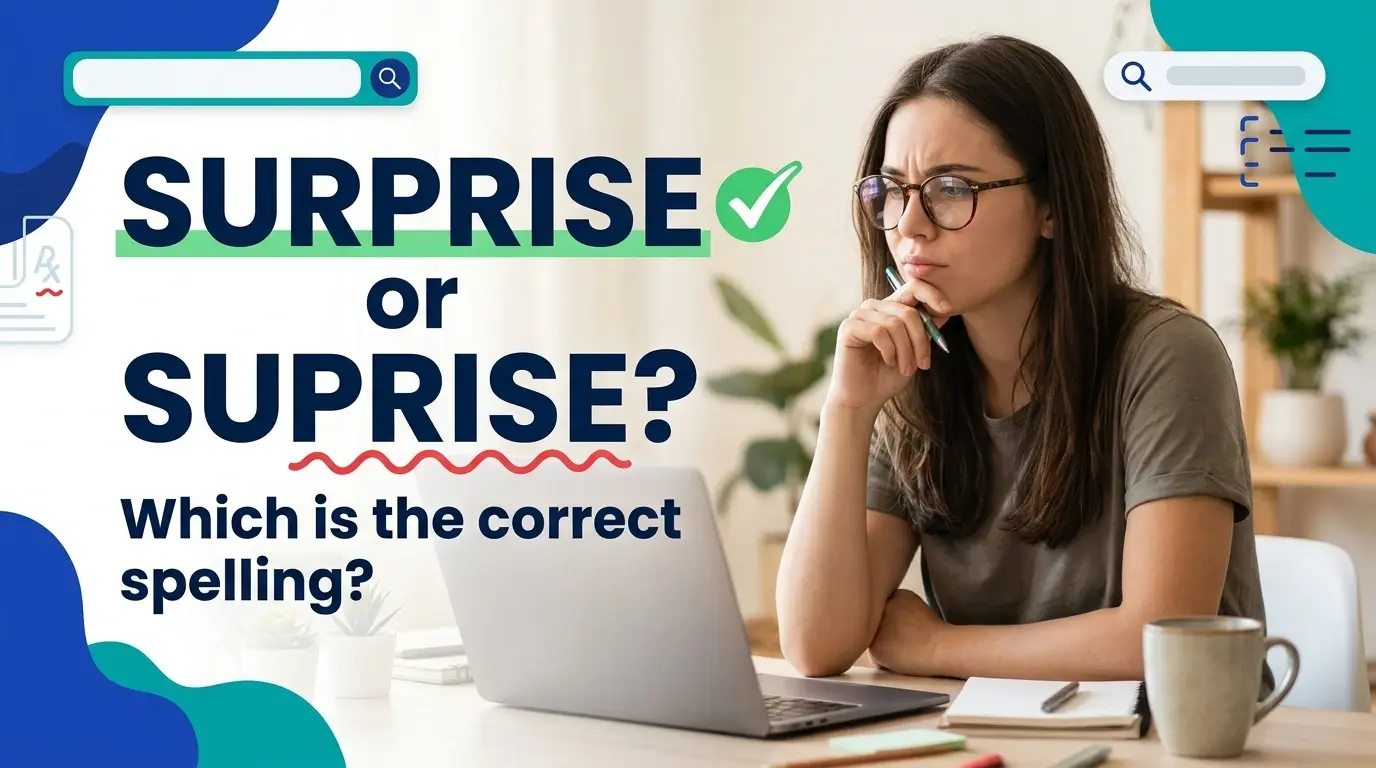
Surprise is the correct spelling, while suprise is a common misspelling. The correct word contains two r’s: surprise.
You may have typed a quick message and suddenly stopped at the word. You know what you want to say, but surprise looks strange for a moment.
Then another spelling appears in your mind: suprise.
This mistake is easy to understand. When people say surprise quickly, the first r may not sound strong. That can make suprise seem natural when you write it.
However, standard English uses surprise in both American and British English. Cambridge and Oxford list surprise as the correct word. It can work as a noun, verb, and related adjective form.
The good news is that the spelling is easy to remember once you know where the first r belongs.
Quick Answer: Surprise or Suprise?
Surprise is the correct spelling. Suprise is a misspelling and should not be used in standard English. The word surprise has two r’s, even though the first r may be difficult to hear in quick speech. Use surprise in schoolwork, emails, professional writing, and everyday communication.
Quick Rule in 1 Line:
Remember the first r in surprise, even when you barely hear it when speaking.
Surprise or Suprise: Which Is Correct?
Surprise is the only standard spelling of this word in modern English. Suprise is a misspelling caused mainly by pronunciation and the easy-to-miss first r.
The correct spelling is:
surprise
The incorrect spelling is:
suprise
Notice the difference:
surprise → has r after u
suprise → leaves out that r
The first part of the correct spelling is:
sur-
The incorrect version changes it to:
su-
This small difference matters in formal and informal writing.
For example:
- I have a surprise for you.
- The news was a big surprise.
- I wanted to surprise my sister.
- The results surprised everyone.
Cambridge defines surprise as an unexpected event or the feeling caused by something unexpected. It also lists surprise as a verb.
Oxford also lists surprise as both a noun and a verb.
                               Choses or Chooses? The Correct Spelling Explained
Read More :
                               This or These? The Correct Choice Explained
Why Is “Surprise” the Correct Spelling?
Surprise is correct because it is the established standard spelling used in English dictionaries. The word keeps the r in the first syllable, even when that sound is not strongly heard.
The spelling can look confusing because English pronunciation does not always show every letter clearly.
When you say surprise naturally, the word can sound close to:
suh-PRIZE
That pronunciation may cause writers to forget the first r.
Cambridge gives the pronunciation as /səˈpraɪz/ in British English and /sɚˈpraɪz/ in American English.
The spelling still remains:
s-u-r-p-r-i-s-e
So, the pronunciation should not be used as a reason to remove the first r.
Correct:
- surprise
- surprised
- surprising
Incorrect:
- suprise
- suprised
- suprising
The same spelling pattern continues in related forms.
Why Do People Spell It “Suprise”?
Suprise is usually written by mistake because the first r in surprise can be easy to miss when the word is pronounced quickly.
This is a pronunciation-based spelling mistake.
The word has two important r letters:
suR pRise
When speaking quickly, the first r may receive very little attention.
That can make the word sound as if it starts with:
su-
instead of:
sur-
This is not unusual in English. Some words contain letters that are less noticeable in everyday speech.
A spelling guide from Dictionary.com also identifies suprise as a common misspelling of surprise. It connects the mistake with the way the word is pronounced.
That explains why suprise may feel familiar.
However, familiarity does not make it correct.
If you are writing an assignment, resume, email, article, or business message, use:
surprise
What Does Surprise Mean?
Surprise refers to something unexpected or to the feeling caused by something unexpected. It can describe an event, a feeling, or an action that makes someone feel surprised.
For example:
The party was a surprise.
Here, surprise means an unexpected event.
You can also use it to describe a feeling:
She looked at him in surprise.
Here, surprise means the feeling caused by something unexpected.
The word can also be a verb:
I wanted to surprise my brother.
Here, surprise means to make someone feel surprised.
Cambridge lists these major noun and verb uses, while Oxford also gives examples of surprise as an unexpected event and as a feeling.
Is “Suprise” a Word?
Suprise is not the standard English spelling of the word. It is a misspelling of surprise and should be corrected in standard writing.
You may see suprise online because people make spelling mistakes.
Seeing a misspelling does not make it an accepted spelling.
The standard form is:
surprise
For example:
❌ I have a suprise for you.
✅ I have a surprise for you.
❌ The party was a suprise.
✅ The party was a surprise.
❌ She wanted to suprise her parents.
✅ She wanted to surprise her parents.
When spell-check software marks suprise as an error, it is identifying the missing r.
Surprise as a Noun
Surprise is a noun when it names an unexpected event, piece of news, or feeling caused by something unexpected.
Consider these examples:
- What a nice surprise!
- The party was a complete surprise.
- Her visit was a pleasant surprise.
- I have a surprise for you.
- He could not hide his surprise.
Oxford lists surprise as a countable noun for an unexpected event or piece of news. It also lists an uncountable or countable use for the feeling caused by something unexpected.
Surprise as an unexpected event
The birthday party was a surprise.
The party itself was unexpected.
Surprise as a feeling
She stared at him in surprise.
The sentence describes her reaction.
Both uses have the same spelling:
surprise
Never change it to suprise.
Surprise as a Verb
Surprise is a verb when it means to make someone feel surprised or to find someone unexpectedly.
For example:
The news surprised me.
Here, surprised describes the action that caused a reaction.
You can also say:
I want to surprise my mother.
The speaker plans to do something unexpected.
Oxford lists surprise as a verb meaning to make someone feel surprised. It also gives a second use involving finding or attacking someone unexpectedly.
More examples include:
- The gift surprised her.
- You surprised me.
- His answer surprised everyone.
- We wanted to surprise our teacher.
- The sudden question surprised him.
The spelling stays connected to the base word:
surprise → surprised → surprising
Surprise, Surprised, and Surprising
Surprise, surprised, and surprising are related forms, but they have different grammatical jobs. All keep the important letters from the original spelling.
1. Surprise
This can be a noun or verb.
The gift was a surprise.
I want to surprise her.
2. Surprised
This commonly describes how a person feels.
I was surprised by the news.
3. Surprising
This describes something that causes surprise.
The result was surprising.
Notice the spelling:
- surprise
- surprised
- surprising
A common mistake is to remove the first r in these forms.
Incorrect:
- suprised
- suprising
Correct:
- surprised
- surprising
Oxford lists surprised as an adjective and surprising as an adjective related to surprise.
How to Remember the Spelling of Surprise
The easiest way to remember surprise is to focus on the first three letters: S-U-R. Do not let the quiet first R disappear when you write it.
Try this visual memory trick:
SUR + PRISE = SURPRISE
Break the word into two parts:
SUR + PRISE
That gives:
SURPRISE
Another helpful trick is to connect it with the word surfer:
surfer → sure → surprise
The first three letters are easy to remember when you think:
SUR
You can also write the word slowly:
S – U – R – P – R – I – S – E
Then say:
“Surprise has an R before the P.”
This is useful because the first r is the letter most often forgotten.
A simple memory sentence
The SURprise starts with SUR.
The sentence may sound simple, but repetition helps.
Suprise vs Surprise: Comparison Table
| Spelling | Correct? | Meaning | Example |
| surprise | ✅ Yes | An unexpected event, feeling, or action | The party was a surprise. |
| suprise | ❌ No | Misspelling of surprise | Avoid this spelling. |
| surprised | ✅ Yes | Feeling surprise | I was surprised. |
| suprised | ❌ No | Misspelling of surprised | Avoid this spelling. |
| surprising | ✅ Yes | Causing surprise | The result was surprising. |
| suprising | ❌ No | Misspelling of surprising | Avoid this spelling. |
The important point is that surprise keeps the first r.
20 Example Sentences With Surprise
Here are practical examples showing the correct spelling in different situations.
- The birthday party was a surprise.
- I have a surprise for you.
- Her visit came as a complete surprise.
- The news was a big surprise.
- He looked at me in surprise.
- We planned a surprise dinner.
- The gift was a wonderful surprise.
- I did not expect such a pleasant surprise.
- The results came as a surprise to everyone.
- She tried to hide her surprise.
- I wanted to surprise my parents.
- The announcement surprised everyone.
- His answer surprised me.
- The teacher surprised the class with a quiz.
- We decided to surprise our friend.
- Her reaction surprised him.
- The sudden change was surprising.
- It was surprising to see so many people.
- I was surprised by his decision.
- They were surprised when she arrived.
In every example, the correct spelling contains the first r.
Common Mistakes With Surprise
The most common mistake is writing suprise instead of surprise. Other errors include suprised and suprising, which also remove the first r.
Mistake 1: Suprise
❌ I have a suprise for you.
✅ I have a surprise for you.
Mistake 2: Suprised
❌ She was suprised by the gift.
✅ She was surprised by the gift.
Mistake 3: Suprising
❌ The result was suprising.
✅ The result was surprising.
Mistake 4: Losing the first R
Some writers remember the second r but forget the first.
Remember:
surprise
Not:
suprise
Mistake 5: Trusting pronunciation too much
English spelling does not always match pronunciation letter by letter.
A sound may be weak in speech while the letter remains necessary in writing.
That is exactly what makes surprise easy to misspell.
When Should You Use Surprise?
Use surprise whenever you mean something unexpected, the feeling caused by it, or the action of making someone feel surprised.
You can use surprise in many common situations.
Birthday parties
We planned a surprise party.
Gifts
I bought her a surprise gift.
News
The announcement was a surprise.
Feelings
He looked at me in surprise.
Unexpected actions
I wanted to surprise my friend.
Professional writing
The results came as a surprise to the research team.
The word is common in both everyday and formal English.
There is no American spelling that changes surprise to another form. Cambridge’s American Dictionary also lists surprise with the same standard spelling.
Does American English Spell It “Suprise”?
No. American English uses surprise, not suprise. The spelling does not change between American and British English.
Some English words have spelling differences between the United States and the United Kingdom.
For example:
- color / colour
- neighbor / neighbour
- canceled / cancelled
But surprise is not one of those words.
Both varieties use:
surprise
So you should write:
American English: surprise
British English: surprise
The same applies to common forms such as:
- surprised
- surprising
There is no standard US spelling suprise.
Is the First R in Surprise Silent?
The first r in surprise may sound weak, but it is part of the standard spelling. American and British pronunciations both retain the word’s full spelling.
Cambridge gives the British pronunciation as /səˈpraɪz/ and the American pronunciation as /sɚˈpraɪz/.
The first part can sound less noticeable than the main stressed syllable.
That can lead people to write:
suprise
But pronunciation should not cause you to remove the letter.
Think of the spelling as:
SUR-PRISE
The first r belongs there.
Why Is Surprise So Easy to Misspell?
Surprise is easy to misspell because its first r is not strongly emphasized in normal speech. Writers may spell the word from what they hear instead of its standard written form.
This is especially common when people write quickly.
You might say the word several times without noticing the first r.
Then you type:
suprise
instead of:
surprise
The mistake becomes more likely because suprise still looks believable.
It has the same general shape.
It also sounds close enough in casual speech.
That is why remembering the visual pattern is useful:
SURPRISE
The first three letters are:
SUR
A Simple Spelling Trick for Surprise
Remember “SUR” at the beginning and “PRISE” at the end. Joining those two parts gives the correct spelling: SUR + PRISE.
Write it this way:
SUR + PRISE
Now join them:
SURPRISE
Then remember:
SUR comes before PRISE.
This gives you a quick check whenever you are unsure.
If you write suprise, stop and look at the beginning.
Ask:
“Where is my R?”
Add it back:
surprise
This method also helps with related forms.
surprise → surprised → surprising
The first r remains important.
FAQs
Is surprise or suprise correct?
Surprise is correct. Suprise is a misspelling. The standard spelling contains two r’s, including one after the initial u.
Is suprise a real English word?
No. Suprise is not the standard spelling of the English word. It is a common misspelling of surprise.
How do you spell surprise?
The correct spelling is S-U-R-P-R-I-S-E. A useful memory trick is to divide it into SUR + PRISE.
Why do people spell surprise as suprise?
People often write suprise because the first r can be easy to miss when the word is spoken quickly.
Is surprise spelled differently in British English?
No. Surprise is the standard spelling in both American and British English.
Is surprised spelled with one or two r’s?
Surprised is spelled with two r’s. The correct spelling is s-u-r-p-r-i-s-e-d.
Is suprising correct?
No. Suprising is a misspelling. The correct form is surprising, with the first r retained.
Conclusion:
Surprise is the correct spelling, while suprise is a common misspelling. The first r is easy to miss because it may sound weak in quick speech.
The easiest way to remember the word is SUR + PRISE = SURPRISE.
Use surprise for unexpected events, feelings, and actions. The same spelling works in American and British English.
When you are unsure, look at the beginning:
SURPRISE
That first r belongs there.

I am an English language writer passionate about grammar and clear communication. I create simple, easy-to-understand content that helps readers improve their English skills. My goal is to make learning English both practical and enjoyable.





1 thought on “Surprise or Suprise? Which Spelling Is Correct?”