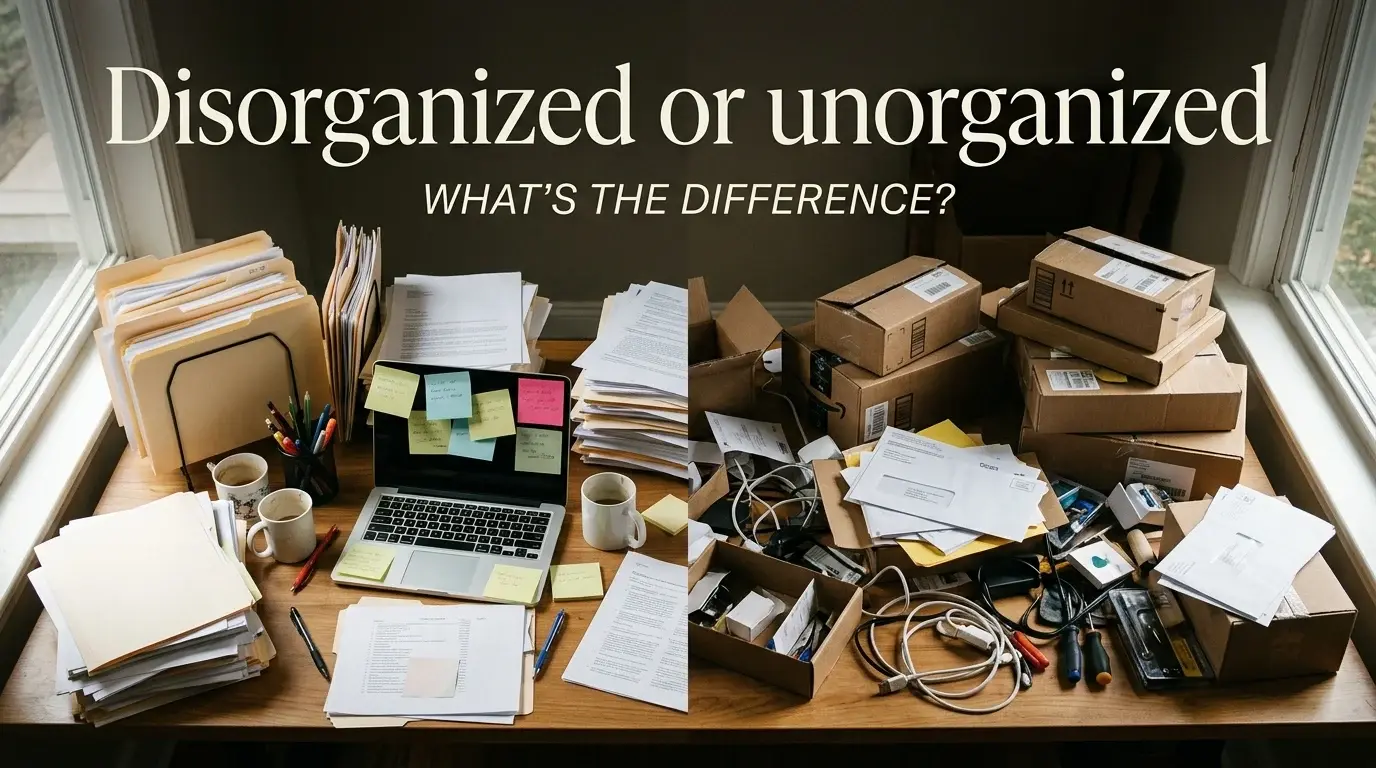
Picture this: you open a shared folder at work and find hundreds of files dumped in one place, with no names, no folders, no order. Would you call it disorganized or unorganized?
Honestly, both would be understood. Both words are correct, and in many sentences they are interchangeable.
But they are not perfectly identical. Each leans toward a slightly different idea, and choosing well can make your writing sound more precise and, in a work setting, more tactful.
This guide explains what each word means, where they overlap, where they differ, and how to pick the right one without overthinking it.
Quick Answer
Both words are correct standard English.
- Disorganized usually means messy, confusing, poorly planned, or badly managed. It is the more common word, and the natural choice for people, meetings, schedules, and rooms.
- Unorganized usually means not arranged into a system, or not formally structured. It fits files, notes, data, collections, and groups.
Quick rule: use disorganized when the problem is disorder or poor planning. Use unorganized when the point is that something hasn’t been sorted or structured.
What Does Disorganized Mean?
Disorganized (adjective) means lacking order, clear planning, or effective management.
It can describe:
- A person: someone who forgets deadlines, loses things, or struggles to plan.
- An event: a conference with no agenda, late speakers, and missing materials.
- A space: a desk or room where nothing can be found.
- A process or plan: a workflow, schedule, or presentation that is confusing or hard to follow.
Examples
- The meeting was disorganized because nobody prepared an agenda.
- My week became disorganized after the schedule changed.
- Her essay felt disorganized, jumping between unrelated ideas.
- He is disorganized when too many deadlines overlap.
Notice that disorganized often describes how well something is being run, not only how it looks.
Read More: Organised or Organized? The Correct Spelling Explained
What Does Unorganized Mean?
Unorganized (adjective) means not organized: not arranged, sorted, or formed into a system or structure.
It is most natural for:
- Information and materials: notes, files, receipts, photographs, research data.
- Groups without a formal structure: an informal committee or a loose online community.
- Labor contexts: workers who are not represented by a union.
Examples
- I have six pages of unorganized notes from class.
- The researcher saved the unorganized data in one folder.
- We inherited a box of unorganized family photographs.
- The report discussed conditions for unorganized workers.
Unorganized often states a condition (“this hasn’t been sorted yet”) rather than passing a judgment.
Disorganized vs. Unorganized: Key Differences
| Disorganized | Unorganized | |
| Main idea | Disorder, confusion, poor planning | No arrangement or formal structure |
| Typical subjects | People, meetings, schedules, rooms, workflows | Files, notes, data, collections, groups |
| Tone | Often more critical | Often more neutral or descriptive |
| Used for a person | Very common | Possible, but less natural |
| Specialized meanings | Clinical and psychological contexts | Workers without union representation; informal groups |
| Everyday frequency | Much more common | Less common |
Tone: the difference that matters most
When you call something disorganized, you often suggest that something has gone wrong: poor planning, confusion, or lost control. When you call something unorganized, you often just describe its current state.
Compare:
- “Your report is disorganized.” (sounds like criticism)
- “The report seems unorganized.” (sounds more like an observation)
This is a tendency, not a dictionary rule. Context and delivery matter more than the word alone. But if you are giving feedback and want to sound constructive, tone is a good reason to think before choosing.
A common myth: “dis-” means it used to be organized
You may read that disorganized means something was organized and then fell apart, while unorganized means it never was. This sounds neat, but it isn’t reliable. Look at this sentence:
The event was disorganized from the very beginning.
Nothing here says the event was ever organized. People use disorganized for things that never had order. And unorganized doesn’t tell you anything about the past either. Don’t rely on history to choose between them. Focus on what you want your reader to understand.
How to Choose the Right Word
Ask yourself these questions:
- Am I judging how well something is run or planned? Use disorganized. (“The registration process was disorganized.”)
- Am I describing a person’s habits? Use disorganized. (“I’m disorganized when I’m stressed.”)
- Am I saying something hasn’t been sorted into a system? Use unorganized. (“The receipts are unorganized.”)
- Am I talking about an informal group, or workers without a union? Use unorganized.
- Still unsure? Disorganized is the safer, more common choice in everyday English.
A simple picture
Imagine two closets. In the first, clothes are spilling out, hangers are tangled, and you can’t find anything. That closet is disorganized. In the second, you just moved in and haven’t unpacked yet. The boxes are closed and nothing has a place. That closet is unorganized. Either word could be applied to both, but these are the pictures each word brings to mind most easily.
Using Each Word in Different Settings
At work
Disorganized is common for meetings, projects, and workflows: “The project became disorganized after two team members left.” For documents and records, unorganized is natural: “The shared drive is still unorganized after the migration.”
At school
Teachers often say a disorganized essay when ideas lack a logical order, and a student may have unorganized notes that still need sorting into topics.
In daily life
“My morning routine is disorganized, so I’m always late.” “We found a box of unorganized photos in the attic.”
In formal or specialized writing
- Labor and economics: unorganized workers are workers without union representation. In South Asia you will often see the phrase unorganized sector for work that is informal or not covered by formal employment structures.
- Psychology and medicine: disorganized appears in clinical terms such as “disorganized thinking” or “disorganized attachment.” These are technical phrases. In everyday writing, avoid using them to label people casually.
- Government and geography: some regions, such as certain US and Canadian territories, are called unorganized because they lack a formal local government.
Spelling: American vs. British English
The meaning does not change, only the spelling:
| American English | British English |
| disorganized | disorganised |
| unorganized | unorganised |
Use -ize if you write for a US audience, and -ise if your audience expects British spelling. Whichever you choose, stay consistent throughout your document.
Pronunciation
- Disorganized: dis-AWR-guh-nyzd (/dɪsˈɔːrɡənaɪzd/)
- Unorganized: un-AWR-guh-nyzd (/ʌnˈɔːrɡənaɪzd/)
In both, the stress falls on the second syllable, “or.”
Alternatives for Disorganized and Unorganized
Sometimes a more specific word is the better choice.
Instead of “disorganized”
| Word | Best for |
| Chaotic | Strong disorder; emergencies, crowded events |
| Messy | Casual; rooms, desks |
| Cluttered | Spaces with too many items |
| Scattered | Thoughts, plans, or a person’s focus |
| Haphazard | Work done without a plan |
| Muddled | Confusing ideas or writing |
Instead of “unorganized”
| Word | Best for |
| Unsorted | Physical items or records |
| Uncategorized | Data, tags, digital files |
| Unstructured | Formal writing; data, plans, processes |
| Informal | Groups without official structure |
| Unplanned | Events or activities |
Common Mistakes to Avoid
1. Saying one of them isn’t a real word. Both are standard English and appear in major dictionaries.
2. Relying on the “used to be organized” rule. As shown above, it doesn’t hold up in real usage.
3. Using a harsh word without meaning to. In feedback, “disorganized” can sound personal. If you mean “this hasn’t been sorted yet,” unorganized, unsorted, or unstructured may land better.
4. Mixing spelling styles. Don’t write disorganized and unorganised in the same piece.
5. Overusing either word. If you can be specific, do it. “The agenda had no clear order” tells your reader more than “the meeting was disorganized.”
Key Takeaways
- Both words are correct standard English.
- Disorganized is more common and usually means disorder or poor planning.
- Unorganized usually means not sorted, arranged, or formally structured.
- The “organized before vs. never organized” rule is not reliable.
- Disorganized often sounds more critical; unorganized often sounds more neutral.
- Spell them -ize in American English and -ise in British English.
FAQs
Is it disorganized or unorganized?
Both are correct. Disorganized usually points to disorder or poor planning, while unorganized usually points to a lack of arrangement or structure. In many situations either word works.
Is unorganized a real word?
Yes. It is a standard English word found in major dictionaries. It also has a specialized meaning for workers who don’t belong to a union.
Are disorganized and unorganized the same?
They are close synonyms and overlap a lot, but they aren’t identical. Disorganized is more common and often more critical. Unorganized is often more neutral and describes a missing structure.
Which one should I use to describe a person?
Disorganized is the more natural choice: “She is disorganized when she’s overloaded.” Unorganized person is understood but less common.
Which is better for files, notes, and documents?
Unorganized fits well when items haven’t been sorted into folders or categories. Disorganized works when the files are messy or hard to navigate. Either is acceptable.
Does disorganized mean something was organized before?
Not necessarily. People use disorganized for things that never had any order, such as a poorly planned event.
Which word sounds more professional?
Neither is unprofessional, but unorganized often sounds softer and more neutral. In sensitive feedback you could also use unstructured, unsorted, or describe the specific problem instead.
What is the British spelling?
Disorganised and unorganised. American English uses disorganized and unorganized.
What does “unorganized sector” mean?
It refers to the part of an economy made up of informal or unregistered work, often without formal contracts or union representation. The term is common in South Asian economic writing.
Conclusion:
Disorganized and unorganized are both correct, and their meanings overlap. The practical difference is emphasis.
Use disorganized when you mean disorder, confusion, or poor planning, especially for people, meetings, and schedules.
Use unorganized when you mean something hasn’t been arranged into a system, such as notes, files, data, or informal groups.
If you’re ever unsure, ask what your reader most needs to understand, and consider whether a more specific word would serve them better.

As an American English writer, I specialize in creating clear and engaging content that makes grammar and language learning accessible to everyone. I enjoy breaking down complex English concepts into simple, practical lessons that readers can apply with confidence. My mission is to help learners strengthen their communication skills through easy and reliable content.










1 thought on “Disorganized or Unorganized: What’s the Difference?”