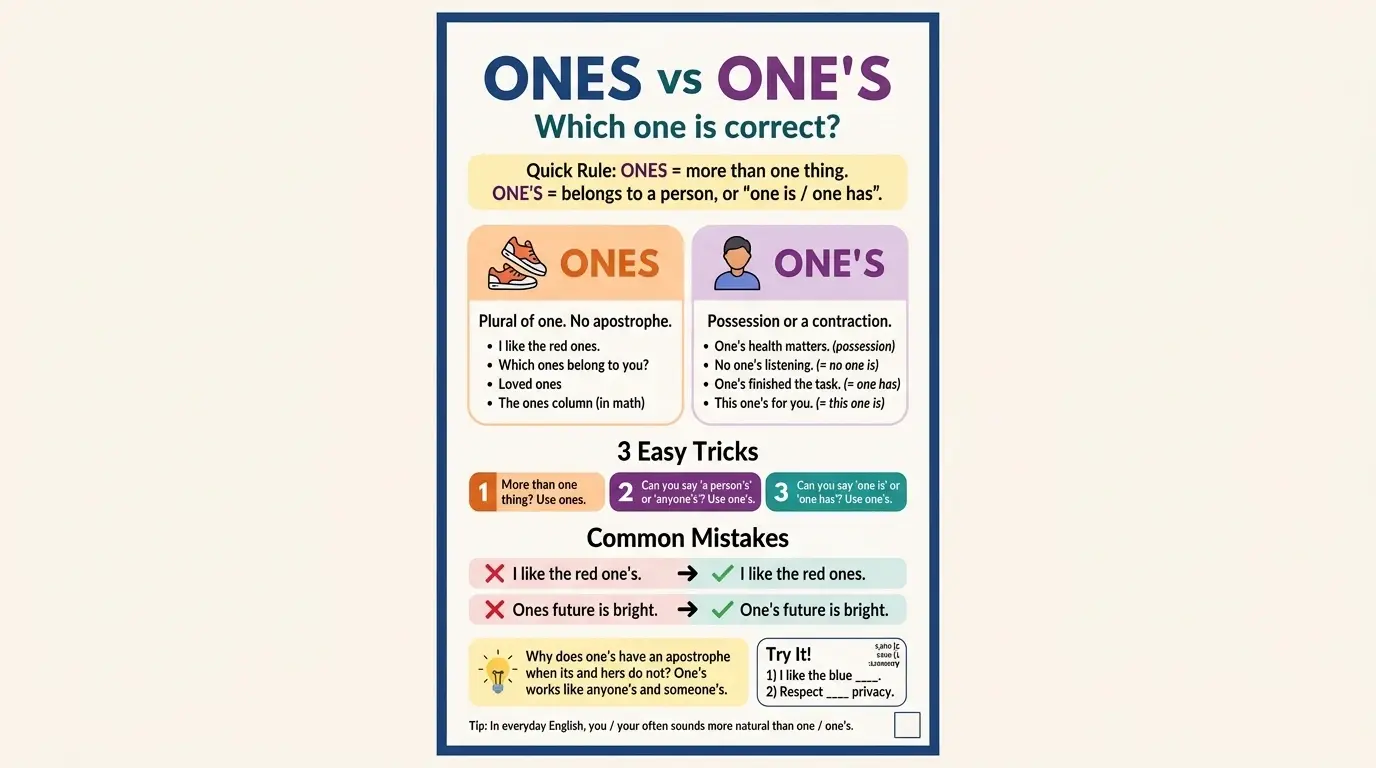
Ones is the plural of one, while one’s shows possession or can be a contraction of one is or one has. The apostrophe changes the meaning and grammatical use of the word.
Imagine writing a message about your favorite shoes. You might say, “I prefer the black ones.” But if you write, “One’s choices matter,” the apostrophe has a different purpose.
These two forms look almost identical, so it is easy to mix them up. However, the rule is simple once you understand what each word does in a sentence.
Use ones when referring to multiple people or things without repeating a noun. Use one’s when something belongs to or relates to a person described by the pronoun one. It can also shorten one is or one has.
This guide explains the difference with simple rules, real examples, and common mistakes. You will learn how to choose the correct form in everyday and formal writing.
Quick Answer Box
Ones is the plural of one and usually replaces a plural noun, as in “I like the blue ones.” One’s is the possessive form of one, as in “One’s health matters.” It can also mean one is or one has. Choose the form that matches your sentence’s meaning.
Quick Rule in 1 Line:
Use “ones” for multiple things and “one’s” for possession or the contraction “one is” or “one has.”
Ones or One’s: What’s the Difference?
Ones and one’s are both correct, but they have different grammatical uses. Ones refers to multiple people or things and often replaces a noun. One’s expresses possession or forms a contraction. The apostrophe is essential because it helps readers understand the intended meaning.
Consider these examples:
- Ones: I like the red ones better than the blue ones.
- One’s: One’s health should always be a priority.
- One’s as a contraction: One’s going to need more time.
In the first sentence, ones refers to multiple items, such as shirts, shoes, or bags. The noun does not need to be repeated because the reader already understands what the speaker means.
In the second sentence, one’s means something like “a person’s.” It refers to a person’s health in a general sense.
In the third sentence, one’s means one is. The sentence could be rewritten as “One is going to need more time.”
The correct choice depends on the role the word plays in your sentence. Do not add an apostrophe simply because the word ends in s.
A Simple Comparison
| Word | Main use | Example |
| Ones | Plural of one | I bought the cheaper ones. |
| One’s | Possession | One’s behavior matters. |
| One’s | Contraction of one is | One’s responsible for the mistake. |
| One’s | Contraction of one has | One’s already finished the task. |
The last two examples are grammatically possible in contexts where the contraction is appropriate. However, contractions can sound less formal. In formal writing, spelling out one is or one has may be clearer.
Read More: Students’ or Student’s? The Correct Possessive Form ExplainedWhen Should You Use Ones?
Use ones when you mean more than one person or thing and want to avoid repeating a noun. It is the plural form of one. It often appears after words such as the, these, those, and adjectives describing a group of items.
For example:
- I prefer the smaller ones.
- These cookies taste better than the ones we bought yesterday.
- Which ones belong to you?
- The new chairs are more comfortable than the old ones.
- She chose the blue ones instead of the green ones.
In these sentences, ones refers to people or things already understood from the context.
1. Use Ones to Avoid Repeating a Noun
Suppose you are comparing two pairs of shoes. Instead of repeating the word shoes, you can use ones.
Without ones: I like the black shoes, but I do not like the brown shoes.
With ones: I like the black ones, but I do not like the brown ones.
The second sentence is shorter and sounds natural because the reader already knows you are talking about shoes.
You can use this pattern with many countable nouns:
- I need new batteries. The old ones no longer work.
- These books are more useful than the ones I read last year.
- The large boxes are heavier than the small ones.
- We tried several recipes, but the easiest ones worked best.
2. Use Ones When Talking About a Group
Ones can identify a particular group of people or things. It is especially useful when a sentence compares different types or categories.
Examples:
- The students who studied regularly were the ones who passed.
- The ripe apples are sweeter than the green ones.
- I prefer the comfortable seats over the hard ones.
- The most expensive products are not always the best ones.
- These questions are easier than the ones on the last test.
In each example, ones points to a group that the reader can identify from the sentence.
3. Use Ones After Adjectives
You can place ones after an adjective when the noun is understood.
Examples:
- I want the fresh ones.
- She picked the red ones.
- We need stronger ones.
- The older ones are still working.
- Please bring the clean ones.
The adjective describes the people or things represented by ones. You do not need to repeat the noun if its meaning is clear.
4. Do Not Use Ones to Show Possession
Remember that ones does not show that something belongs to a person. For possession, use the appropriate possessive form.
Incorrect: Ones responsibility is to finish the task.
Correct: One’s responsibility is to finish the task.
Incorrect: I prefer the red one’s.
Correct: I prefer the red ones.
The first pair needs the possessive form one’s. The second pair needs the plural ones because it refers to multiple items, not ownership.
5. Use Ones in “Loved Ones” and “The Ones Column”
Ones also appears as a plain plural in two common cases. In loved ones, it means the people you love: “She spent the holiday with her loved ones.” In math, the ones column is the place value for single units, as in the 7 in 47. Neither case needs an apostrophe because nothing is being possessed.
When Should You Use One’s?
Use one’s when something belongs to, concerns, or relates to a person represented by the pronoun one. It is the possessive form of one. For example, “One’s choices can affect one’s future” uses the apostrophe to express possession.
This form is often used in formal, general, or instructional writing. Here, one refers to people in general rather than a specific person.
1. Use One’s to Show Possession
The word one’s can mean “a person’s” in a general statement.
Examples:
- One’s health is important.
- One’s actions have consequences.
- One’s education can open new opportunities.
- One’s attitude can influence the outcome.
- One’s responsibilities should be taken seriously.
These sentences discuss things that belong to or relate to a person. The apostrophe before the s marks the possessive form.
This use is more formal than using your or your own. In everyday conversation, many speakers would say, “Your health is important” instead of “One’s health is important.”
2. Use One’s With Common Expressions
You will often see one’s in familiar expressions and phrases.
Examples include:
- One’s own: One should make one’s own decisions.
- One’s best: Everyone should try one’s best.
- One’s life: One should value one’s life.
- One’s mind: It is important to keep one’s mind open.
- One’s responsibilities: A person should understand one’s responsibilities.
- Pull oneself up by one’s own bootstraps: to succeed through your own effort.
- A jury of one’s peers: a jury made up of people equal in standing to the accused.
- Minding one’s own business: not getting involved in other people’s affairs.
Some sentences using one can sound formal or stiff in modern English. Depending on your audience, you may choose a more natural alternative.
For example:
Formal: One should take care of one’s belongings.
More conversational: You should take care of your belongings.
Both communicate a similar idea, but the tone differs.
3. Use One’s Before a Noun
When one’s expresses possession, it commonly comes before a noun.
Examples:
- One’s opinion
- One’s family
- One’s future
- One’s personal goals
- One’s daily routine
You can use these phrases in complete sentences:
- One’s opinion may change with experience.
- One’s family can provide support during difficult times.
- One’s future depends on many factors.
- One’s personal goals should be realistic.
- One’s daily routine can affect productivity.
The apostrophe is not optional in these possessive examples. Writing ones future instead of one’s future is incorrect when you mean the future belonging or relating to a person.
4. Why One’s Has an Apostrophe When Its and Hers Do Not
This is a common point of confusion. Possessive pronouns such as its, hers, his, and theirs do not use apostrophes. One’s is the exception, because it is built from the pronoun one in the same way that anyone’s and someone’s are. If you can write anyone’s, you need the apostrophe in one’s too.
Can One’s Mean “One Is” or “One Has”?
Yes, one’s can be a contraction of “one is” or “one has.” The intended meaning depends on the rest of the sentence. This use is different from the possessive form, even though the spelling is the same.
One’s = One Is
Examples:
- One’s going to be a long day.
- One’s not easy to learn a new language.
- One’s responsible for the final decision.
- No one’s listening.
- This one’s for you.
In these examples, one’s means one is. However, some sentences may sound unnatural because one is a formal way to refer to people in general. The last two are the most natural in everyday speech: no one’s means no one is, and this one’s means this one is.
A clearer version of “One’s going to be a long day” might be “It’s going to be a long day,” depending on the intended meaning.
One’s = One Has
Examples:
- One’s already completed the assignment.
- One’s never seen that movie before.
- One’s finished the work ahead of schedule.
Here, one’s means one has when it is followed by a past participle, such as completed, seen, or finished.
Context matters because the contraction can have more than one expansion. If a sentence feels unclear, write out one is or one has instead.
How to Check the Meaning
Try replacing one’s with the full phrase.
- “One’s responsible for the report.” → “One is responsible for the report.”
- “One’s completed the report.” → “One has completed the report.”
- “One’s report is complete.” → “A person’s report is complete.”
If the replacement works, you can identify whether one’s is a contraction or a possessive form.
Ones vs One’s: Comparison Table
The easiest way to compare these words is to look at what each sentence means. Ones refers to multiple people or things, while one’s shows possession or shortens one is or one has. The apostrophe changes the word’s grammatical function.
| Example | Correct form | Why? |
| I like the blue ___ . | ones | Refers to multiple items |
| ___ health matters. | One’s | Shows possession or association |
| These are the best ___ . | ones | Refers to multiple things |
| Everyone should respect ___ privacy. | one’s | Shows possession |
| ___ going to be difficult. | One’s | Can mean “one is” |
| ___ already finished. | One’s | Can mean “one has” |
| I chose the smaller ___ . | ones | Refers to multiple items |
| ___ decisions can affect others. | One’s | Shows possession or association |
What About Ones’?
Ones’ is not the usual choice for either of the two forms discussed above. It might appear in a sentence that deliberately treats ones as a plural noun and then makes that plural noun possessive. However, this construction is uncommon and often sounds awkward.
For example, a writer might discuss “the chosen ones’ duties,” meaning the duties of a group called “the chosen ones.” In ordinary writing, a clearer phrase may be “the duties of the chosen ones.”
For most everyday grammar questions, focus on the distinction between ones and one’s. Use the plural form without an apostrophe for multiple items. Use the apostrophe form for possession or the relevant contraction.
How to Remember the Difference
Remember that “ones” has no apostrophe because it is simply a plural form, while “one’s” uses an apostrophe for possession or a contraction. Check the meaning of the sentence before choosing the spelling.
Try these simple memory tricks.
Trick 1: Ask, “Am I Talking About More Than One?”
If the answer is yes, ones may be the correct choice.
- I like the green ones.
- The older ones need repairs.
- Which ones should we choose?
In these sentences, the word replaces a plural noun.
Trick 2: Replace One’s With “A Person’s”
If the sentence still makes sense, you probably need the possessive form.
- One’s health is important.
- A person’s health is important.
The meaning is similar, so one’s is correct.
Trick 3: Try “One Is” or “One Has”
If either full phrase fits the sentence, one’s may be a contraction.
- One’s ready to leave. → One is ready to leave.
- One’s finished the task. → One has finished the task.
If neither replacement makes sense, review the sentence. You may need a possessive form or a different word.
Trick 4: Try “Anyone’s”
Swap one’s with anyone’s. If the sentence still works, you need the apostrophe.
- One’s opinion matters. → Anyone’s opinion matters.
Since anyone’s has an apostrophe, one’s needs one too.
Common Mistakes to Avoid
The most common mistake is adding an apostrophe to ones when you mean multiple things, or leaving it out when you mean possession. Always check the sentence’s meaning. Do not decide based only on how the word sounds.
Mistake 1: Using Ones for Possession
Incorrect: Ones future is important.
Correct: One’s future is important.
Why? The sentence refers to the future of a person. The possessive apostrophe is needed.
Mistake 2: Using One’s for a Plural Noun
Incorrect: I like the expensive one’s.
Correct: I like the expensive ones.
Why? The sentence refers to multiple items. It does not express possession.
Mistake 3: Confusing a Possessive With a Contraction
The word one’s can have different meanings. It can show possession or mean one is or one has.
Possession: One’s work should reflect care and effort.
Contraction: One’s finished the work.
The surrounding words help you understand the difference.
Mistake 4: Adding an Apostrophe to Every Word Ending in S
Not every word ending in s needs an apostrophe. Plural words generally do not use apostrophes just to show that there is more than one.
Examples:
- Correct: apples
- Correct: books
- Correct: ones
- Correct: one’s responsibility
An apostrophe is used for a grammatical purpose. It should not be added just because a word ends with s.
Mistake 5: Using Formal One in Every Conversation
Although one’s is grammatically correct, using one repeatedly can sound formal or old-fashioned. In casual writing, your or you may sound more natural.
Formal: One should protect one’s personal information.
Conversational: You should protect your personal information.
Choose the form that fits your audience and tone.
Examples of Ones and One’s in Sentences
These examples show how each form works in everyday writing. Ones refers to multiple people or things, while one’s expresses possession or acts as a contraction. Read the full sentence to identify the intended meaning.
Examples Using Ones
- I prefer the black shoes over the brown ones.
- The new phones are faster than the old ones.
- Which ones did you buy at the store?
- These apples are sweeter than the ones we picked yesterday.
- The students who arrived early were the ones who found seats.
- We need clean towels, not the wet ones.
- The smaller boxes fit better than the larger ones.
- She likes mystery novels more than the romantic ones.
- The blue flowers look brighter than the white ones.
- Please put the broken toys aside and keep the good ones.
Examples Using One’s for Possession
- One’s health should never be taken for granted.
- One’s actions can affect other people.
- It is important to respect one’s privacy.
- One’s goals may change over time.
- One should learn from one’s mistakes.
- One’s family can offer valuable support.
- One’s choices can influence the future.
- Everyone should take responsibility for one’s work.
- One’s attitude can shape the way one handles challenges.
- One should protect one’s personal information online.
Some examples use the formal pronoun one. In everyday English, you can often replace it with you to make the sentence sound more conversational.
Examples Using One’s as a Contraction
- One’s going to need a little more time.
- One’s already completed the first step.
- One’s not always easy to please.
- One’s finished the task ahead of schedule.
- One’s going to be responsible for the final choice.
These contractions are possible, but they may sound formal or unnatural in some contexts. For clarity, consider writing one is or one has in formal work.
Quick Practice Quiz
Choose ones or one’s for each sentence. Answers are below.
- I like the red ___ better.
- It is important to respect ___ privacy.
- No ___ listening to the speech.
- She spent the holiday with her loved ___.
- This ___ for you.
Answers: 1. ones. 2. one’s. 3. one’s (no one is). 4. ones. 5. one’s (this one is).
Key Takeaways
- Ones is the plural of one.
- One’s is the possessive form of one.
- One’s can also mean one is or one has.
- Use ones when replacing a plural noun, as in “the red ones.”
- Use one’s for possession, as in “one’s health.”
- Do not add an apostrophe just to make a word plural.
- If anyone’s fits the sentence, one’s needs an apostrophe too.
- In everyday writing, you and your may sound more natural than formal uses of one and one’s.
FAQs
1. Is it ones or one’s?
Both forms are correct, but they have different meanings. Ones is the plural of one and often replaces a noun. One’s shows possession or means one is or one has. Choose the spelling that fits your sentence.
2. What does ones mean?
Ones is the plural form of one. It can refer to multiple people or things when the noun is already clear. For example, “I like the red ones” means “I like the red items,” such as shirts or shoes.
3. What does one’s mean?
One’s is the possessive form of one. It refers to something that belongs to or relates to a person in a general sense. For example, “One’s health is important” means that a person’s health is important.
4. Does one’s mean “one is”?
Yes. One’s can be a contraction of one is. For example, “One’s ready” can mean “One is ready.” It can also mean one has, as in “One’s finished.” The surrounding words reveal the intended meaning.
5. Is ones correct without an apostrophe?
Yes. Ones is correct when it refers to multiple people or things. For example, “These are the ones I wanted.” You do not need an apostrophe to make one plural.
6. Should I write “one’s own” or “ones own”?
Write one’s own when you mean something belonging to a person. For example, “Everyone should make one’s own decision” uses the possessive form. The spelling ones own is incorrect when expressing this meaning.
7. Is “loved ones” correct?
Yes. Loved ones is the correct expression when referring to people you love, such as family members or close friends. It does not need an apostrophe because ones is plural, not possessive.
8. What is the plural of one?
The plural form of one is ones. For example, you might say, “The new ones are better than the old ones.” The word often replaces a noun that has already been mentioned.
9. Can one’s be used in formal writing?
Yes. One’s is correct in formal writing when expressing possession or forming a contraction. However, contractions are often avoided in highly formal writing. You can write one is or one has instead when greater clarity is needed.
10. How can I quickly tell ones and one’s apart?
Ask what the sentence means. If you are referring to multiple things, use ones. If you mean something belongs to or relates to a person, use one’s. You can also test whether one’s means one is or one has.
Conclusion:
Ones and one’s are both correct, but they are not interchangeable. Use ones when referring to multiple people or things.
Use one’s to express possession or to shorten one is or one has.
The easiest way to choose is to check the meaning of the sentence before adding an apostrophe.
With this simple rule, you can avoid a common grammar mistake and write more clearly.

I am an English language writer passionate about grammar and clear communication. I create simple, easy-to-understand content that helps readers improve their English skills. My goal is to make learning English both practical and enjoyable.





1 thought on “Ones or One’s: What’s the Difference? Meaning, Rules, and Examples”