You are about to email your team to ask whether they would join a new training program. You type “We are gauging interest…” and stop. Should it be gaging?
Spellcheck did not complain either way, which makes the doubt worse.
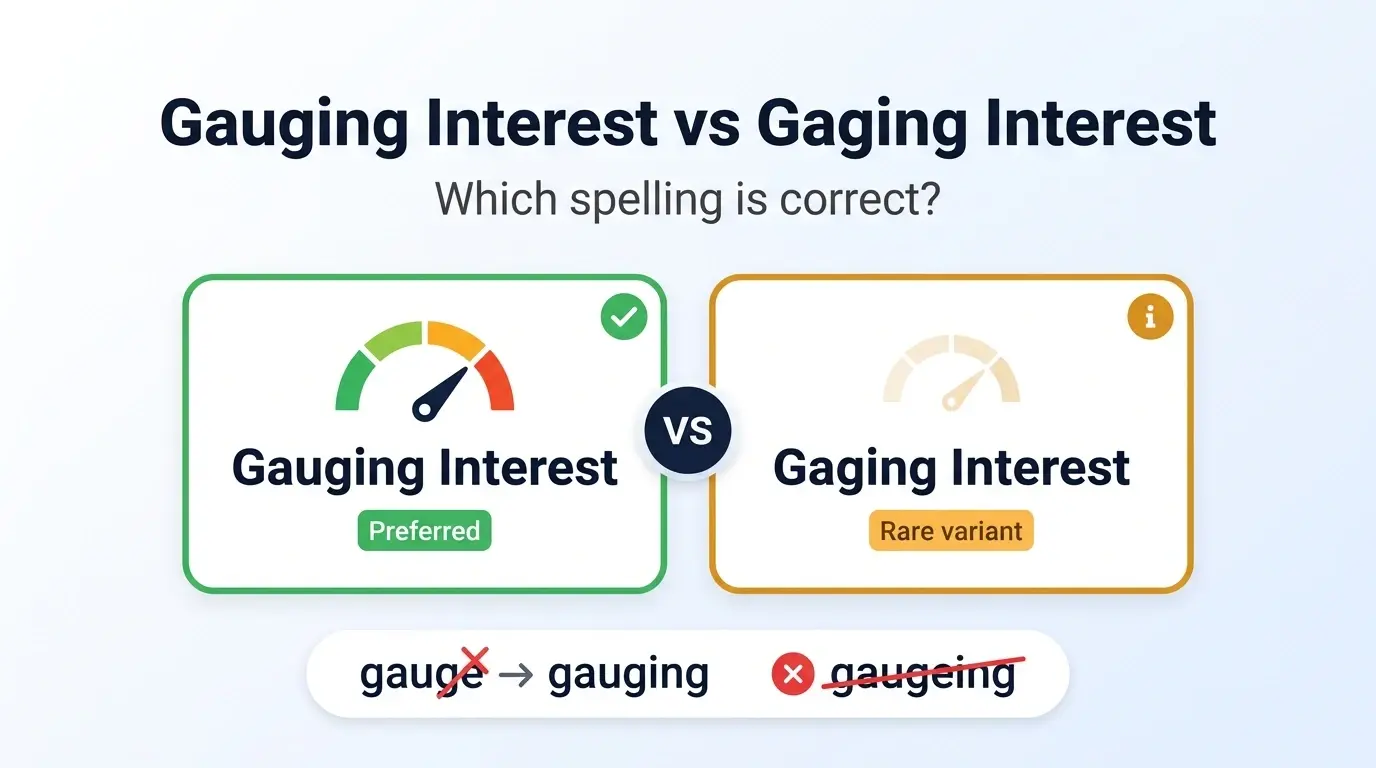
The short answer: gauging interest is the spelling to use almost every time.
Gaging interest is not a made-up word, but it is a rare variant that most readers will take for a typo.
This guide explains the difference, why the mix-up happens, and how to actually gauge interest once your spelling is right.
Gauging Interest vs Gaging Interest: The Quick Answer
Use “gauging interest.” It is the standard spelling in American and British English, and it is what readers and editors expect.
“Gaging interest” is a recognized variant, not the standard form. Major dictionaries list gage as an alternative spelling of gauge, mostly in American English and technical fields, so gaging can appear. In everyday, business, and academic writing, though, it looks like a mistake.
| Gauging interest | Gaging interest | |
| Base word | gauge | gage |
| Meaning | Estimating how interested people are | Same meaning, when used as a variant |
| Status | Standard, preferred | Rare variant |
| Best for | Emails, reports, essays, web content | Only where a style guide or technical field requires gage |
| Example | We are gauging interest in the course. | We are gaging interest in the course. |
Rule of thumb: gauge → gauging. Drop the silent e, then add -ing.
What Does “Gauging Interest” Mean?
Gauging interest means finding out how interested people are in something before you commit to it. You might do it before launching a product, booking a venue, starting a project, or proposing a change at work.
Imagine you want to run a weekend writing workshop. Before paying for a room, you ask around to see how many people would sign up. Their answers tell you whether the idea is worth pursuing. That is gauging interest.
The phrase is common in business, marketing, education, and event planning. It does not always involve numbers. You can gauge interest with a survey, but also by asking a few questions, watching how people react, or counting who replies to an invitation.
What does the verb “gauge” mean?
As a verb, gauge means to measure, estimate, or judge. It can describe a physical measurement, such as gauging the depth of a river, or a judgment about people, such as gauging someone’s mood from their tone of voice.
As a noun, a gauge is a measuring instrument or a standard of measurement, as in a fuel gauge or a tire-pressure gauge.
When you gauge interest, you treat interest as something that can be estimated, even if it cannot be measured exactly.
How do you pronounce gauge and gauging?
Gauge sounds like “gayj” and rhymes with page. Gauging is “GAY-jing.” The au does not match the sound, which is one reason people second-guess the spelling.
Read More: Written or Writen: Which Spelling Is Correct? Easy Rule & Examples
Is “Gaging Interest” Also Correct?
It exists, but it is a poor default. Gage is a legitimate English word, so forms built from it, such as gaging, are not invented. The real question is not whether the spelling exists but whether your reader expects it.
Two separate things are going on with gage.
Gage as a spelling variant of gauge
In American English, gage is an accepted alternative spelling of gauge, and it survives mostly in technical and institutional settings. The U.S. Geological Survey, for example, uses gage in its own terminology, such as “streamgage.” That is an organizational convention, not a sign that gaging interest suits general readers.
Gage as a separate, older word
Gage also has its own older meaning: a pledge, a security deposit, or a challenge. “To throw down the gage” means to issue a challenge, as in a medieval duel. This sense is now rare and mostly literary or historical.
Neither sense is a natural fit for “interest” in everyday writing. If you write gaging interest for a general audience, many readers will assume you made a spelling error.
So is “gaging interest” wrong?
Not strictly. It is better described as non-standard for general writing. Calling it “never a real word” is inaccurate, and treating it as equal to gauging is misleading. Choose gauging interest unless a specific style guide tells you otherwise.
Why Do People Confuse Gauge and Gage?
The mix-up is easy to understand. Four things usually cause it:
- The words look alike. They differ by two letters, and fast readers do not notice the change.
- Spellcheck often stays silent. Gage is a real word, so software may not flag it even when it is not what you meant.
- The spelling is irregular. Gauge does not sound the way it is written, so writers fall back on the shorter, more phonetic-looking gage.
- Variants exist. Because gage is legitimate in some contexts, writers assume both forms work everywhere.
How to Spell Gauging Correctly (and Avoid “Gaugeing”)
The standard pattern is simple:
gauge + -ing = gauging
The final silent e is dropped before -ing, exactly as in other common verbs:
- make → making
- write → writing
- change → changing
- gauge → gauging
“Gaugeing” is always wrong. Keeping the e is a common slip, especially in fast typing.
- Correct: We are gauging customer interest.
- Incorrect: We are gaugeing customer interest.
The past tense is gauged (“We gauged interest last month”), and the noun is gauge (“a gauge of interest”).
Other Common Misspellings: Guage, Guaging, and Gague
Guage, guaging, and gague are all misspellings. The correct forms are gauge and gauging, with the a before the u.
Most of these errors come from swapping the first two vowels. The word sounds like “gayj,” so the letters are easy to scramble when typing fast.
| Misspelling | Correct form |
|---|---|
| guage | gauge |
| guaging | gauging |
| gague | gauge |
| gage interst | gauge interest |
A quick memory trick: think of a gas gauge. Both words start with ga. If you can picture the gauge on a dashboard, you can picture the spelling, g-a-u-g-e.
Examples of Gauging Interest in Sentences
The phrase usually takes a person, group, or audience whose interest is being assessed. These examples show it in different settings.
Business and marketing
- We are gauging interest in the new product before placing a large order.
- The company is gauging customer interest through a short online survey.
- Our team is gauging interest in a possible subscription plan.
- Early signups helped us gauge public interest before the official announcement.
Events and community
- The organizer is gauging interest in a weekend workshop.
- We made a quick poll to gauge interest in the neighborhood event.
- The library is gauging interest in a new reading group.
Work and education
- The manager sent an email to gauge interest in flexible working hours.
- The instructor asked a few questions to gauge the class’s interest in the next project.
- The university is gauging interest in an online version of the course.
Everyday conversation
- I’m gauging interest before I invite everyone to the party.
- He mentioned the idea casually to gauge my interest.
You can also say gauge someone’s interest, gauge public interest, gauge demand, or gauge reaction.
Read More: Its vs. It’s: A 5-Second Test to Choose Correctly
Gauge My Interest, Gauge Their Interest: Using the Phrase Naturally
You can gauge my, your, his, her, or their interest, or simply gauge the interest. The pronoun goes between “gauge” and “interest,” and you do not need “of.”
| Pattern | Use it when | Example |
| gauge my / your interest | You mean one specific person | The recruiter called to gauge my interest in the role. |
| gauge their interest | You mean a group or customers | The shop sent a short form to gauge their interest in a loyalty card. |
| gauge the interest | You mean interest in general | Let’s gauge the interest before booking the hall. |
| gauge the level of interest | You care about how strong it is | The poll will help us gauge the level of interest. |
| a gauge of interest (noun) | You mean a sign or measure | Early ticket sales are a good gauge of interest. |
The tense changes the verb, not the pattern: “She gauged my interest in a short call,” or “I am gauging your interest before I send the proposal.”
“Just gauging interest” and “trying to gauge interest” are softer, casual versions. “Just gauging interest” tells people there is no pressure or commitment yet. “Trying to gauge interest” suggests you are still deciding whether to go ahead.
If you searched for “gage my interest” or “gage their interest,” the standard spelling is still gauge. The phrase “interest gauge” is not a standard everyday phrase, so “a gauge of interest” sounds more natura
How to Gauge Interest in Practice
Getting the spelling right is the easy part. Gauging interest well is harder, because people do not always do what they say. Someone may reply “Sounds great!” and never show up.
Common methods
| Method | Best used when | Main strength | Main limit |
| Surveys and polls | You need quick opinions from many people | Fast and easy to run | People may overstate their interest |
| Direct conversations | Your audience is small | Rich, honest detail | Hard to scale |
| Sign-up or waitlist | You want proof of real intent | Shows people took action | Needs an audience that already knows you |
| Pre-orders or deposits | You are testing demand for a product | Strongest signal of commitment | Harder to ask for |
| Engagement data (clicks, replies, views) | Content or campaigns are already live | Based on real behavior | Shows attention, not always intent |
| A/B testing | You are comparing two messages or offers | Clear, controlled comparison | Needs enough traffic to be reliable |
Focus Groups and Pilot Programs
When a survey is too shallow, try a focus group or a pilot program. Both give you deeper feedback before you commit fully.
- Focus group: a small group discusses your idea while you listen and ask follow-up questions. It shows why people like or dislike something, which a survey often cannot.
- Pilot program: you release a small, limited version of your idea and watch what happens. Sign-ups, repeat use, and feedback show how people behave when the idea is real.
A focus group is better for understanding opinions. A pilot is better for seeing real behavior.
Stated interest vs. real interest
What people say and what people do are different signals.
- Stated interest comes from surveys, replies, and conversations. It is cheap and useful, but optimistic.
- Behavioral interest comes from actions such as signing up, paying, attending, or coming back. It is harder to collect and more reliable.
The strongest approach combines both. Start with a quick survey, then ask interested people to take a small real step, such as joining a list or paying a deposit.
Steps to gauge interest before you launch
- Define what you are testing. Be specific: the idea, the price, the date, or the format.
- Pick the right audience. Ask people who would actually use or attend it, not only friends who want to be polite.
- Ask a clear, neutral question. “Would you attend a two-day workshop on this topic for $50?” works better than “Don’t you think a workshop would be great?”
- Look for commitment, not just enthusiasm. A signup beats a “maybe.”
- Set a threshold in advance. Decide how many yes answers mean “go” and how many mean “rethink.”
- Review and decide. Treat the result as guidance, not a guarantee.
What to measure
Interest has layers, so one number rarely tells the whole story:
- Attention: views, clicks, and opens show that people noticed.
- Engagement: replies, questions, and time spent show that people cared enough to respond.
- Intent: signups, waitlist joins, and deposits show that people are leaning toward acting.
- Retention: repeat visits or ongoing participation show interest that lasts.
A short spike of attention is not the same as steady interest, so compare results over time when you can.
How to Gauge Someone’s Interest in Conversation
To gauge a person’s interest, notice how much effort they put in, not just what they say. One signal alone rarely tells you much, but a pattern usually does.
Here is what to look for:
- They ask questions back. People who are interested want to know more.
- Their replies are timely and detailed. One-word answers often mean low interest, though a busy person may reply briefly too.
- They suggest next steps. Offering a time, a plan, or a follow-up is a strong sign.
- Their energy changes. In person, eye contact, leaning in, and a livelier tone can show real engagement.
If you are unsure, ask directly: “Would you like to do this again?” A clear question saves more time than guessing.
Keep in mind that shy or busy people may show interest quietly. Treat what you notice as a hint, not proof.
“Gauging someone” can also mean sizing up their mood or character, as in gauging how a colleague feels about a decision.
Synonyms for Gauging Interest
If you want variety, these alternatives keep the same meaning:
- assess interest
- measure interest
- test demand
- sound out people’s interest
- estimate the response
- find out whether people are interested
Gauge interest remains the most natural and concise choice in most business writing.
Synonyms for the Verb Gauge on Its Own
Gauge, used alone, can be replaced by estimate, assess, judge, evaluate, or size up. The best choice depends on what you are measuring.
- estimate: gauge how many people will come
- assess / evaluate: gauge the results of a test
- judge: gauge how far away a car is
- size up: gauge a new colleague quickly
- read / sense: gauge the mood in the room
Pick the closest fit, and keep “gauge” when you want a short, natural word.
Common Mistakes to Avoid
1. Writing “gaugeing”
The e is dropped: gauging, not gaugeing.
2. Using “gaging” without a reason
In general writing, gaging will probably be read as a typo. Use it only when a style guide or technical convention requires gage.
3. Claiming “gaging” is not a real word
It is a recognized variant. The more accurate statement is that it is non-standard for general writing.
4. Mixing both spellings in one document
Pick one form and use it throughout. Inconsistency looks careless.
5. Treating interest as a guarantee
Gauging interest estimates how people feel today. It does not promise that they will buy, attend, or support the idea later.
6. Assuming a survey is always required
Surveys help, but conversations, sign-ups, and observed behavior can all reveal interest too.
When Should You Use Gauging or Gaging?
Use gauging for nearly everything: blog posts, emails, proposals, school assignments, reports, presentations, surveys, and social media.
Consider gaging only if you write inside a field or organization that consistently uses gage, such as certain hydrology or engineering documents, and its style guide requires that spelling.
When no special rule applies, follow the form your readers expect: gauging interest.
FAQs
Is it gauging interest or gaging interest?
Gauging interest is the preferred spelling. Gaging interest is a rare variant that most readers will take for a typo, so use gauging in everyday and professional writing.
Is “gaging” a real word?
Yes, it exists as a form of the variant spelling gage, but it is uncommon. For the meaning “to estimate or measure,” gauging is the standard choice.
What does gauging interest mean?
It means trying to find out how interested people are in an idea, product, event, or plan. For example, a company may survey potential customers before launching a product.
What is the difference between gauge and gage?
Gauge is the standard spelling for measuring, estimating, and for measuring instruments. Gage is a variant spelling in some American and technical contexts, and it also has an older, separate meaning of “pledge” or “challenge.”
Why is gauging spelled without an e before -ing?
The silent e in gauge is dropped before -ing, the same way make becomes making. That is why gaugeing is incorrect.
Is “gaugeing” ever correct?
No. The correct form is gauging.
Can I use “gauging interest” in a professional email?
Yes. For example: “We are gauging interest in the proposed training session before confirming a date.”
Is “gauge interest” correct?
Yes. Gauge interest is the base form, gauging interest is the -ing form, and gauged interest is the past tense.
What is the easiest way to remember the spelling?
Think gauge → gauging: drop the e and add -ing. If you are unsure, choose gauging interest.
What is the best way to gauge interest before a launch?
Combine methods. Start with a quick survey or conversations, then look for stronger signals such as signups, waitlist joins, or pre-orders. Actions are more reliable than opinions.
Conclusion
Gauging interest is the correct and preferred spelling for almost all writing.
It means estimating how interested people are in an idea, product, or event, and it follows the standard rule of dropping the final e from gauge before adding -ing.
Gaging interest is not an invention, since gage is a recognized variant, but it is rare outside specialized settings and will often look like a mistake. Gaugeing is simply wrong.
Use gauging interest in your emails, reports, and articles, keep your spelling consistent, and remember that the best way to gauge interest is to watch what people do, not only what they say.
Read More: New Year or New Years? The Correct Spelling and Grammar Explained

I’m Sophia Mitchell, an English grammar and writing enthusiast. I create simple, easy-to-understand content to help learners improve their English. My goal is to make grammar clear, practical, and enjoyable for everyone.











1 thought on “Gauging Interest vs Gaging Interest: Which Spelling Is Correct?”