You type “I drink tea everyday,” pause, and wonder whether a space is missing. You’re not alone.
The two forms sound almost identical out loud, so your ear can’t help you, and even confident writers second-guess themselves.
The fix is smaller than it seems. One word describes a thing. Two words describe how often something happens.
In this guide you’ll get clear definitions, three quick tests you can run in seconds, examples for school, work and home, the mistakes people make most, and a few tricky cases most guides skip. By the end, choosing between everyday vs every day will feel automatic.
The Short Answer
Here is the whole rule in two lines:
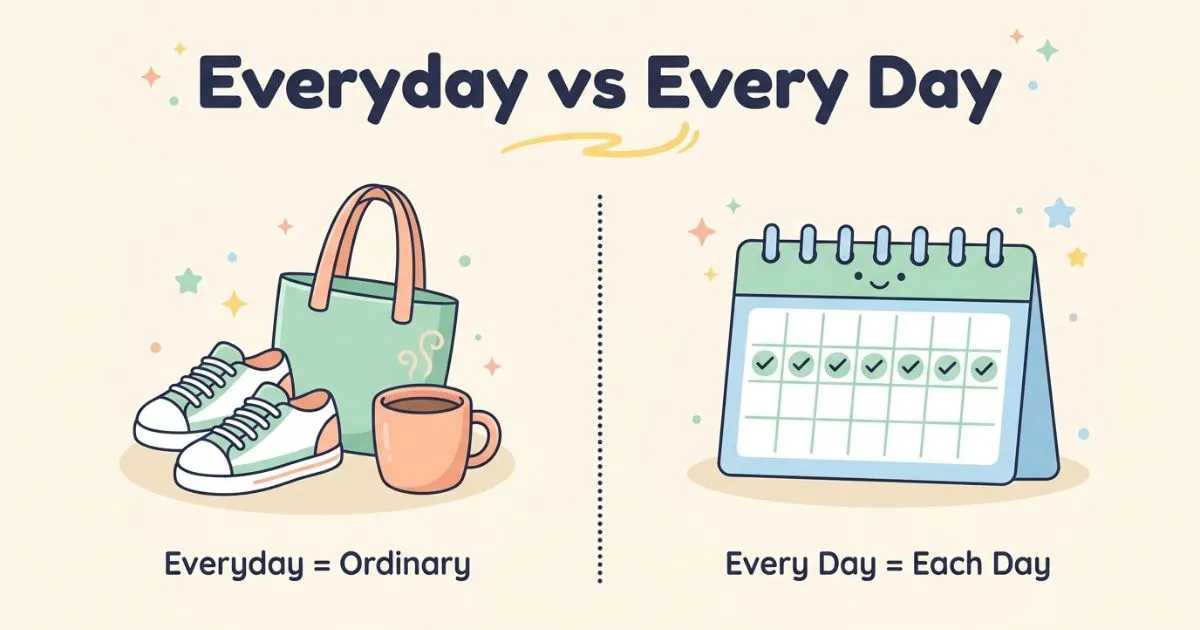
- Everyday (one word) is an adjective. It means ordinary, typical, or part of normal routine, and it sits in front of a noun.
- Every day (two words) means “each day.” It tells the reader how often something happens.
Both can live in one sentence: I wear my everyday shoes every day. The first one describes what kind of shoes they are. The second says how often you wear them.
Here’s a handy way to link them. If you do something every day, it can become an everyday habit.
What Does “Everyday” Mean?
Everyday is a single word with one job: describing a noun. Think “normal, regular, nothing special.”
Thesauruses offer words like ordinary, usual, routine, standard, average and mundane. Any of these will usually slot in without changing the sense.
Everyday in Sentences
- Her everyday bag is big enough for a laptop.
- Money worries can weigh on everyday life.
- He explained the topic in everyday language, with no jargon.
- Cooking is an everyday task in our house.
- Wear everyday clothes for the hike and save the nice jacket for dinner.
A Contrast That Helps
Everyday clothing means the ordinary things you wear on regular days, as opposed to outfits for weddings or holidays. So “everyday” often carries a quiet comparison with something special or unusual.
It Doesn’t Always Mean “Daily”
This is easy to miss. Everyday problems are not necessarily problems that happen on each single day. The word means ordinary or commonplace. That’s why you can’t always treat it as a synonym for “daily.”
Read More: Its vs. It’s: A 5-Second Test to Choose Correctly
What Does “Every Day” Mean?
Every day is two separate words. Every is an adjective and day is a noun. Together they mean “each day,” exactly like every word means “each word” or every page means “each page.”
Because it answers the question “how often?”, it usually appears after a verb or at the end of a sentence:
- I stretch every day before work.
- The bakery sells out of bread every day.
- She calls her grandmother every day.
- We learn a few new words every day.
Starting a Sentence With It
You can also open with it, followed by a comma: Every day, the cat waits by the window for us to come home.
When It Is the Subject
Sometimes “every day” is the thing the sentence is about: Every day is a chance to improve. It’s still two words and still means each day. You could say “each day is a chance to improve” and nothing breaks.
Why Do People Mix Them Up?
There are two reasons. First, both look like real words, so a spell checker rarely complains. Second, they sound alike.
There is a small difference in speech, though. In everyday, the stress falls on the first syllable (EV-ry-day). In every day, the stress usually lands on the last word (every DAY).
That can help you hear the difference when you speak. But fast talking blurs it, so don’t rely on sound when you write. Use the tests below instead.
Three Quick Tests to Choose the Right Form
Test 1: Swap in “Each Day”
Replace the phrase with each day. If the sentence still makes sense, write two words.
- They feed the ducks every day. → They feed the ducks each day. ✅
- We discussed everyday scenarios. → We discussed each day scenarios. ❌
The second one breaks, so it stays as one word: everyday scenarios.
Test 2: Add “Single”
Put the word single between every and day. If it fits naturally, you need two words.
- We talked on the phone every day after school. → every single day after school. ✅
- Consider your everyday habits first. → Consider your every single day habits first. ❌
Test 3: Swap in “Ordinary”
Replace the word with ordinary or usual. If the meaning survives, write one word.
- These are my everyday shoes. → These are my ordinary shoes. ✅
- I study every day. → I study ordinary. ❌
Which Test Should You Use?
Start with Test 1, because it’s the fastest. If you’re still unsure, run Test 3 as a double-check. When both agree, you can stop worrying.
Side-by-Side Comparison
| Everyday | Every day | |
| Spelling | One word | Two words |
| Part of speech | Adjective | Adverbial phrase of time |
| Meaning | Ordinary, usual | Each day |
| Usual position | Before a noun | After a verb, or at the start with a comma |
| Quick test | Swap in “ordinary” | Swap in “each day” |
| Example | everyday shoes | I walk every day |
Real-Life Examples
The same topic can need either form. What matters is the job the word is doing.
At school
- Reading is an everyday part of my routine.
- I read for twenty minutes every day.
At work
- Clear writing is an everyday work skill.
- I answer customer emails every day.
At home
- Laundry is an everyday chore in a big family.
- We eat dinner together every day.
In messages and emails
- Thanks for the everyday tips. (describes the tips)
- Thanks for checking in every day. (says how often)
Common Mistakes and How to Fix Them
1. Using “Everyday” After a Verb
❌ I exercise everyday.
✅ I exercise every day.
You’re saying how often. That calls for two words.
2. Splitting the Word Before a Noun
❌ These are my every day shoes.
✅ These are my everyday shoes.
You’re describing the kind of shoes, not the frequency.
3. Trusting the Spell Checker
Both forms are valid words, so most checkers won’t flag the wrong one. A quick read-through with the tests is more reliable.
4. Choosing by Topic Instead of Grammar
Writing about daily life doesn’t automatically mean you need “everyday.” Compare I use this app every day with This is my everyday app. The topic is the same, but the grammar differs.
5. Over-Correcting
After learning the rule, some writers start using “every day” everywhere. That leads to errors like an every day problem. If the phrase sits in front of a noun and describes it, go back to one word: an everyday problem.
Tricky Cases Worth Knowing
Both Forms in One Sentence
I wear my everyday jacket every day in winter. This looks odd but is perfectly correct. Run the tests on each one separately.
“Everyday” as a Noun
Occasionally people use everyday as a noun, as a shorthand for their routine. You may spot it in casual writing, but in your own work it’s safer to stick with the adjective.
Other Pairs With the Same Problem
Anytime/any time and anyone/any one cause the same trouble. The one-word and two-word versions don’t always mean the same thing, so it’s worth pausing on those too.
A Two-Minute Proofreading Routine
Use this before you publish or submit anything:
- Search your document for “everyday.”
- For each result, try swapping in “ordinary.” If it doesn’t fit, add a space.
- Search for “every day.”
- For each result, try “each day.” If it fails, or the phrase sits before a noun, join it into one word.
Practice: Choose the Right Form
Fill in each blank with everyday or every day. Answers are below.
- I check my messages ______.
- She packed her ______ clothes for the trip.
- ______, the bus arrives at eight.
- Traffic is an ______ problem in big cities.
- We practise spelling ______.
- He talks about ______ life in simple words.
- They walk to school ______.
- This is just an ______ pen, nothing fancy.
Answers: 1. every day, 2. everyday, 3. Every day, 4. everyday, 5. every day, 6. everyday, 7. every day, 8. everyday.
FAQs
Is “everyday” one word or two?
It depends on the meaning. Write everyday as one word when it describes something ordinary or routine, as in everyday clothes. Write every day as two words when you mean each day, as in I read every day. Both are correct; they just do different jobs.
Is “I go there everyday” correct?
No. In that sentence you’re saying how often you go, so you need two words: I go there every day. A quick check is to swap in each day. If “I go there each day” makes sense, the space belongs.
Can I write “my every day routine”?
In standard writing, no. When the word describes a noun, use the one-word adjective: my everyday routine. Two-word every day belongs with actions and time. The ordinary swap confirms it, because “my ordinary routine” sounds right.
Is “everyday” the same as “daily”?
Not quite. Every day means daily, and the two often swap. But everyday means ordinary or commonplace, and it doesn’t promise that something happens each day. Everyday problems are common ones, not necessarily problems that appear every single day.
Do they sound different when spoken?
Slightly. In everyday, the stress falls on the first syllable. In every day, the stress usually lands on day. Many speakers blur this in fast conversation, so don’t rely on sound when writing. Use the each-day test instead.
How can I check a long document quickly?
Use your editor’s search for everyday. For each result, try replacing it with ordinary. If that makes no sense, add a space. Then search every day and confirm each one means each day or isn’t sitting before a noun. It takes a couple of minutes.
Conclusion:
The everyday vs every day question comes down to one idea. One word describes something ordinary, and two words say how often something happens.
If “each day” fits, use two words. If “ordinary” fits, use one.
Your next step is simple. Open something you wrote recently, run the two-minute proofreading routine, and fix any slips.
After a few rounds, you won’t need the tests anymore.

As an American English writer, I specialize in creating clear and engaging content that makes grammar and language learning accessible to everyone. I enjoy breaking down complex English concepts into simple, practical lessons that readers can apply with confidence. My mission is to help learners strengthen their communication skills through easy and reliable content.










1 thought on “Everyday vs Every Day: The Simple Rule That Ends Confusion”