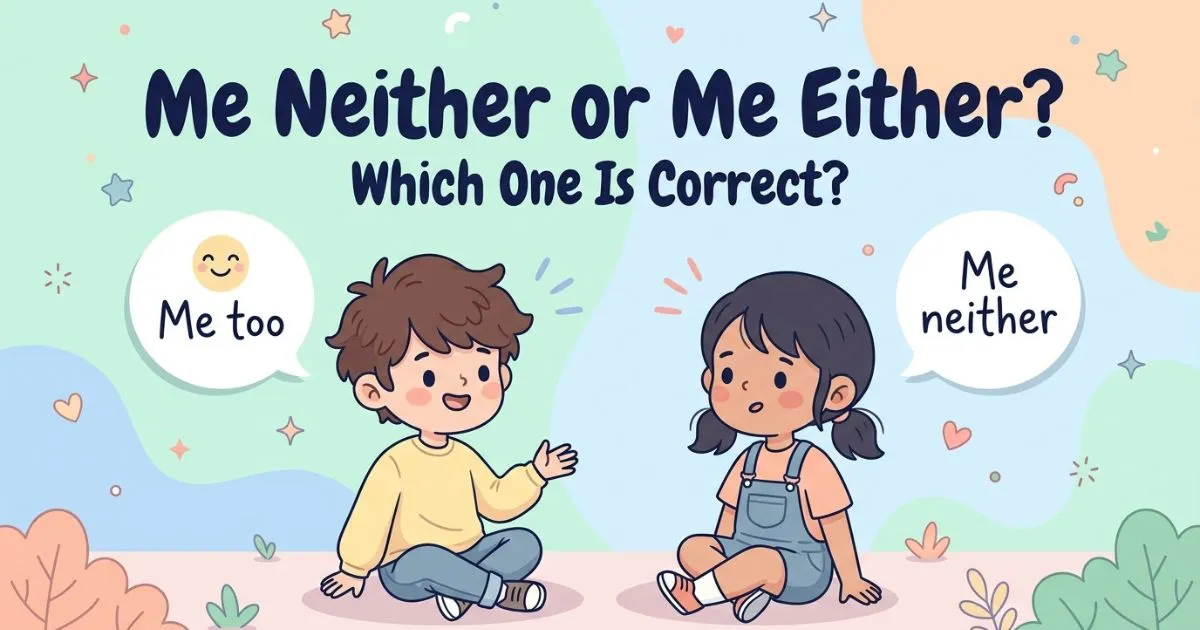
Your friend groans, “I don’t feel like going to work today.” You feel exactly the same, so you want to agree in two quick words. But which two? “Me neither” or “me either”?
The confusion is fair. Both phrases are everywhere, and both do the job in everyday conversation. Yet dictionaries and grammar guides don’t fully agree on which one is better, and some people call “me either” a mistake.
In this guide, you’ll learn what each phrase means, what Britannica and GrammarBook actually say, which one to pick in different situations, and what to say when you need a more polished reply.
The Quick Answer
Here is the short version before we go deeper:
- Casual reply to a negative statement: “Me neither” is the safer choice. Britannica says many people use “me either” too, but some consider it incorrect.
- Writing, school, or work emails: Skip both. Say “Neither do I,” “Nor do I,” or “I don’t either.”
- Reply to a positive statement: Use “me too.” Never “me either” or “me neither.”
One honest caveat: the experts are not unanimous. GrammarBook discourages both phrases, yet leans slightly toward “me either” for American English. You’ll see why below, and you’ll see why “me neither” is still the lower-risk habit.
What Do “Me Neither” and “Me Either” Mean?
Both phrases do one job. They tell the other person, “That’s true for me too,” when the original statement was negative.
How the Shortcut Works
Think of these phrases as a shortened version of a longer sentence. The listener fills in the missing words from the conversation.
- “I haven’t tried the new café.” / “Me neither.” = “I haven’t tried it either.”
- “I’m not ready for the quiz.” / “Me neither.” = “I’m not ready either.”
- “I don’t want to wake up early.” / “Me either.” = “I don’t want to wake up early either.”
Notice that the first speaker’s sentence always has a negative idea in it: haven’t, not, don’t, never. That negative is what makes these replies work.
Are They Formal or Casual?
Casual. GrammarBook describes both as idiomatic rather than formal constructions, which means people use them because they sound natural, not because they follow strict grammar rules. They are perfect for a chat with a friend and risky in an essay.
Read More: Everyday vs Every Day: The Simple Rule That Ends Confusion
Is It “Me Neither” or “Me Either”? What the Sources Say
Two well-known references take slightly different positions. Reading them side by side explains why this question never seems to die.
Why the Sources Disagree
Here is the thing. Neither phrase is a complete, grammatical sentence, so people argue over which shortcut makes more sense.
- The case for “me neither”: The original statement is negative, and “neither” carries a negative meaning. It feels like a natural match.
- The case for “me either”: It works like a shortened “I don’t either.” The word “either” is the one that normally appears at the end of a negative sentence.
- The “me” problem: Both phrases use “me” where a full sentence would use “I.” That is part of why strict grammar guides don’t love them.
Both arguments are reasonable, which is exactly why the safest habit is to match your reply to your audience.
Which One Should You Use?
A simple way to decide is to look at where you are and who is listening.
| Situation | Best choice | Example |
| Chatting with friends | “Me neither” | “I can’t stand loud restaurants.” / “Me neither.” |
| Texting or social media | “Me neither” or “same here” | “I haven’t started yet.” / “Same here.” |
| Class presentation or interview | “Neither do I” / “I don’t either” | “I don’t enjoy public speaking.” / “Neither do I.” |
| Essay, report, or email | Full sentence | “I do not support the plan either.” |
Why lean toward “me neither” in casual talk? Because Britannica notes that some people consider “me either” incorrect, while the same source treats “me neither” as the standard short reply. You lose nothing by choosing the one fewer people will question.
That said, don’t correct a friend who says “me either.” It is a common spoken habit, and everyone understands it.
Better Alternatives for Formal Situations
When the setting is serious, or when you simply want to sound more precise, use a complete reply. These are easy once you know the pattern.
Use “Neither” or “Nor” Plus the Right Helper Verb
Start with “neither” or “nor,” then repeat the helper verb from the first speaker’s sentence, then add “I.”
| They say | You reply |
| I don’t drive. | Neither do I. |
| I can’t swim. | Neither can I. |
| I wasn’t ready. | Neither was I. |
| I haven’t finished. | Neither have I. |
| I’m not tired. | Neither am I. |
| I won’t be late. | Nor will I. |
The helper verb must match. “I can’t swim” calls for “can,” not “do.”
Use “I Don’t Either”
This one is flexible and sounds very natural. You simply repeat the negative and add “either” at the end.
- “I don’t like horror movies.” / “I don’t either.”
- “I haven’t seen it.” / “I haven’t either.”
- “I can’t make it.” / “I can’t either.”
GrammarBook offers a similar option: repeating the full thought, as in “I do not want to go to work either.” It may feel a little stiff in conversation, but it is perfectly correct in writing.
Try “Same Here”
“Same here” is a friendly, flexible reply that works for both positive and negative statements. It sidesteps the whole debate. If you ever freeze up, it is a handy escape route in casual talk.
“Me Too” vs. “Me Neither”: Match the First Statement
The easiest way to pick the right reply is to ignore the phrases for a moment and look at what the other person said. Is it positive or negative?
Positive Statement: Use “Me Too”
Britannica is clear about this: for a positive statement, the grammatical short reply is “me too.”
- “I love going to the beach.” / “Me too.”
- “I went to a summer camp as a kid.” / “Me too!”
- “I’m so tired.” / “Me too.”
The fuller versions are “So do I” and “So am I.” They mirror “Neither do I” and “Neither am I.”
Never Use “Me Either” for a Positive Statement
Britannica answers a reader who asked whether “I love this meal” can be answered with “me either.” The answer is no. For agreeing with a positive statement, the correct reply is “me too.”
Here is a handy way to remember:
- Positive statement? Say “me too.”
- Negative statement? Say “me neither” (casual) or “neither do I” (careful).
- Not sure? Say “same here.”
When Short Replies Create Confusion
Short replies can occasionally cause a misunderstanding, especially when the first sentence is about another person.
GrammarBook points out a good example. Imagine someone says, “I don’t trust them,” and you answer, “Me either.” Depending on the context, that could mean “I don’t trust them either” or even “You don’t trust me either.” If two people have just argued, the second meaning becomes possible.
The fix is easy. When there is any chance of confusion, use a complete sentence:
- “I don’t trust them either.”
- “Neither do I.”
Clear communication always beats saving two seconds.
Common Mistakes to Avoid
Most errors with these phrases fall into a few patterns.
- Using a negative reply for a positive statement. “I love this song.” / “Me neither.” This says the opposite of what you mean. Use “me too.”
- Picking the wrong helper verb. “I can’t swim.” / “Neither do I.” The first sentence uses “can,” so the reply needs “can”: “Neither can I.”
- Adding a second negative. “Neither don’t I” does not work. “Neither” already carries the negative idea, so the helper verb stays positive: “Neither do I.”
- Saying “either do I.” It sounds like it should work, but it is not a standard reply. Use “neither do I” instead.
- Using the shortcut in formal writing. GrammarBook suggests that choosing more precise wording can strengthen how refined and professional you sound. In an essay or work email, write the full sentence.
Quick Practice: Test Yourself
Cover the answers and try these. There may be more than one good reply.
- “I’ve never tried sushi.” → Me neither / Neither have I.
- “I love rainy days.” → Me too / So do I.
- “I can’t sleep without a fan.” → Neither can I / I can’t either.
- “I wasn’t ready for the news.” → Neither was I.
- “I’m so tired today.” → Me too / So am I.
- “I didn’t see the message.” → Neither did I / I didn’t either.
If you got most of these right, you already have the pattern: look at the first sentence, then match its mood and its helper verb.
FAQs
1. Is it “me neither” or “me either”?
Both are used to agree with a negative statement, but “me neither” is the safer choice. Britannica says “me either” is often considered ungrammatical, even though many people say it. In writing or formal speech, use “neither do I” or “I don’t either” instead.
2. Can I say “me either” after a positive statement?
No. If someone says “I love this meal,” the correct short reply is “me too.” Britannica specifically addresses this. “Me either” and “me neither” only match negative statements, such as “I don’t like this meal.”
3. Is “me neither” formal or informal?
Informal. It suits conversations with friends, family, and coworkers, but not essays or professional emails. GrammarBook describes these phrases as idiomatic rather than formal. In formal settings, use “neither do I,” “nor do I,” or “I don’t either.”
4. What can I say instead of “me neither”?
Several options work. “Neither do I,” “Nor do I,” and “I don’t either” are all complete and correct. In casual talk, “same here” is a friendly shortcut. Just match the helper verb: “I can’t swim” calls for “Neither can I.”
5. Should I say “me too” or “me neither”?
Look at the first statement. Use “me too” to agree with something positive, like “I love pizza.” Use “me neither” to agree with something negative, like “I don’t like pizza.” Saying “me neither” to a positive statement flips your meaning.
6. Which one is better in American English?
The experts differ. Britannica treats “me neither” as the safer reply, while GrammarBook discourages both but calls “me either” the better of the two for American English. Since “me either” can draw criticism, “me neither” remains the lower-risk everyday choice.
Conclusion:
So, is it “me neither” or “me either”?
In casual speech, both are understood, but “me neither” is the safer pick, since some people consider “me either” incorrect. For formal situations, skip both and choose “neither do I,” “nor do I,” or “I don’t either.”
Remember the basics. Positive statement, “me too.” Negative statement, “me neither” in a casual chat or a complete reply when you want to be precise.
Your next step is simple: the next time someone says something negative, try answering with “Neither do I” or “I don’t either.” A few repetitions, and it will feel as natural as the shortcut.

I’m Sophia Mitchell, an English grammar and writing enthusiast. I create simple, easy-to-understand content to help learners improve their English. My goal is to make grammar clear, practical, and enjoyable for everyone.








2 thoughts on “Is It “Me Neither” or “Me Either”? A Clear Guide”