You are about to send an important email when you freeze. Is it “its deadline” or “it’s deadline”?
That tiny apostrophe causes one of the most common spelling mistakes in English, and it can make a careful message look rushed.
The good news is that its vs. it’s comes down to a single question. Are you showing that something belongs to or is connected with a thing, or are you shortening “it is” or “it has”?
In this guide, you will get plain-language rules, a quick test that works almost every time, real examples, the mistakes to avoid, and a short quiz so you can check yourself.
Its vs. It’s: The Quick Answer
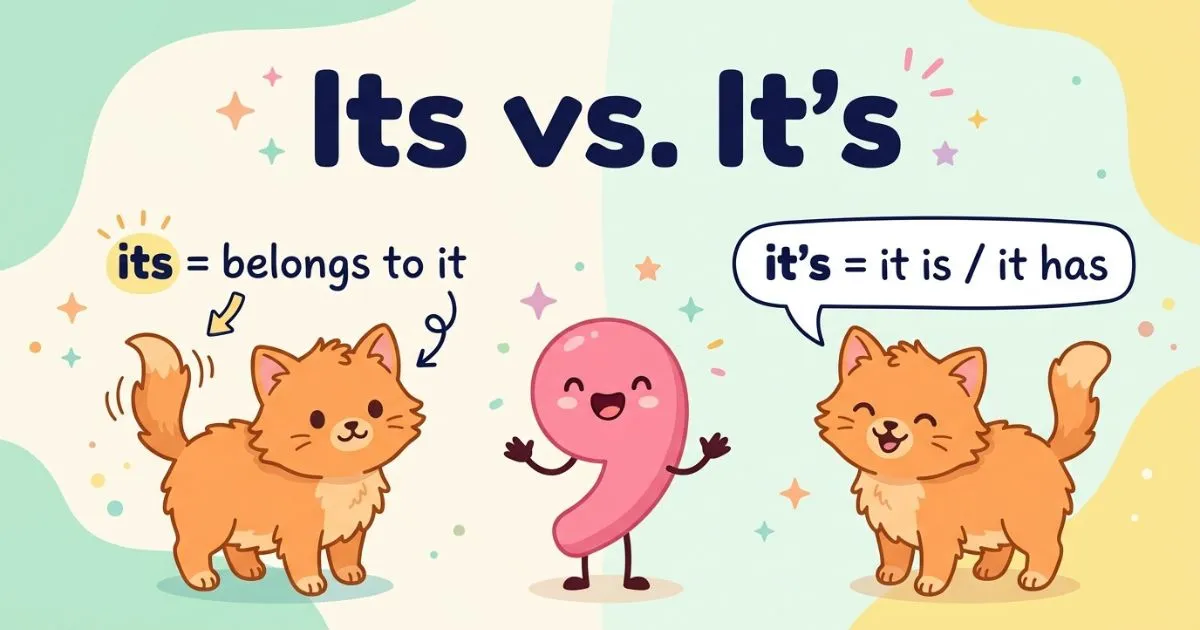
Its (no apostrophe) shows that something belongs to or is connected with “it.” It’s (with an apostrophe) is a short form of “it is” or “it has.”
| Word | Meaning | Example |
| its | belonging to it | The bird cleaned its feathers. |
| it’s | it is | It’s a sunny morning. |
| it’s | it has | It’s been a busy week. |
If you remember only one thing, remember this: the apostrophe in it’s replaces missing letters. It never shows ownership.
What Does “Its” Mean?
Its is a possessive word. It tells the reader that a person, animal, object, place, or group has something, or that something is part of it. It works the same way as his, her, and their, but for things that are not male or female.
Notice that “its” almost always comes right before a noun:
- The dog wagged its tail.
- The school changed its schedule.
- The laptop is too old for its new software.
“Its” Is Not Only About Ownership
The word does not always mean legal ownership. A city can have its history, a book can have its own style, and a plan can have its weak points. In each case, “its” simply links the noun to the thing it belongs to or describes.
“Its” With Groups and Personification
You can use “its” for groups such as teams, companies, and committees:
- The committee announced its decision.
- The team celebrated its first win.
Writers also use “its” when they give human qualities to nature or objects:
- The storm left damage in its path.
- Time moves at its own pace.
Can “Its” Refer to a Person?
Mostly, no. Its is meant for things, animals, and groups. Some dictionaries also list it for a baby or child whose sex is unknown, but for people you would normally use his, her, or their.
Why Doesn’t “Its” Have an Apostrophe?
Because possessive pronouns never use one. Look at the pattern:
- I → my
- you → your
- he → his
- she → her/hers
- we → our
- it → its
Nobody writes “hi’s book” or “your’s.” Its simply follows the same rule. The apostrophe-plus-s habit belongs to nouns, as in “Sara’s bag” or “the company’s website.”
Read More: How to Spell Whether or Not (and Never Mix It Up Again)
What Does “It’s” Mean?
It’s is a contraction, which means two words squeezed into one. The apostrophe shows where letters were removed. Study it like any other contraction: they are becomes they’re, and he is becomes he’s.
When “It’s” Means “It Is”
This is the most common use. If you can say “it is” in its place, the apostrophe is correct.
- It’s a beautiful day. (It is a beautiful day.)
- It’s important to double-check names. (It is important…)
- It’s getting late. (It is getting late.)
Here the apostrophe replaces the letter i.
When “It’s” Means “It Has”
You can also use it’s for “it has,” but only when has works as a helping verb before a past participle such as been, gone, or started.
- It’s been a long week. (It has been a long week.)
- It’s already started. (It has already started.)
- It’s got a great view. (It has got a great view.)
In this case, the apostrophe replaces the letters ha.
Be careful with this one. When “has” means “owns” or “includes,” it does not shrink this way. “It’s a nice garden” means “It is a nice garden,” not “It has a nice garden.” If you want the second meaning, write “It has a nice garden.”
“It’s” Does Not Mean “It Was”
Another quick warning: it’s never stands for “it was.” If your sentence talks about the past, write the full words.
- Correct: It was raining yesterday.
- Incorrect: It’s raining yesterday.
The 5-Second Test for Choosing Between Its and It’s
You do not need to memorize grammar terms. Use this simple test instead.
- Find the word in your sentence.
- Replace it with “it is.” Does the sentence still make sense?
- If not, try “it has.” Does that make sense?
- If neither works, use its with no apostrophe.
Let’s try it on a real sentence:
The restaurant changed ___ menu because ___ been losing customers.
- First blank: “The restaurant changed it is menu” makes no sense, and neither does “it has menu.” Use its.
- Second blank: “because it has been losing customers” works. Use it’s.
Correct sentence: The restaurant changed its menu because it’s been losing customers.
Read it back with the full forms: “…because it has been losing customers.” The sentence works, so the choice is right.
Its vs. It’s Examples
Seeing both words in action makes the pattern easier to remember.
“Its”
- The cat washed its face.
- The company updated its privacy policy.
- The tree lost its leaves early this year.
- The phone ran out of its battery.
- The town is proud of its old library.
“It’s”
- It’s too early to decide.
- It’s raining again.
- It’s been a pleasure working with you.
- It’s easier than I expected.
- It’s a good idea to save your work.
Both in One Sentence
- It’s a great app, but its design feels crowded.
- The dog is wagging its tail because it’s excited.
- It’s clear that the shop improved its service.
Each pair shows the same idea: one word is a short form, and the other shows connection.
Common Mistakes With Its and It’s
Even confident writers slip here. Watch for these five.
Mistake 1: Adding an Apostrophe to Show Possession
- ❌ The puppy chewed it’s bed.
- ✅ The puppy chewed its bed.
“The puppy chewed it is bed” makes no sense, so the apostrophe has to go.
Mistake 2: Dropping the Apostrophe From a Contraction
- ❌ Its a lovely day.
- ✅ It’s a lovely day.
This one is common in fast emails and text messages. The meaning is “it is,” so the apostrophe belongs there.
Mistake 3: Writing “Its Been”
- ❌ Its been a long time.
- ✅ It’s been a long time.
If you can say “it has been,” you need the apostrophe.
Mistake 4: Inventing “Its’”
- ❌ The club held its’ annual meeting.
- ✅ The club held its annual meeting.
There is no standard word spelled its’. The only forms in modern English are its and it’s.
Mistake 5: Writing “It’s Own”
- ❌ The brand has it’s own style.
- ✅ The brand has its own style.
“Own” follows a possessive, so you need its.
Why Do People Mix Them Up?
There are three reasons, and knowing them helps you catch the mistake.
1. We learn that apostrophes show possession. We see “Maria’s phone” and “the school’s rules” so often that any possessive feels like it needs an apostrophe. Pronouns are the exception.
2. The two words sound identical. Words that sound the same but have different spellings and meanings are called homophones. In speech, nobody notices the difference. In writing, the spelling matters.
3. Its has a confusing past. According to ProWritingAid’s grammar guide, English writers once used “his” for neuter nouns. Around 1600, “its” appeared, and for a while it was written with an apostrophe. By the 1800s the apostrophe was dropped, in line with his, hers, and yours. So if the old habit feels natural, that is partly why.
How to Proofread for Its and It’s
Reading aloud will not help, since both words sound the same. Try these instead:
- Search your document. Use Find to look for “it’s” and “its,” then test each one with “it is” or “it has.”
- Slow down on fast writing. Emails, chats, and social posts are where most slips happen.
- Read the full form. Mentally expand every “it’s” into two words. If the sentence breaks, fix it.
Quick Practice Quiz
Choose its or it’s for each blank. Answers are below.
- The company opened ___ new office last week.
- ___ been a long time since we last met.
- The laptop lost ___ charge overnight.
- I think ___ going to rain this afternoon.
- The team celebrated ___ victory.
- ___ a shame the café changed ___ menu.
Answers: 1. its 2. It’s 3. its 4. it’s 5. its 6. It’s / its
If you got all six, you have the habit. If you missed one, run the 5-second test on it and see where the logic changed.
FAQs
Is it “its” or “it’s”?
Both are correct, but they mean different things. Use its to show that something belongs to or is connected with a thing, as in “The cat licked its paw.” Use it’s when you mean “it is” or “it has,” as in “It’s cold today.”
Is “its’” a real word?
No. Its’ is not a standard word in modern English. The only correct forms are its (possessive) and it’s (the contraction of “it is” or “it has”). If you see its’ in a draft, delete the extra apostrophe.
Can “it’s” ever show possession?
No. In standard modern English, the apostrophe in it’s marks missing letters, not ownership. If you are showing that something belongs to a thing, write its. A quick check: if “it is” or “it has” does not fit the sentence, you need its.
Why doesn’t “its” have an apostrophe?
Possessive pronouns do not use apostrophes. We write my, your, his, her, our, and their without them, and its follows the same pattern. Apostrophes show possession with nouns, such as “the company’s website,” but not with pronouns.
Does “it’s” ever mean “it was”?
No. It’s stands for “it is” or “it has,” never “it was.” If you are talking about the past, write “it was” in full. For example, say “It was raining yesterday,” not “It’s raining yesterday.”
Can I use “it’s” in formal writing?
Yes, when it correctly means “it is” or “it has.” Some formal documents prefer full forms such as “it is” for style, but the contraction is not incorrect. Check any style guide your school, employer, or publisher requires.
Can “its” refer to people?
Its mainly refers to things, animals, and groups, such as “the team and its coach.” Some dictionaries also list it for a child whose sex is unknown. For individual people, use his, her, or their instead.
Conclusion:
The difference between its vs. it’s is small but easy to master. Use its when something belongs to or is connected with a thing.
Use it’s only when you mean “it is” or “it has.” The apostrophe never shows possession in this word.
Your next step is simple: open something you wrote recently, search for “it’s” and “its,” and check each one with the 5-second test. After a few rounds, you will stop needing the test.

I am an English language writer passionate about grammar and clear communication. I create simple, easy-to-understand content that helps readers improve their English skills. My goal is to make learning English both practical and enjoyable.




1 thought on “Its vs. It’s: A 5-Second Test to Choose Correctly”