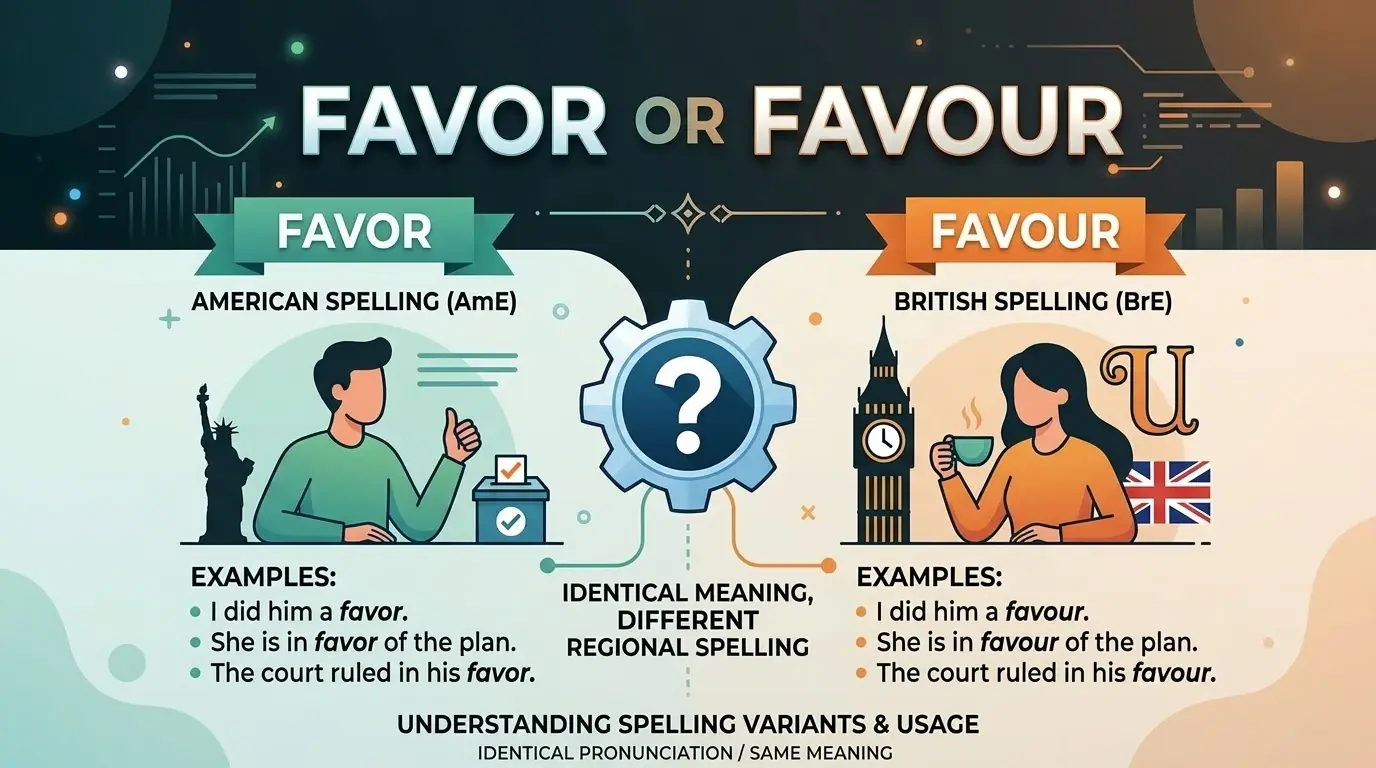
You are writing an email, school assignment, or professional message when you suddenly pause: should it be favor or favour?
Both spellings are correct, but the right choice depends on the type of English you are using.
Favor is the standard spelling in American English, while favour is used in British English and other varieties influenced by British spelling.
They have the same meaning and pronunciation, so the difference is mainly regional spelling.
This small difference can be confusing, especially when you read websites, books, or messages from different countries.
You may also see related forms such as favorite/favourite and favorable/favourable, which follow the same spelling pattern.
In this guide, you will learn when to use favor or favour, see clear examples, and discover an easy way to remember the difference.
Quick Answer
Favor is the standard American English spelling, while favour is the standard British English spelling. Both words have the same meaning and pronunciation. The main difference is the letter u. U.S. writers normally use favor, while British writers use favour.
For example:
- American English: Can you do me a favor?
- British English: Can you do me a favour?
Neither spelling is wrong. The correct choice depends on the variety of English you are using.
Cambridge Dictionary identifies favor as the U.S. spelling of favour and favour as the UK spelling of favor.
Quick Rule
Use favor in American English and favour in British English; both spellings have the same meaning.
What Is the Difference Between Favor and Favour?
Favor and favour have the same meaning, but they belong to different English spelling systems. Favor is used in American English, while favour is used in British English and other varieties that follow British spelling conventions.
The difference is simply the letter u.
American English
favor
British English
favour
For example:
Could you do me a favor?
This is the standard American spelling.
A British writer would normally write:
Could you do me a favour?
The meaning does not change.
The word can be used as both a noun and a verb.
As a noun, favor or favour can mean help, support, approval, or a small gift.
As a verb, it can mean to support, prefer, or give an advantage to someone or something.
Cambridge lists these meanings for both forms and identifies the spelling difference as a U.S.-British variation.
Read More: Thank You in Advance or Advanced? The Correct Phrase ExplainedIs Favor the American Spelling?
Yes, favor is the standard American English spelling. If you are writing for readers in the United States, favor is normally the preferred form. American English removes the u found in the British spelling favour.
Examples include:
- Do me a favor.
- She asked me for a favor.
- The decision went in his favor.
- I am in favor of the proposal.
- The evidence appears to favor one explanation.
These examples use the standard American spelling.
The same word appears with a u in British English:
- Do me a favour.
- She asked me for a favour.
- The decision went in his favour.
- I am in favour of the proposal.
- The evidence appears to favour one explanation.
The meaning remains the same.
If your website targets a U.S. audience, using favor consistently is the better choice.
Is Favour the British Spelling?
Yes, favour is the standard British English spelling. British English normally keeps the u in words such as favour, colour, and honour.
For example:
Could you do me a favour?
A British reader will recognize this as the standard spelling.
You may also see:
- in favour of
- favourable
- favoured
- favouring
These forms follow the same British spelling pattern.
In American English, they usually become:
- in favor of
- favorable
- favored
- favoring
Grammarly notes that American and British English have several spelling differences involving -or and -our endings. Words such as color/colour, honor/honour, and favor/favour follow this pattern.
Favor or Favour: Comparison Table
| American English | British English | Meaning |
| favor | favour | Support, approval, help, or preference |
| favorable | favourable | Positive or helpful |
| favored | favoured | Preferred or given an advantage |
| favoring | favouring | Supporting or preferring |
| favorably | favourably | In a positive way |
| favorite | favourite | Most liked or preferred |
The main spelling pattern is easy to see.
American English usually uses -or.
British English usually uses -our.
However, you should not assume that every word ending in -or changes to -our in British English. English has exceptions, so individual words should be checked when you are unsure.
Favor and Favour Have the Same Meaning
Favor and favour are not different words with different meanings. They are spelling variants used in different varieties of English. Changing the spelling does not change the basic meaning.
For example:
She asked me for a favor.
And:
She asked me for a favour.
Both sentences mean that she asked someone to help her.
The only difference is the spelling convention.
The same applies to:
The decision was in his favor.
and:
The decision was in his favour.
Both mean that the decision benefited or supported him.
This is an important point because some readers may think the u changes the meaning.
It does not.
The difference is regional spelling.
Why Does American English Use Favor?
American English uses favor without the letter u as part of a broader spelling pattern that distinguishes many American spellings from British ones. Similar differences appear in words such as color/colour and honor/honour.
The shorter American forms became established through changes in American English spelling.
Noah Webster played an important role in promoting distinctive American spelling conventions. His dictionaries influenced American written English and helped establish forms that differed from British conventions.
However, it would be too simple to say that Webster personally created every American spelling difference.
The history of English spelling developed over a long period.
Grammarly explains that words such as color, favor, and honor use the shorter -or spelling in American English, while British English uses colour, favour, and honour.
The result is the spelling difference we see today:
American: favor
British: favour
Favor vs Favour: Which One Is More Correct?
Neither spelling is universally more correct. Favor is correct in American English, while favour is correct in British English. Your choice should match the English variety and audience you are writing for.
If you are writing for an American audience, use:
favor
If you are writing for a British audience, use:
favour
For example, a U.S. business email might say:
Could you do me a favor?
A British email might say:
Could you do me a favour?
Both are grammatically correct.
The important thing is consistency.
If you choose American English, avoid switching between favor and favour without a reason.
Favor and Favour in Common Expressions
The spelling difference appears in many common phrases.
Do me a favor
American English:
Could you do me a favor?
British English:
Could you do me a favour?
The phrase means asking someone to help you.
In favor of
American English:
The committee voted in favor of the proposal.
British English:
The committee voted in favour of the proposal.
The phrase means supporting or approving something.
Find favor
American English:
The new plan found favor with the committee.
British English:
The new plan found favour with the committee.
The phrase means receiving approval or support.
Win someone’s favor
American English:
He tried to win her favor.
British English:
He tried to win her favour.
The meaning is the same.
Out of favor
American English:
The style has fallen out of favor.
British English:
The style has fallen out of favour.
Again, only the spelling changes.
Favor, Favour, and Related Words
The spelling difference does not stop with the basic word.
Several related forms also change between American and British English.
Favor vs. Favour
American:
favor
British:
favour
Favorable vs. Favourable
American:
The review was favorable.
British:
The review was favourable.
Favored vs. Favoured
American:
She is the favored candidate.
British:
She is the favoured candidate.
Favoring vs. Favouring
American:
The evidence is favoring one explanation.
British:
The evidence is favouring one explanation.
Favorably vs. Favourably
American:
The product was viewed favorably.
British:
The product was viewed favourably.
The same American-British pattern continues across these related forms.
Favorite or Favourite?
Favorite and favourite follow the same American-British spelling difference. American English uses favorite, while British English uses favourite.
For example:
American:
Blue is my favorite color.
British:
Blue is my favourite colour.
Notice that both words change in the British sentence.
favorite → favourite
color → colour
This is useful because readers often encounter these words together.
Cambridge Dictionary identifies favorite as the U.S. spelling of favourite.
So if you are writing in American English, use:
favorite
If you are writing in British English, use:
favourite
Common Mistakes With Favor and Favour
The most common mistake is not choosing the wrong spelling. It is mixing American and British spelling styles in the same piece of writing.
Mistake 1: Mixing favor and favour
For example:
My favorite color is blue, and I asked him for a favour.
The sentence is understandable.
However, it mixes American favorite/color with British favour.
If you are following American English, write:
My favorite color is blue, and I asked him for a favor.
If you are following British English, write:
My favourite colour is blue, and I asked him for a favour.
Consistency makes your writing look more polished.
Mistake 2: Thinking favour is incorrect
Favour is not incorrect.
It is the standard British spelling.
If you see favour in a British newspaper or book, the spelling is not a mistake.
Mistake 3: Thinking favor is incorrect
Favor is not incorrect.
It is the standard American spelling.
If you are writing for U.S. readers, favor is the normal choice.
Mistake 4: Changing the spelling in a quotation
If you are quoting a source, do not automatically change its spelling.
For example, if a British source uses favour, keep the original spelling when quoting it.
The same applies to American sources using favor.
This helps preserve the original wording.
How to Remember Favour vs Favor
A simple memory trick is to connect favor with other common American spellings.
American English
favor
color
honor
British English
favour
colour
honour
Think:
American English drops the U.
This is not a rule for every English word.
But it works for this group of common words.
Another useful trick is to remember the phrase:
American = favor
British = favour
If your target audience is in the United States, choose the shorter spelling.
15 Examples Using “Favor” in American English
Here are natural examples using the American spelling:
- Could you do me a favor?
- She asked me for a small favor.
- The decision went in his favor.
- I am in favor of the new plan.
- The evidence seems to favor this explanation.
- The weather may favor the home team.
- He wanted to win her favor.
- The policy received favor from several groups.
- The new design was viewed favorably.
- The judge ruled in the defendant’s favor.
- The company favored the cheaper option.
- The conditions favor rapid growth.
- She was the favored choice for the position.
- The proposal was received favorably.
- He asked his neighbor for a favor.
All of these use standard American spelling.
15 Examples Using “Favour” in British English
Here are equivalent examples using the British spelling:
- Could you do me a favour?
- She asked me for a small favour.
- The decision went in his favour.
- I am in favour of the new plan.
- The evidence seems to favour this explanation.
- The weather may favour the home team.
- He wanted to win her favour.
- The policy received favour from several groups.
- The new design was viewed favourably.
- The judge ruled in the defendant’s favour.
- The company favoured the cheaper option.
- The conditions favour rapid growth.
- She was the favoured choice for the position.
- The proposal was received favourably.
- He asked his neighbour for a favour.
The meanings remain the same.
Only the spelling conventions differ.
When Should You Use Favor?
Use favor when you are writing in American English. This is especially useful for U.S. websites, school assignments, business writing, emails, resumes, and other documents aimed at American readers.
Examples:
- favor
- favorite
- favorable
- favored
- favoring
If your website targets the United States, maintaining these American spellings throughout your articles will give your content a consistent style.
When Should You Use Favour?
Use favour when you are following British English spelling conventions.
This is common in writing intended for readers in the United Kingdom and in other regions that use British spelling conventions.
Examples:
- favour
- favourite
- favourable
- favoured
- favouring
The word is not more formal or less formal than favor.
It is simply the British spelling.
Is Favour vs Favor Used in Canada?
Canadian English can use spelling conventions from both American and British English. Favour is commonly used in Canadian English, although Canadian spelling has its own patterns and should not simply be treated as identical to British English.
For a U.S.-focused article, the important distinction is:
United States → favor
United Kingdom → favour
If your content targets Canada, check the preferred Canadian spelling for the specific word and context.
Does the Pronunciation Change?
The pronunciation of favor and favour is essentially the same in standard American and British usage.
The main difference is the spelling.
American:
favor
British:
favour
You do not need to change the pronunciation simply because the spelling changes.
This is one reason the words can be confusing when you hear them instead of seeing them written.
Is Favor a Noun or a Verb?
Favor can be both a noun and a verb.
As a noun, it can mean help, approval, support, or a small gift.
Can you do me a favor?
As a verb, it can mean to prefer or support something.
The evidence favors this explanation.
British English uses favour in both cases:
Can you do me a favour?
The evidence favours this explanation.
The spelling changes, but the grammatical role and meaning remain the same.
FAQs
Is favor or favour correct?
Both are correct. Favor is the standard American English spelling, while favour is the standard British English spelling.
Is favor American or British?
Favor is the American English spelling. British English normally uses favour.
Is favour American or British?
Favour is the British English spelling. American English normally uses favor.
Does favor mean the same as favour?
Yes. The two spellings have the same basic meanings. The difference is mainly regional spelling.
Should I use favor or favour in the United States?
Use favor when writing for an American audience. It is the standard U.S. spelling.
Should I use favor or favour in the UK?
Use favour when writing in British English. It is the standard UK spelling.
Is “do me a favor” correct?
Yes. Do me a favor is the standard American spelling. In British English, write do me a favour.
Conclusion:
Favor and favour are both correct spellings. The difference depends on the variety of English you are using.
Use favor for American English and favour for British English. The two forms have the same meaning, pronunciation, and grammatical uses.
For a U.S.-focused website, favor should be your standard spelling. If you are writing for British readers, use favour instead.
The same pattern appears in related words, including favorite/favourite, favorable/favourable, and favored/favoured.
The easiest rule is simple:
American English uses favor; British English uses favour.

I am an English language writer passionate about grammar and clear communication. I create simple, easy-to-understand content that helps readers improve their English skills. My goal is to make learning English both practical and enjoyable.