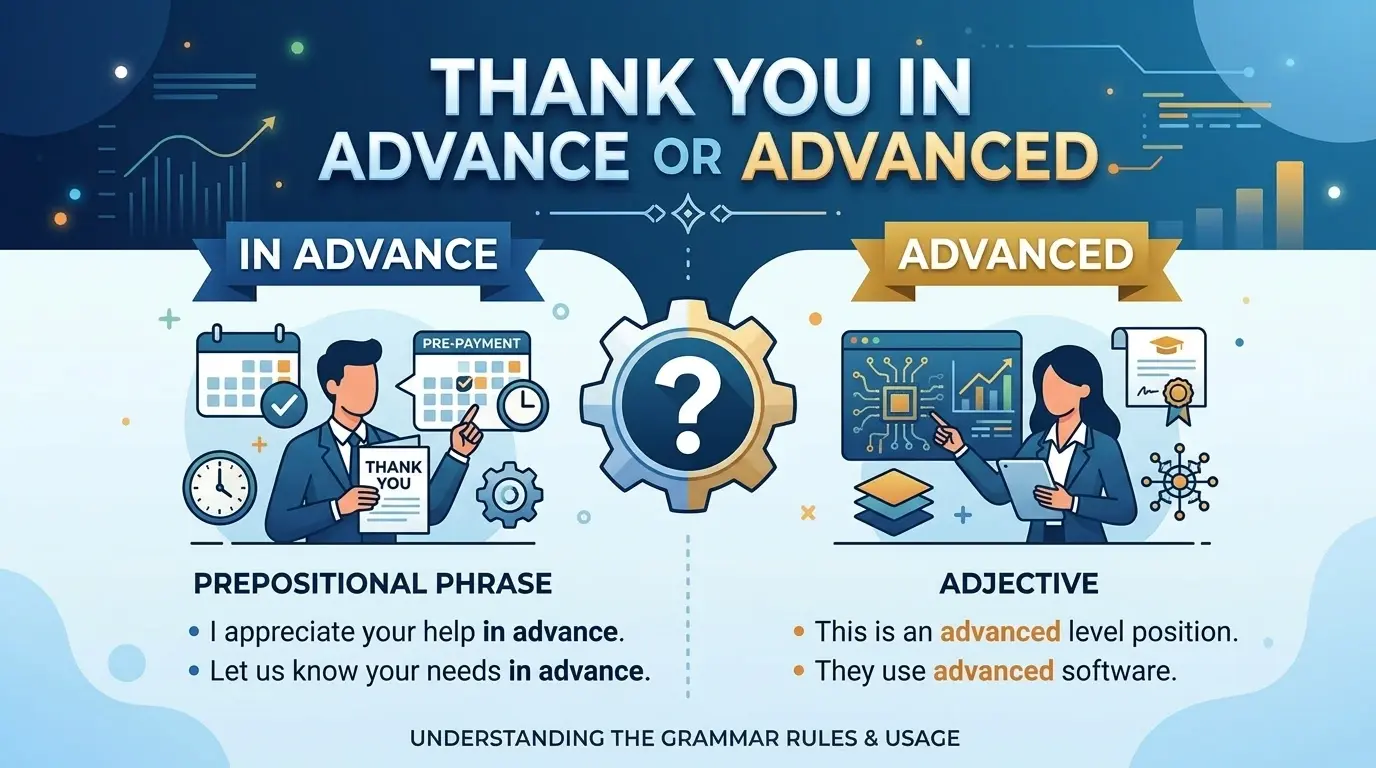
“Thank you in advance” is the correct phrase, while “thank you in advanced” is incorrect in this expression. The word advance means something happens before a future event or action.
You may have typed a work email and paused before the final sentence. You want to thank someone for their help, but they have not helped yet. Should you write “thank you in advance” or “thank you in advanced”?
The answer is simple: use thank you in advance.
The phrase is commonly used when you thank someone before they complete a requested action.
Advanced is a different word. It is an adjective that can describe something modern, developed, or at a higher level.
Quick Answer
Thank you in advance is the correct phrase. It means you are expressing thanks before someone completes a requested action. Thank you in advanced is incorrect because advanced is an adjective and does not fit this expression. Use advance after in: “Thank you in advance for your help.”
Quick Rule in 1 Line
Use “thank you in advance” when thanking someone before they complete the requested action.
Why “Thank You in Advance” Is Correct
Thank you in advance is correct because in advance is an established expression meaning “before something happens.” The phrase is commonly used when someone has made a request and wants to express thanks before receiving the expected help.
For example:
Thank you in advance for your help.
You are thanking the person before they provide the help.
Another example is:
Thank you in advance for your response.
You are thanking the person before they respond.
The key part is in advance.
Cambridge defines in advance as meaning before a particular time or before doing something.
So the standard phrase is:
Thank you in advance.
Not:
Thank you in advanced.
Read More: Loosing or Losing? The Correct Spelling and Meaning ExplainedWhat Does “In Advance” Mean?
In advance means something happens before a particular time, event, or action. It can refer to preparing, paying, informing someone, or doing something earlier than expected.
For example:
Please let me know in advance.
This means:
Please tell me before the event or action happens.
Another example:
We booked the tickets in advance.
The tickets were booked before the trip or event.
You can also say:
Please prepare the documents in advance.
The documents should be prepared before they are needed.
Cambridge lists in advance as an expression meaning before something happens.
This explains why thank you in advance works.
You are giving your thanks before the requested action happens.
What Does “Advanced” Mean?
Advanced is a different word from advance. It is commonly used as an adjective to describe something highly developed, modern, or at a higher level of difficulty.
For example:
She uses advanced technology.
Here, advanced describes the technology.
You can also say:
He is taking an advanced English course.
Here, advanced describes the level of the course.
Another example:
This is an advanced mathematics class.
The class is intended for people with a higher level of knowledge.
These examples show why advanced does not belong in thank you in advance.
The two words have related forms, but they have different grammatical uses.
Advance
Advance can refer to something happening earlier or moving forward.
Please tell me in advance.
Advanced
Advanced is often an adjective.
She is taking an advanced course.
Thank You in Advance or Thank You in Advanced
Thank you in advance is correct because in advance is the expression meaning “beforehand.” Thank you in advanced is incorrect because advanced does not work as part of this expression.
| Phrase | Correct? | Explanation |
| Thank you in advance | ✅ Correct | Thanks before a future action |
| Thank you in advanced | ❌ Incorrect | “Advanced” does not fit this expression |
| Thanks in advance | ✅ Correct | Shorter version of the phrase |
| Thank you beforehand | ✅ Correct | Similar meaning |
Correct example
Thank you in advance for your assistance.
Incorrect example
Thank you in advanced for your assistance.
The problem is the extra d.
Remember:
in advance ✅
in advanced ❌
“Thanking You in Advance” or “Thank You in Advance”?
Both are understood, but modern writers prefer “thank you in advance.” “Thanking you in advance” is an older, formal letter-closing style and is not a complete sentence.
The meaning is the same: thanks given before the action happens.
The difference is grammar. Thank you has a verb and an object, so it works as a full sentence. Thanking you is only a participle phrase, so it hangs without a main clause. You will mostly see it before a sign-off like “Yours sincerely” in traditional letters.
| Phrase | Type | Best for |
|---|---|---|
| Thank you in advance | Full sentence | Modern emails and messages |
| Thanking you in advance | Sentence fragment | Traditional formal letters |
| I thank you in advance | Full sentence, a bit stiff | Very formal writing or speech |
Tip: In everyday emails, use thank you in advance. Use “thanking you in advance” only if you are following a traditional letter format.
Thx, Thank U, TIA: Short Forms of Thank You in Advance
Short forms exist, but they are informal. For work emails, “thanks in advance” is the only short form you should use.
| Form | Where it fits |
|---|---|
| Thanks in advance | Most emails and messages |
| Thx in advance | Texts and quick chats |
| Thank u in advance | Very casual messages |
| TIA | Forums and chats (short for “thanks in advance”) |
| Thankyou in advance | Avoid it; write thank you as two words |
Skip the casual forms in job applications, client emails, and messages to senior people.
Many Thanks, Thanks a Lot and Thank You All in Advance
You can add a few words to change the warmth or the audience. All of these are correct as long as you keep “in advance” together.
- Many thanks in advance: slightly formal and warm. It means the same as “thank you in advance,” with a little more emphasis.
- Thanks a lot in advance: casual and friendly.
- Thank you so much in advance: warm, but it can feel heavy for a very small request.
- Thank you all in advance: useful for group emails.
Example: Please share your availability by Monday. Thank you all in advance.
For formal messages, the simple version is usually enough.
Why Is “Advanced” Wrong Here?
The difference comes down to how the words function in a sentence.
Advance is used in the fixed expression in advance, which works as an adverbial phrase. It tells us that something happens earlier than another event. Cambridge gives in advance as an idiomatic expression meaning before something happens.
Advanced, on the other hand, is an adjective.
It describes a noun.
For example:
an advanced course
advanced technology
an advanced system
You would not normally put advanced after in to express the idea of “beforehand.”
That is why:
Thank you in advance.
is correct.
How to Use “Thank You in Advance” in an Email
Thank you in advance is commonly used at the end of emails when you have asked someone to do something. It is especially common when requesting information, assistance, a response, or another action.
Example 1: Asking for information
Could you please send me the updated report?
Thank you in advance for your help.
Example 2: Asking for a response
Please let me know if you need any additional information.
Thank you in advance for your response.
Example 3: Asking for assistance
Could you please review this document?
Thank you in advance for your assistance.
Example 4: Making a workplace request
Please complete the form by Friday.
Thank you in advance for your cooperation.
Example 5: Asking for consideration
Thank you for taking the time to review my application.
Thank you in advance for your consideration.
The phrase works because the requested action has not happened yet.
Is “Thank You in Advance” Polite?
Thank you in advance is a commonly used polite expression, especially in requests and professional communication. However, its tone can depend on context because it may sound as though you already expect the other person to agree.
For example:
Could you please send me the file? Thank you in advance.
This is a normal way to end a request.
However, some situations may call for a softer phrase.
You could write:
I would appreciate your help with this.
Or:
I would appreciate it if you could send the file.
Indeed’s guidance notes that thank you in advance can sometimes give the wrong impression when used in an unsuitable context.
So the phrase is not grammatically wrong or automatically rude.
Its suitability depends on the situation and tone.
When to Use “Thank You in Advance” at Work (and When to Skip It)
It is a safe choice for routine requests and teammates. Skip it for big favors, or when writing to a manager or client, because it may sound like you already expect a yes.
Use it when:
- You are asking for something small, like a file or a quick confirmation.
- You are working with teammates who share the same tasks.
- You are giving routine instructions to your own team.
Skip it when:
- The request is big or sensitive.
- You are writing to your manager. Ask first, then thank them for their time.
- You are writing to a client. A softer line sounds more respectful.
A softer version:
Would you be able to review this by Friday? I would appreciate your time.
Examples of “Thank You in Advance”
Here are natural examples you can use in emails and everyday writing.
- Thank you in advance for your help.
- Thank you in advance for your response.
- Thank you in advance for your time.
- Thank you in advance for your assistance.
- Thank you in advance for your consideration.
- Thank you in advance for reviewing my application.
- Thank you in advance for sending the documents.
- Thank you in advance for answering my questions.
- Thank you in advance for looking into this issue.
- Thank you in advance for your cooperation.
- Thank you in advance for checking the information.
- Thank you in advance for letting me know.
- Thank you in advance for getting back to me.
- Thank you in advance for your support.
- Thank you in advance for taking the time to help.
- Thank you in advance for considering my request.
- Thank you in advance for your quick response.
- Thank you in advance for reviewing these details.
- Thank you in advance for helping me with this matter.
- Thank you in advance for any assistance you can provide.
“Thanks in Advance” vs. “Thank You in Advance”
Thanks in advance and thank you in advance have the same basic meaning. The shorter thanks in advance can sound more casual, while thank you in advance is often suitable for professional emails.
Compare:
Thanks in advance for your help.
and:
Thank you in advance for your help.
Both are grammatically correct.
Your choice can depend on the tone of your message.
More casual
Thanks in advance for your help!
More formal
Thank you in advance for your assistance.
However, neither phrase is automatically formal or informal in every context.
The rest of the email matters too.
Thank You in Advance for Your Help
Thank you in advance for your help is one of the most common ways to use the phrase. It expresses gratitude for help that you are requesting but have not received yet.
For example:
Could you please check these figures before the meeting?
Thank you in advance for your help.
Here, the writer has asked for help.
The help has not happened yet.
Therefore, in advance is appropriate.
You can also shorten it:
Thanks in advance for your help.
Both forms are correct.
Thank You in Advance for Your Response
Thank you in advance for your response is useful when you expect someone to reply to your message. It thanks the reader before their response arrives.
For example:
Please let me know whether Thursday works for you.
Thank you in advance for your response.
This wording is common in professional communication.
You could also write:
I appreciate your response when you have a chance.
That version does not explicitly thank the person before they respond.
Reply or Answer? Which One to Use
Both work. Use “reply” for a message and “answer” for a question.
- Thank you in advance for your reply.
- Thank you in advance for your answer.
If you are not sure, response (the heading above) works for both.
Thank You in Advance for Your Consideration
Thank you in advance for your consideration is often used when asking someone to review, consider, or decide on something. The phrase expresses thanks before the requested consideration takes place.
For example:
Thank you for reviewing my application.
Thank you in advance for your consideration.
It can appear in applications, requests, and professional messages.
However, always consider whether the context makes the phrase sound natural.
Thank You in Advance for Your Time
Use this when you are asking someone to spend time reading, meeting, or reviewing something. It thanks them before they spend that time.
For example:
I have attached my proposal. Thank you in advance for your time.
Notice the timing. If the person has already spent the time, say “Thank you for your time” without “in advance.”
- Before: Thank you in advance for your time.
- After: Thank you for your time today.
Thank You in Advance Grammar: Pattern, Word Order and Punctuation
The correct pattern is: thank you + in advance + for + noun or -ing word.
Thank you in advance for your help.
Thank you in advance for helping me.
Word order: You may also see “Thank you for your help in advance.” People will understand it, but the first pattern reads more smoothly.
Punctuation tips:
- End the line with a period or an exclamation mark. The exclamation mark sounds friendlier.
- Write your sign-off on a new line: “Thank you in advance.” then “Best regards, Sam.”
- Do not write “Thank you in advance, Sam” in one line. Put the name on its own line.
“I thank you in advance” is also correct. It sounds more formal, so most people drop the “I.”
Common Mistakes
1. Writing “Thank You in Advanced”
❌ Thank you in advanced for your help.
✅ Thank you in advance for your help.
The correct expression is in advance.
2. Adding “-ed” to Advance
❌ Thank you in advanced.
✅ Thank you in advance.
The word advanced is not the past-tense version you need here.
It is commonly used as an adjective.
3. Confusing “Advance” and “Advanced”
❌ Please let me know in advanced.
✅ Please let me know in advance.
Here, you need the expression meaning “beforehand.”
4. Using “Advanced” Before the Wrong Noun
Advanced can be correct when it describes a noun.
For example:
She is taking an advanced English course.
But:
Please tell me in advanced.
is incorrect.
The correct phrase is:
Please tell me in advance.
5. Thinking “Advanced” Means “Beforehand”
Advanced does not simply mean “beforehand.” In advance carries that meaning as a fixed expression. Cambridge defines in advance as before a particular time or action.
Other Wrong Versions: “For Advance”, “By Advance”, “On Advance”
The correct phrase is always “in advance.” Other small words, or a missing word, make the phrase wrong.
| Wrong | Correct | What went wrong |
|---|---|---|
| Thank you for advance | Thank you in advance | Wrong preposition |
| Thank you by advance | Thank you in advance | Not standard English; often a literal translation from another language |
| Thanks on advance | Thanks in advance | Wrong preposition |
| Thank you for in advance | Thank you in advance | Extra word |
| Thank you advance | Thank you in advance | Missing “in” |
| Thank you and advance | Thank you in advance | Wrong word |
| Thank in advance / Thank advance | Thank you in advance | Missing “you” |
Rule: Keep in advance together, and always start with in.
Advanced vs Advance: Simple Comparison
| Word | Common function | Example |
| advance | Noun, verb, or part of “in advance” | Please book in advance. |
| advanced | Adjective | This is an advanced course. |
| in advance | Before something happens | Tell me in advance. |
| thank you in advance | Thanks before a requested action | Thank you in advance for your help. |
This table makes the difference easier to remember.
Advance belongs in the phrase in advance.
Advanced describes something that is developed or at a higher level.
Advance as Noun, Verb and Adjective
“Advance” can work as a noun, a verb, or an adjective. “Advanced” is mainly an adjective, and it is also the past tense of the verb “advance.”
| Word | Job | Example |
|---|---|---|
| advance (verb) | move forward | Prices may advance next month. |
| advance (noun) | progress or early payment | This is a big advance in medicine. |
| advance (adjective) | done beforehand | Please give advance notice. |
| advanced (adjective) | higher level or highly developed | an advanced course |
| advanced (past tense) | moved forward | The team advanced to the final. |
Other common “advance + noun” examples are advance booking, advance payment, and advance copy.
You may also see “for your advance information,” which means “so that you know beforehand.” It is understood, but it is quite formal. In most emails, “for your information” is simpler.
Congratulations in Advance or Advanced?
“Congratulations in advance” is correct. “Congratulations in advanced” is wrong, for the same reason as “thank you in advanced.”
Use it when you congratulate someone before an event or result, such as before an exam result or a big day. “Congrats in advance” is the casual short form.
You may also see “advance congratulations.” Here advance is used as an adjective (like “advance notice”). It is understandable, but “congratulations in advance” sounds more natural. “Advanced congratulations” is incorrect.
| Phrase | Correct? |
|---|---|
| Congratulations in advance | ✅ Correct |
| Congrats in advance | ✅ Casual |
| Advance congratulations | ⚠️ Understood, less natural |
| Congratulations in advanced | ❌ Incorrect |
| Advanced congratulations | ❌ Incorrect |
Tone note: If the result is not certain yet, some readers may find early congratulations a little presumptuous. Choose it according to your relationship with the person.
Happy Birthday in Advance
“Happy birthday in advance” is the natural phrase. “Advanced happy birthday” is incorrect. “Advance happy birthday” is also less natural. You can say “early happy birthday” too.
Apologize, Appreciate and Tell Me in Advance
“In advance” works with many verbs, not only “thank.” Always use “advance,” not “advanced.”
- Apologize in advance: I apologize in advance for the delay. (British spelling: apologise. “Apologies in advance” also works.)
- Appreciate in advance: I appreciate your help in advance.
- Tell / let me know in advance: Please tell me in advance if the time changes.
“Let me know in advance” means “tell me before it happens.” Similar phrases are beforehand and ahead of time.
- Please let me know in advance.
- Please let me know ahead of time.
- Please let me know beforehand.
Alternatives to “Thank You in Advance”
Sometimes you may want a different phrase.
Here are some options:
For professional emails
- I appreciate your help.
- I appreciate your time and consideration.
- I would appreciate your assistance.
- Thank you for your consideration.
- I appreciate your response.
For casual messages
- Thanks for your help!
- I really appreciate it!
- Thanks for taking a look!
- I appreciate your help with this.
Choose an alternative when you want to avoid suggesting that the other person has already agreed to help.
Which Alternative Fits Which Situation?
Pick the alternative by how big the request is and how well you know the reader.
| Situation | Try this |
|---|---|
| Small, routine request | Thanks for your help. |
| You are unsure the person can help | Thank you for considering this request. |
| Asking an expert for guidance | Any guidance you can share would be appreciated. |
| Big or urgent request | Your help with this would mean a lot. |
| You want to sound relaxed | Thanks for taking a look! |
| After the help arrives | Thank you for sending this over. |
A plain “thank you” is often enough. It removes the feeling that you have already assumed a yes.
How to Reply When Someone Says “Thank You in Advance”
You do not need to say “you’re welcome” yet, because you have not helped. A short, friendly confirmation is better.
Good replies:
- Happy to help.
- Sure, I’ll send it today.
- Of course. I’ll get back to you by Friday.
- No problem. I’ll let you know once it is done.
If you cannot help, reply politely:
- I’m sorry, I can’t help with this, but I can suggest someone who can.
Should you thank them again afterwards? Yes, if you are the one who asked. A short “Thank you for sending this” after the help arrives shows you noticed their effort.
Memory Trick
The easiest way to remember the correct phrase is:
Advance = before
So:
Thank you in advance.
Think of it as:
Thank you beforehand.
Now compare that with advanced.
Advanced = developed or higher level
For example:
an advanced course
advanced technology
So remember:
Before something happens → in advance
Higher or more developed → advanced
FAQs
Is it “thank you in advance” or “thank you in advanced”?
Thank you in advance is correct. Thank you in advanced is incorrect because in advance is the established expression meaning before something happens.
What does “thank you in advance” mean?
It means you are expressing thanks before someone completes a requested action. It is often used after making a request.
Is “thank you in advance” grammatically correct?
Yes. Thank you in advance is a standard and widely used expression.
Is “thank you in advanced” correct?
No. Use thank you in advance instead.
What is the difference between advance and advanced?
Advance can mean moving forward or can appear in in advance, meaning beforehand. Advanced is commonly an adjective meaning highly developed or at a higher level.
Can I say “thanks in advance”?
Yes. Thanks in advance is a common shorter version of thank you in advance.
Is “thank you in advance” rude?
Not automatically. It is commonly used in requests, but the tone can depend on the situation. Some readers may feel that it assumes they will agree to the request.
Can I use “thank you in advance” in a work email?
Yes. It is commonly used in workplace emails when requesting help, information, a response, or another action.
What can I say instead of “thank you in advance”?
You can say I appreciate your help, I appreciate your time, or Thank you for your consideration, depending on the situation.
Is “thank you beforehand” correct?
Yes. Beforehand means before a particular event or action. However, thank you in advance is the established phrase commonly used for this purpose.
Conclusion:
The correct phrase is thank you in advance, not thank you in advanced. The expression uses in advance because it means thanking someone before a requested action happens.
Advanced is a different word. It commonly describes something that is highly developed or at a higher level, such as an advanced course or advanced technology.
So, when writing an email or making a request, remember:
Thank you in advance. ✅
Thank you in advanced. ❌

I’m Sophia Mitchell, an English grammar and writing enthusiast. I create simple, easy-to-understand content to help learners improve their English. My goal is to make grammar clear, practical, and enjoyable for everyone.






1 thought on “Thank You in Advance or Advanced? The Correct Phrase Explained”