You’re typing a sentence, you reach for “i.e.” or “e.g.,” and you freeze. Which one is it? You’re not alone.
Even confident writers guess, and a wrong guess can quietly change your meaning. Say “snacks, i.e., chips” and you’ve told readers chips are the only snack.
Say “snacks, e.g., chips” and you’ve offered just one sample. One tiny abbreviation, two very different messages.
The good news: you only need one question to get it right every time. In the next few minutes, you’ll learn that test, see side-by-side examples, avoid the most common mistakes, and sort out the punctuation rules that trip up even professionals.
It takes three minutes, and you’ll use the skill in every email you write. Let’s make sure your next sentence says exactly what you mean.
Short answer:
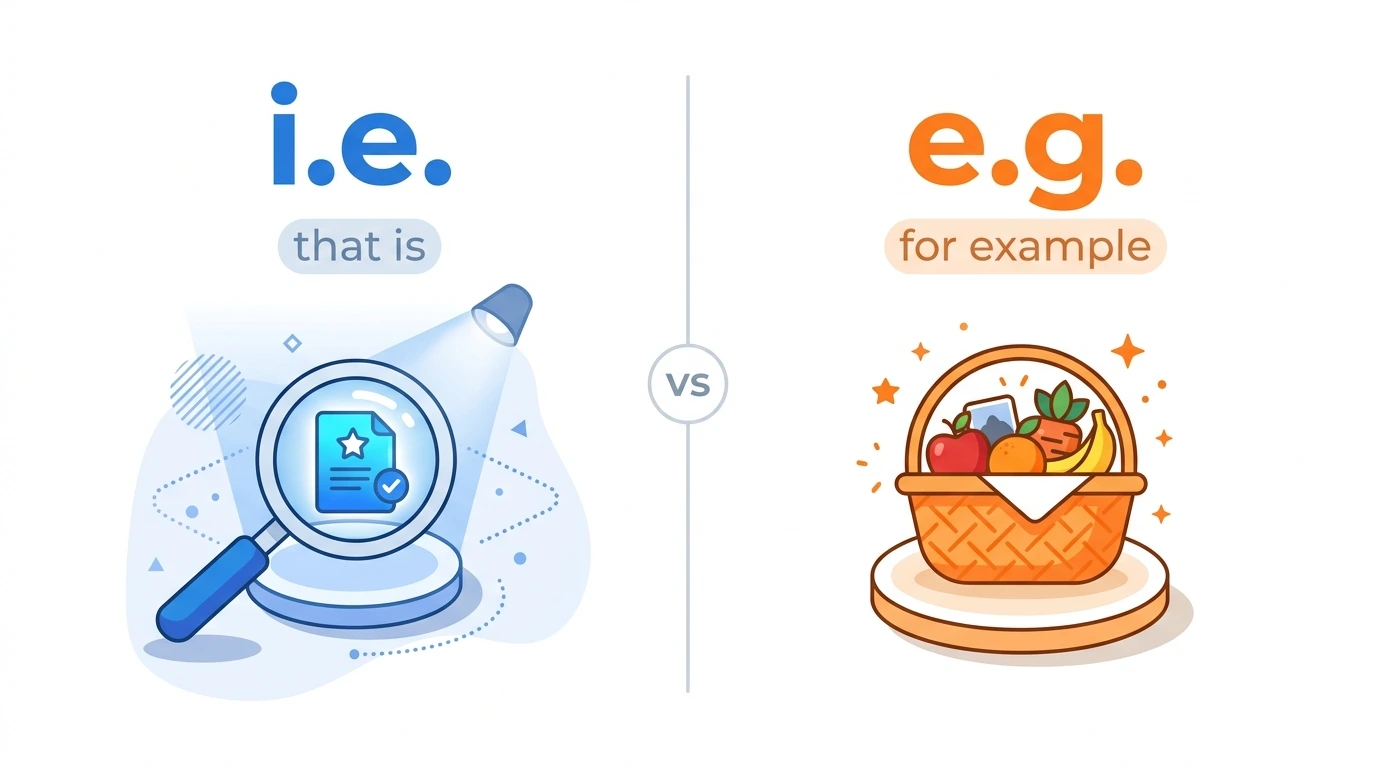
Use e.g. when you’re giving examples (for example). Use i.e. when you’re restating or clarifying (that is).
Read More: Sew or Sow: What’s the Difference?The 5-second test ie vs eg
Ask: Is my list complete or just a sample?
| If you mean… | Use | Swap in |
| A sample or example | e.g. (exempli gratia) | “for example” |
| A clarification or the full definition | i.e. (id est) | “that is” / “in other words” |
Memory trick: e.g. = example given. i.e. = in essence.
Side by side ie or eg
- She loves citrus fruits, e.g., oranges and lemons. (Other citrus exists.)
- She loves the fruit on our tree, i.e., oranges. (Oranges are the whole answer.)
- Avoid allergens (e.g., peanuts, shellfish). (Samples.)
- The meeting is at the usual time (i.e., 9 a.m.). (Restating.)
Common mistakes ie or eg
| ❌ Wrong | ✅ Right |
| Bring snacks, i.e., chips and fruit. | Bring snacks, e.g., chips and fruit. |
| Use e.g. to name every option: “Our plan covers three tiers, e.g., Basic, Plus, Pro.” | Use i.e.: “…three tiers, i.e., Basic, Plus, and Pro.” |
| Fruits, e.g., apples, etc. | Fruits, e.g., apples and pears. |
Because e.g. already signals an incomplete list, don’t add “etc.” after it.
Punctuation
- Periods: US style uses them (i.e., e.g.). UK style often drops them (ie, eg).
- Comma after: Standard in US style, often skipped in UK style. Choose one and stay consistent.
- Before the abbreviation: Use a comma, semicolon, dash, or opening parenthesis.
- Italics: Don’t italicize either one.
- Starting a sentence: Avoid it. Write “For example,” or “That is,” instead.
Semicolon example: Several of our offices are closed on Friday; i.e., staff won’t be reachable.
In academic and formal writing
Many style guides (APA, for instance) want these abbreviations only inside parentheses. In running text, spell them out: “for example” or “that is.” Check your target journal’s rules.
Alternatives that read more smoothly
- Instead of e.g.: such as, for example, for instance, including
- Instead of i.e.: that is, in other words, namely
FAQ
1. What is the meaning of i.e. or e.g.?
I.e. means “that is” and clarifies a point, while e.g. means “for example” and introduces samples from a larger group.
2. How do you use e.g. in a sentence?
Place e.g. before examples, followed by a comma: “Bring snacks, e.g., chips or fruit.” Don’t add etc. after the list.
3. What is the full form and meaning of i.e.?
I.e. stands for the Latin “id est,” meaning “that is.” Use it to restate or clarify what you just said.
4. When should I use i.e.?
Use i.e. when giving a definition or clarification, such as “our discount, i.e., 10% off.” Don’t use it for samples.
5. How do you punctuate i.e.?
Put periods after each letter, a comma or parenthesis before it, and a comma after it in standard American style.
6. Does i.e. mean “in essence”?
Not literally, but it’s a handy memory trick. The Latin “id est” really means “that is” or “in other words.”
7.Can I use them in an email?
Yes, but “for example” is friendlier and clearer.
8.Do I need two examples after e.g.?
No, but a single one reads better as “such as.”
9.Is it ever correct to use both?
Rarely. Choose one for each point you make.
Conclusion:
Choosing between i.e. and e.g. comes down to one question: is your list complete or just a sample?
Use e.g. (exempli gratia) when you’re offering examples, and i.e. (id est) when you’re clarifying or restating. Remember the memory trick: e.g. means example given, and i.e. means in essence.
Keep the punctuation consistent. American style uses periods and a comma afterward, while British style often drops both.
Place a comma, semicolon, dash, or parenthesis before the abbreviation, never italicize it, and avoid starting a sentence with it. Don’t pair e.g. with “etc.,” since both signal an incomplete list.
In academic or formal writing, keep these abbreviations inside parentheses and spell out “for example” or “that is” in running text. When in doubt, smoother alternatives like “such as” and “in other words” work beautifully.
Master this one small habit, and your writing will be clearer, sharper, and more professional. Readers will notice.

I’m Sophia Mitchell, an English grammar and writing enthusiast. I create simple, easy-to-understand content to help learners improve their English. My goal is to make grammar clear, practical, and enjoyable for everyone.











1 thought on “ie vs eg : How to Choose the Right One”