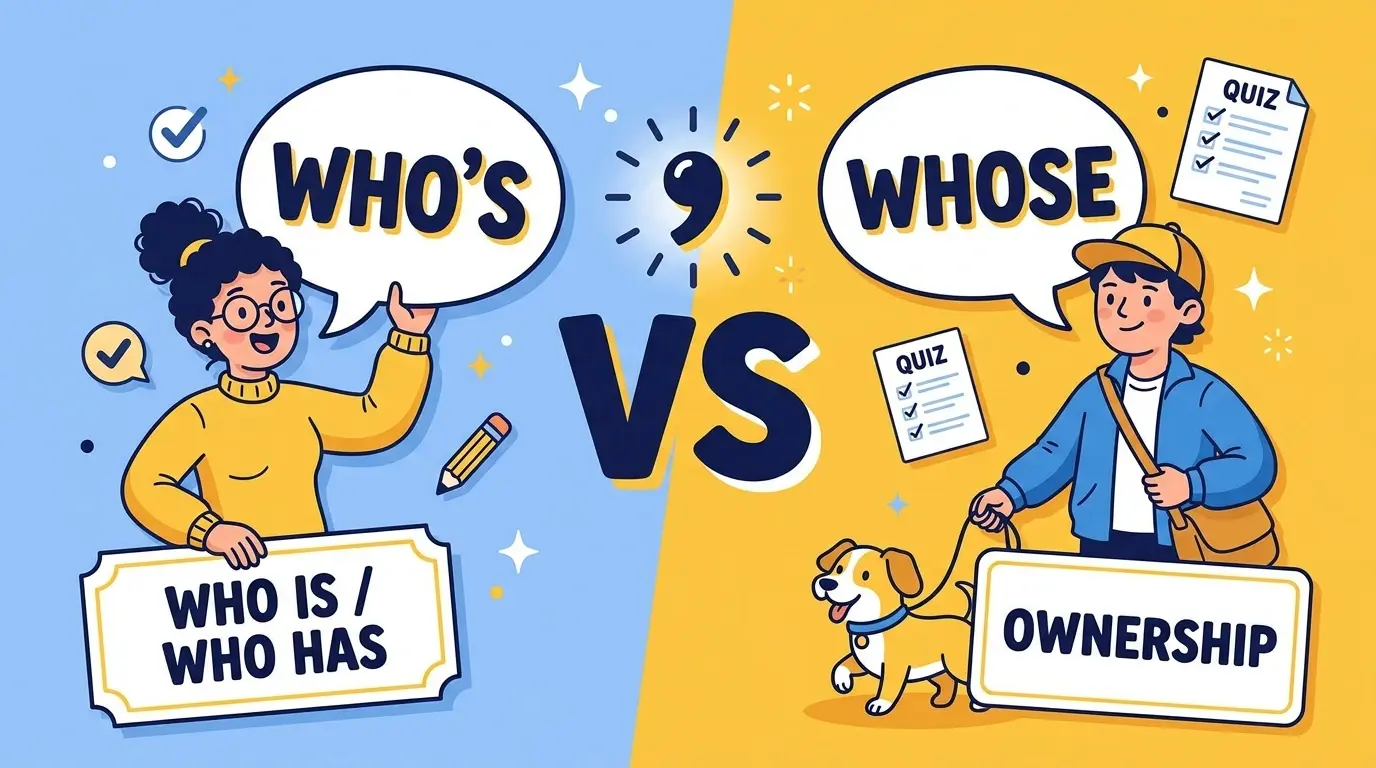
Who’s or whose? It’s one of the most common mix-ups in English, and it trips up even confident writers.
The two words sound identical, so your ear can’t help you. But on the page, one tiny apostrophe changes everything.
Who’s means “who is” or “who has,” while whose shows ownership. Get it wrong, and a polished email or essay suddenly looks careless.
The good news?
You don’t need to memorize grammar rules. A simple one-step test, a few real examples, and a short quiz at the end will help you choose the right word every time. Let’s clear this up for good.
Quick answer :
Who’s always means “who is” or “who has.” Whose shows ownership. If you can swap in “who is” or “who has,” use who’s. If you’re asking about or describing possession, use whose.
Why people mix them up Whos or Whose
We’re taught that apostrophe + s shows possession (Maria’s laptop). So who’s looks like it should be possessive. It isn’t. Possessive pronouns (his, hers, its, theirs, whose) never take an apostrophe. The apostrophe in who’s only marks a missing letter.
Side-by-side Whos vs Whose
| Who’s | Whose | |
| Meaning | Who is / who has | Belonging to whom |
| Part of speech | Contraction | Possessive pronoun/determiner |
| Example | Who’s coming tonight? | Whose jacket is this? |
| Expands to | Who is coming tonight? | Can’t be expanded |
The one-step test Whos or Whose
Say the sentence with “who is” or “who has.“
- Who’s at the door? → Who is at the door? ✅ Use who’s.
- Who’s finished the report? → Who has finished the report? ✅ Use who’s.
- Whose phone is ringing? → Who is phone is ringing? ❌ Use whose.
Watch out for “Who’s got…” In Who’s got the keys?, who’s means who has (got). It’s correct.
Whose in questions and in descriptions
Whose appears in two patterns, and most guides only cover the first.
Questions: Whose turn is it?
Relative clauses, where it links a noun to a description:
- She’s the author whose novel won the prize.
- I met a man whose brother plays for Arsenal.
Can “whose” refer to things?
Yes. Many people think whose only works for people, but it’s standard English for companies, places, and objects. Of which often sounds stiff.
- ✅ A company whose profits fell sharply…
- ✅ A house whose roof was damaged…
- ⚠️ A house the roof of which was damaged… (correct but clunky)
Common mistakes
| ❌ Wrong | ✅ Right |
| Who’s bag is this? | Whose bag is this? |
| Whose going to the party? | Who’s going to the party? |
| He’s the player who’s goal won the match. | He’s the player whose goal won the match. |
| I wonder whose been using my desk. | I wonder who’s been using my desk. |
Memory trick
Whose has the letters hose, as in “belonging to whom.” Or ask yourself: can I say “who is”? If yes, you need the apostrophe.
Quick quiz
Choose who’s or whose:
- ___ going to drive tonight?
- I don’t know ___ umbrella this is.
- She’s a teacher ___ students adore her.
- ___ been eating my lunch?
- Tell me ___ fault it was.
Answers: 1. Who’s 2. whose 3. whose 4. Who’s 5. whose
FAQ
1.Is “who’s” ever possessive?
No. It’s always a contraction.
2.Can I use “whose” for non-living things?
Yes, it’s standard English.
3.What is the meaning of who’s and whose?
Who’s means “who is” or “who has.” Whose is the possessive form, showing that something belongs to someone.
4.How do you use who’s or whose in a sentence? Use who’s for “who is/has”: “Who’s coming?”
Use whose for ownership: “Whose bag is this?”
5.Is there a quiz to practice who’s vs. whose?
Yes. Fill in the blank: “___ going to drive?” (Who’s) and “___ coat is this?” (Whose). See the quiz above.
6.What is the grammar rule for who’s and whose?
Who’s is a contraction, so it takes an apostrophe. Whose is a possessive pronoun, and possessive pronouns never take apostrophes.
7.Are there exercises to help me master who’s and whose?
Yes. Replace the word with “who is” or “who has.” If the sentence still makes sense, use who’s.
8.Is it “who’s name” or “whose name”?
It’s whose name. You’re showing possession, and “who is name” makes no sense, so whose is correct.
9.Are its/it’s and your/you’re the same problem?
Yes. Each pair has a possessive with no apostrophe (its, your, whose) and a contraction with one (it’s, you’re, who’s).
10.Is “who’s” ever “who was”? Rarely and informally, as in Who’s there yesterday?
Use who was in writing.
Conclusion:
Choosing between who’s and whose comes down to one simple question: can you say “who is” or “who has”?
If yes, use who’s.
If you’re talking about ownership or connection, use whose. Remember that possessive pronouns like whose, its, and your never take an apostrophe.
The apostrophe in who’s only marks missing letters. With the one-step test and the examples above, you can now catch this mistake before anyone else does.
Keep this guide handy, practice with the quiz, and your writing will look sharper and more professional every time.

As an American English writer, I specialize in creating clear and engaging content that makes grammar and language learning accessible to everyone. I enjoy breaking down complex English concepts into simple, practical lessons that readers can apply with confidence. My mission is to help learners strengthen their communication skills through easy and reliable content.










